Discover the life cycle chart from Dan Millman's work. Learn to interpret your nine-year cycle for personal growth, career, and relationships with this guide.
June 28, 2026 (28d ago) — last updated June 28, 2026 (27d ago)
Life Cycle Chart: Map Your 9-Year Personal Journey
Discover the life cycle chart from Dan Millman's work. Learn to interpret your nine-year cycle for personal growth, career, and relationships with this guide.
← Back to blog
Some years feel like you're pushing a boulder uphill. Other years, doors open with less force, your energy returns, and choices seem clearer. That pattern is often recognized long before it can be put into words.
A life cycle chart gives that pattern a shape. In Dan Millman's The Life You Were Born to Live, and in the framework used by the official digital companion, the Life Purpose App, life doesn't move in a straight line. It moves in recurring phases, each with its own lesson, pressure, and opportunity. When you start reading your life this way, confusion often softens into timing.
Beyond the Calendar What Is a Life Cycle Chart
A calendar tells you what date it is. A life cycle chart tries to tell you what kind of season you're in.
That difference matters. You can be in the same month as everyone else and still feel as if your inner world is asking for something very different. One person may need to begin. Another may need to pause. Someone else may be finishing a chapter they've outgrown. Dan Millman's The Life You Were Born to Live offers a way to read those shifts as part of a meaningful pattern instead of random emotional weather.
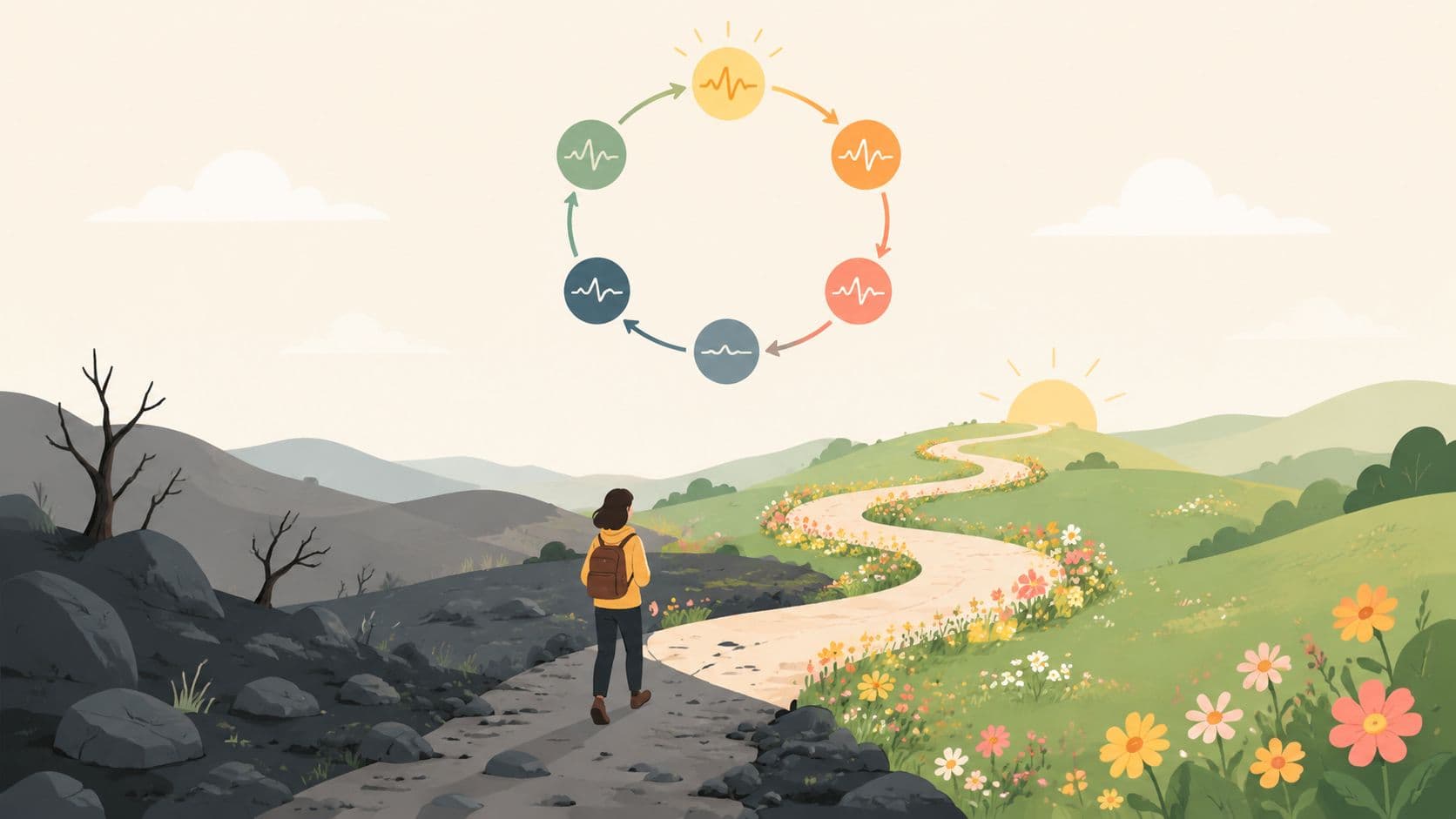
A useful analogy is a personal weather map. You don't use a forecast to control the sky. You use it to choose the right clothes, adjust your plans, and stop blaming yourself for the rain. A life cycle chart works in a similar way. It doesn't remove free will. It gives context.
That's one reason people often connect this system with developmental models. If you've ever explored reVIBE's family development insights, you've already seen a similar idea in a different language: people and families move through recognizable stages, and each stage asks for different skills.
Why this system feels different
Dan Millman's work doesn't treat your path as a generic label. It treats your birth date as the starting point for a deeper map of strengths, recurring lessons, and timing. In this approach, a life cycle chart isn't just about personality. It's about how your lessons ripen over time.
A hard year isn't always a wrong year. Sometimes it's the right lesson arriving in a form you didn't expect.
People often get stuck because they ask, “What's wrong with me?” The better question is often, “What is this season asking of me?” That small shift can change how you work, love, rest, and decide.
Unpacking the 9-Year Cycle from Dan Millman's Work
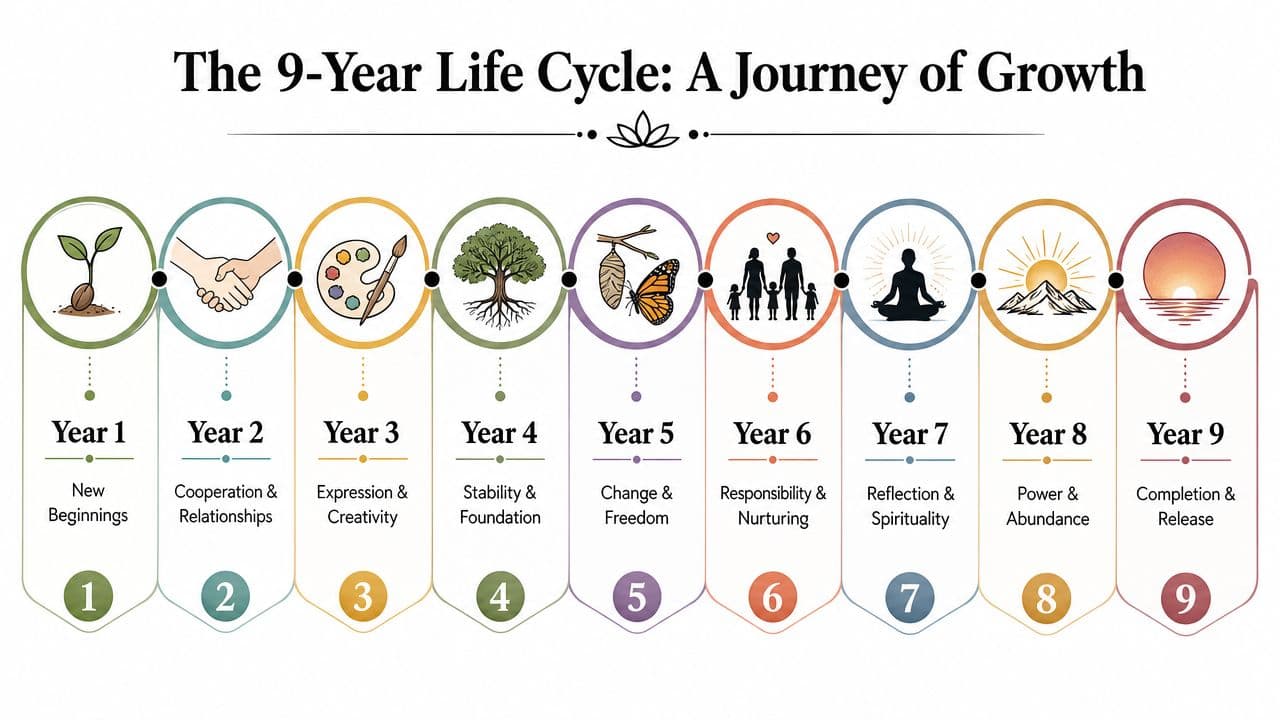
In Dan Millman's The Life You Were Born to Live, and in the cycle feature explained through the Life Purpose App's guide to cycles, the life cycle chart follows a repeating nine-year pattern. It functions as a long internal season wheel. The cycle keeps moving, but each year carries a different tone.
The birth number sets the pattern
Here's the structural core. In Dan Millman's system from The Life You Were Born to Live, the life cycle chart is anchored by a birth number derived from the full birth date, which maps to one of 45 distinct life paths, and those lessons unfold through nine-year cycles in which Personal Years 1 through 9 each carry a distinct energetic signature. The system is designed to help people align major projects with the phase they're in for better timing and fit.
That sentence holds a lot, so let's slow it down.
Your birth date is used to calculate a birth number. That number places you within a specific life-path pattern in Dan Millman's framework. Then, within that larger path, your experience moves through recurring nine-year cycles. So there are two layers at once:
- Your path gives the larger lesson set.
- Your current year in the cycle describes the tone of the phase you're living now.
People sometimes confuse those two. Your path is the road. Your current personal year is the weather on the road.
Why nine years instead of random moods
A nine-year cycle gives rhythm to change. Without a rhythm, every shift in energy feels personal and chaotic. With rhythm, you start noticing sequence.
A simple way to picture it is this:
| Personal year | General feeling |
|---|---|
| Year 1 | Starting, initiating, planting |
| Year 2 | Relating, waiting, cooperating |
| Year 3 | Expressing, creating, communicating |
| Year 4 | Building, organizing, stabilizing |
| Year 5 | Changing, moving, breaking old limits |
| Year 6 | Caring, committing, taking responsibility |
| Year 7 | Reflecting, studying, turning inward |
| Year 8 | Managing, achieving, using power wisely |
| Year 9 | Completing, releasing, clearing space |
That doesn't mean every Year 5 feels exciting or every Year 7 feels peaceful. It means those themes tend to be more present. Your choices still matter. Your awareness matters too.
Practical rule: Don't read a personal year as a command. Read it as a current. You can swim against it, but you'll use more energy.
If you like comparing spiritual systems with modern tools, it can also help to discover BuddyPro's AI platform, which presents Dan Millman-related exploration in a different format. The value of any tool, though, depends on whether it helps you see your timing more clearly and live with more honesty.
Interpreting the Phases of Your Personal Cycle
Once you know that life moves through nine recurring phases in Dan Millman's The Life You Were Born to Live and in the framework used by the Life Purpose App, the next question is simple: what does each year feel like?
The best way to use a life cycle chart is to treat each personal year like a tone, not a prison. You're not trapped inside a label. You're learning the language of timing.
Year 1 through Year 3
Year 1
This is the year of initiative. Something in you wants movement, even if you can't fully explain it yet.
Year 1 often supports fresh starts, independent action, and choices that require courage. The challenge is impatience. You may want certainty before the first step, but this phase usually rewards motion before perfection.
Year 2
Year 2 slows the pace. Relationships, cooperation, and sensitivity tend to matter more here than force.
If Year 1 is planting a seed, Year 2 is learning how to tend it. Progress can feel subtle. People often misread this year as stalled, when it may be teaching patience, listening, and emotional maturity.
Year 3
Year 3 opens expression. Creativity, communication, friendship, and visibility often come forward.
This can be a lighter year in tone, but it still has a lesson. The challenge is scattering your energy. It helps to create, speak, write, or share, without turning every impulse into a commitment.
Year 4 through Year 6
Year 4
Year 4 asks for structure. You build systems, habits, boundaries, and reliable foundations.
This phase supports steady work more than dramatic leaps. If you resist routine, Year 4 can feel heavy. If you accept the value of order, it can become one of the most productive phases in the cycle.
Year 5
Change moves through Year 5. Restlessness increases. Old limits start to feel smaller than they used to.
This can be a year for exploration, travel, reinvention, or a sharper need for freedom. The caution is overreaction. Not every discomfort means you need to burn everything down.
Year 6
Year 6 centers responsibility, care, and commitment. Home life, family bonds, partnership, and duty may take on greater weight.
That doesn't mean it's only about sacrifice. It can also be a year of deepening love and learning mature devotion. The tension often comes from giving too much or trying to rescue everyone.
Some years ask you to prove yourself. Others ask you to steady someone else without abandoning yourself.
Year 7 through Year 9
Year 7
Year 7 turns inward. Reflection, study, spiritual inquiry, solitude, and inner honesty often take priority.
This is the year many people misjudge. If your outer life feels quieter, that doesn't mean nothing is happening. Often, underlying work is invisible. Insight grows underground before it changes your visible life.
Year 8
Year 8 brings themes of power, achievement, management, and material expression. You may feel called to lead, decide, organize resources, or claim authority.
This year can sharpen ambition, but it also tests integrity. The deeper question is not only whether you can succeed, but how you handle influence, money, and responsibility.
Year 9
Year 9 is the phase of completion and release. Old roles, habits, attachments, and even relationships may come up for review.
This can feel emotional because endings rarely arrive as clean theory. Yet Year 9 often clears space for the next cycle. Letting go isn't failure here. It's preparation.
Using Your Life Cycle Chart for Real-World Decisions
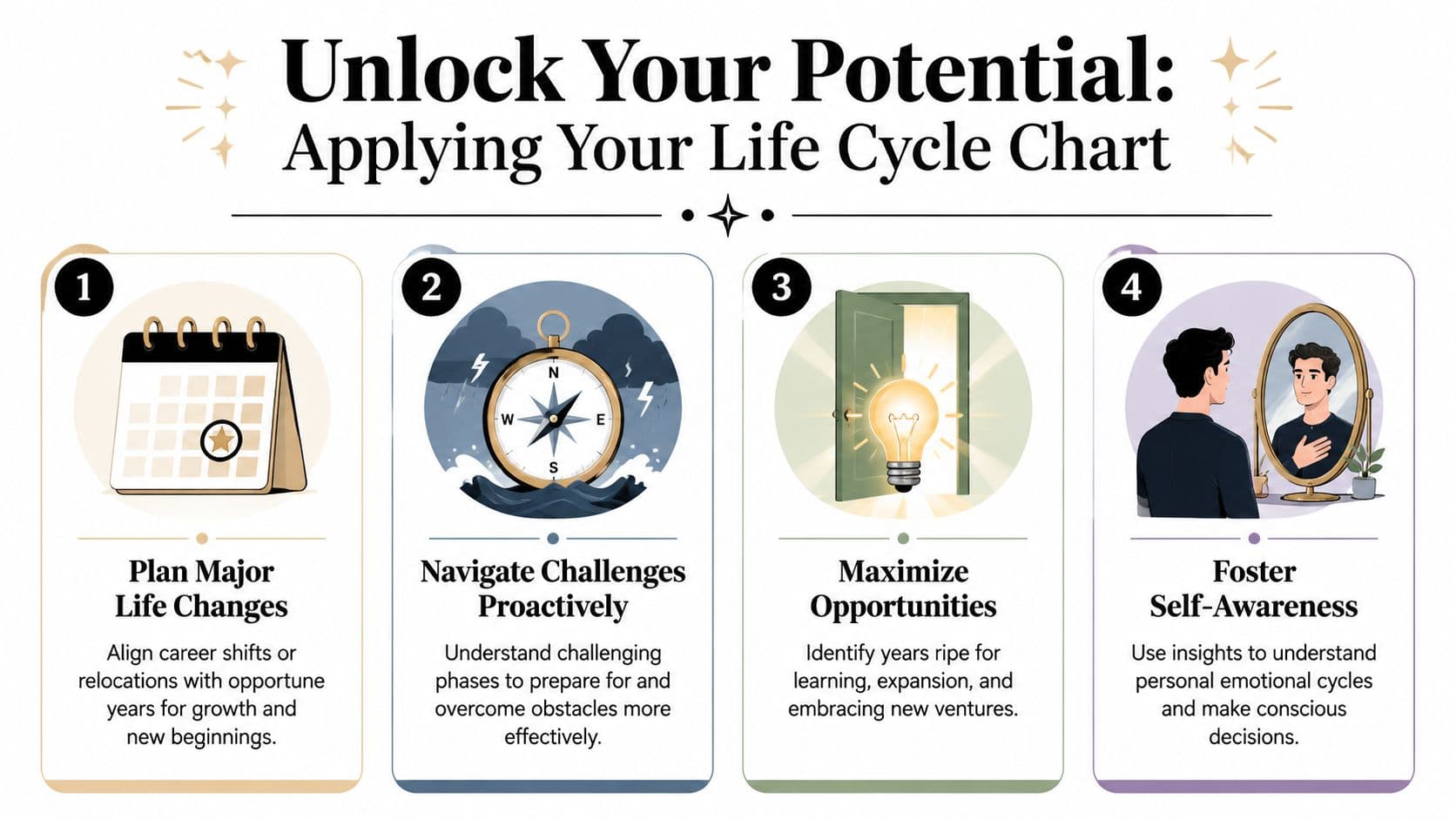
A life cycle chart becomes useful when it leaves the page and enters ordinary life. Not as fortune-telling. As timing, self-awareness, and perspective.
Here's what that can look like when someone uses Dan Millman's The Life You Were Born to Live and the interpretive lens it offers through the Life Purpose App.
Career choices
Someone in a Year 1 may feel a strong urge to launch a project, change direction, or step into a role that asks for more independence. Before learning the cycle language, they might call that feeling reckless. After learning it, they may recognize it as the season of beginning.
By contrast, a Year 4 often supports the less glamorous work that makes later success possible. Think process design, training, budgeting, and rebuilding consistency. If you expect fireworks in a building year, you may miss the quiet value of discipline.
Relationships
Cycles can soften judgment in close relationships. Suppose one partner is in a reflective phase and seems less socially available. Without context, the other partner may hear rejection.
With cycle awareness, the conversation changes. Instead of “Why are you pulling away?” it becomes “Are you in a season where you need more inward space?” That doesn't solve every conflict, but it can replace blame with curiosity.
- When emotions rise: Ask whether the season calls for closeness, patience, or closure.
- When plans change: Notice whether one person is trying to expand while the other is trying to simplify.
- When old tension returns: Consider whether the current phase is bringing unfinished lessons back to the surface.
Personal growth
A Year 7 often supports therapy, spiritual practice, journaling, reading, and careful self-examination. It may not feel externally impressive, but it can be richly fertile.
A Year 9, on the other hand, often asks for emotional honesty about what's complete. That may mean clearing clutter, ending obligations that no longer fit, or grieving an identity you've already outgrown.
Use timing to reduce self-judgment. If a season is asking for completion, forcing expansion can feel exhausting for reasons that have nothing to do with laziness.
A simple way to apply your chart is to pause before major decisions and ask:
- What kind of year am I in?
- What action fits this phase naturally?
- What am I trying to force too early or hold too long?
That's a grounded use of spiritual insight. You're not handing your life over to a system. You're using a map to make better human choices.
How the Life Purpose App Visualizes Your Journey
For many people, the hardest part of Dan Millman's The Life You Were Born to Live isn't the meaning. It's the calculation and organization. A symbolic system can feel rich on the page and still be hard to track in daily life.
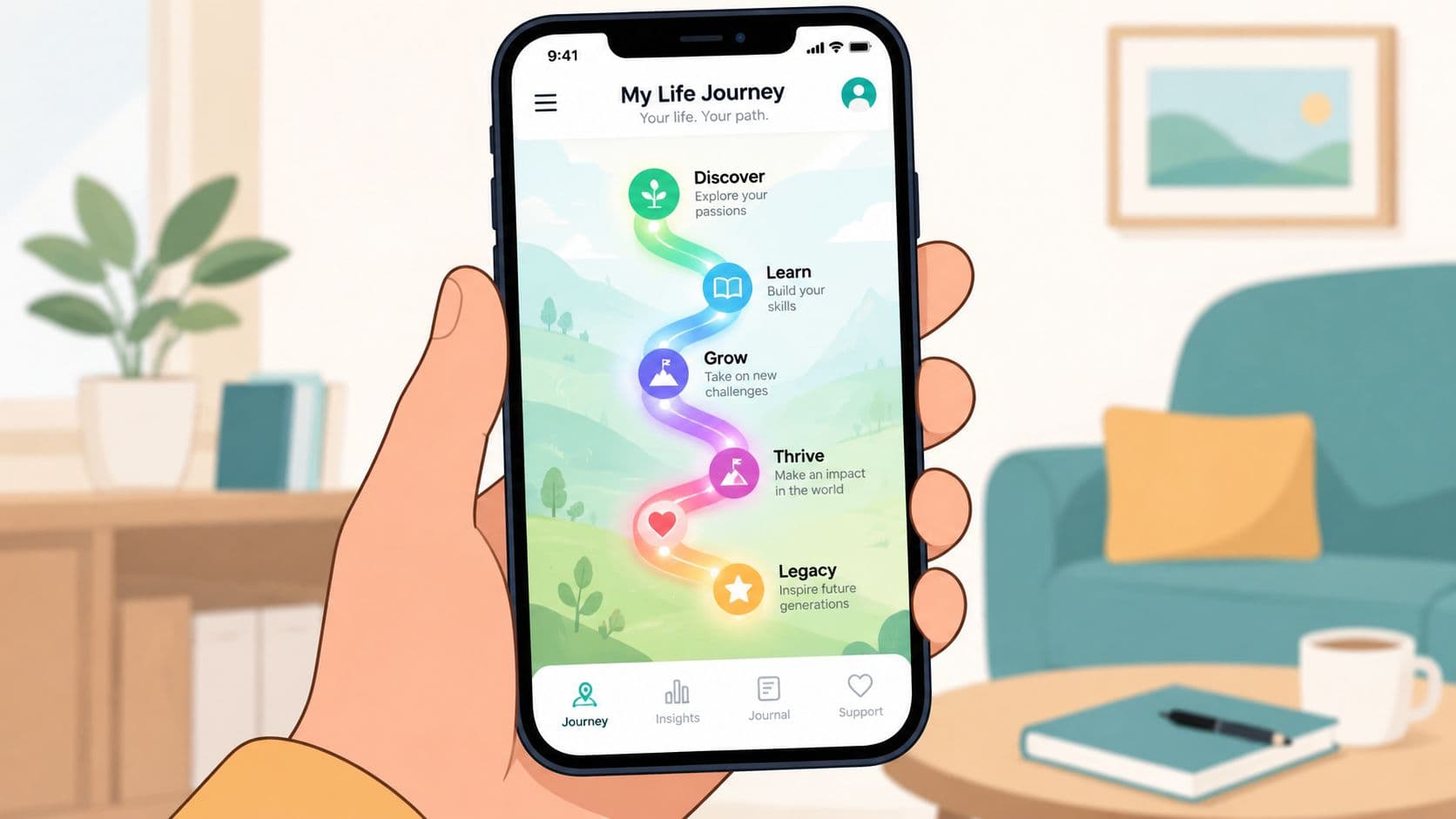
That's where the Life Purpose App becomes practical. It's the official digital companion to Dan Millman's The Life You Were Born to Live, and it allows users to enter their birth date to instantly access one of 45 unique life paths, explore nine-year life cycles, and analyze relationship compatibility.
What that changes in practice
Instead of manually holding several layers in your head, a digital view lets you see your chart as a living pattern. That matters because timing is easier to trust when you can visualize it.
A clear interface can help with questions like:
- Current phase awareness so you can notice whether this is a year for initiative, consolidation, or release
- Life-path context so your cycle isn't interpreted in isolation
- Relationship comparison so you can reflect on how different timing patterns may affect connection
Some people love to calculate everything by hand. Others want the insight without the arithmetic. Neither approach is more spiritual. The useful one is the one you'll find yourself using when life gets noisy.
Why visualization helps
A life cycle chart is easier to work with when you can glance at it and immediately understand where you are in the rhythm. Visual tools reduce friction. They also reduce the chance that you'll flatten the whole system into one vague idea about “good years” and “bad years.”
The deeper value is clarity. When a chart is visible, it becomes easier to reflect accurately, plan with more care, and notice patterns that used to feel random.
Living in Harmony with Your Natural Rhythms
The most helpful thing a life cycle chart can do is restore kindness to your self-understanding. If you know you're in a season of reflection, you stop demanding nonstop outward achievement. If you know you're in a season of completion, you stop treating every ending like a mistake.
That's the quiet wisdom inside Dan Millman's The Life You Were Born to Live and the framework made practical in the Life Purpose App. Your life has motion, but it also has rhythm. You don't need to fear the changing tone of a year if you can learn from it.
This kind of work also benefits from simple grounding rituals. Some people journal. Some take long walks. Some build a quiet evening routine with sensory cues, such as a harmony crystal candle, to mark reflection and reset. The object itself isn't the insight. The pause is.
A life cycle chart won't make every decision easy. It can make your decisions more conscious. And that often changes everything.
If you want a simpler way to explore your cycle, path, and relationship patterns through Dan Millman's The Life You Were Born to Live, the Life Purpose App gives you a direct place to start.
Discover Your Life Purpose Today!
Unlock your true potential and find your life’s purpose.
