Explore life cycle questions tied to nine-year cycles in The Life You Were Born to Live. Prompts for journaling, coaching and cycle reviews.

November 2, 2026 (16d ago)
Life Cycle Questions: 8 Reflective Prompts for 2026
Explore life cycle questions tied to nine-year cycles in The Life You Were Born to Live. Prompts for journaling, coaching and cycle reviews.
← Back to blog
Explore life cycle questions tied to nine-year cycles in The Life You Were Born to Live. Prompts for journaling, coaching and cycle reviews.
If a life-stage chart can tell you where you supposedly belong, why can't it tell you what to do when your actual life doesn't fit?
People often encounter life stages as labels or age ranges. Those labels can provide orientation, but they rarely explain how to handle a career setback, changing relationship, caregiving responsibility, or quiet loss of direction. Good life cycle questions connect a framework to something you can examine and act on.
The frameworks below offer different kinds of help. Developmental models organize questions about identity, intimacy, work, and aging. Life course research adds historical circumstances and relationships, while reflective tools such as the nine-year cycles in Dan Millman's book, The Life You Were Born to Live, and the Life Purpose App offer symbolic themes for self-inquiry.
Keep the distinction clear: A research framework can help explain patterns across lives. A symbolic framework can prompt reflection, but it can't establish what will happen to you.
You don't need to choose a permanent label or agree with every part of a model. You need a useful question, an honest answer, and enough flexibility to revise your interpretation.
Bring these prompts to a journal, a coaching conversation, or an annual review. Where a description doesn't match your experience, record the mismatch rather than forcing your story to fit.
1. What is a life cycle, and why do people study it?
A human life cycle describes development from birth through later adulthood, including recognizable stages, challenges, and changes in responsibility. People study these patterns to understand development, prepare for transitions, and make sense of experiences that otherwise feel disconnected.
Developmental categories provide reference points, not universal deadlines. The Baylor University lifespan development textbook distinguishes childhood, adolescence, emerging adulthood, and later adult periods while explaining that age boundaries are conventions rather than absolute biological rules.
Think of the journey as a path with recognizable terrain, not compulsory stops.

Start with transitions rather than ages
Say someone reviews their career and family priorities after a bereavement. An age label offers little practical guidance, but naming the transition reveals questions about responsibility, identity, grief, and support.
Create a personal timeline and use these prompts:
- Name the change. What ended, began, or became uncertain?
- Identify the demand. What did that transition ask me to learn, accept, or renegotiate?
- Notice the carryover. Which response still helps me, and which one no longer fits?
- Choose support. Who or what would make the next transition more manageable?
A counselor might use the same timeline to help someone distinguish an ongoing concern from a recent disruption. That distinction gives the conversation a clearer starting point without turning the chart into a diagnosis.
For another introductory lens, explore the four life cycles. Give any stage model descriptive weight, not authority over your identity. Its usefulness depends on whether it helps you describe your experience more accurately.
2. What are Erikson's eight stages of psychosocial development?
Erik Erikson's psychosocial model organizes development around tensions between personal needs and social relationships. The New York City developmental resource identifies eight stages, moving from trust versus mistrust in infancy to integrity versus despair in later adulthood.
The model's central conflicts are useful vocabulary for reflection:
- Trust versus mistrust. Can I depend on others?
- Autonomy versus shame and doubt. Can I act independently?
- Initiative versus guilt. Can I pursue an intention?
- Industry versus inferiority. Can I develop competence?
- Identity versus role confusion. Who am I becoming?
- Intimacy versus isolation. Can I build close relationships?
- Generativity versus stagnation. How am I contributing?
- Integrity versus despair. How do I understand the life I've lived?
These are psychological themes, not exams to pass. You can use a theme associated with an earlier period without concluding that your development has failed.
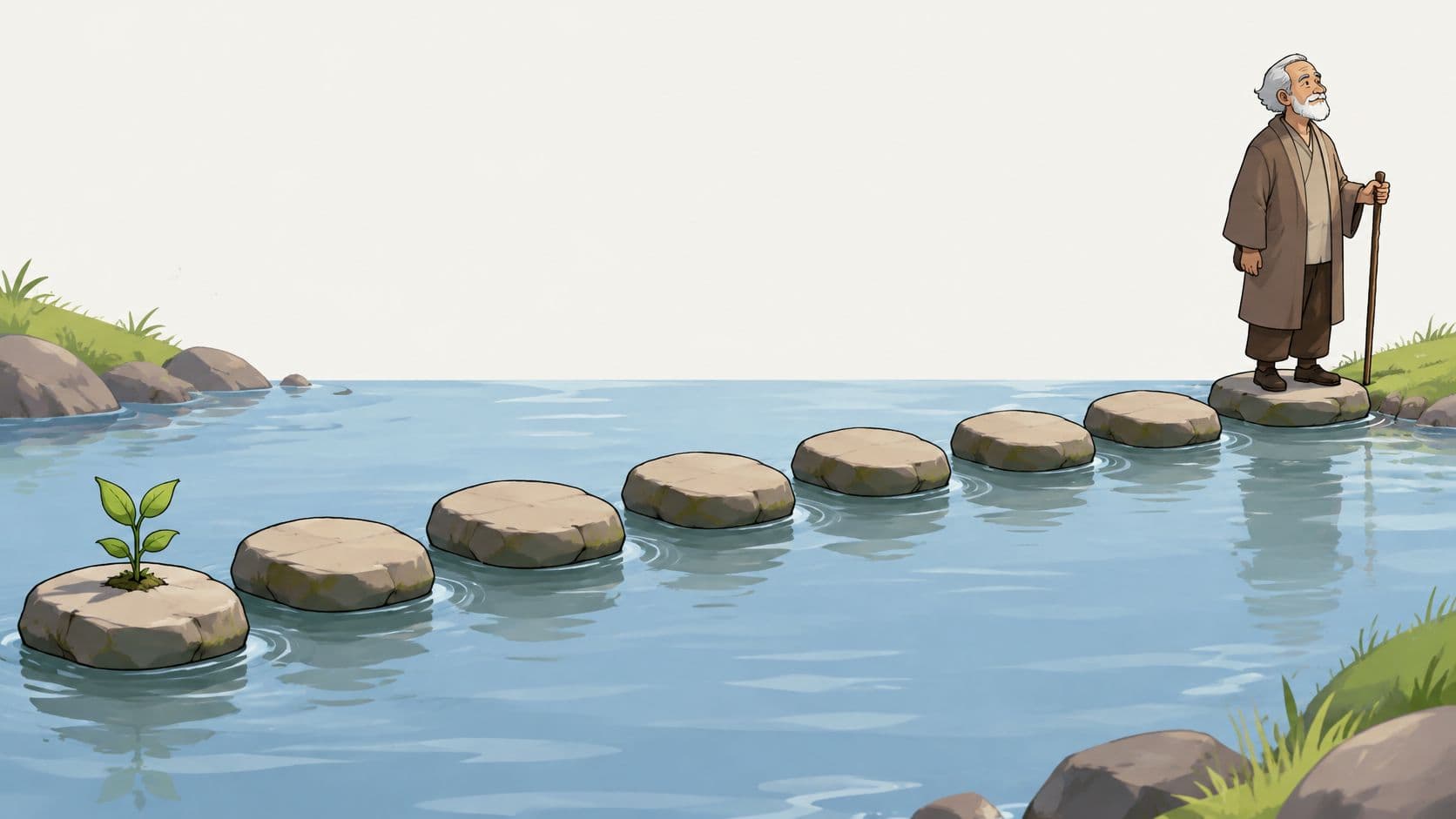
The later-life question becomes especially concrete when reflection includes both satisfaction and regret.
Choose the conflict that feels active
A teacher might use identity versus role confusion to discuss a teenager's experimentation with interests and roles. A retiree might use integrity versus despair to consider what they value about their working and family life, including what remains unresolved.
For your own journal, choose the tension that feels most relevant. Ask what each side looks like in everyday behavior, what circumstances intensify it, and what a constructive response would involve.
The model can organize a conversation, but it can't diagnose you or predict your future. Use your answer to identify a practice, such as asking for help or making time for a close relationship.
3. What are Levinson's seasons of life?
You can reach an important goal and still wonder whether the life surrounding it suits you. That's a useful starting point for Daniel Levinson's seasons of life, which describes adult development through relatively settled periods and transitions.
Levinson and his colleagues explored how adults build a life structure, the arrangement of work, relationships, commitments, and aspirations. During a transition, someone may question that arrangement and begin constructing a different one.
The model grew from interviews with men, so it shouldn't be treated as a universal timetable. Its strongest reflective contribution is the distinction between living within a structure and reconsidering the structure itself.
Examine what you've built
Say a professional achieves the position they wanted, then realizes that constant availability leaves little room for friendships or creativity. Rather than assuming they need a completely different career, they can investigate which parts of the arrangement need revision.
- Locate the unsettled feeling. When did my current arrangement start feeling restrictive?
- Separate goals from expectations. Which ambitions still belong to me, and which am I maintaining for someone else?
- Review relationships. Who supported an earlier version of my life, and what support do I need now?
- Test a change. What could I adjust before making an irreversible decision?
A couple could answer these questions separately, then compare how their shared hopes have changed. The point isn't to prove that they're in a prescribed season, but to make their assumptions visible.
A feeling of dissatisfaction is a reason to investigate, not automatic evidence that everything must change.
Keep physical health separate from the metaphor. If menopause is relevant, explore the different menopause stages as a distinct topic rather than attributing symptoms to an adult-development transition.
4. How do career life stages unfold over time?
A layoff can put an experienced worker back into exploration. Returning to study can do the same, even when someone already has a substantial career history.
Donald Super's life-span, life-space theory offers a way to think about career development through growth, exploration, establishment, maintenance, and disengagement. It also recognizes that work exists alongside other roles, including student, parent, partner, and community member.
Those overlapping roles matter as much as the career label. In the AARP and National Alliance for Caregiving report, 70% of working-age caregivers in the United States also hold paid employment, illustrating why career reflection needs to include responsibilities outside work.
A useful career map leaves room for exploration throughout adulthood.

Map roles before choosing a direction
Draw overlapping circles for your current roles. In each, write what you give, what you receive, and what feels unsustainable.
Then ask:
- Career task. Am I exploring possibilities, building stability, maintaining skills, or preparing to step back?
- Role conflict. Which responsibilities compete for the same time and energy?
- Practical limits. What income, schedule, location, or training requirements must I respect?
- Small experiment. What conversation, course, or work sample would help me test an option?
For example, someone returning after caregiving might need a predictable schedule before they need a promotion. That isn't necessarily reduced ambition; it may be a more accurate definition of success for their present circumstances.
Reviewing career progression routes for adults can help turn exploration into concrete options. Use the model to organize choices, not to decide what someone your age should have achieved.
5. What is a nine-year personal cycle, and how does it work?
In the numerology-based framework described in Dan Millman's book, The Life You Were Born to Live, and the Life Purpose App, personal development is interpreted through repeating nine-year cycles. Themes such as beginnings, growth, harvest, and completion provide a symbolic way to review experience.
The Life Purpose App maps the current cycle and year using birth-date information. This is a reflective system, not a scientifically validated method of predicting events. A theme can give you something to consider without explaining why an event occurred.
Turn a theme into a testable question
Suppose the theme you're exploring concerns completion. You might examine unfinished commitments, decisions you've postponed, or responsibilities you're ready to hand over, but you shouldn't assume that a job or relationship must end.
Try these prompts:
- Compare with experience. Which parts of the theme fit my circumstances, and which don't?
- Seek an alternative. Could ordinary factors, such as workload or changing responsibilities, explain what I'm noticing?
- Choose a practice. What useful action would I take even if I hadn't read this interpretation?
- Keep disagreement visible. What evidence would make me revise my reading?
A coach could use the same theme to open a discussion about recent transitions. The client's actual circumstances should determine the conversation, rather than the coach steering every answer toward the interpretation.
Practical boundary: Let a symbolic theme suggest a question. Don't let it overrule evidence, consent, safety, or professional advice.
Write the theme and your response separately. That small distinction helps preserve the difference between what the framework proposes and what you experience.
6. How does my life path relate to my life cycle?
Think of the distinction as a broad theme compared with a changing chapter. In Dan Millman's book, The Life You Were Born to Live, and the Life Purpose App, a life path represents a central birth-date-derived pattern, while cycles describe changing emphases within the symbolic framework.
The book presents those patterns through gifts, challenges, and spiritual lessons. The Life Purpose App lets readers consider their life path alongside cycle information, but neither description should replace an assessment of skills, circumstances, or available choices.
For a fuller explanation of the terminology, see the life path definition. Keep its meaning within Dan Millman's The Life You Were Born to Live and the Life Purpose App separate from evidence-based developmental categories.
Compare interpretation with observable behavior
Use a journal page with distinct spaces for the broad description, the current cycle theme, and your lived experience. Don't merge them into a single statement about who you must be.
Ask yourself:
- Personal meaning. How would I summarize the description in my own words?
- Concrete example. What recent behavior fits it, and what behavior contradicts it?
- Current challenge. Does this cycle theme raise a useful question about something I'm facing?
- Independent judgment. What would I decide if I'd never encountered this framework?
Say you're considering a career change. A theme about expression could prompt you to examine whether you want more creative work, but it doesn't establish which occupation suits you or whether you can afford to leave your job.
Give the framework interpretive weight only. Use it to articulate possibilities, then evaluate those possibilities through conversations, practical experiments, financial realities, and your own judgment.
7. How can life cycle questions help with relationship compatibility?
Compatibility becomes more useful when you stop treating it as a single verdict. Ask instead whether people's expectations, communication habits, responsibilities, and desired futures can work together.
Relationships deserve space in a purpose review. In the American Psychological Association's Stress in America report, 92% of U.S. adults identify relationships as meaningful. That finding supports asking about connection, not just individual goals.
Within Dan Millman's book, The Life You Were Born to Live, and the Life Purpose App, symbolic compatibility involves comparing life paths and current cycles. The app includes compatibility exploration for friends, family, co-workers, and public figures through in-app look-ups.
Use a comparison to begin a conversation
A couple might notice that they want different things from the coming year. Rather than treating a cycle interpretation as the explanation, they can use it to ask directly about capacity, expectations, and support.
- Communication. How do you prefer to receive difficult feedback?
- Capacity. Which responsibilities are taking most of your energy?
- Connection. What helps you feel supported without feeling managed?
- Expectations. Which assumptions about money, time, or commitment need discussion?
Co-workers could adapt these prompts to deadlines, feedback, and shared responsibilities. Compare their actual answers rather than assuming that an interpretation describes how either person behaves.
A love compatibility report is best treated as a conversation starter, not a verdict about whether a relationship will last. A symbolic reading can't establish another person's intentions or excuse harmful behavior.
When conflict needs more than reflection, consider appropriate professional support, including location-specific services such as family support options in Vernon. Decisions about safety and respect should never depend on a compatibility label.
8. How do life course researchers study transitions across the lifespan?
Life course researchers ask what happened, when it happened, and under what conditions. This approach, associated especially with sociologist Glen Elder and colleagues, examines how personal development intersects with history, institutions, and connected lives.
The Springer overview of life-course research describes the field's move beyond fixed stages toward attention to cohorts, relationships, historical context, and the timing of transitions. Researchers use longitudinal surveys and life histories to examine change over time rather than relying only on snapshots.
The distinction matters because similar events can have different consequences depending on someone's responsibilities and resources. Leaving a job while supported by family is a different transition from leaving while supporting dependents.
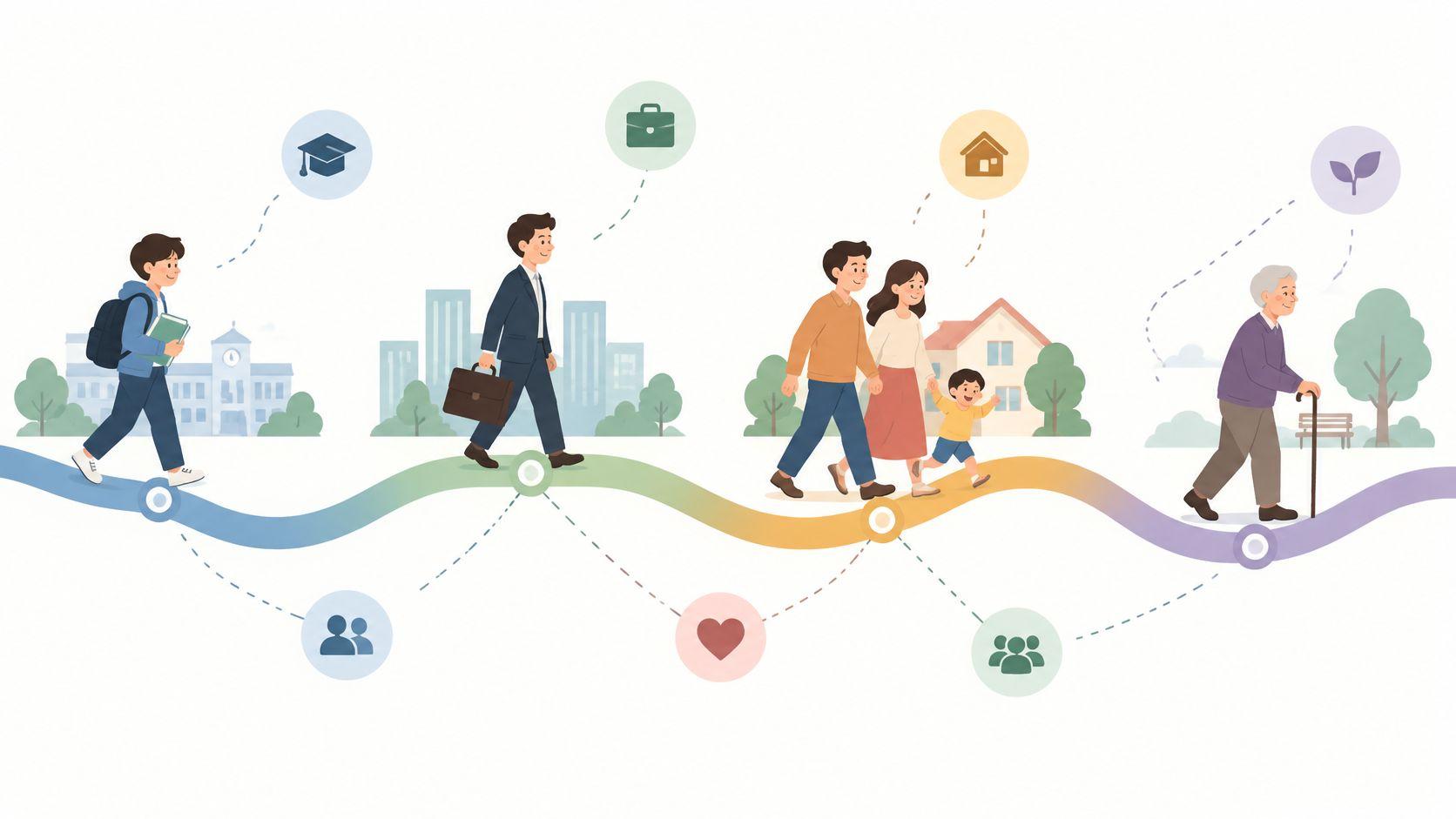
A broad lifespan picture is only a starting point for those details.
Add context to your timeline
Choose a turning point and examine more than the decision itself:
- Timing. What else was happening when this event occurred?
- Linked lives. Whose needs, choices, or support affected my options?
- Institutions. How did school, work, healthcare, or public services influence what happened?
- Available choices. What could I realistically control, and what was beyond my control?
For example, a school district examining student transitions could consider family changes and access to support alongside classroom performance. In personal reflection, the same lens helps you distinguish a difficult choice from a lack of viable options.
This framework has stronger explanatory grounding than symbolic cycle interpretation, but it still can't predict an individual outcome with certainty. Its practical value is helping you build a fuller account of your circumstances before deciding what to change.
How the eight life cycle frameworks differ in scope, timing, and evidence
| Item | Time Scale | Core Focus | Best For | Evidence Base |
|---|---|---|---|---|
| What is a life cycle, and why do people study it? | Birth through later adulthood; timing varies | Recognizable stages, transitions, and personal change | Making sense of life transitions and supporting self-reflection | Varies by model; stage frameworks may oversimplify individual and cultural differences |
| What are Erikson's eight stages of psychosocial development? | Eight stages from infancy to late adulthood | Psychosocial conflicts and strengths across the lifespan | Teaching or reflecting on developmental tasks and life reviews | Widely taught; research support for the exact sequence and outcomes is mixed |
| What are Levinson's seasons of life? | Adult eras of roughly 20 to 25 years, with transitions | How people reassess and reshape life structures, relationships, and work | Understanding adult transitions and midlife reassessment | Based initially on a small sample of men; eras are difficult to test |
| How do career life stages unfold over time? | Lifelong; stages may recur | Career development, self-concept, and changing life roles | Career counseling, education, and planning work transitions | Practical framework; boundaries are approximate and the model assumes a relatively stable workforce |
| What is a nine-year personal cycle, and how does it work? | Repeating nine-year blocks | Symbolic themes for growth and reflection | Setting intentions and exploring personal themes | Numerology-based; not supported by controlled scientific research |
| How does my life path relate to my life cycle? | Fixed life path with cycles shifting over time | Relating birth-date-based patterns to changing themes | Symbolic reflection, journaling, and goal setting | Belief-based framework without scientific support |
| How can life cycle questions help with relationship compatibility? | Compares life paths and current cycles | Exploring potential support, friction, and relationship timing | Starting conversations about communication and expectations | Not a validated measure of compatibility |
| How do life course researchers study transitions across the lifespan? | Lifespan, studied across time | How event timing, social context, history, and relationships shape lives | Research and planning in sociology, health, education, and policy | Empirical approach using longitudinal research and social data |
Turning Your Answers Into a Regular Review Habit
Choose a framework that matches the question you're facing, rather than the one that offers the most comforting label. Erikson can help you explore a psychosocial tension, Super can organize career and role questions, and a life course timeline can clarify the circumstances surrounding a transition.
Set aside ten minutes and answer a small selection of prompts in writing. Record what surprised you, what remained unclear, and what you're willing to do next.
Keep the record simple
Use a notebook or a private digital document with a dated entry. Preserve your original answers rather than rewriting them to match what later happened.
A useful entry includes:
- Present situation. Describe what's happening without interpreting it first.
- Framework. Name the model and the question you're borrowing from it.
- Response. Write what fits, what doesn't, and what you're uncertain about.
- Next action. Choose something observable, such as arranging a conversation or testing a study option.
- Review point. Decide when you'll return to the entry.
Repeat the exercise annually or after a meaningful transition. If you use the nine-year symbolic framework in Dan Millman's book, The Life You Were Born to Live, and the Life Purpose App, you can also review your answers when entering a new cycle.
Don't wait for a designated review date if your circumstances change substantially. A new caregiving role, separation, health concern, or job loss may require practical attention before any broader interpretation is useful.
The most useful record isn't one that proves a framework right. It's one that shows what you understood, what you tried, and what you learned.
Look for changes, not a perfect story
When you revisit an entry, compare your earlier assumptions with what happened. Notice which concerns keep returning, which relationships need attention, and which goals no longer feel like your own.
A recurring answer doesn't automatically reveal a fixed trait. It may point to an unresolved practical problem, a responsibility you can't carry alone, or a question that needs a different kind of support.
Bring selected entries to a coaching or counseling conversation if that would help. Keep private material private unless you choose to share it, and seek qualified medical, psychological, or financial guidance when your questions move beyond reflection.
Life cycle questions are useful when they lead to clearer observation and proportionate action. You don't need a final explanation of your whole life before taking a sensible next step.
The Life Purpose App is a digital companion to Dan Millman's The Life You Were Born to Live, offering birth-date-based life path information, nine-year cycle themes, and relationship compatibility exploration. Visit Life Purpose App to explore its reflective framework, then bring a theme to your journal alongside the practical questions that matter in your current circumstances.
Discover your life path today
Enter your date of birth and see your life path, free.
Find your life path