Learn how life cycle transitions unfold across Dan Millman's nine-year cycles, when to expect change, and how to plan your next chapter.

November 23, 2026 (3d ago)
Life Cycle Transitions: How Nine-Year Cycles Shape Change
Learn how life cycle transitions unfold across Dan Millman's nine-year cycles, when to expect change, and how to plan your next chapter.
← Back to blog
Learn how life cycle transitions unfold across Dan Millman's nine-year cycles, when to expect change, and how to plan your next chapter.
If you handed in notice last month, moved house in the same season, and still catch yourself checking the old work phone out of habit, you're inside a change that doesn't feel like a sequence. It feels like weather.
A nine-year cycle won't forecast that weather. It does something smaller and more useful: it gives you a way to judge whether a change is arriving on time, whether you chose it, and whether you're carrying it alone. Those three questions shape how a transition lands more than the transition itself.
That matters more now than it did for your grandparents, because the life course has stretched. United Nations estimates put global life expectancy at birth at 73.3 years in 2024, an increase of 8.4 years since 1995, with average global longevity projected to reach about 77.4 years by 2054, according to the UN World Population Prospects. More years mean more chapters, and more boundaries worth planning around.
Nine-Year Age Bands at a Glance
Say you're 35. The job is fine. The flat is fine. And for six months you've had the nagging sense that something is about to end, without being able to say what.
In Dan Millman's The Life You Were Born to Live, that feeling has a shape. Life is organised into nine-year cycles, each carrying its own theme, and the friction people notice tends to gather near the boundaries between them. A 35-year-old sits at the end of the band that runs from 27 to 35, which puts the next boundary at 36. That is one explanation for the itch, and only one.
Chapters don't end cleanly. You know the feeling of finishing a chapter late at night and reading two pages of the next one before you fall asleep. That's what a boundary feels like from the inside. The new chapter has already started while the old one still feels unfinished.
The Grid From Birth to Eighty
Here's the arithmetic, so you can find yourself in it at a glance.
| Cycle | Next boundary |
|---|---|
| Cycle 1, ages 0 to 8 | Age 9 |
| Cycle 2, ages 9 to 17 | Age 18 |
| Cycle 3, ages 18 to 26 | Age 27 |
| Cycle 4, ages 27 to 35 | Age 36 |
| Cycle 5, ages 36 to 44 | Age 45 |
| Cycle 6, ages 45 to 53 | Age 54 |
| Cycle 7, ages 54 to 62 | Age 63 |
| Cycle 8, ages 63 to 71 | Age 72 |
| Cycle 9, ages 72 to 80 | Age 81 |
Treat this as a planning grid, not a horoscope. In the book and in the Life Purpose App, the exact starting point of your cycle is worked out from your date of birth, which means two people the same age can be a year apart in their cycles. Check your own dates there rather than trusting the arithmetic alone. The bands are also only one layer; our guide to the four life cycles explains how the shorter cycles sit inside the longer arc.
Some boundaries arrive early, and not because of you. If a parent's memory is slipping, the change in their life can pull yours forward by a year or two, and early dementia support from Velma is a practical place to start on the signs worth tracking.
Find the band that contains your age and write down the age at which the next one begins. That number, not the label on your current cycle, is the thing to watch.
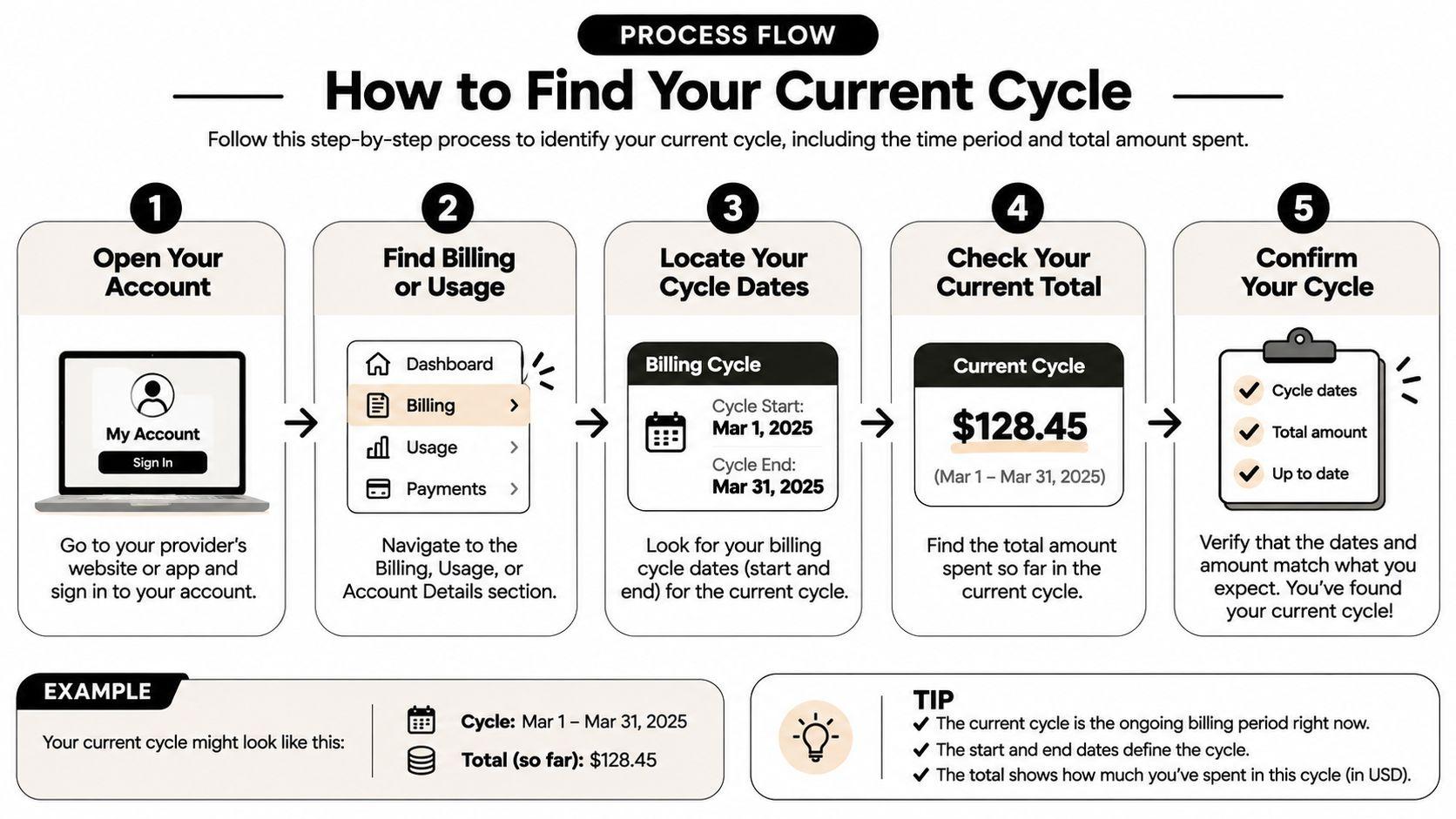
How to Find Your Current Cycle
The grid tells you roughly where you are. Finding your actual position takes ten minutes and one fact you already know by heart.
-
Confirm your date of birth from a document, not from memory. A passport or birth certificate settles it in seconds. A single wrong digit moves every boundary by a year, and you'd spend the next hour reading a cycle that belongs to someone else.
-
Enter that date in the Life Purpose App. You enter your date of birth and the app reveals insights about your life path, including where you sit in the current nine-year cycle. The date of birth you enter to reveal a life path isn't stored or collected, so there's no profile sitting on a server afterwards.
-
Read the cycle description in The Life You Were Born to Live. The app supplies your dates; the book supplies the themes. Keeping those two roles separate is what stops you from treating a general description as a personal prophecy.
-
Write down the start and end years in calendar terms. If you turn 36 in 2025, that band runs through 2033 and the next boundary falls in 2034. Calendar years are easier to match against real events than ages are.
-
Mark where you sit in it. Years one to three are early, four to six the middle, seven to nine late. The same theme asks different things at each stage, and the late years are for preparing rather than launching.
-
Compare the boundary year with changes you've already made. List job moves, home moves, separations, births and bereavements with dates. If two or three cluster near a boundary, the framework is at least describing your life accurately. If they're scattered, note that too.
-
Write one sentence about what this cycle asks of you. One sentence, your words, no jargon. That sentence is what you'll test decisions against for the next few months.
The app supplies your dates. The book supplies the meaning. Neither one is a verdict.
If your notes match the theme the book describes for your cycle, the reading is working. If they don't, keep the notes and revisit them at the next boundary, because a mismatch is information rather than failure.
Reading Whether a Transition Fits You
Think about a key and a lock. The key turns because the cuts line up, not because the key is impressive on its own. A life change works the same way: it fits when timing, direction and support line up with what's already around you.
Four signals tell you which way a change is leaning.
| Signal | Supportive pattern | Strained pattern |
|---|---|---|
| Timing | Arrives within the expected window of the current cycle | Arrives well ahead of or behind the window |
| Choice | You started it or accepted it with intent | It was imposed with little say |
| Support | People and resources are in place | You carry it alone |
| Load | One change is landing at a time | Several changes land together |
A change that arrives early, feels imposed, or lands without support isn't doomed. It deserves more attention in the planning, more slack in the schedule, and a smaller first step.
Timing is the signal people misread most often, because it's easy to confuse "this is difficult" with "this is wrong." In a nationally representative cohort of 8,749 Australian women followed from ages 18 to 23 through to ages 22 to 27, normative moves such as leaving home, starting work or becoming a mother were generally not linked to higher stress, while transitions arriving earlier than expected were linked to more stress, as reported in the Australian longitudinal study on life transitions and stress. Judge the change by whether it's on time for your age, not by whether it feels comfortable in week one.
Answer these three in a notebook before you decide anything:
- Did I choose this? If not, name who did, because that shifts the plan from ambition to adaptation.
- Who is with me in it? One person who knows the details beats a wide circle who know the headline.
- What else is changing at the same time? A transition rarely travels alone, and the company it keeps changes how much room you have.
A cycle suggests a theme and a likely timing. It never issues a verdict on what will happen.
When Several Changes Land in One Cycle
A job ends in March. The lease runs out in June. By August a close relationship has shifted into something you don't have a name for yet. Three events, one year, and none of them large enough on its own to explain why you're exhausted.
That exhaustion has a mechanism. A life-course analysis of employment loss, employment gain, marriage and divorce found that employment losses and divorces had significant negative effects on self-rated health and depression, while gains and marriage produced smaller or no effects, and that the effects grew stronger as the number of transitions increased, according to a life-course study of work and family instability. The same analysis found instability later in life more damaging than comparable disruption at younger ages. Stacked change isn't three small events. It's one large load.
Run this check before you plan anything new:
- Count the changes of the last 12 to 24 months, including the ones you welcomed.
- Mark each as chosen or imposed. The ratio tells you more about your reserves than the count alone.
- List the life areas touched. Work, home, relationships, health and money are the five that carry most of the weight.
- Name the change with the most immediate practical impact. That's the one to solve first, whatever the others are doing.
If a move is the piece that has destabilised you, therapist guidance for young adults relocating covers both the practical and emotional sides of that particular transition.
Stabilize Before You Decide
- Secure income for the next few months, even at a lower level than you want.
- Protect sleep and health, because decisions made on four hours of sleep are usually somebody else's decisions.
- Lean on one trusted person and tell them the full picture.
- Only then make new choices.
The Life You Were Born to Live sets out strengths and challenges for each life path in areas that include health and money. Use those notes as a reference point for where your strain usually shows up, not as a diagnosis of what's wrong with you. Then anchor a single area for the next few months, usually income or housing, so the rest of the changes have something solid to land on.
When Caregiving or Work Changes Your Cycle
Most writing about caregiving explains how to cope while you're doing it. Very little covers the year after the role ends, when the thing that organised your week disappears and nobody sends a card.
Identity loss, unresolved grief, a career with a gap in it, finances that never recovered, friendships that lapsed. Those are the tasks of leaving care, and they arrive while everyone around you is congratulating you on getting your life back. An Australian longitudinal study on leaving the caregiving role found that people who provided at least 10 hours of care a week reported immediate and persistent improvements in mental health, emotional wellbeing, social functioning, employment and working hours once the role ended. Relief and bereavement can coexist.
Working-age carers face a different squeeze, and the questions are blunter: how do I revise my career without abandoning ambition, and what happens when caregiving changes my identity, income and long-term security? The 2025 State of Caring survey from Employers for Carers found 73% of working carers considered balancing work and care stressful, 40% of all surveyed carers had left work completely, and 43% of those who left employment reported bad or very bad mental health. That's not a work-life balance problem. It's a life-course redesign.
Three steps help here:
- Check the timing against your current band. A caregiving exit in the first year of a cycle reads differently from one in its final year.
- Run the four fit signals. Imposed, unsupported and clustered is the strain pattern, and it calls for a smaller plan, not a bigger one.
- Choose one stabilizing step around income. A phased return, a retained client, a fixed monthly figure you must clear.
For the cycle themes, read the descriptions in Dan Millman's The Life You Were Born to Live. If the question is how your work and your nature fit together, numerology and career goes further. Your personal dates come from the Life Purpose App.
Myths About Life Cycles and Fate

Four beliefs cause most of the confusion. Each one is worth naming plainly.
A cycle predicts specific events on a set date. It doesn't. Cycles mark periods of theme and timing, not calendar appointments. Nobody can tell you which month a job ends because of a number derived from your birth date.
A difficult cycle ruins the years inside it. The same period produces growth or strain depending on choice, support and pace. Those are the signals that decide the outcome, and you influence all three.
Two people with the same cycle will live the same experience. Circumstances differ: health, money, country, family, obligations. A shared theme plays out through entirely different material.
A numerology reading proves a decision is right. It doesn't, and treating it that way is how people end up justifying a choice they'd already made. The framework works best as a reflection prompt standing next to the facts, including the numbers in your bank account.
A cycle shows you where to look, not what you will find.
The book itself frames the system as a tool for self-knowledge, and the honest move is to check any interpretation against its own text rather than against a summary someone posted online. For the wider argument about how much of a life is chosen, fate versus free will takes it apart. Dan Millman's The Life You Were Born to Live and the Life Purpose App are the two references to hold any numerology-style reading against, and both are built to support reflection rather than issue rulings on your decisions.
Plan Your Next Change Around the Boundary
A nine-year cycle has three working phases, and each asks something different of you. The first three years carry the launch, when initiatives suggested by the cycle's theme are easiest to start. The middle years, roughly four to six, are for consolidating and reviewing what worked. The final three are for preparation, closing commitments and clearing ground before the next boundary arrives.
The Three Phases in Practice
Take someone in a career-themed cycle. They enrol in a training course in year one, while the appetite for new starts is high. By year five they review what the qualification produced, which clients it brought, which doors it didn't open. In the final year they list three commitments to finish and three to begin, and the boundary stops being something that happens to them.
That's the whole method: start early, review in the middle, prepare at the end.
A useful rule: plan the boundary like a project review, not a forecast. You're deciding what to carry forward, not predicting what will happen.
Your Boundary Checklist
- Name one thing to finish. An unfinished course, a half-run project, a conversation you've avoided. Carrying it into the next cycle costs you the fresh start.
- Name one thing to start. Small enough to begin within a month, specific enough that you'll know whether it happened.
- Name one habit to release. Something the last cycle rewarded that the next one won't, such as saying yes to every request or working through weekends.
Then confirm your position in the Life Purpose App, which covers the nine-year life cycle and shows you how to make the most of your current year in it. Pick one transition from the four fit signals to test, and write two lines: one goal, one stabilizing step. The free version includes a summary of your life path and an overview of the Life Purpose System, which is enough to run this exercise once and see whether the timing rings true.
When the boundary passes, that's when you review. Return to the age-band table, check your notes against what happened, and adjust. The theme is a lens for choosing where to put effort, not a script, and people in the same cycle live it out very differently, so your own notes carry more weight than any general description. The app is a companion to the 25th edition of The Life You Were Born to Live, which supplies the cycle themes themselves. When a boundary arrives with a promotion attached, how transition coaching supports new executives covers the first-ninety-days work that separates a strong start from a faltering one.
The Life Purpose App maps the nine-year cycle you're in right now and shows you how to make the most of the year ahead, drawing its themes from Dan Millman's The Life You Were Born to Live. Enter your date of birth and it returns your life path, your current cycle position, and the strengths and challenges that come with it, so the next boundary you plan around is one you can see coming. Visit Life Purpose App to start with the free summary and find your own timing.
Discover your life path today
Enter your date of birth and see your life path, free.
Find your life path