Use life cycle worksheets to track your nine-year cycle in Dan Millman's system, with clear steps and prompts you can fill in today.

November 25, 2026 (1d ago) — last updated November 25, 2026 (Today)
Life Cycle Worksheets for Tracking Your Nine-Year Cycle
Use life cycle worksheets to track your nine-year cycle in Dan Millman's system, with clear steps and prompts you can fill in today.
← Back to blog
Use life cycle worksheets to track your nine-year cycle in Dan Millman's system, with clear steps and prompts you can fill in today.
You've got a free evening, a notebook you keep meaning to use, and a feeling that the same money worry has come back around for the third time in your life. So you search for life cycle worksheets and get pages of butterflies, pumpkins, and cut-and-paste caterpillars. Useful for a second grade classroom, not much help for a forty-year-old trying to work out why a familiar pattern keeps returning.
The adult version of a life cycle worksheet is simpler than the school version, and stricter. It puts you at a specific point in a nine-year cycle, records what's happening in one area of your life, and holds that next to what happened in the same area one cycle earlier. Facts on one side, interpretation on the other. That separation is the whole point, because a cycle year is a lens you look through, not a forecast of what's coming.
The Life Cycle Worksheet Layout at a Glance
A worksheet earns its keep by answering three questions on one page. Where am I in the cycle? What's happening in one named area of my life? What happened here last time? Dan Millman's The Life You Were Born to Live covers these nine-year cycles, and the Life Purpose App, which is based on that bestselling book, helps you apply the system once you enter a date of birth.
Seven fields cover it. Copy them exactly, in this order.
| Field | What to write | Why it matters |
|---|---|---|
| Date of birth | The exact date you entered in the Life Purpose App | Anchors your position in the cycle |
| Current cycle year | The cycle year you're in now, as a single number | Sets the theme you reflect on |
| Cycle start and end years | The calendar years that cycle covers | Shows where you stand within the full run |
| Life area focus | One of five areas: health, money, sexuality, career or livelihood, relationships | Keeps the reflection specific |
| Current issue | One sentence naming the decision or pattern you face | Gives the entry something to test |
| Earlier cycle entry | What happened in the same area one cycle back | Reveals recurring patterns |
| Review date | The date you plan to revisit the entry | Turns one-off writing into a habit |
Fill the anchor fields before you reflect
The first three rows are the anchor. Date of birth, current cycle year, and the calendar span of that cycle are recorded facts, and everything below them is your reading of those facts. Fill the anchor first so you can't adjust the timing later to fit a story you like.
Keep the page visually quiet, too. Guidance from Paths to Literacy on adapting worksheets for students with visual impairments recommends reducing visual clutter and limiting each page to one clear focus, and that advice holds for adults writing at a kitchen table. One cycle, one area, one page. Skip the decorative circles and arrows.
Practical rule: if a field can hold two ideas, it's two fields. Split it.
Set the layout up in a notebook or a spreadsheet, whichever you'll open again. In a spreadsheet, give every row a column for the earlier cycle entry rather than tacking a comparison on at the end. Reuse the identical layout each year so your entries stay comparable, because a reflection you can't compare with last time is just a diary entry.
How to Find Your Current Cycle Year
Locating your position takes about ten minutes, and most of the errors happen in the first minute. The infographic below shows the short version of the sequence.
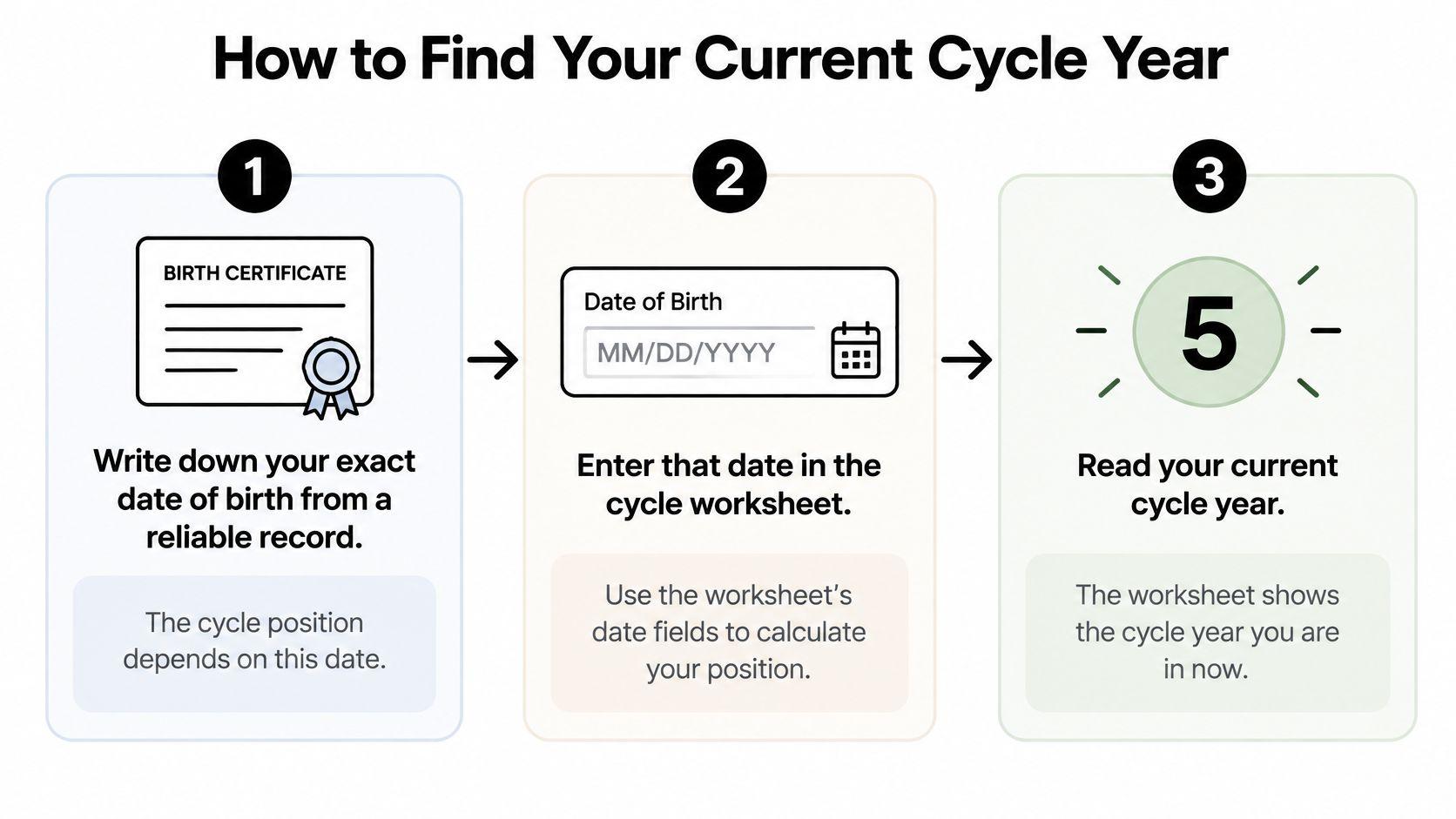
- Write down your exact date of birth from a reliable record. Use a birth certificate or passport, not memory. Your position in the cycle depends on that date, so a one-digit slip moves everything downstream.
- Enter that date in the Life Purpose App. You enter your date of birth to reveal insights about your life path, and that birth date isn't stored or collected. If you typed it wrong the first time, correct it and write the correction in your notes line so you know which version produced which reading.
- Open the book and read the matching cycle. Publisher descriptions of Dan Millman's The Life You Were Born to Live explain that it covers nine-year life cycles and helps readers identify where they currently are within one. Find that material and read the description of the cycle year the app points to.
- Write the cycle year and its start and end years into the first fields. Single number for the year, two calendar years for the span. Nothing else yet.
- Compare the app summary with the book text. If they disagree, don't pick the answer you prefer. Write the mismatch in a notes line beneath the table.
- Re-check the cycle year on your review date. Cycle years move forward, and an entry written eighteen months ago may be describing a position you've already left.
When the app and the book disagree
The book is the reference and the app is its companion, so a mismatch is a note, not a decision. Write something plain like "app shows a different cycle year than the book text for this date, checking again at review." That keeps the discrepancy visible instead of buried.
A settled entry looks like this: one cycle year, one sentence naming its theme in your own words, and a short line on whether your present circumstances match that theme. If they don't match, say so. Readers working through a change of position often find it useful for naming what shifted, and a mismatch is exactly the kind of thing worth recording rather than smoothing over.
Mapping Your Five Life Areas to the Cycle
The five areas aren't a self-help invention. Descriptions of The Life You Were Born to Live name health, money, sexuality, career or livelihood, and relationships as the concrete areas the life-purpose system examines, which gives your worksheet a five-part structure straight from the source.
Use one prompt per area and answer only the one you pick.
- Health. Where does your energy or a specific habit need attention this year? Name the habit, not the aspiration.
- Money. Which income, spending, or debt decision have you been postponing? Write the decision and the date you first noticed you were avoiding it.
- Sexuality. Where do intimacy, desire, or honesty in a close partnership need attention?
- Career or livelihood. Does your work match your drives and abilities, or does something need adjusting? The Life Purpose App is built to help you find a livelihood consistent with those drives and abilities, so this is the area where the system has the most to say.
- Relationships. Which friendship, family tie, or working relationship is shifting right now?
Choose one primary area, not five
Pick one area as the focus for this cycle year. Add a second only if another issue is pressing, and mark it clearly as secondary. Five half-answered prompts produce nothing you can compare next year; one fully answered prompt produces a record.
For your chosen area, write the current issue in a single sentence, then judge whether your present cycle position seems to intensify, challenge, or clarify it. Those three verbs are the whole interpretive move. You're not claiming the cycle caused the issue, only describing how the timing appears to interact with it.
Relationship entries can use the same format, since the book is described as offering insight into personal and professional relationships and into the dynamics of an individual or relationship path. If you want a fuller breakdown of what belongs in each category, the overview of life categories sorts them out.
Then apply one test before you close the page: if your entry could describe any year of your life, rewrite it until it names a specific decision.
Reading Patterns Across Earlier Cycles
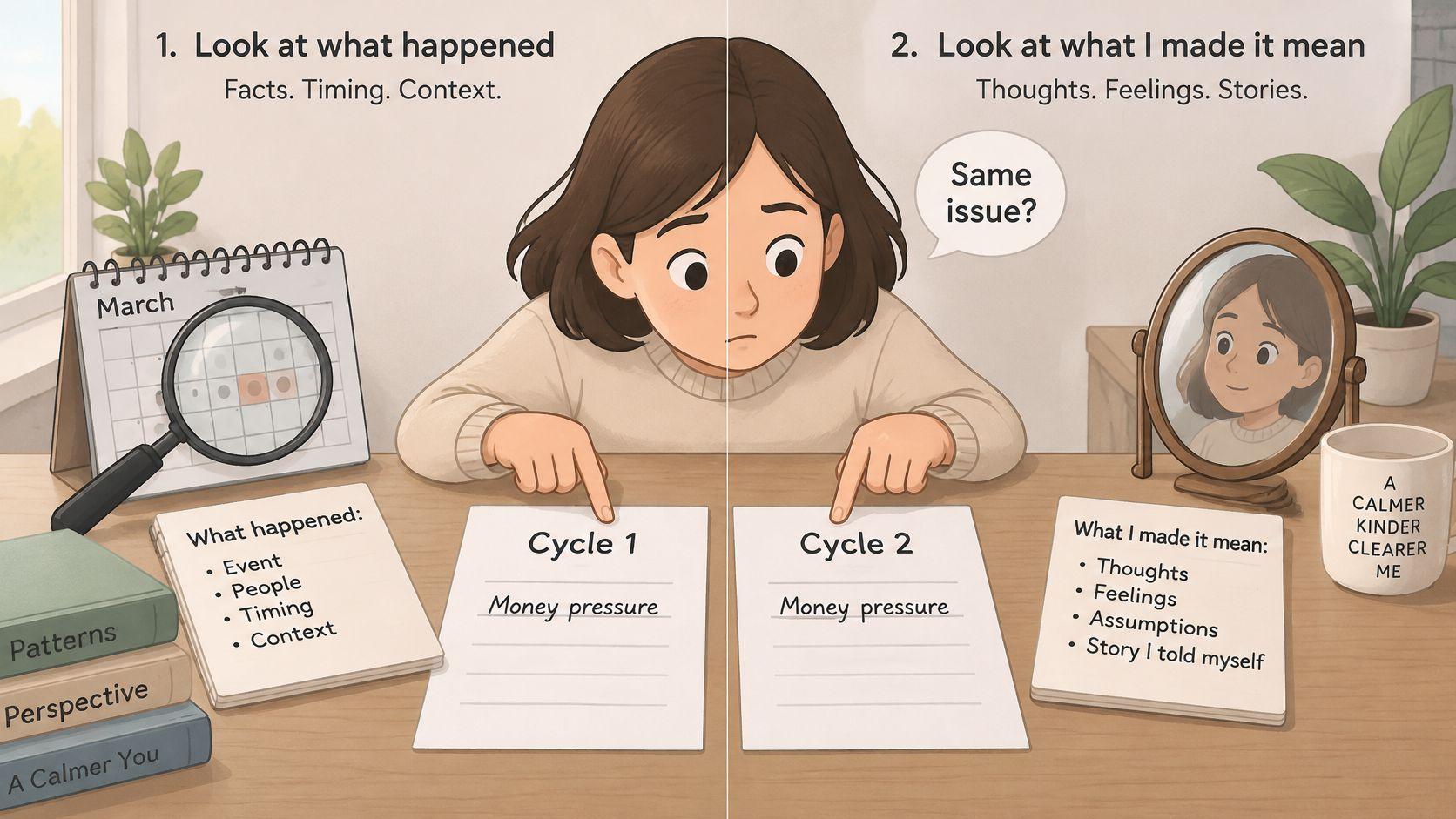
Say you've written "money pressure" in two separate cycles, years apart, and you want to know whether it's the same issue wearing different clothes. That question is the reason the earlier cycle entry field exists, and it's the question a single-entry worksheet can't answer.
The worksheet separates two tasks that people usually blur. First you record the cycle information. Then you reflect on how recurring patterns, timing, and personal responsibility relate to that cycle. The indexed contents of The Life You Were Born to Live on Google Books list "The Law of Cycles" as a named section, with nine-year cycles appearing later in the book, so this reflection stays tied to a specific framework rather than drifting into general goal-setting.
Three labels for sorting entries
Give each area one of three labels. A recurring pattern means the same issue shows up in the same area as an earlier cycle. A shift means the same area, different issue. An exception is an entry that fits neither, including one with no earlier record to compare against.
| Life area | Earlier cycle entry | Current cycle entry | Label |
|---|---|---|---|
| Money | Postponed a debt repayment | Still postponing the same debt | Recurring pattern |
| Career or livelihood | Left a job search unfinished | Choosing a new training path | Shift |
| Health | Ignored a sleep problem | No earlier entry in this area | Exception |
These labels are interpretive tools, not verdicts. EPA guidance on life-cycle inventory documentation warns against treating estimated values as measured facts, and the same discipline applies here: what you recorded happened is a fact, and the label you attach is a judgment. Note a pattern even when it doesn't repeat exactly, and write down what's different about this round.
Readers who also follow Vedic astrology sometimes want a second timing lens alongside this one, and the explanation of why Saturn matures a life offers a different tradition's view of long developmental arcs. Keep any such comparison in a separate notes line so it doesn't get mixed into your recorded entries. The collection of life cycle questions can help you phrase the reflection half of the page.
A repeated pattern is information to act on, not proof that a future is fixed.
Common Worksheet Mistakes and How to Fix Them
Most readers arrive here with a school habit in their hands. The Education.com life-cycle worksheet collection has 53 resources covering plants, animals, and insects, where the task is to sequence stages, label diagrams, and paste pictures in order. That habit transfers badly. A nine-year cycle is a reflection frame, so you describe themes and decisions, not stages.
| Mistake | What it looks like | Fix |
|---|---|---|
| Treating the cycle as a prediction | Entries read like forecasts, such as "this year will bring a new job" | Write the cycle as a lens and log outcomes separately |
| Skipping the date check | Cycle year copied from memory or a friend's chart | Re-check the cycle year in the app and in the book |
| Vague current issue | Entry says "work is stressful" | Name one decision, person, or habit |
| Filling in only once | Only the first cycle is recorded | Set a review date and reuse the same layout |
| Copying biology habits | Entries use stage labels like egg, larva, adult | Describe themes and decisions, not stages |
| Recording only confirmations | Every entry fits the expected pattern | Log one exception per cycle |
Tidy diagrams cause trouble even in biology. A 2024 study reported by NC State University found that 30% of participants who saw a traditional diagram showing a single offspring incorrectly inferred that all offspring survive to adulthood. A clean circle implies a certainty the content doesn't support, which is exactly what happens when a worksheet implies your development is perfectly cyclical.
Three checks keep entries honest:
- Write the review date the same day. Not later, not "sometime next year." The date goes in while the notebook is open.
- Log one exception per cycle. Even when most entries fit the expected theme, find the one that didn't and record it.
- Keep a line for what you didn't expect. Surprises are the entries you'll want most at the next review.
The earlier cycle entry is the field people leave blank most often, and blanking it removes the only comparison the worksheet is built for. A page with a few honest entries beats a stack of polished ones.
Start Your First Worksheet This Week
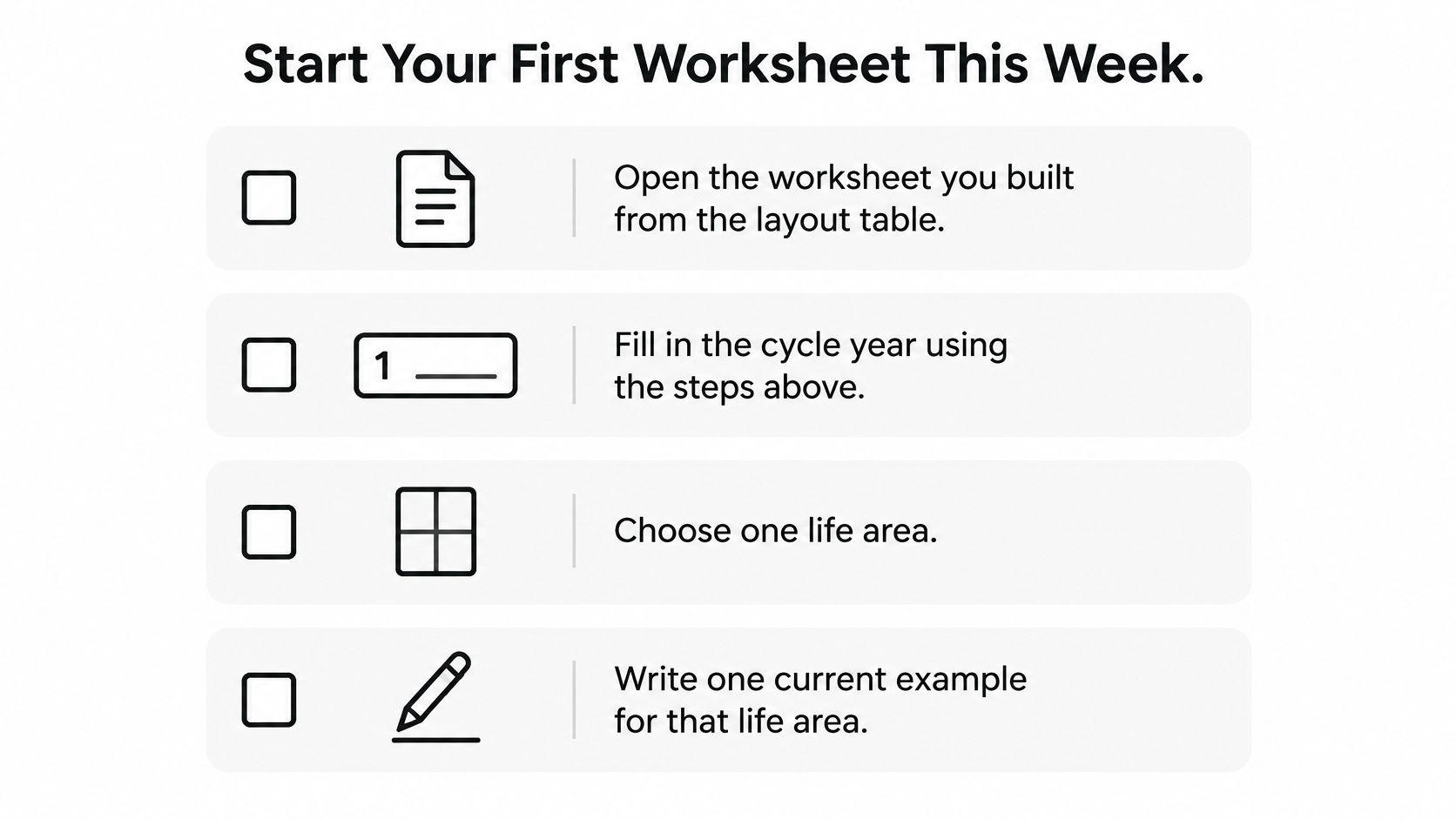
Do this in one sitting, tonight if you can. Open the worksheet you built from the layout table, fill in the cycle year using the steps above, choose one life area, and write one current issue in a single sentence. Twenty minutes is plenty.
If you have no earlier record, leave the earlier cycle entry blank and mark it as a gap to fill later. Don't invent a memory to complete the row. An honest gap tells you something about your record-keeping; a fabricated comparison poisons every future review. Then set the review date for your next change of cycle year and put it in your calendar before you close the notebook.
If health is your chosen area, the entry gets sharper when it names a routine rather than a feeling, and this guide on how to plan a healthier daily routine is a practical companion for turning "low energy" into something you can track week to week.
What this worksheet claims, and what it doesn't
The reference for the nine-year cycles is Dan Millman's The Life You Were Born to Live. The revised 25th Anniversary Edition listing at Target describes a modern life-purpose method based on ancient wisdom, covering life paths, spiritual laws, livelihood, relationships, and nine-year cycles, and notes that his books have been published in 29 languages.
We built the Life Purpose App as a companion to that 25th edition. A basic version is free and will always remain free, while the paid version includes the complete text of the 25th Anniversary Edition, which the free version doesn't include. Both the book and the app present an interpretive system of insight and purpose-finding, not a scientifically validated forecasting method. Your worksheet inherits that boundary. It records where you stand and what you're facing, and it invites a reading, not a prophecy.
Write the first entry before you read the next chapter.
The Life Purpose App maps your nine-year cycle and shows how to make the most of the year you're in, alongside the life-path material on health, money, sexuality, career, and relationships that gives your worksheet its five areas. Enter your date of birth, note your current cycle year, and write your first entry against it tonight, then set the review date so the comparison is waiting for you next time. Visit the Life Purpose App to find your position in the cycle and start the page.
Discover your life path today
Enter your date of birth and see your life path, free.
Find your life path