Explore the life cycles Christine DeLorey model for self-discovery. Learn to navigate your 9-year cycles and align with your path using this practical guide.
June 19, 2026 (1mo ago) — last updated June 28, 2026 (28d ago)
Life Cycles Christine DeLorey: A Guide to Your Path
Explore the life cycles Christine DeLorey model for self-discovery. Learn to navigate your 9-year cycles and align with your path using this practical guide.
← Back to blog
Some years feel like a long uphill climb. Other years open doors without much forcing at all. You may have noticed this in your own life. One stretch brings motion, confidence, and fresh ideas. Another asks for patience, repair, and quieter choices.
That pattern is part of why people look for systems that help life make sense.
Regarding Life Cycles Christine DeLorey, the focus is often not on abstract spiritual theory. Instead, individuals seek to understand why the same effort feels easy in one season and heavy in another. They want a framework that helps them respond with less self-judgment and more clarity.
Christine DeLorey's Life Cycles speaks to that need. Her work is presented as a year-by-year, month-by-month guide built around Yearly Cycles, Monthly Cycles, and Destiny Path numbers, according to the book listing on Creative Numerology's store page. That matters because it gives readers something more structured than a one-time personality reading. It offers a rhythm.
If you already know Dan Millman's The Life You Were Born to Live, you may recognize a similar appeal. Both systems invite self-study through numbers and patterns connected to your date of birth. Millman's work helps readers reflect on purpose and life themes. DeLorey's approach helps readers think about timing, momentum, and emotional weather.
The most helpful way to use this kind of material is gently. Not as prophecy. Not as proof that every event was 'meant' to happen in exactly one way. More as a reflective calendar. A way to ask better questions when life feels confusing.
Introduction to Your Personal Seasons
A lot of people come to cyclical systems after a frustrating moment. They've been pushing hard at work, trying to heal a relationship, or forcing a decision that refuses to settle. Then they look back and realize the year has had a distinct mood. Not just one event, but a tone.
That's a useful starting point.
Think of personal cycles the way you think of seasons. Spring doesn't demand the same things as winter. In the same way, one period of life may support initiation, while another seems to reward patience, cleanup, or emotional honesty. If you expect every month or year to feel equally productive, you can end up fighting your actual circumstances.
When life feels out of sync
A reader might say, "Nothing is wrong, exactly. I'm just slower than I was last year." Another might notice that relationships suddenly take center stage after a period dominated by career ambition. These shifts can feel random if you don't have a framework for them.
DeLorey's work gives readers a language for those shifts. Her book is described on Goodreads as a “year-by-year, month-by-month guide to the rest of your life,” which points to a long-range model rather than a single snapshot reading. That kind of structure can be comforting. It suggests that a difficult period may still have shape and meaning, even if it doesn't feel pleasant.
Some seasons are for building. Some are for waiting. Some are for letting go without panic.
A practical lens, not a rigid script
Many readers get confused. They hear “cycle” and assume prediction. Then they worry that a difficult cycle means a bad year, or that a supportive cycle guarantees success. That's not the wisest way to work with symbolic systems.
A better approach is to treat cycles as context. If a period emphasizes cooperation, you might focus on listening, timing, and relationship repair. If a period emphasizes completion, you might stop forcing brand-new commitments and instead finish what's already on your plate.
Used this way, life cycles can reduce friction. They don't erase free will. They help you notice the kind of effort a season seems to welcome.
The Foundations of Creative Numerology
A helpful way to approach Christine DeLorey's work is to see it as a map of timing. If Dan Millman's system helps you explore the deeper lessons you came here to learn, DeLorey's cycles help you notice the season those lessons are moving through.
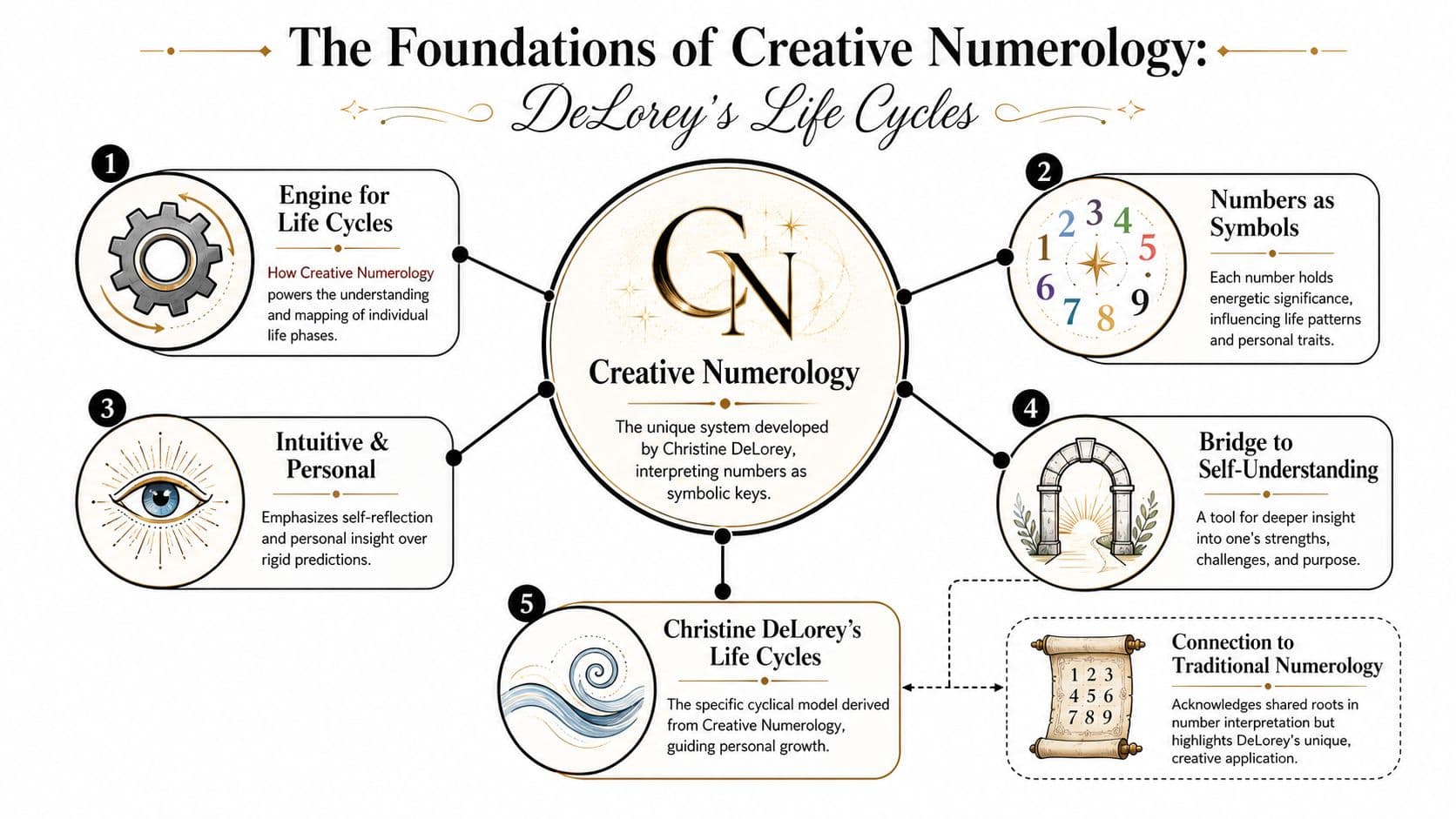
Her broader method, often called Creative Numerology, treats numbers as symbols for recurring patterns in human experience. The focus is not fixed fate. The focus is rhythm. People often find that distinction relieving, especially if they are curious about spiritual tools but do not want to hand over their judgment to them.
What makes this system distinct
Many readers start with broad number meanings, then wonder why that knowledge still feels abstract in real life. DeLorey adds another layer. She pays close attention to timing, so the question becomes not only who you are, but what kind of period you are living through. That framing can feel like a calendar for self-reflection. A personality-oriented system may describe your enduring tendencies. A cycle-based system asks whether this is a period for initiative, patience, expression, structure, or release.
How this relates to Dan Millman's work
This comparison helps many Life Purpose App readers.
Millman's framework is often used to reflect on core lessons, life purpose, and the long arc of personal growth. DeLorey's framework can sit beside it and answer a different kind of question. It helps you ask, 'How is this lesson showing up right now?'
You might put it this way:
- Millman helps you reflect on the curriculum.
- DeLorey helps you notice the current semester.
- Together they offer a practical way to connect purpose with timing.
Used carefully, this keeps both systems grounded. You are not trying to predict every event. You are checking whether a season seems to favor beginning, maintaining, relating, questioning, or completing.
Why readers find it grounding
Creative Numerology can be useful because it gives spiritual reflection a structure you can test against ordinary life. If a cycle suggests patience, you can look at your calendar, your energy, your relationships, and your unfinished tasks and ask, 'Does that fit?' If it does, the idea may help you choose your pace more wisely. If it does not, you are allowed to set it aside.
That is an important point.
DeLorey's cycles work best as prompts for awareness, not commands. They can help you name patterns, reduce self-blame, and choose responses with more care. They do not replace common sense, responsibility, or free will.
Mapping Your Nine-Year Cycle
DeLorey's framework is built around repeating annual themes. The clearest verified detail is that her model uses a recurring 12-month cycle framework, and her “2 Year” page defines that cycle as a twelve-month journey focused on relationship-building and slow, incremental progress, as described on the Creative Numerology 2 Year cycle page.
Many readers also connect this kind of annual rhythm with the broader idea of numerology. Even if you're new to this, you don't need to memorize every nuance at once. Start with the emotional tone of each year.
The 9 yearly life cycles at a glance
| Yearly Cycle | Primary Theme |
|---|---|
| 1 Year | New beginnings, initiative, fresh direction |
| 2 Year | Patience, connection, cooperation |
| 3 Year | Expression, communication, creativity |
| 4 Year | Structure, discipline, steady effort |
| 5 Year | Change, movement, flexibility |
| 6 Year | Responsibility, care, home, commitment |
| 7 Year | Reflection, inner work, understanding |
| 8 Year | Power, results, material focus, accountability |
| 9 Year | Completion, release, emotional closure |
Reading the cycle as mood, not command
These descriptions work best as broad themes.
A 1 Year often feels like a threshold. People may feel ready to try something new, define themselves differently, or begin a chapter that had been waiting in the background.
A 2 Year is the one we can speak about most concretely from the verified material. DeLorey describes it as a twelve-month period centered on connection, partnership, patience, cooperation, and gradual progress. That makes it a helpful example of how her system works. Not every year is about speed.
A 3 Year often invites expression. Some people feel more social. Others find themselves writing, speaking, or rediscovering play.
A 4 Year tends to feel practical. It's often easier to notice what needs organization, boundaries, and consistency.
The middle years of the cycle
A 5 Year usually carries movement. This can show up as external change, restlessness, or a desire to break stale routines.
A 6 Year often turns attention toward responsibility and care. Family, home, commitment, and service may ask for more presence.
A 7 Year can feel quieter. People often describe it as a time of study, introspection, solitude, or spiritual searching.
If your outer life slows down during a reflective year, that doesn't mean you're failing. It may mean your work has moved inward.
The closing stretch
An 8 Year is often associated with consequence, capability, and material focus. It can bring questions about leadership, money, or how you use influence.
A 9 Year is usually read as a period of completion. Many people experience it as emotional sorting. What is ending? What no longer fits? What deserves gratitude before release?
Readers sometimes get tripped up here and think they must manufacture change to match the theme. You don't need to do that. Let the cycle help you notice what's already ripening in your life.
Applying Life Cycles to Your Daily Life
The most useful question isn't, “What will happen to me this month?” It's, “How can I respond wisely to the season I'm in?”
That shift changes everything.
Goodreads material around Life Cycles highlights an important challenge for readers. A cycle should be used as a decision aid, not a deterministic forecast, and one of the most honest questions a reader can ask is, “When a monthly cycle says one thing but my life says another, which should I trust?” You can find that framing on the Goodreads page for Life Cycles. The healthiest answer is simple. Trust reality first, and use the cycle as a reflective lens.

A grounded way to work with a cycle
Try this simple practice at the start of a month:
- Name the theme: Write down the yearly theme you believe you're in.
- Check your real life: Note what's happening in work, health, relationships, and energy.
- Look for overlap: Ask where the symbolic theme and lived experience support each other.
- Ignore pressure: If the cycle language creates fear or grand expectations, set it aside.
This makes the system more humane.
For example, if you believe you're in a change-oriented phase but you're also exhausted, the lesson may not be 'make dramatic moves now.' It may be 'change your pace, your boundaries, or your habits.' For someone dealing with stress, practical support like burnout prevention strategies may be more important than any symbolic interpretation.
Journaling prompts that actually help
Pick one prompt and stay with it for a week.
- For a beginning phase: What new direction feels alive, even if I'm not ready to announce it?
- For a patience phase: Where would gentler timing help more than force?
- For a completion phase: What am I carrying out of habit, not truth?
- For a reflective phase: What am I learning from this quieter period that noise would hide?
Use the cycle to ask better questions. Don't use it to argue with your own experience.
What cycles can and can't tell you
They can suggest a theme. They can support reflection. They can help you notice why certain tasks feel aligned and others feel strained.
They can't replace therapy, medical care, financial judgment, or honest conversations. They can't guarantee outcomes. They can't tell you that staying in a harmful situation is spiritually required because 'the numbers say so.'
That boundary matters. It keeps spiritual practice rooted in care.
DeLorey's Cycles and Other Life-Path Systems
People rarely use only one system for self-understanding. Some turn to journaling. Some to therapy. Some to contemplative practice. Others are drawn to symbolic systems such as numerology because they offer language for patterns that are hard to explain any other way.
Life Cycles Christine DeLorey fits well alongside Dan Millman's The Life You Were Born to Live.
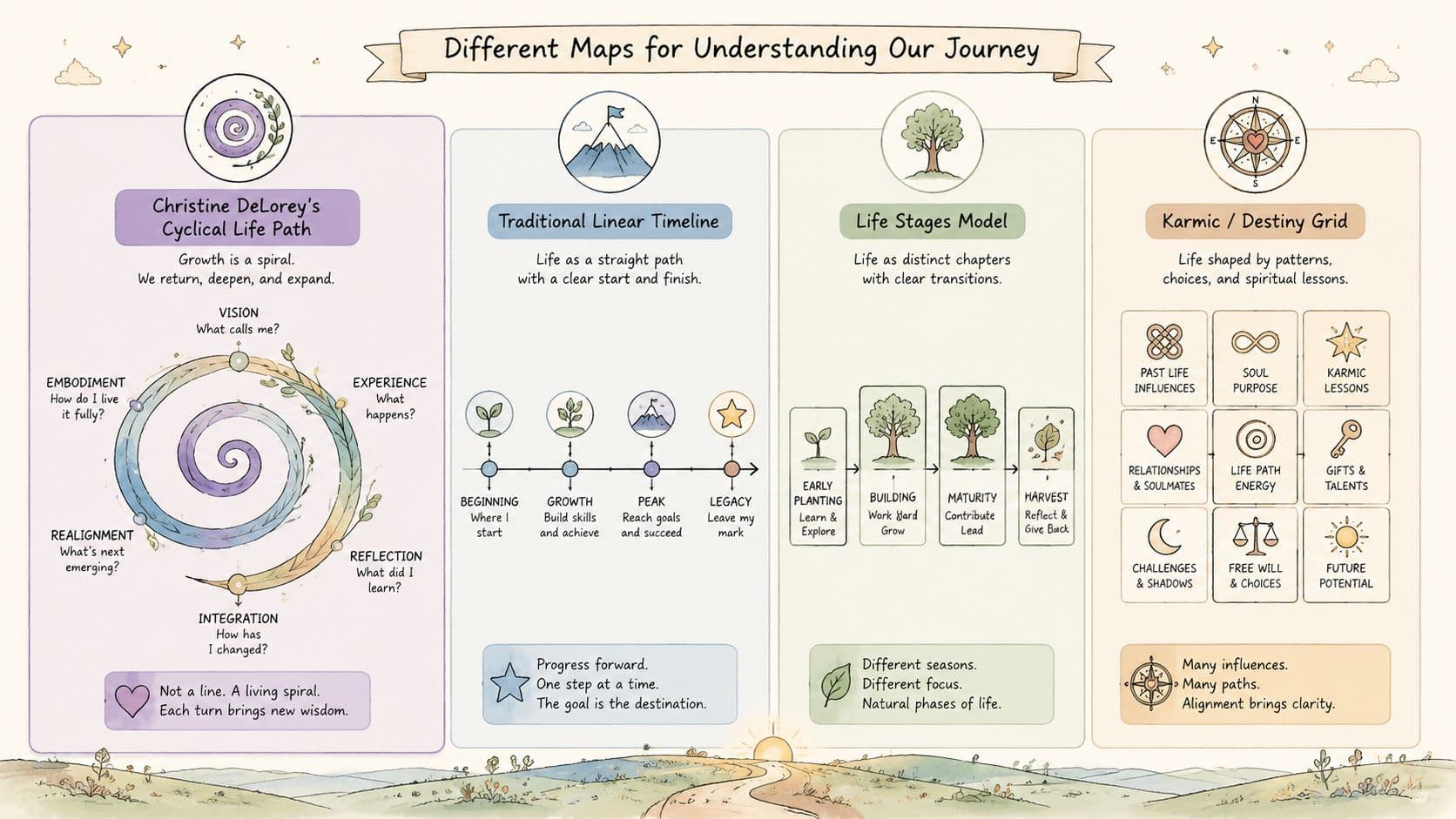
One focuses on purpose, one focuses on timing
Millman's book is widely known for helping readers reflect on their life path, core lessons, and spiritual growth through a date-of-birth based framework. People often return to it when they want to understand why certain challenges keep repeating, or what deeper capacities they're here to develop.
DeLorey's system asks a different question. It looks less at the lifelong architecture of your path and more at the season you're currently walking through.
A simple comparison helps:
| System | Best used for |
|---|---|
| Dan Millman's The Life You Were Born to Live | Reflecting on purpose, lessons, and enduring traits |
| Christine DeLorey's Life Cycles | Reflecting on timing, periods, and recurring yearly themes |
Why they work well together
If Millman gives you the inner map, DeLorey gives you a calendar.
That pairing helps readers avoid a common mistake. Sometimes people discover a meaningful life-path insight and then expect themselves to embody it in a constant, unchanging way. But human growth isn't steady. Even clear purpose moves through waves, pauses, and resets.
A compassionate way to bridge the two
Say someone learns through Millman's work that they're here to cultivate courage, service, discipline, or emotional honesty. DeLorey's cycles can then help them ask, 'What does that lesson look like in this particular season?'
Maybe courage this year means bold action. Maybe next year it means patience. Maybe another year asks for closure, forgiveness, or trust.
The same life lesson can wear different clothing in different seasons.
That's why these systems don't have to compete. One can help you understand the larger path. The other can help you walk it with better timing and less force.
Common Questions About Life Cycles
What if my experience doesn't match my supposed cycle
This happens often. It doesn't mean you did anything wrong.
A cycle is best treated as symbolic guidance, not a test you're failing. If the theme doesn't fit, pause and get curious. You may be interpreting the cycle too directly. Or your current circumstances may require a more grounded response than the symbolic language suggests.
If your real life and the cycle reading conflict, trust your real life first. Then ask whether the cycle might still describe an inner process rather than an outer event.
Is this different from astrology
Yes, though both try to describe patterns and timing.
Astrology typically works through planetary symbolism and charts. DeLorey's work uses a numerology-based cycle model tied to time periods and personal interpretation. Some people resonate more with one than the other. Some use both. The important part isn't which system sounds more mystical. It's whether the system helps you reflect and act responsibly.
Can I calculate my cycle myself
Many readers like to calculate for themselves, and some prefer books, websites, or apps that do the math for them.
The deeper challenge usually isn't calculation. It's interpretation. People often want a definitive answer when the wiser move is to sit with the theme, compare it to lived experience, and notice what unfolds over time. A journal is often more useful than a quick prediction.
Does a hard cycle mean something bad is coming
Not necessarily.
A demanding cycle may ask for patience, endings, responsibility, or deeper self-examination. That can feel uncomfortable, but discomfort isn't the same as doom. Some of the most meaningful personal growth happens during periods that don't feel easy.
The healthiest stance is steady and practical:
- Stay observant: Notice patterns without dramatizing them.
- Stay flexible: Let the cycle inform your choices, not trap them.
- Stay supported: Bring in trusted help when life gets heavy.
- Stay honest: If a framework increases fear, step back from it.
You don't need perfect certainty to benefit from symbolic work. You need self-respect, curiosity, and the willingness to test insight against reality.
If you want a practical companion for exploring life paths through Dan Millman's The Life You Were Born to Live, the Life Purpose App offers a simple way to study your path, reflect on recurring lessons, and work with cycle-based insight in everyday life. It's a helpful next step if you're looking for a more guided way to connect self-discovery with daily decisions.
Discover Your Life Purpose Today!
Unlock your true potential and find your life’s purpose.
