Wondering if life has purpose? Explore what purpose means, how to recognize it, and practical ways to find direction with insights from Dan Millman.

September 13, 2026 (1mo ago)
Life Has Purpose How to Find Your Direction Today
Wondering if life has purpose? Explore what purpose means, how to recognize it, and practical ways to find direction with insights from Dan Millman.
← Back to blog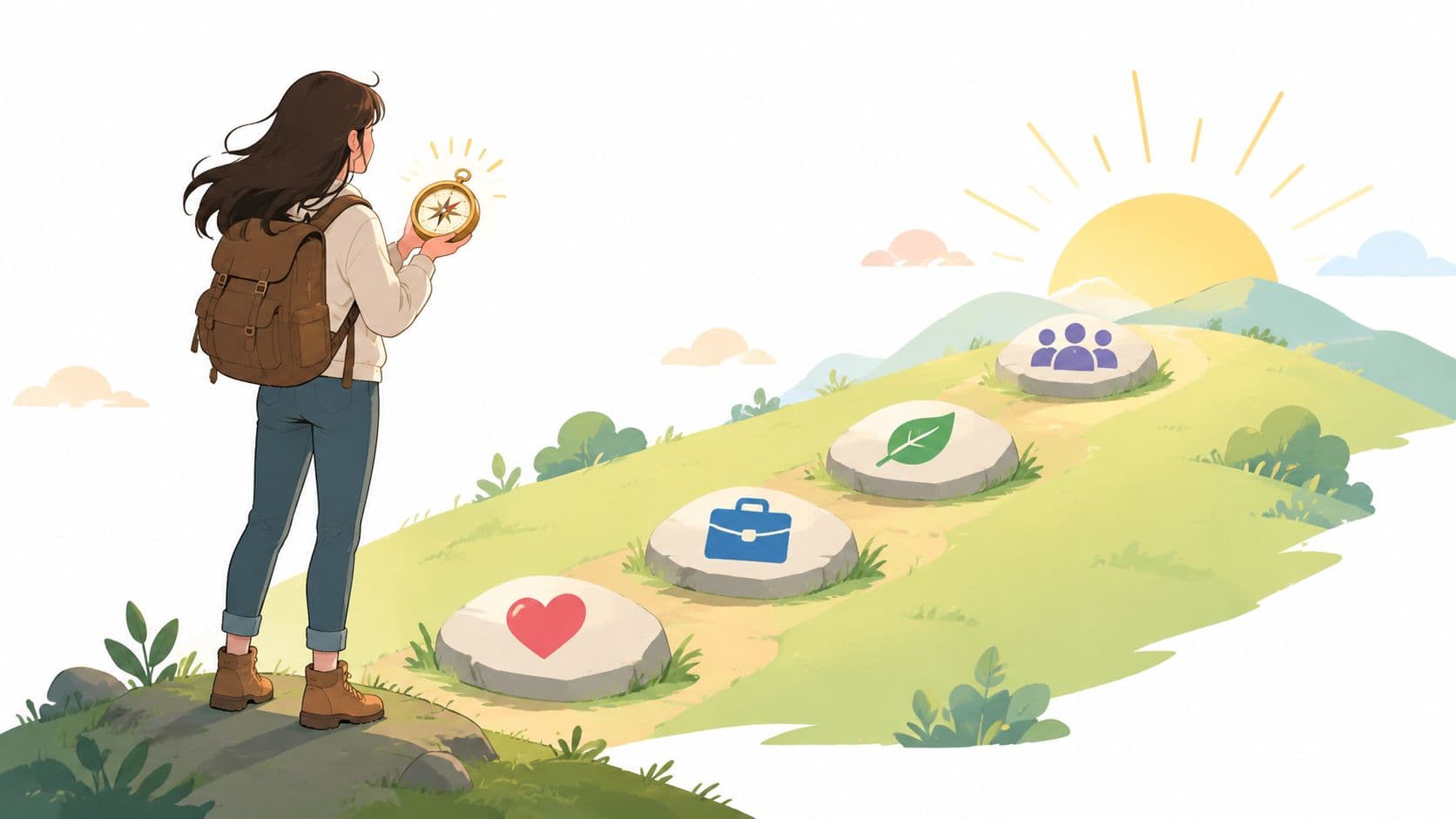
Wondering if life has purpose? Explore what purpose means, how to recognize it, and practical ways to find direction with insights from Dan Millman.
Have you ever wondered whether the problem is that your life has no purpose, or that you've been taught to look for purpose in the wrong place?
Many people expect direction to arrive as one dramatic answer. They imagine a perfect career, a single calling, or a moment of certainty that makes every difficult choice simple. Meanwhile, ordinary life keeps asking quieter questions. Who needs your care? What work feels worth doing? Which relationships help you become more honest? What kind of person are you becoming through repeated choices?
Purpose often begins there.
A life can feel empty even when it looks successful from the outside. Someone may have a job, responsibilities, and a full calendar, yet still wonder whether any of it matters. Another person may be in a season of uncertainty but feel connected because they're supporting a loved one, learning a meaningful skill, or serving a community.
This guide treats purpose as something you can recognize, test, and build. It brings together evidence about the everyday sources of meaning, a practical lens from Dan Millman's The Life You Were Born to Live and the Life Purpose App, and simple ways to notice whether your daily choices point in a meaningful direction.

The question isn't whether you can discover one permanent mission. It's whether you can identify the values, relationships, abilities, and forms of contribution that make your life feel coherent, then express them through the next choice in front of you.
Introduction Why Asking If Life Has Purpose Matters Now
A young professional closes a laptop after another long day and notices an uncomfortable silence. Nothing is obviously wrong. The bills are paid, messages have been answered, and tomorrow is already scheduled. Still, the question returns: “What am I doing all this for?”
That question doesn't mean someone is ungrateful. It may mean their activities aren't connected to a direction they recognize as their own. Purpose gives effort a context. Without it, even progress can feel like motion without a destination.
The phrase life has purpose can sound comforting, but comfort alone isn't enough. You need a definition that helps you make decisions. You also need a way to examine your life without turning the search into another performance, where you feel pressured to produce a grand answer immediately.
A useful starting point comes from the Pew Research Center's study of meaning in life. Conducted from February 1 to May 26, 2021, the survey interviewed 18,850 adults across 17 advanced economies. Family was the dominant source of meaning, with a median of 38% mentioning immediate or extended family, children, grandchildren, parenthood, or other family ties. In 14 of the 17 publics, family ranked above every other source of meaning. Work also mattered, with a median of 25% citing a job, career, or profession.
Those findings make purpose feel less abstract. People often locate meaning in relationships, work, health, and stability, the very areas where daily decisions happen.
Purpose doesn't have to begin with a life-changing revelation. It can begin with noticing what you already treat as worth protecting, practicing, or offering.
The pages ahead move from definition to application. You'll clarify what purpose is, see how Dan Millman's system organizes life-path reflection, examine the domains where people commonly find meaning, and use small daily experiments to discover which directions create a stronger sense of contribution and coherence.
What It Means When We Say Life Has Purpose
Purpose is easier to understand when you separate it from nearby ideas. A goal is an outcome you want to reach, such as finishing a qualification or changing jobs. Motivation is the energy that helps you act today. Happiness is an emotional experience that can rise and fall. Purpose is the deeper orientation that helps you decide which goals deserve your time.
Think of purpose as a compass, not a map. A map can tell you exactly how to reach a destination. A compass can help you choose a direction when the road changes, visibility drops, or the original route disappears. Purpose doesn't remove uncertainty. It helps you respond to uncertainty without abandoning what matters most.
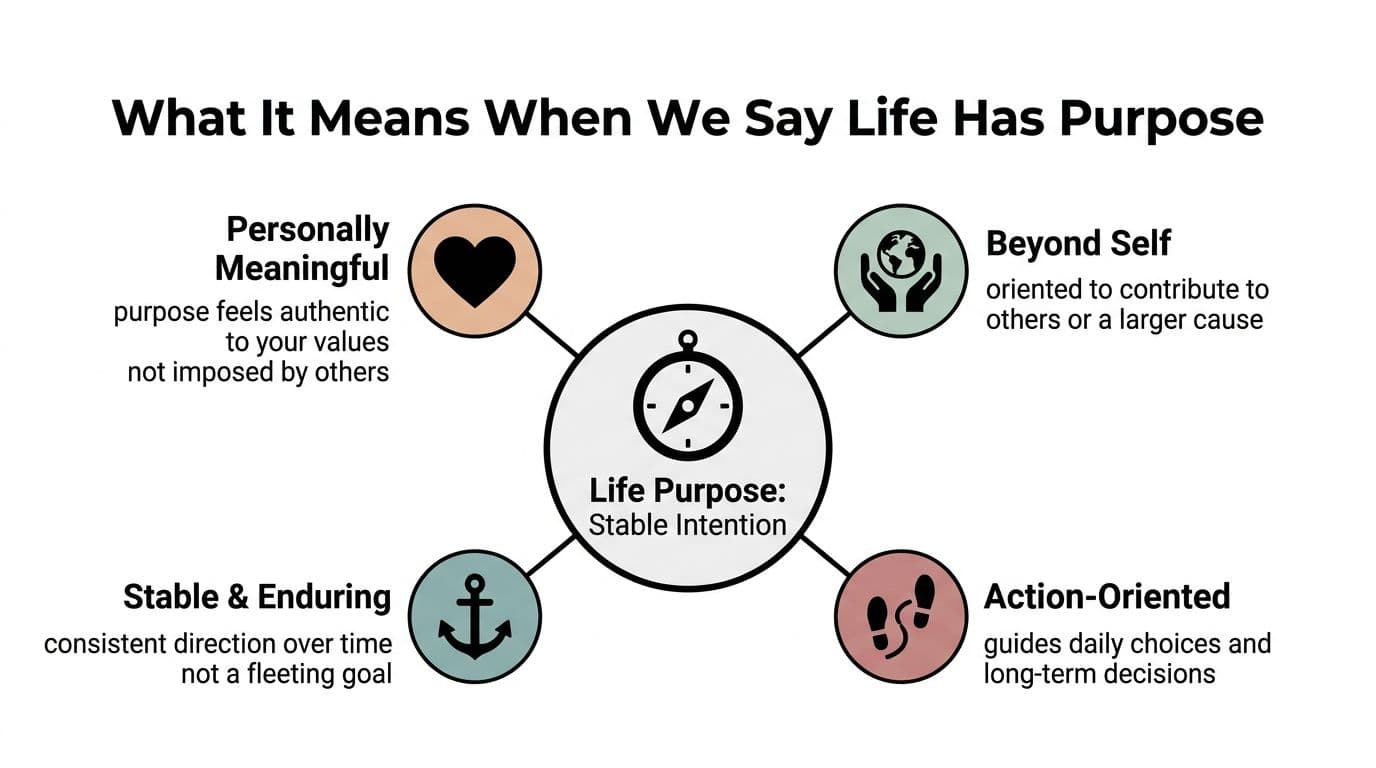
Psychology commonly describes purpose as a stable, goal-oriented intention that feels personally meaningful and reaches beyond the self. That definition contains several ideas that are easy to miss.
A working definition: Purpose is a personally meaningful and relatively enduring direction that guides action toward something larger than immediate comfort.
First, purpose needs personal meaning. A direction borrowed from family, culture, or social media may look impressive but still feel hollow. Second, purpose has some stability. It doesn't vanish every time your mood changes, although its expression can develop as your circumstances change.
Third, purpose points beyond the self. That doesn't require heroic sacrifice or a public mission. Raising a child, creating useful work, caring for a friend, mentoring someone, or improving a local community can all connect personal effort with another person's wellbeing.
Finally, purpose becomes visible through action. If a value never affects your calendar, relationships, spending, or choices, it may be an ideal rather than an active purpose.
Purpose is not a demand for certainty
People often ask whether they need to identify one calling and follow it forever. That question assumes purpose behaves like a hidden object waiting to be found. A more practical view treats it as a pattern. You notice recurring concerns, abilities, relationships, and forms of service, then make choices that strengthen the pattern.
A person whose purpose includes teaching might express it through parenting, technical leadership, writing, or community work. The role can change while the underlying direction remains recognizable.
The numerology explanation connected with Dan Millman's system provides an accessible starting point for readers who want to understand how these themes are organized.
Start with the birth date
The birth date acts as the input. The system applies a precise calculation to identify a life path, then connects that path with themes for reflection. The result isn't meant to dictate every decision. It gives you a set of possible patterns to compare with your actual life.
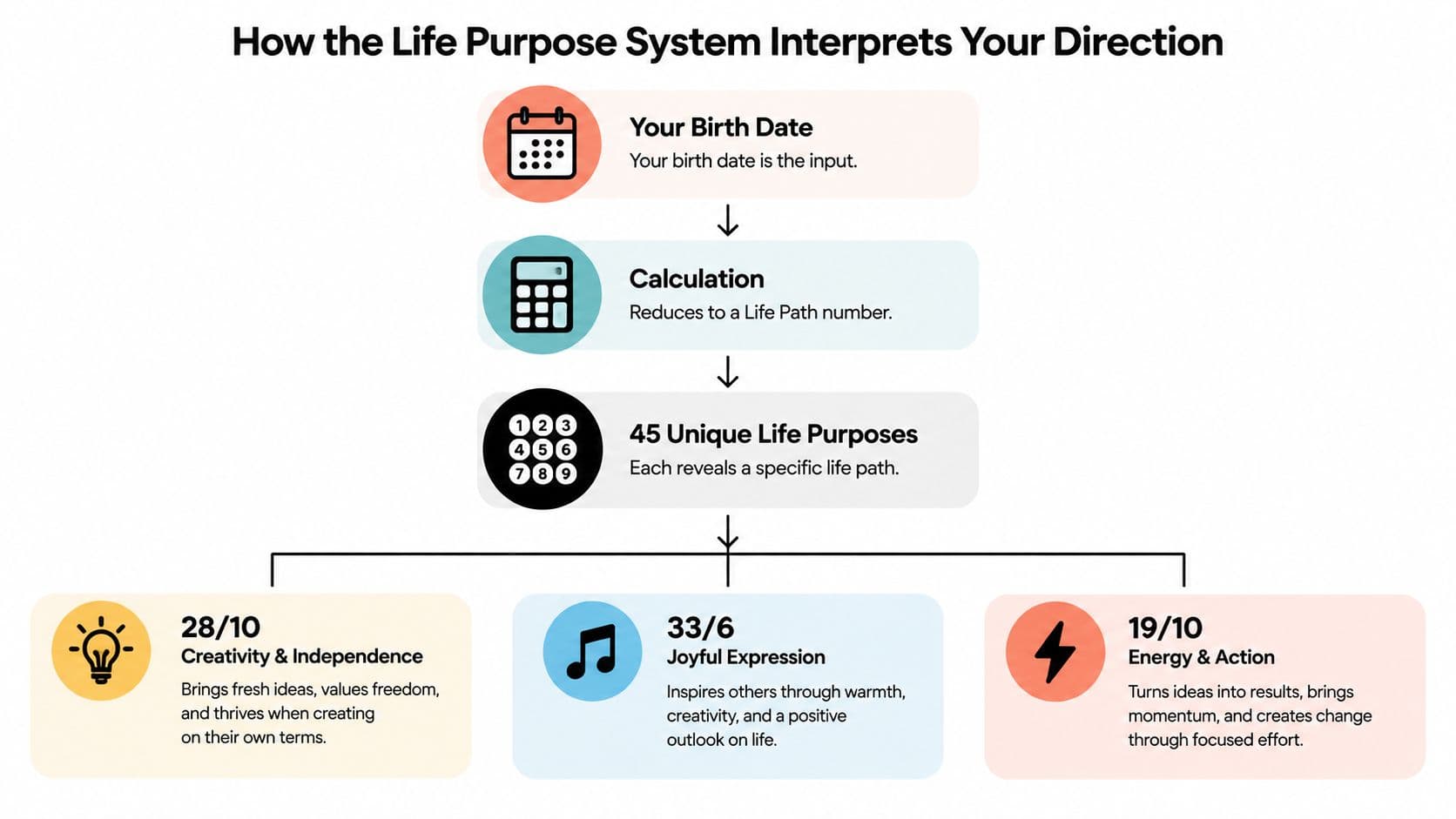
Millman's book describes each path through core issues, innate talents, and special needs connected with areas such as health, money, sexuality, career, and relationships. That range matters because direction rarely appears in work alone. A career may express your abilities, while relationships reveal your lessons, health exposes your limits, and money tests how you value security or freedom.
The numerology explanation connected with Dan Millman's system provides an accessible starting point for readers who want to understand how these themes are organized.
Use the themes as questions
After identifying a path, read the material as a prompt for honest comparison. Which descriptions resemble patterns you've observed? Which ones feel inaccurate? Where do you repeatedly experience tension between an ability and a responsibility?
The Life Purpose App serves as a digital companion to The Life You Were Born to Live. It provides a life-path summary and system overview, with additional access to the complete text from the 25th Anniversary Edition, detailed analyses, contacts, relationship dynamics, and cycle information depending on the selected access level.
A useful reading doesn't leave you thinking, “This label explains everything.” It leaves you with better questions, such as:
- Where do I feel naturally useful?
- Which challenge keeps returning until I address it?
- How do my relationships affect the way I express my abilities?
- What would this theme look like in a small action this week?
That is the practical value of a system. It turns a broad search for meaning into a conversation between a symbolic framework and your lived evidence.
Where People Actually Find Purpose in Everyday Life
Purpose tends to live in familiar places. People may describe it in philosophical language, but they often experience it while caring for family, doing useful work, maintaining health, or showing up for friends.
The Pew Research Center survey mentioned earlier offers a clear picture. Across the 17 advanced economies included in the study, a median of 38% named family-related ties as a source of meaning, while a median of 25% named work, careers, or professions. The same research found that health and material wellbeing also ranked highly in many countries. See the full Pew Research Center report on meaning in life for the methodology and country-level findings.
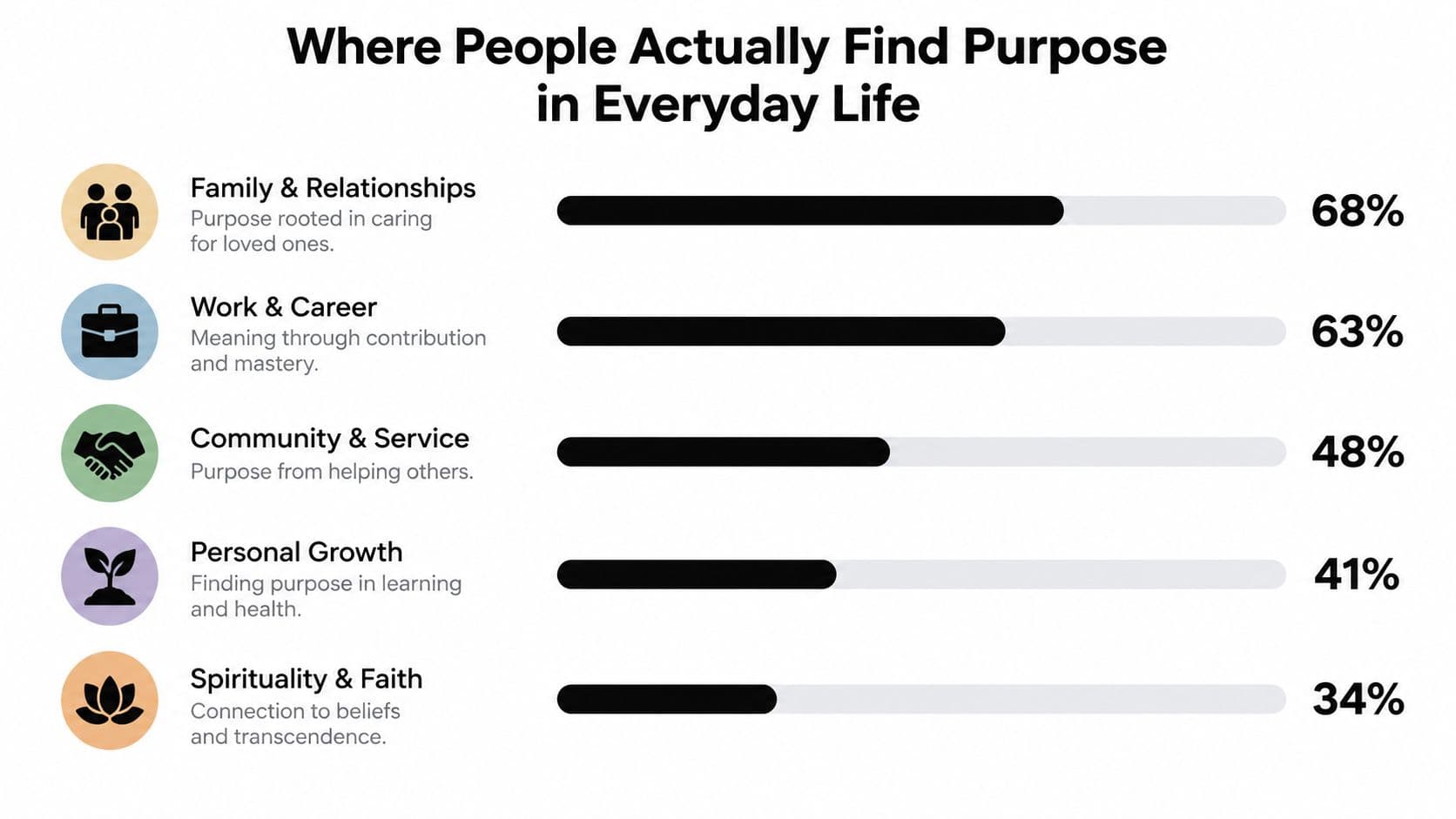
These results challenge the assumption that purpose must be unusual. A parent may find direction in providing stability. A nurse may experience meaning through care. A craftsperson may find it in skill and usefulness. Someone recovering from illness may discover that protecting health becomes a meaningful commitment rather than a background concern.
Read your own life by domain
Try reviewing the main areas of your life without asking whether they look impressive. Ask instead where your attention produces a sense of responsibility, connection, or worthwhile effort.
| Domain | Questions to ask |
|---|---|
| Relationships | Who becomes stronger, safer, or more hopeful because I show up? |
| Work | What problem do I care enough to solve carefully? |
| Health | Which habits help me remain available for what matters? |
| Stability | What resources allow me to support myself and others? |
| Growth | What am I learning that changes how I contribute? |
This exercise can reveal that your purpose is already partly active. You may not need to invent a direction. You may need to name it and give it more room.
For readers who want a more immersive setting for reflection, an independent resource on finding your self discovery retreat can help you think through what to consider before choosing a retreat. Any retreat should be approached thoughtfully, with attention to safety, informed consent, personal readiness, and appropriate professional support.
Values add another layer. A values clarification exercise can help distinguish values you practice from values you admire in theory. That difference is important. Purpose becomes clearer when your chosen direction fits both your convictions and your actual capacity.
Common Misconceptions That Keep Purpose Feeling Out of Reach
The most limiting belief is that purpose must arrive fully formed. Under that assumption, uncertainty becomes evidence of failure. If you don't know your calling, you conclude that you're behind.
A healthier comparison looks like this:
| Common assumption | More useful interpretation |
|---|---|
| Purpose is one permanent calling | Purpose can have a stable direction with changing expressions |
| Purpose must come from a career | Work is one domain, alongside family, health, relationships, and service |
| Purpose should feel inspiring every day | Meaningful commitments can include effort, repetition, and grief |
| You must discover purpose before acting | Action often provides the evidence needed to clarify direction |
| Purpose is only about personal fulfillment | Purpose also involves contribution beyond immediate self-interest |
The psychology literature defines purpose as meaningful, goal-oriented, and oriented beyond the self, but that doesn't require a single occupation or identity. Newer approaches to wellbeing also make room for personal growth and the feeling that what you do is worthwhile. The field is moving away from treating purpose as one existential answer and toward examining how people develop, contribute, and flourish in ordinary life. This broader perspective is discussed in recent work on purpose, personal growth, and flourishing.
Waiting can become a form of avoidance
Suppose you believe you must first feel certain before volunteering, learning, mentoring, creating, or repairing a relationship. You may spend months consuming advice while gathering no new evidence about what actually matters to you.
Purpose works more like a path than a hidden destination. You walk, notice what happens, adjust your pace, and learn which direction creates a durable sense of usefulness. A small commitment can reveal more than a large amount of private speculation.
You don't need complete certainty to take a meaningful step. You need enough clarity to test a direction responsibly.
This approach also protects you from forcing meaning onto a life that doesn't fit. You're allowed to change jobs, revise priorities, leave an unhealthy relationship, or redefine success. A flexible purpose is not a weak purpose. It's one that can survive honest contact with reality.
Practical Signs and Daily Practices That Reveal Meaningful Direction
You can look for purpose without waiting for a mystical feeling. Start with behavior. Your repeated choices often reveal your direction more reliably than the identity you claim.
Watch for these signs:
- Useful contribution: You feel more grounded when your effort improves another person's situation.
- Sustained curiosity: You return to a subject even when learning it requires patience.
- Responsible energy: A task may tire you, but it leaves a sense that the effort was worthwhile.
- Relational alignment: Your direction strengthens trust rather than requiring you to neglect everyone close to you.
- Growing coherence: Health, work, relationships, and personal development begin to support one another instead of pulling in opposite directions.
A practical experiment can take one week. Each evening, record one activity that felt meaningful, one moment when you helped someone, one task that drained you without a clear reason, and one question you want to investigate. After several entries, look for repeated themes rather than judging individual days.
Let cycles support reflection
The Life Purpose App's guide to the numerology nine-year cycle calculates a Personal Year by adding your birth month, birth day, and the current year, then reducing the total to one digit from 1 to 9. It associates the repeating sequence with themes including new beginnings, cooperation, expression, structure, change, responsibility, reflection, power, and completion. You can use these themes as prompts, not predictions.
For example, a year framed around structure might encourage you to examine routines, boundaries, and unfinished commitments. A reflection theme might invite rest, study, or deeper review before you make a major outward push. The point is to ask what kind of attention would serve your life now.
A life purpose guided meditation can offer another quiet way to notice inner signals before turning them into decisions. Keep the practice simple. Sit without your phone, breathe naturally, and ask, “Where can I make a useful contribution today?” Then choose one action small enough to complete.
Meaning grows through repetition. Send the message, keep the appointment, practice the skill, prepare the healthy meal, or offer help without waiting to feel transformed.
Moving Forward With Clarity and Compassion for Your Path
You don't have to settle the entire question of existence before choosing your next step. If life has purpose, that purpose may become visible through the way you respond to the people, responsibilities, abilities, and opportunities already present.
The compass analogy remains useful. A compass doesn't tell you every detail of the journey, and it doesn't guarantee easy weather. It helps you correct your direction when distractions, fear, or other people's expectations pull you away from what matters.
Dan Millman's The Life You Were Born to Live offers one structured lens for examining recurring themes through a birth date, life path, and personal cycles. The Life Purpose App makes that system available in a digital format, but the most important test remains your experience. Does a theme help you notice useful patterns? Does it encourage wiser choices? Does it improve the way you relate to yourself and others?
Evidence also gives purpose practical weight. A four-year longitudinal study of a nationally representative sample of U.S. adults over age 50 found that people in the highest purpose quartile had better later physical, behavioral, and psychosocial outcomes than those in the lowest quartile, including lower risks across several health outcomes and higher life satisfaction. The peer-reviewed study on purpose and health outcomes supports treating purpose as more than a pleasant idea.
A 2026 meta-analysis of 25 samples from the United States, Europe, and Asia found that higher purpose was associated with about a 30% lower risk of earlier mortality, with a meta-analytic hazard ratio of 0.76 and a 95% confidence interval of 0.70 to 0.83. Those findings come from the published mortality meta-analysis. They show an association, not a promise or a personal diagnosis.
Your next step can be modest. Write down the people you care about, the work you return to, the problems you want to help solve, and the habits that keep you available for those commitments. If your search includes education or a spiritually grounded academic setting, you might also explore Discover your academic path as one possible direction for further reflection.
The Life Purpose App offers birth-date-based life-path readings, themes from Dan Millman's The Life You Were Born to Live, relationship insights, and nine-year cycle reflections. Visit the Life Purpose App to explore your themes, then use what you learn as a prompt for one practical act of contribution today.
Discover your life path today
Enter your date of birth and see your life path, free.
Find your life path