Discover the life path 5 meaning through Dan Millman's system. Explore core gifts, challenges, cycles, career, relationships, and how the Life Purpose App
September 2, 2026 (1d ago) — last updated September 2, 2026 (Today)
Life Path 5 Meaning: Gifts, Challenges, and What It Reveals
Discover the life path 5 meaning through Dan Millman's system. Explore core gifts, challenges, cycles, career, relationships, and how the Life Purpose App
← Back to blog
You're staring at a packed suitcase in the hallway. Part of you wants to accept the job in another city, learn a different rhythm, and meet people you don't know. Another part is thinking about the lease, the relationship, the unfinished project, and the quiet comfort of staying put. That tug between movement and commitment is often where Life Path 5 meaning becomes personal.
In Dan Millman's The Life You Were Born to Live, the number 5 isn't just a label for a carefree wanderer. It describes a freedom-centered path that asks you to experience life widely, then develop enough discipline to turn those experiences into wisdom. The Life Purpose App offers a practical way to explore that system through your birth date, life cycles, and relationship patterns.
What Life Path 5 Reveals About You
A Life Path 5 person may look perfectly ordinary from the outside. They might be the dependable colleague, the affectionate partner, or the friend who always appears ready with a new idea. Inside, though, they often feel a strong need for variety, learning, movement, and direct experience.
Dan Millman describes the number 5 through freedom, independence, and the ability to see things from different angles. That combination gives the path its appeal. You may understand several sides of an argument, adapt quickly when plans change, and feel energized by unfamiliar places or people. A repetitive environment can feel less like security and more like a narrowing room.
The inner question behind the restlessness
The important question isn't, “How can I escape?” It's, “What kind of freedom am I trying to create?”
A Life Path 5 may change jobs because the current role has become too restrictive. That change could be wise. The same person might also leave just as a valuable skill is beginning to develop, then repeat the pattern in the next position. The outer action looks similar, but the inner motivation differs. One choice comes from conscious growth, while the other may come from discomfort with staying long enough to gain depth.
Millman's framework gives language to that difference. The path involves a recurring movement between dependence and independence, comfort and risk, and variety and focus. You're not meant to eliminate one side. You're learning how to hold both without letting either control every decision.
Why freedom needs direction
Think of freedom as water. Without a channel, it spreads everywhere. With a channel, it can irrigate a field, turn a wheel, or carry a boat toward a destination.
That's the deeper lesson of Life Path 5. Your curiosity, adaptability, and appetite for experience are valuable, but they become more useful when you direct them. Exploring related systems of self-understanding, such as this guide to the Buddhist Enneagram, can also help you compare freedom-seeking patterns with approaches centered on awareness and inner change.
If you recognize yourself in the packed-suitcase feeling, keep going. The number 5 may explain why you crave change, but Millman's teaching goes further. It asks how you can choose change deliberately, build stability without feeling imprisoned, and discover that commitment can sometimes expand your world.
How Millman Defines Life Path 5
Dan Millman's The Life You Were Born to Live places Life Path 5 within a larger system of 45 distinct life paths. The book's 25th Anniversary Edition presents an objective method for determining life paths for people born between 1750 and the present, giving the number 5 a specific place within that wider structure. Millman's discussion of the book and its system provides useful context for understanding why the number shouldn't be treated as an isolated personality slogan.
The calculation begins with your complete birth date. In the basic process, you add the digits of the day, month, and year, then reduce the resulting sum until you reach the relevant life-path number. For example, a birth date whose digits total 23 would be reduced by adding 2 and 3, producing 5. The calculation identifies the path, but the interpretation gives that path meaning.
The specific lesson of the number 5
Millman frames 5 as a path concerned with freedom, independence, and seeing life from multiple perspectives. Yet the detailed teaching also describes a pattern of extremes. People working with this path may seek freedom through a wide range of direct or vicarious experiences, take on too much, and move between dependence and independence before discovering a more internal form of freedom.
That's why the phrase freedom and discipline matters. Discipline doesn't mean turning yourself into a rigid person who never changes plans. It means learning to choose your experiences rather than allowing every new possibility to pull you away from the last one.
Millman's numerology resource from the Life Purpose App places this interpretation within the same broader system. Used carefully, the framework becomes less about predicting what you'll do and more about noticing the lesson behind repeated choices.
| Element | Life Path 5 |
|---|---|
| Central theme | Freedom shaped by conscious choice |
| Natural movement | Variety, exploration, and adaptation |
| Recurring tension | Independence versus dependence |
| Key growth practice | Discipline, depth, and focus |
| Mature expression | Inner freedom that doesn't depend on constant novelty |
The number 5 can therefore be understood as a student of balance. Routine may feel limiting, but unlimited change can become its own form of dependence. Risk can open a door, but responsibility determines whether you can walk through it without damaging what matters.
This tension will appear in work, money, health, intimacy, and relationships. The details change, but the question stays recognizable: can you remain free while making choices that require consistency?
The Freedom and Discipline Paradox in Everyday Life
A freelancer with Life Path 5 energy loves the beginning of a project. A new client brings new language, new problems, and new people to understand. The freelancer feels alive while building the proposal and shaping the first ideas. Without a workable schedule, though, deadlines begin to collide, invoices get delayed, and the freedom that attracted them to independent work starts producing anxiety.
The answer isn't to abandon variety. It's to give variety a container. A few protected work blocks, clear delivery dates, and a limit on simultaneous commitments can preserve movement while preventing scattered effort.
Three ordinary versions of the same lesson
Consider another 5 in a stable corporate role. Their salary and routine provide useful security, but they secretly build a passion project at night. The side project becomes exciting because it belongs entirely to them. If they keep adding ambitions without acknowledging their available energy, one obligation eventually weakens the other.
A third person brings the paradox into love. They care deeply about their partner but keep testing the relationship's boundaries, perhaps by disappearing into spontaneous plans or resisting conversations about the future. When their partner asks for predictability, they feel guilty, then interpret that guilt as proof that commitment is a trap.
In each vignette, the need for freedom is real. The problem begins when freedom becomes an excuse to avoid consequences. Millman's lesson isn't anti-adventure or anti-commitment. It's about handling change with awareness instead of reacting to every uncomfortable feeling.
Practical rule: Before making a major change, ask whether you're moving toward a chosen value or simply away from temporary discomfort.
Commitment as a chosen structure
A Life Path 5 doesn't need a life with no structure. They need structures that feel alive, flexible, and consciously selected. A relationship can include personal space. A career can include changing projects. A budget can make travel possible rather than preventing it.
The practice resembles the patience required to build bonsai patience. A bonsai doesn't become expressive by growing without limits. Careful shaping creates the conditions for distinctive growth. In the same way, discipline can help a 5 keep the qualities that make them adaptable without letting every impulse determine the next step.
Genuine freedom is the ability to choose commitment without feeling erased by it. Once a 5 can make that choice, staying becomes an active decision, not a surrender.
Gifts, Challenges, and Life Areas of a 5
The same quality can become either a gift or a difficulty depending on how consciously you use it. Adaptability helps a 5 handle change, but constant adaptation can prevent roots from forming. Curiosity opens doors, while unchecked curiosity can turn every open door into a distraction.
Millman's treatment of Life Path 5 connects this tension to practical areas of life. Rather than treating the number as a fixed personality, it's more useful to ask where you're practicing freedom wisely and where you're using freedom to avoid depth.
The gifts that make a 5 compelling
A 5 often brings magnetic curiosity into a room. They ask questions others haven't considered, connect ideas across different subjects, and learn through contact with real situations. Their communication can persuade because it carries lived experience rather than theory alone.
They may also catalyze change in other people. A friend with strong 5 qualities can encourage someone to travel, apply for an unfamiliar role, or question an assumption they've carried for years. The shadow appears when inspiration turns into pressure, or when the 5 mistakes constant motion for meaningful progress.
Sensory richness is another part of the pattern. Food, music, physical surroundings, movement, and intimacy may all feel especially important. These experiences can anchor a 5 in the present. They can also become forms of excess when stimulation replaces honest reflection.
Five domains, five expressions
| Life Area | Core Gift | Common Challenge |
|---|---|---|
| Health | Enjoys varied movement and responds well to active living | Resists consistent routines that support long-term wellbeing |
| Money | Can spot opportunities and adapt to changing conditions | Earning and spending may become cyclical without discipline |
| Sexuality | Brings intensity, presence, and openness to sensual experience | Novelty may replace honest communication or emotional depth |
| Career | Thrives in travel, sales, teaching, media, or changing environments | Starts with energy but may lose focus during follow-through |
| Relationships | Offers warmth, excitement, and a broad view of life | May fear that loyalty and predictability mean confinement |
Health often improves when movement stays varied. A repetitive routine may be difficult to sustain, while alternating walking, dance, strength work, outdoor activity, or another form of exercise can keep attention engaged. The principle is consistency through variety, not abandoning consistency altogether.
Money reveals the discipline lesson sharply. A 5 may earn through persuasive communication or flexible work, then undermine that freedom through impulsive decisions. A simple system for tracking obligations, saving, and discretionary spending can make independence more durable.
In sexuality and relationships, honesty matters more than performance. A 5's desire for intensity doesn't automatically mean they can't be loyal. It means they need language for space, novelty, attraction, and changing needs. The mature choice is to communicate before restlessness becomes secrecy or withdrawal.
Career suits the 5 when the role contains movement within a larger direction. Travel, sales, teaching, media, consulting, and entrepreneurial work may provide variety, but no role removes the need to finish, plan, and take responsibility. These aren't fixed traits or guaranteed outcomes. They're lessons you can meet through conscious choices.
Nine-Year Cycles and Timing for Life Path 5
Dan Millman's The Life You Were Born to Live also describes repeating nine-year cycles. The cycle gives a timing framework for noticing how the freedom-and-discipline lesson changes across a period of initiation, development, testing, culmination, and release. It doesn't remove personal choice. It helps you recognize why a familiar theme may be returning in a new form.
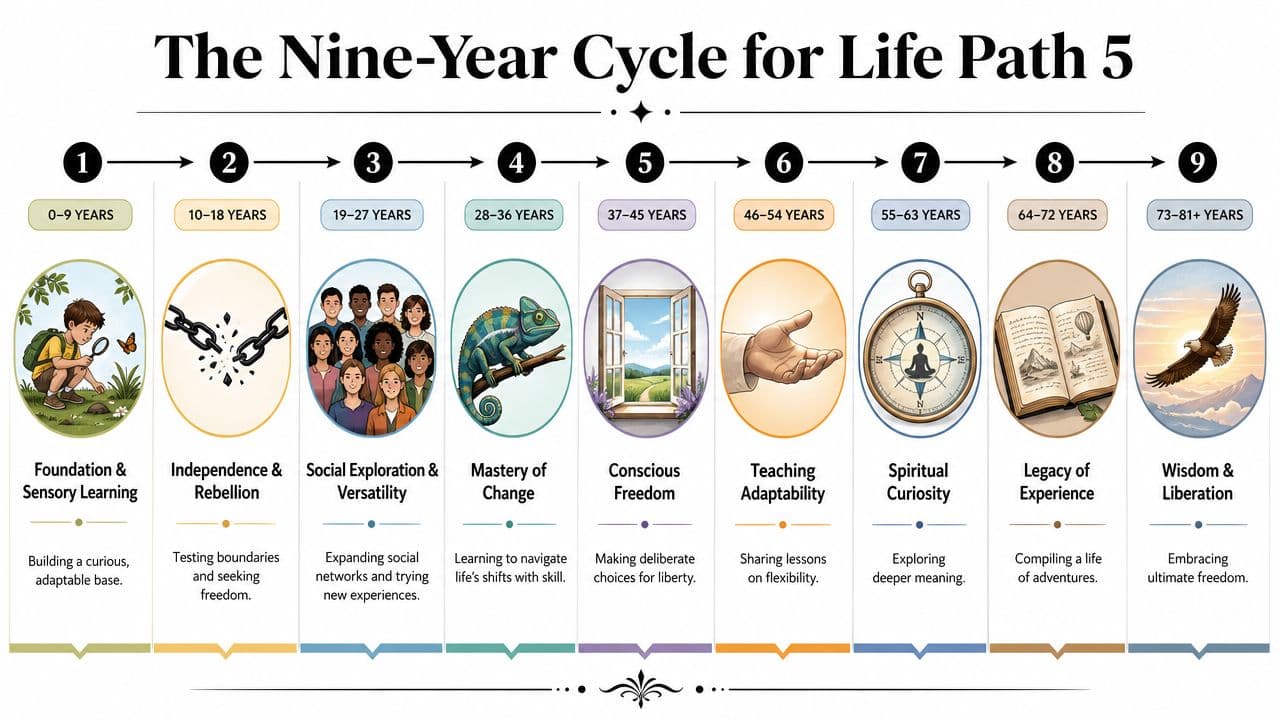
Beginning with expansion
The opening phase tends to invite exploration. For a 5, that may look like travel, study, a new social circle, a different professional direction, or a willingness to experiment with identity. The opportunity is breadth with awareness. The temptation is to treat every possibility as an obligation to act immediately.
A 5 entering a relationship during an expansive period might feel swept into a new world. That excitement can be meaningful, but the person still needs to ask whether they're building a connection or chasing the emotional charge of novelty.
The next phase emphasizes development and testing. Initial excitement has to become skill, trust, and follow-through. At work, a new role may require sustained learning after the first challenge loses its shine. In love, the relationship may ask for practical conversations that feel less thrilling but create real security.
Ending with review and release
The culminating phase asks you to examine what your choices have produced. A 5 may notice that a sequence of moves, projects, or relationships has expanded their experience but not their stability. That realization doesn't require shame. It offers a chance to release habits that no longer serve the deeper goal of freedom.
The Life Purpose App nine-year cycle guide can help you place recurring experiences into a larger pattern. Use the cycle as a reflection tool rather than a command. You're not waiting for a perfect year to act. You're asking what kind of action fits the phase you're already living.
Reflection prompt: What keeps repeating in your work, money, or relationships, and what would change if you responded with focus instead of speed?
Look back over the current window and mark moments when you began, committed, tested, completed, or released something. For a Life Path 5, repeated patterns often reveal where freedom has become avoidance and where discipline could create a wider life.
Compatibility and Relationship Dynamics for a 5
Compatibility in Dan Millman's framework isn't a promise that two people will have an effortless relationship. It's a way to notice how different needs meet. A 5 generally does well with someone who respects independence while offering grounding, and struggles when a partner tries to control, monitor, or smother their natural movement.
Millman groups Life Paths 1, 3, and 6 among harmonious allies for a 5. These pairings can support mutual growth because they bring different strengths into the relationship. A 1 may offer direction, a 3 can share social energy and creative expression, and a 6 may contribute care and responsibility. The connection works best when support doesn't become control.
Where ease can become friction
A partner with strong structure needs may find the 5's changing plans unsettling. Life Path 4 and Life Path 8 dynamics can feel particularly demanding when their preference for order, responsibility, or control collides with the 5's need for flexibility. That doesn't make either person wrong. It means the couple must negotiate routines, money, time, and personal space rather than assuming love will solve the difference.
The infographic below presents a complementary comparison using Millman's pairing logic.
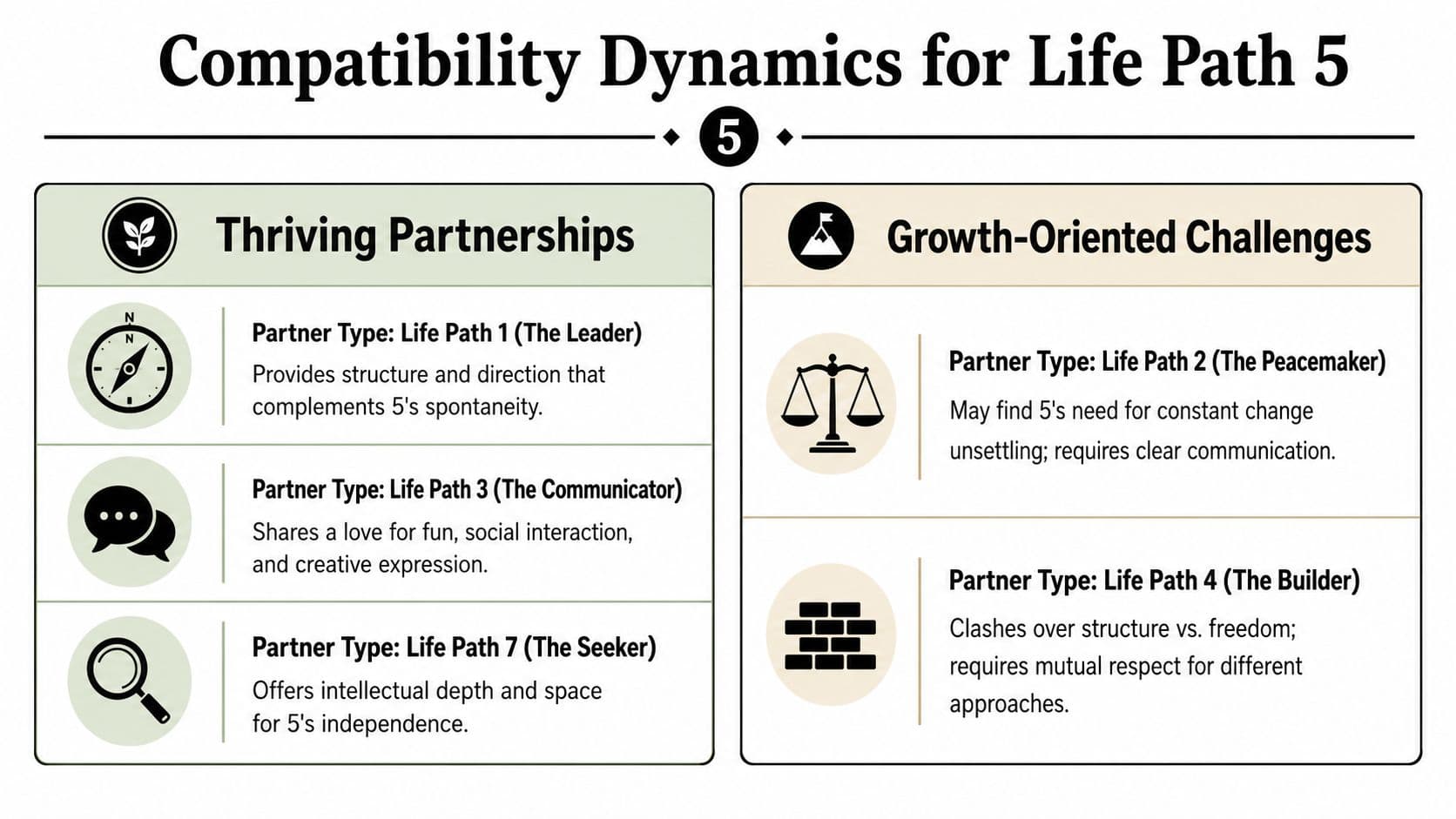
A Life Path 5 can move from theory into personal reflection with the Life Purpose App relationship guide. Look at the specific pattern between you and another person. Do you feel energized because you both allow room to grow, or exhausted because one person keeps demanding certainty while the other keeps resisting it?
Every pairing can succeed through conscious choice. The useful question isn't whether a number guarantees compatibility. It's whether both people can respect different rhythms, state their needs clearly, and create agreements that preserve autonomy and trust.
Putting It All Together and Exploring Your Path Further
Life Path 5 meaning reaches beyond adventure. In Dan Millman's The Life You Were Born to Live, the central lesson is that authentic freedom grows from disciplined choices. Health, money, work, sexuality, and relationships each give you a different place to practice that lesson.
The restless person with the suitcase may need change, but they also need to know what they're carrying forward. The freelancer, employee, and partner may all crave independence, yet each can build structures that protect rather than restrict it. The nine-year cycles add another lens, helping you notice when life is inviting exploration, testing commitment, or asking for release.
The Life Purpose App lets you enter your birth date to explore your life path, related gifts and challenges, nine-year cycles, and relationship dynamics within Millman's system. Visit Life Purpose App to examine your Life Path 5 pattern and turn reflection into a more deliberate next choice.
Discover Your Life Purpose Today!
Unlock your true potential and find your life’s purpose.
