Learn what life path counseling is, how birth-date insights from Dan Millman's book support self-reflection, and what to expect from a session.

November 18, 2026 (8d ago)
Life Path Counseling: What It Is and How to Use It
Learn what life path counseling is, how birth-date insights from Dan Millman's book support self-reflection, and what to expect from a session.
← Back to blog
Learn what life path counseling is, how birth-date insights from Dan Millman's book support self-reflection, and what to expect from a session.
You've typed your birth date into a box and the paragraph that came back felt uncomfortably accurate. Or you've booked a session with a counselor and you're not entirely sure what you've signed up for. Either way, the same question is probably circling: is this real, and what am I supposed to do with it?
That question deserves a straight answer rather than a sales pitch. Life path counseling is a reflective practice, not a test, and the most useful thing you can do with any reading is treat it as a hypothesis you get to check against your own life.
Here's how the framework works, how the number is calculated, what a session involves, and where the practice has to stop and hand you over to a clinician.
What Life Path Counseling Is and Where It Comes From
Life path counseling is a structured conversation that begins with a life path derived from your date of birth, then uses that as a lens for examining values, abilities, work, relationships and direction. The life path works as a compass bearing, not a turn-by-turn route. It tells you which questions to ask. It doesn't tell you which answers to pick, and a decent counselor says so in the first ten minutes.
The framework here isn't generic numerology. It comes from Dan Millman's book The Life You Were Born to Live, and the Life Purpose App is its digital companion, presenting the same 45 paths with their gifts and challenges. Naming the system precisely matters, because plenty of online "life path number" content borrows the phrase and means something else entirely.

Talking through vocation and identity is far older than any app. Frank Parsons opened what's widely regarded as the first formal career-counseling center in Boston in 1909, an approach that spread to schools in 35 U.S. cities, and collegiate training in counseling began at Harvard University in 1911, according to this history of the counseling profession. School counselors numbered approximately 12,000 by 1958, and in 1952 four professional associations met in Los Angeles to create what became the American Counseling Association.
That lineage matters for one practical reason. The conversation is the intervention. Your reading is the opening move, and you should leave a session with a single question to carry into the week rather than a verdict about who you are.
How Your Life Path Is Calculated and Which Paths Exist
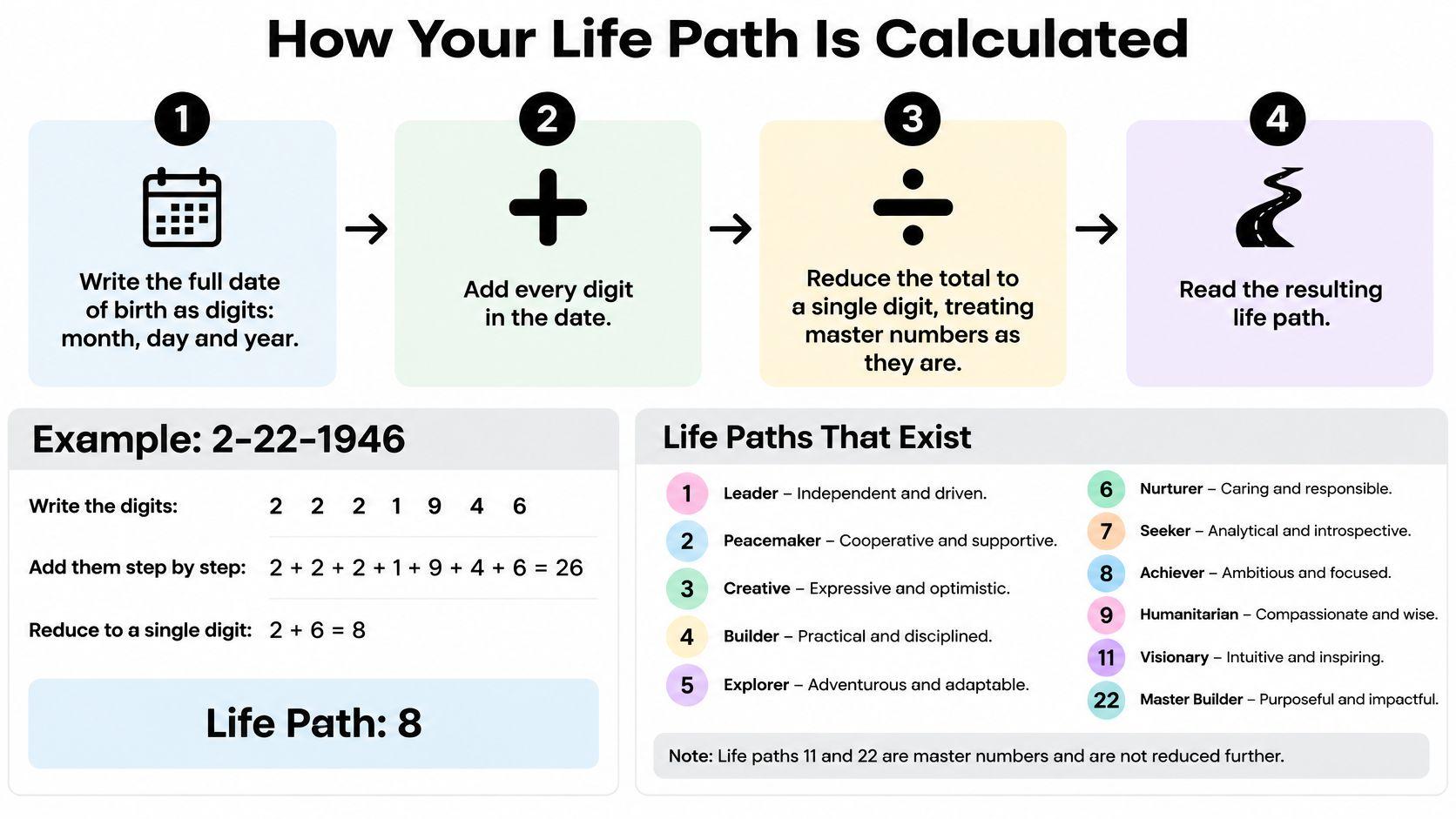
Check the arithmetic before you trust the interpretation. That instinct is correct, and the calculation is short enough to verify by hand. It uses the complete date of birth in four steps.
- Write the date out in digits. Month, day and year, with no separators.
- Add every digit, including zeros. For the book's worked example of 2-22-1946, that's 2+2+2+1+9+4+6, giving an original sum of 26.
- Reduce the sum by adding its digits until one digit remains. Here, 2+6 gives a final sum of 8.
- Write the pair as original sum, slash, final sum. The result is 26/8.
The reduction rule is where people slip. An original sum of 20 becomes 2+0, so the final sum is 2, as the instructions for The Life You Were Born to Live show. One digit, always. If your reduction lands on 10 or higher, add its digits again, because the final sum in this system is a single digit. This framework is tied to Millman's book and the Life Purpose App. It makes no claim about every numerology tradition, and mixing methods mid-reading is how people end up with a number that describes nobody.
Why You Might Need the Revised Edition
The system expanded. In an interview about the 25th anniversary edition, Dan Millman explains that the book grew from 37 to 45 life paths. The earlier edition covered people born from 1750 through 1999, and the revised edition added eight birth-number paths to include people born after 2000.
| Edition | Life paths | Birth years covered |
|---|---|---|
| Earlier edition | 37 | 1750 through 1999 |
| 25th Anniversary Edition | 45 | 1750 through 1999, plus eight added paths for births after 2000 |
So if you were born in 2000 or later, an older copy of the book may not contain your path at all. You're holding the wrong edition. The Life Purpose App is built on the 25th Anniversary Edition and contains the complete text of all 45 life paths, so it covers the range a superseded copy cannot.
What to Do With Your Result
Do this before you read the description. Write down the two or three themes you already believe about yourself, then compare them with the chapter. It stops you from nodding along after the fact.
Enter the same date of birth into the Life Purpose App, which reveals insights about your life path, and read the summary next to the book's own text. Where the two point at the same theme in different words, you've found something worth testing. Where they diverge, trust the book and note the discrepancy. Treat the result as a hypothesis about yourself, one you can check against how you behaved over the past few weeks rather than how you'd like to see yourself.
Reading Life Path Insights Across Life Areas and Cultures
A reading in Dan Millman's system describes the gifts and challenges of a path, and the Life Purpose App organizes those themes across health, money, sexuality, livelihood, and relationship dynamics. That range can reveal a pattern worth examining, while also creating more places where a vague statement can appear accurate.
A broad reading works like a wide searchlight. It illuminates more of the room and makes unrelated objects appear connected.
Take a concrete case. Your path describes strong drive at work paired with tension around rest. Instead of asking whether that sounds true in general, review the last three months. Find one weekend you planned to keep free but spent working. Record who made the request, what you chose, and what you told yourself afterward.
One incident does not confirm the theme. Look for the same choice under different conditions: accepting extra work without checking your capacity, treating rest as something to earn, or feeling uneasy when no task is waiting. A repeated pattern gives you a hypothesis to test. If it involves persistent distress or interferes with daily functioning, clinical care is the appropriate next step.
Culture Shapes What Purpose Means
Purpose material often presents meaning as an individual discovery process, as though everyone chooses a direction independently. Research across the United States, Australia, China and Japan found that cultural differences affect both the experience of meaning and its relationship with well-being, and concluded that interventions should account for cultural and individual differences rather than assume one universal model, according to this study of meaning across cultures.
That raises a useful question for every interpretation: does it account for family duty, community identity, spirituality, and collective values, or does it measure your life only against individual ambition?
Sort each theme into three columns:
- What gives me meaning. The activities and relationships that consistently draw your energy.
- What my community expects. The obligations, roles, and duties shaped by family or culture.
- How I reconcile the two. The compromises, conversations, and boundaries you use in practice.
Personal growth and self-compassion can shape how you search for meaning and recognize it in daily life. A change in family role, spiritual practice, or responsibility can also alter which challenges feel most relevant.
Before labeling a theme as yours, identify what truly motivates you through a structured values exercise. Then compare the result with the reading. Your life path remains tied to your date of birth, while the way its themes appear can change with your culture, role, and responsibilities. The reading supplies possible patterns; your lived choices provide the evidence.
Turning Insights into Reflection Prompts and Experiments
A reading becomes useful the moment you treat it as a hypothesis. Psychotherapy research gives a strong reason to build the work around agreement and collaboration rather than authority. The therapeutic alliance, meaning agreement on goals and tasks plus the quality of the client and practitioner relationship, is an important process variable: a meta-analysis covering 60 independent samples and 6,061 participants found alliance and outcome correlations of approximately r = .23 to .31, even after adjusting for intake characteristics and concurrent treatment processes, according to this meta-analysis of therapeutic alliance.
In plain terms, the part that helps is the shared work, not the pronouncement.
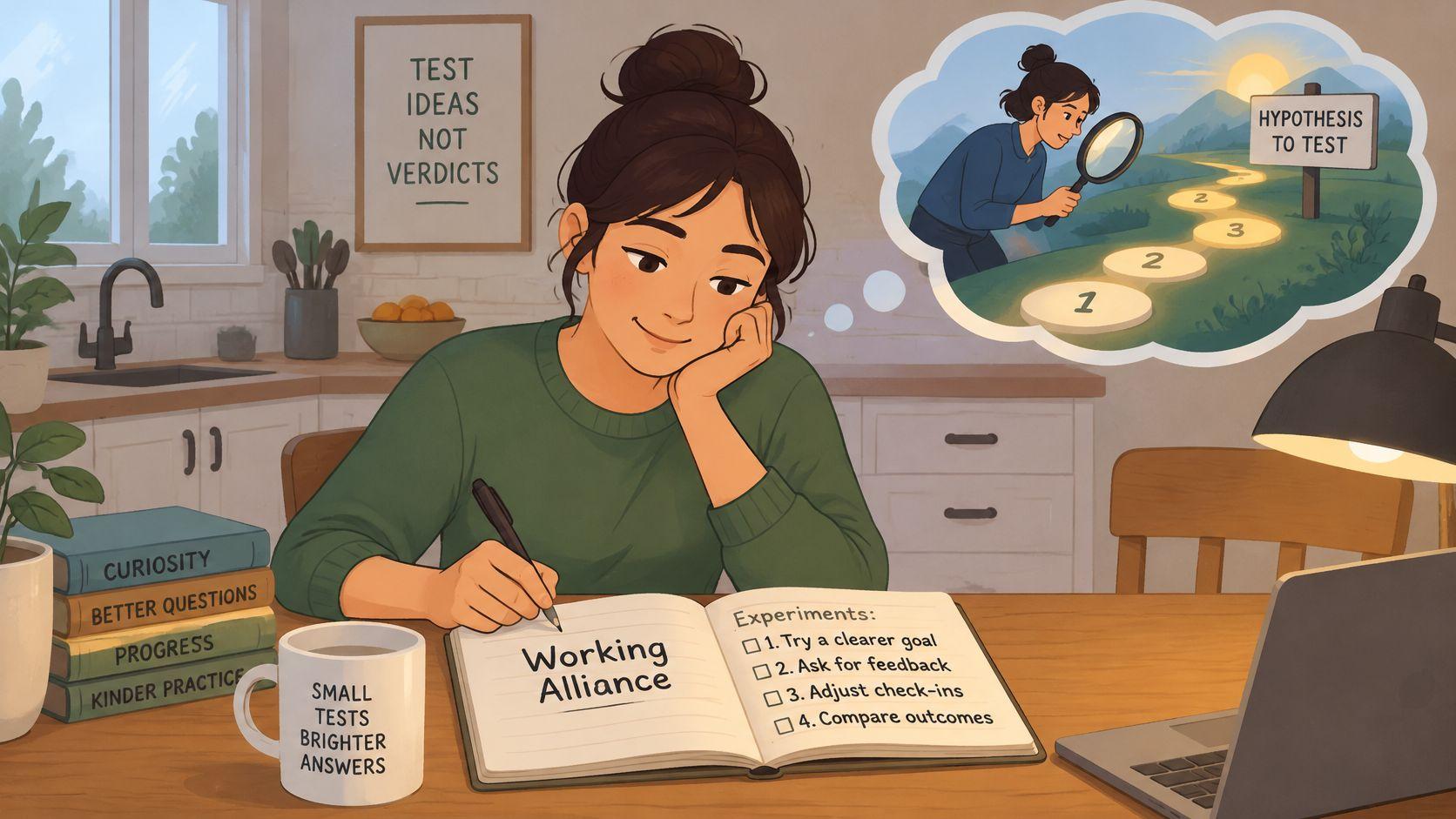
Here's the workflow, run on a single theme. Say your reading flags a pattern of taking on other people's work.
- Name the pattern precisely. Not "I'm too helpful." Try "I accept tasks in meetings before checking my own deadlines.\n"
- Define observable indicators. What you did, when you did it, who asked, and how you felt an hour later.
- Design one measurable experiment for the coming week. Decline one request, politely and without a long justification, and note what happens in the room and in your body.
- Review the result against your indicators. Did the feared consequence occur? What did the other person do?
- Keep, adjust or drop the theme. A theme that survives two or three honest tests has earned its place. One that never shows up in behavior gets retired.
Practical rule: if a reading can't be turned into something you do differently by Friday, you haven't finished reading it yet.
Sometimes a reading feels wrong. Say so out loud, to your practitioner or in your journal, and don't let the system's interpretation win by default. A counselor who treats disagreement as resistance is showing you something important about the counseling. These questions are a useful starting point when you want to notice how a theme shifts across phases of your life rather than treating it as a permanent trait.
What to Expect in a Session or App Exploration
Formats differ far more than the marketing suggests, and the differences decide what you can reasonably expect from each one.
| Format | What happens | Best for | Limit |
|---|---|---|---|
| Practitioner-led session | Counselor reviews your profile, asks you to confirm or reject each theme and helps set one goal | Turning themes into a plan | Needs your confirmation; not a clinical assessment |
| Self-guided app reading | You enter your birth date and read the life path summary alongside Millman's book | Getting oriented with the framework | A prompt to reflect on, not a verdict |
| Journaling after reading | You note which themes match events over two to four weeks | Tracking change over time | Only as useful as your honesty in the notes |
| Relationship lookup | You compare two life paths and look at possible dynamics | Starting a conversation | Not a prediction of how a relationship will go |
In a practitioner-led session, expect the counselor to walk through your life path profile from the book and then hand the material back to you: which themes fit, which don't, and which are half right. The session should end with one goal, not a personality report.
How to Choose a Practitioner and Protect Your Data
Look for a licensed counselor or therapist in your region, and ask two questions before booking. First, do they treat life-path material as a reflective prompt rather than a diagnosis? Second, how do they handle a reading you disagree with? A vague answer to either one tells you plenty.
Privacy deserves the same scrutiny. We don't store or collect the date of birth you enter to reveal a life path, and you should check the same point in any other tool before typing it in.
How to Tell Whether It's Working
A technically defensible evaluation measures change with validated, domain-specific outcomes rather than perceived insight or satisfaction. Meaning-oriented work can be assessed across presence of meaning, search for meaning, purpose clarity, goal commitment, psychological distress and functioning, recorded at baseline, immediately after the intervention and at follow-up. A systematic review of meaning-in-life interventions in older adults found moderate overall evidence alongside substantial limitations from heterogeneous designs and variable outcome definitions, and recommends validated measures to assess change.
For your own review, three questions do the job. Are my goals clearer than before? Does my behavior match the values I named? Do my relationships and daily functioning feel better, without a growing sense that everything is fixed? Check them at the start, right after your first experiment, and again four to twelve weeks later.
Relationship Comparisons and What They Can and Cannot Show
A partner's birth date is usually the next thing people type after their own. Friends, siblings and potential partners get compared side by side, and the output can start to sound like a forecast.
Treat it more modestly. There is no scientific evidence that two birth dates can predict whether a relationship will last, so read compatibility material as a belief-based prompt. Its value is the quality of conversation it opens and the honesty it makes easier.
Use the two paths as a hypothesis about friction, then test that hypothesis against ordinary life. Start with four areas and write one question for each.
Conflict. If one path reads as direct and the other as avoidant, ask what signal means "pause" without meaning "leave."
Pace. If one person decides quickly and the other needs time, agree which choices can be made fast because they are easy to reverse, and which deserve a second conversation.
Money. Ask what money meant early in each home: safety, freedom, duty, status or secrecy. That history often explains the present reaction better than a pairing label.
Affection. Ask how care lands best, how each person shows it by habit, and how they want to be told when they miss.
If one path prizes independence and the other closeness, the practical question is how to design time apart and time together so neither need becomes a defeat. Run one small experiment: choose a recurring friction point, predict how each of you will respond under stress, then watch what happens. Keep what the evidence supports and revise what it does not.
The Life Purpose App lets you save friends and check their life paths, life cycles and relationship dynamics, which makes it a low-pressure place to begin. For a side-by-side framing that avoids turning two paths into a score, use this guide to reading a love compatibility report.
A mismatch marks where attention is needed. A comparison result alone never justifies ending a relationship.
Digital Limits and When to Seek Clinical Care
More reflection isn't automatically better. An app can hand you a reading in seconds, which makes it easy to confuse frequency with progress, the way weighing yourself ten times a day feels like dieting without changing anything you eat. A 2025 scoping review examined digital mental-health interventions for people aged 16 to 25 and assessed delivery formats, target populations and retention, finding that access alone does not produce sustained engagement or effectiveness, as detailed in the review of digital mental-health interventions. Analysis of OECD data discussed alongside it linked heavier daily screen use to poorer mental well-being and life satisfaction, though sleep, financial hardship and physical activity predicted outcomes more strongly than screen time itself.
Research on well-being apps adds a quieter warning: having used these tools before does not reliably correspond with greater life satisfaction or better mental well-being. Downloads and session counts measure nothing that matters.
The test of a purpose tool is what you do offscreen, not how often you open it.
So set limits you can keep. One reflection block a week, no daily rereading of your profile, and offline conversations as the primary test of any theme. Each reading is a hypothesis, and a hypothesis only earns its keep when you run it against something observable: one experiment, one week, one written result. If you want a plain explanation of how symbolic systems relate to evidence, a piece on numerology draws the line between reflection and prediction.
Then there's the point where a life path reading stops being the right tool at all. No amount of reframing turns persistent despair into a growth exercise, and trying is like using a map to treat a broken leg: the tool isn't wrong, it's the wrong category. Stop using the reading as guidance and contact a licensed clinician or crisis service if you notice any of these:
- Depression that persists for weeks.
- Thoughts of self-harm or suicide.
- Trauma symptoms that intrude on daily life.
- Psychosis, including hearing or seeing things others don't.
- Substance-use problems you can't reduce on your own.
- Severe impairment at work or home.
If you're unsure whether what you're feeling needs clinical attention, guidance from Refresh Psychiatry & Therapy lays out the signs plainly. A life path reading can support reflection, values clarification and goal setting. It cannot assess or treat depression, trauma, suicidality, psychosis or substance-use disorders, and no experiment you design at home can substitute for that kind of care.
Decide Whether Life Path Counseling Fits Your Next Step
Here's the verdict. Life path counseling suits you if you want a structured reflective prompt, you're willing to confirm or reject interpretations rather than swallow them, and you treat the framework as a tool rather than a diagnosis. It doesn't suit anyone seeking assessment or crisis care.
Four steps you can start today:
- Work out your number with the calculation above and find your section in The Life You Were Born to Live, using the edition table to confirm which text covers your birth year.
- Enter your date of birth in the Life Purpose App and read the summary next to the book, noting where the two agree.
- Run one experiment this week on a single theme, using the workflow for turning themes into observable goals.
- Pick a route. Book a practitioner session for an outside view, or set a four-week review date and judge the result against the three progress questions.
The free version of the Life Purpose App includes a summary of your life path and an overview of the Life Purpose System, and it will always remain free. The paid version includes the complete text of the 25th Anniversary Edition of The Life You Were Born to Live, which the free version doesn't include. Whichever route you take, Millman's book and the Life Purpose App are the reference points for every life path claim you meet.
The Life Purpose App puts Dan Millman's system in your pocket: enter your date of birth and you'll see one of 45 life paths, with the gifts and challenges it describes across health, money, sexuality, career and relationships. Use it as the prompt this article describes, reading your summary next to The Life You Were Born to Live and testing one theme at a time against what happens in your week. Visit Life Purpose App to explore your path and start your first experiment.
Discover your life path today
Enter your date of birth and see your life path, free.
Find your life path