Life path definition from Dan Millman's The Life You Were Born to Live: how a birth date yields one of 45 paths, plus laws and cycles.

November 1, 2026 (17d ago)
Life Path Definition in Dan Millman's System
Life path definition from Dan Millman's The Life You Were Born to Live: how a birth date yields one of 45 paths, plus laws and cycles.
← Back to blog
Life path definition from Dan Millman's The Life You Were Born to Live: how a birth date yields one of 45 paths, plus laws and cycles.
In Dan Millman's The Life You Were Born to Live and the Life Purpose App, a life path is a symbolic profile drawn from every digit of your birth date and matched to a framework of 45 paths, not a single destined job. The popular advice to find your one true calling asks this number to do something it can't: choose your future for you.
A more useful approach starts with curiosity. You can examine gifts, recurring difficulties, and choices without assuming that a calculation knows which occupation you should pursue or whom you should love.
What a Life Path Means Here
A life path definition in Dan Millman's The Life You Were Born to Live and its digital companion, the Life Purpose App, is a symbolic description of gifts, friction, and recurring personal themes derived from the complete birth date. It isn't a career title, a personality score, or a promise about what will happen.
Think of someone deciding whether to remain in a familiar job, care for a relative, or develop a creative interest. That person might want a reading to identify the correct choice. A more grounded use is to ask what strengths they could bring to each possibility, what difficulties deserve attention, and which responsibilities they're willing to accept.
The distinction matters because a description and a decision aren't the same thing. You still have to consider your circumstances, skills, commitments, and opportunities.
A compass rather than a train ticket
A compass gives you a bearing while leaving you responsible for the route. A train ticket names a destination and an expected arrival. Millman's framework is more useful as the former: a way to orient reflection, not a reservation for a predetermined future.
Suppose a passage prompts you to examine how you handle responsibility. You might explore that theme through paid work, parenting, friendship, or community service. None of those settings has to become your permanent identity.
A useful reading gives you questions to investigate, not instructions to surrender your judgment.
In everyday speech, someone's path can mean the direction their life takes. Here, the term has a narrower meaning: the book-based profile associated with their birth-date calculation.
A definition you can repeat
The short version is: my birth-date profile gives me a symbolic language for examining strengths and challenges, not a fixed destination.
That wording also prevents a common mix-up. Some explanations reduce a birthday to a basic digit and stop; Millman's approach retains the complete sum for matching to his framework. The app provides the corresponding book-based profile when you enter a date.
You don't have to make every passage fit. Read with a pencil, identify what seems relevant, and note what doesn't describe your experience. The value of the exercise lies in the quality of your reflection and subsequent choices, not in your ability to agree with every description.
How a Birth Date Becomes the Number
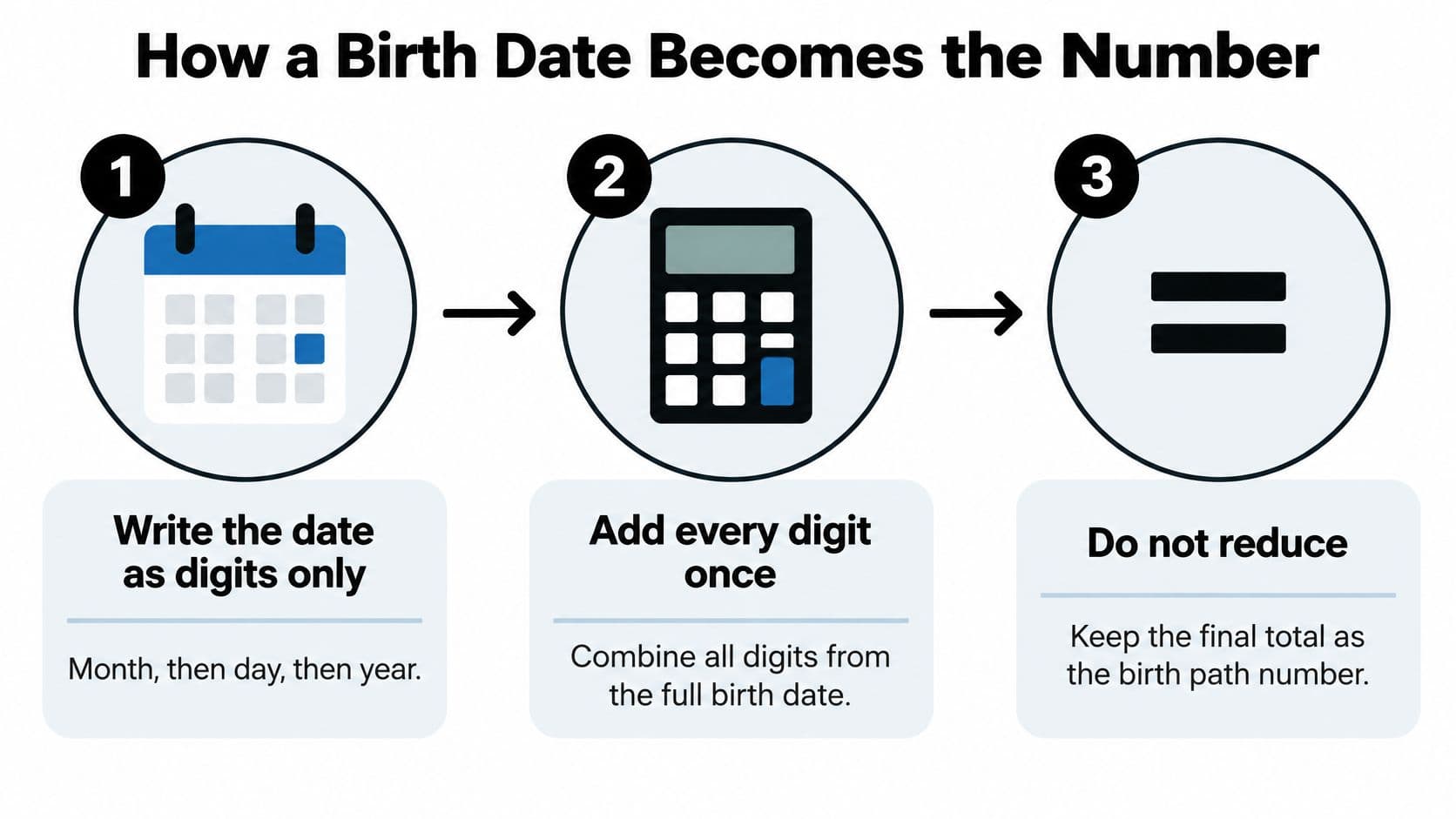
Dan Millman's The Life You Were Born to Live and the Life Purpose App use the full-date digit sum. The Life Purpose App's explanation of the book illustrates the method with October 25, 1987: 1 + 0 + 2 + 5 + 1 + 9 + 8 + 7 = 33.
The important detail is what you add. You add the digits of the complete birthday, rather than simplifying each calendar component first.
Keep the calculation in order
- Write the date as digits only. Use the month, then the day, then the full year. Check that you've copied the birthday correctly before calculating.
- Add every digit once. Include all the digits rather than replacing the month, day, or year with a reduced value.
- Keep the total. Match that sum to the corresponding profile in the book instead of continuing to reduce it.
Zeros don't increase the sum, but writing them can help you keep track of the date. Likewise, using the full year prevents you from accidentally leaving out part of the information the method requires.
For the birthday in the example, keep 33 as the lookup total. Don't replace it with a smaller number before finding the relevant reading.
Same birthday, two addition rules
The alternative calculation below is a comparison, not an additional step. It shows why people can enter the same birthday into different systems and receive different answers.
| Rule | What is added | Result for Oct 25, 1987 | Used by the book and app |
|---|---|---|---|
| Full-date digit sum | Every digit in month, day, and year, once | 33 | Yes |
| Component-first reduction | Month, day, and year reduced, then added and reduced | 6 | No |
Under the component-first approach, the month's 10 becomes 1, the day's 25 becomes 7, and the year's 1987 becomes 25, then 7. Adding those reduced components gives 1 + 7 + 7 = 15, which reduces to 6. These are arithmetic consequences of the contrasting rule, not a second result within Millman's method.
The disagreement doesn't mean your birthday has become ambiguous. It means the calculations answer different systems' questions.
Calculation check: If another reading gives a different result, compare the addition rules before comparing the interpretations.
Two-digit totals are meaningful lookup values in this framework. Keeping the full sum preserves the distinction the book uses rather than substituting a different method halfway through.
Once you've checked your addition, find the matching chapter in the book or enter that same birthday in the app. Don't choose the profile that sounds most flattering and work backward toward its number.
Why the System Uses 45 Paths
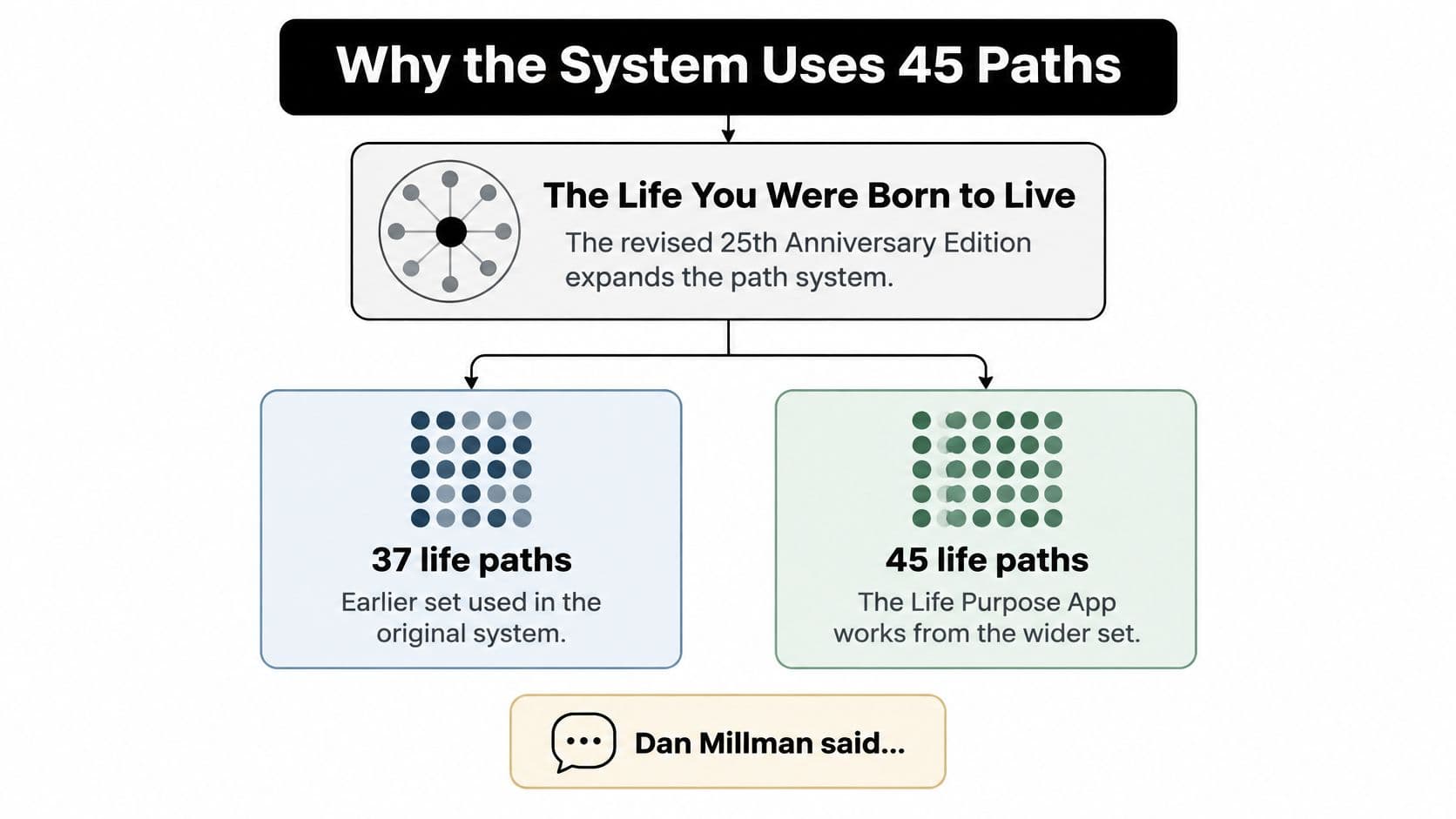
The revised 25th Anniversary Edition of Dan Millman's The Life You Were Born to Live expands the framework from 37 life paths to 45, and Millman describes the method as intended for people born from 1750 to the present, according to The Shift Network's discussion with the author. The Life Purpose App works from that wider book-based set.
This is a change in the system's coverage, not a general claim that people belong to an assortment of personality types. A calculation needs both a consistent addition rule and a reference set that includes the resulting profile.
Millman explained that the additions make the system more complete for people born after 2000. That explanation concerns the scope of the revised framework, not a claim that everyone born in a particular period shares the same character.
A birthday from the newer date range
As a worked example, take January 1, 2000, written 01012000. Adding its digits gives 0 + 1 + 0 + 1 + 2 + 0 + 0 + 0 = 4.
The arithmetic is straightforward. The practical question is whether the reference you consult contains the appropriate profile within the expanded framework.
That example doesn't establish that this particular total was newly added. It demonstrates why a reader should distinguish the date calculation from the edition used to interpret it.
- Check the edition. An older list may not include the additional profiles in the revised book.
- Use your own complete birthday. Being born in the same year as someone else doesn't replace the individual calculation.
- Keep generation and interpretation separate. A profile isn't a label for an entire age group.
Coverage isn't scientific validation
The word objective, when used to describe a calculation method, needs careful handling. People can follow the same arithmetic and reproduce a total without establishing that the interpretation objectively measures their personality or future.
That's the difference between a reproducible procedure and a validated conclusion. You can verify whether you copied and added the digits correctly; you can't use that arithmetic alone to prove that a description explains your life.
Use the expanded edition or its digital companion for consistency with this framework. Your result should come from your complete birth date, matched against the wider reference set, rather than from a generation label or whichever description happens to appeal to you.
Themes Each Path Is Meant to Cover
Dan Millman's The Life You Were Born to Live and the Life Purpose App organize a reading around practical areas of experience rather than a personality sticker. The book's description identifies subjects including core issues, innate talents, special needs, health, money, sexuality, career direction, primary relationships, spiritual laws, and the cycles of life.
Those subjects define the questions you bring to a reading. They don't turn the reading into professional advice.
What a Millman life-path reading examines
| Subject | What the path is for | What it is not |
|---|---|---|
| Core issues and innate talents | Recurring strengths and friction | A fixed identity label |
| Special needs | Conditions the profile suggests reflecting on | A clinical assessment |
| Health | Themes to reflect on around the body | A medical diagnosis |
| Money | Patterns in earning, spending, and security | Financial advice |
| Sexuality | Themes in desire and intimacy | A prescription for behavior |
| Career direction | How work can use the profile's talents | One required occupation |
| Primary relationships | Dynamics with close people | A compatibility score |
| Spiritual laws | Principles paired with that profile | A separate belief test |
| Cycles of life | A timing layer beside the profile | Proof the underlying number changes |
Start with core issues and talents by asking where a strength helps and where you overuse it. Treat special needs as an invitation to notice supportive conditions, not as evidence of a disorder.
For health, consider habits and questions you could discuss with a qualified clinician. For money, examine your behavior without treating the passage as an investment recommendation. With sexuality, keep consent, communication, and personal agency central.
Apply the subjects without inventing a verdict
For the earlier birthday's profile, the career question is how the talents described in the chapter might appear in someone's actual work. It isn't permission to assign that person a profession without reading the chapter or understanding their skills.
The relationship question is similarly concrete: where might the described strengths and difficulties appear in a close bond? Don't invent traits for the example number or assume a shared description explains a disagreement.
The guide to using birth-date reflection for career questions can help frame work as an area of inquiry rather than a required occupation.
The revised book also provides a way to determine other people's profiles, allowing friends, relatives, and partners to be considered within the same subject list. The app carries these areas into its detailed analyses, but comparing descriptions shouldn't become a verdict about someone else.
Spiritual laws are principles within the framework; cycles concern timing. You don't need to resolve every subject at once. Choose the areas closest to a live question, such as money and work, and test the passages against what's happening.
Primary Numbers and Nine-Year Cycles
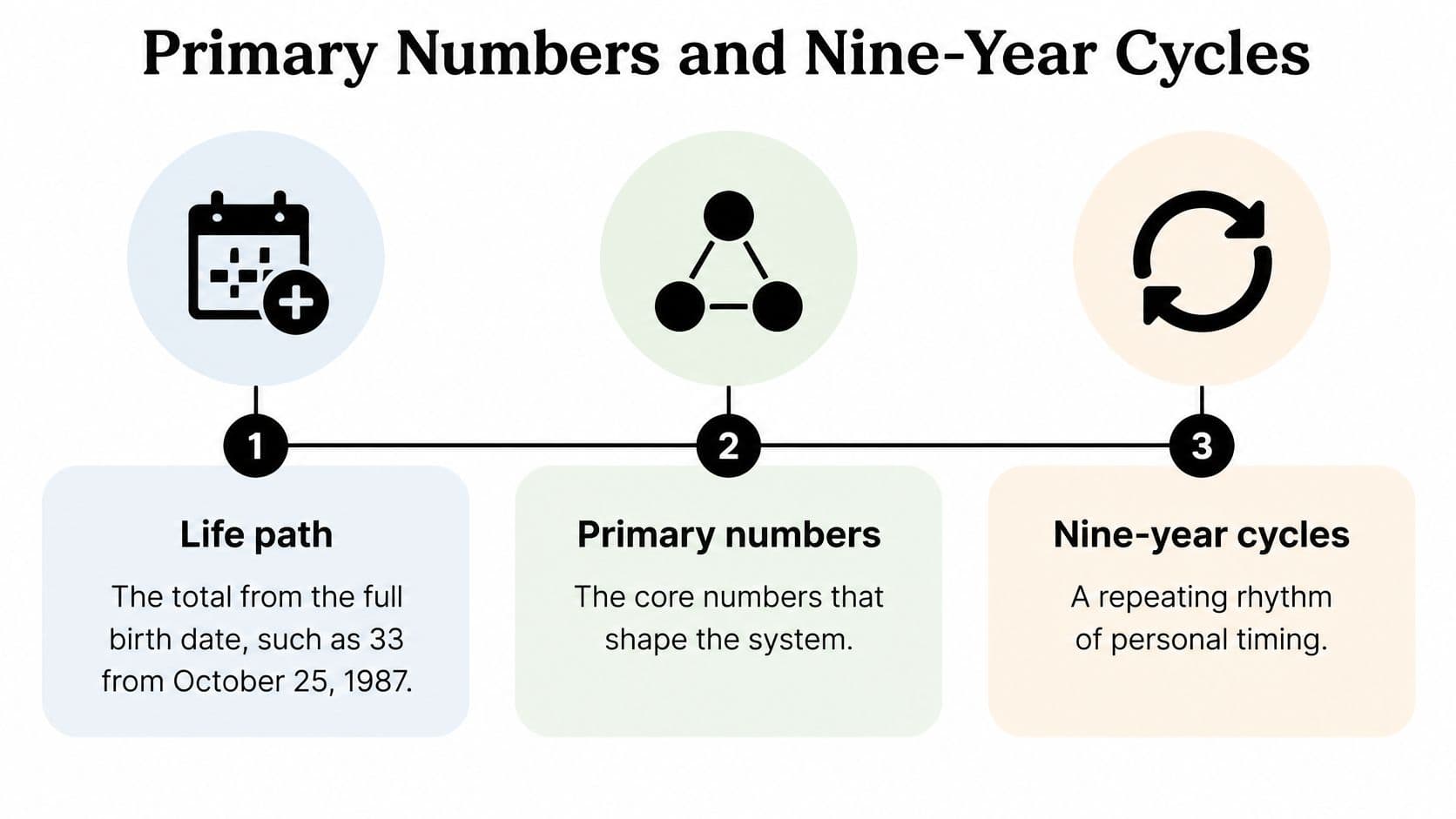
Dan Millman's The Life You Were Born to Live and the Life Purpose App distinguish the underlying birth-date profile from timing information. The book's Google Books contents and description identify a dedicated “Nine-Year Cycles” section and guidance on living in harmony with that recurring sequence.
The easiest way to avoid confusion is to keep the layers separate. A new phase doesn't require you to recalculate your birthday.
The underlying profile and its ingredients
The full birth-date total identifies the underlying profile. As an analogy, treat it as the climate: a broad symbolic backdrop rather than a description of what must happen on a particular day.
Primary numbers belong to the book's explanatory framework and appear alongside the profile in the app. Think of them only as ingredients used to understand that framework, not as a reason to invent another calculation. Use the book's explanations directly rather than attaching meanings or formulas borrowed from elsewhere.
That restraint matters. A familiar term can be used differently by different writers, and importing another author's interpretation can subtly change the system you're trying to understand.
The cycle is the season
The nine-year cycle is the timing layer, more like a season than a climate. Within this symbolic picture, you can consider changing phases without replacing the underlying birth-date profile.
| Layer | Question to keep in mind |
|---|---|
| Birth-date profile | Which recurring themes am I examining? |
| Primary numbers | How does the book explain the elements of its framework? |
| Cycle | Which changing phase am I considering? |
A season might prompt you to pay particular attention to work, health, money, or a relationship. That doesn't mean the calendar has changed your gifts or dictated an event. It means you're using a different reflective lens.
When reading about life cycles and their terminology, check which timing concept is being discussed rather than assuming that every reference to a cycle means the same thing.
The practical rule is simple: read the profile and the current phase alongside each other, not as interchangeable results. If a timing passage suggests reassessment, for example, you can review a commitment without assuming you must end it. Your circumstances and judgment still determine what action makes sense.
When the Number Stays and Life Changes
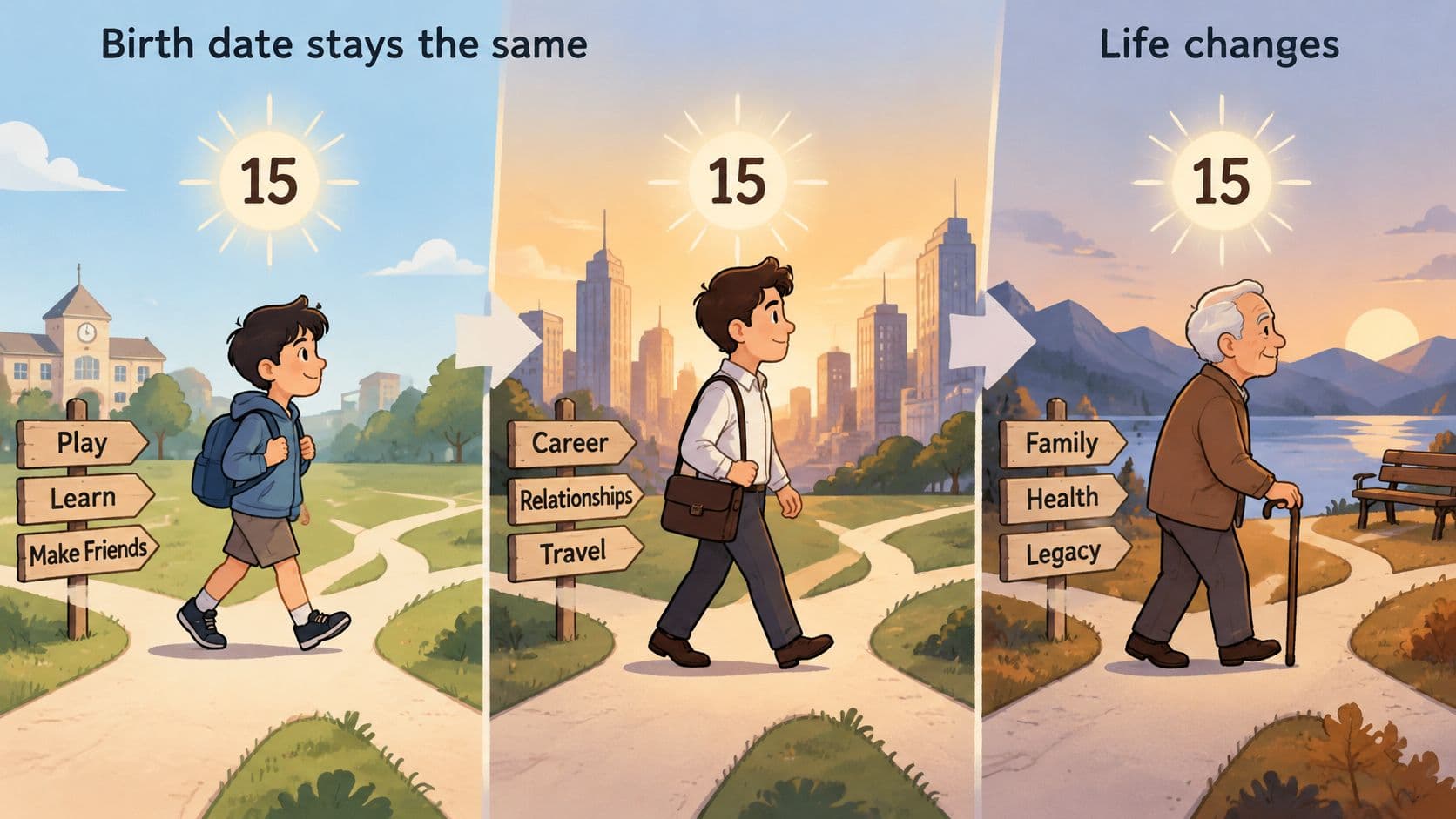
Your birth-date profile in Dan Millman's The Life You Were Born to Live and the Life Purpose App stays the same because your birth date stays the same. How you express its themes can change, which is why a stable reading needn't confine you to one role.
The assumption worth challenging is that purpose must arrive as a permanent occupation. A meaningful life can involve work, friendship, creativity, care, and spiritual practice without requiring one of them to explain everything.
Purpose isn't confined to a job
In a 2025 survey of 4,475 U.S. adults, only 17% of employed Americans strongly agreed that they had a strong sense of life purpose, according to the Gallup–Stand Together Power of Purpose report. The report classified roughly a third as having strong, moderate, or low purpose and found that respondents identified work, friendships, personal passions, and faith or spirituality in broadly similar proportions.
Those findings don't validate birth-date interpretation. They do challenge the narrower idea that purpose must mean discovering one dominant vocation.
Someone using the earlier example's chapter might reflect on paid work during one period and caregiving during another. A reader born in the newer date range can likewise apply a chapter to changing responsibilities rather than treat it as a generation-specific job assignment.
A change in role doesn't have to mean you've lost your direction.
Keep reflection separate from certainty
This is spiritual self-exploration within a symbolic tradition, not a validated test demonstrating that birth-date arithmetic shapes personality or events. Relationship comparisons and timing passages can supply discussion prompts, but they can't establish whom you should trust, hire, marry, or leave.
Don't lean on a reading for medical certainty, financial decisions, employment judgments, or major relationship choices. Bring those questions to relevant evidence, qualified support, and honest conversation.
The distinction is constant pattern, changing expression. You can retain a familiar language for reflection while allowing your priorities, responsibilities, and understanding of yourself to develop.
Look Up Your Date and Read It in Life
Use Dan Millman's The Life You Were Born to Live or the Life Purpose App with a specific question in mind. A focused reading is easier to evaluate than an attempt to explain your whole life at once.
Turn the reading into a practical exercise
- Enter or calculate your birthday. Add every digit using the book's method, or enter the same complete date in the app.
- Open the matching profile. Use the revised anniversary edition or the corresponding digital result rather than choosing a description by intuition.
- Choose the relevant subjects. Read the passages closest to your current concern, such as money and work, and leave unrelated areas for another time.
- Check the timing separately. Read your current cycle as a changing phase, not a replacement for the underlying profile.
- Return to your judgment. Use the result as language for choices, not proof of a future or a basis for medical, financial, hiring, or relationship decisions.
If your question still feels vague, use these life-purpose questions to make it concrete. Replace a question about your entire destiny with something you can examine through your behavior and circumstances.
Finish by naming one gift to use this month and one friction to handle more openly. Write down where you'll practice each, then review what you did rather than how convincing the description sounded.
The digital companion to Dan Millman's The Life You Were Born to Live offers birth-date profiles, subject-based readings, and cycle information for this kind of reflection. Visit Life Purpose App, enter your date, and choose a current question to explore without treating the result as a forecast.
Discover your life path today
Enter your date of birth and see your life path, free.
Find your life path