Learn the life path foundation behind Dan Millman's The Life You Were Born to Live: calculate your birth number, read digit meanings and cycles.

November 26, 2026 (Today)
Life Path Foundation: How to Read Your Birth Number
Learn the life path foundation behind Dan Millman's The Life You Were Born to Live: calculate your birth number, read digit meanings and cycles.
← Back to blog
Learn the life path foundation behind Dan Millman's The Life You Were Born to Live: calculate your birth number, read digit meanings and cycles.
Can a birth-date reading help you ask better questions about your life without telling you what your future must be? That's the useful distinction to keep in mind when approaching a life path foundation through Dan Millman's The Life You Were Born to Live and the Life Purpose App.
Start with the method, then consider the meaning. You don't have to accept every description to find a worthwhile question about your habits, relationships, or priorities.
What a Life Path Foundation Is and Where It Comes From
A life path, in Dan Millman's The Life You Were Born to Live and the Life Purpose App, is a number calculated from a complete birth date. The book interprets that number as a combination of life issues, innate abilities, and challenges, rather than a generic personality type.
Say you're reconsidering your work. Instead of treating a reading as an instruction to change careers, you might use its themes to ask what you enjoy doing, where you struggle, and which responsibilities you're avoiding.

The book is the reference point
In an interview about the revised edition, Millman explains that the 25th Anniversary Edition expanded from 37 to 45 birth-number paths, including paths for some people born after 2000. The book applies its framework to health, money, sexuality, livelihood, and personal or professional relationships.
Our Life Purpose App, first published in 2010, is based on Millman's bestselling book. The origins of the Life Purpose System provide background for understanding that connection.
A similar name, a different organization
Search results can also lead to LifePath, Inc., a Pennsylvania human-services nonprofit, and its fundraising arm, LifePath Foundation. That organization is unrelated to Millman's system.
For personal reflection, the useful building blocks are the calculation, the digit meanings, cycle timing, relationship conversations, and the limits of interpretation. Keep the distinction between what the book describes and what a reading can establish in view throughout.
How to Calculate Your Life Path Number Step by Step
The calculation in Dan Millman's The Life You Were Born to Live, followed by the Life Purpose App, begins with the digits of your complete birth date. The revised book's documented method adds those digits individually, keeps their original total, and then adds the digits of that total.
Keep the total as well as the final digit
-
Write the complete date. For a hypothetical person born on 14 March 1985, write 14/03/1985. Include the full year so you don't accidentally omit part of the calculation.
-
Add every digit individually. In this example, 1 + 4 + 0 + 3 + 1 + 9 + 8 + 5 = 31. Don't add the month, day, and year as whole numbers, and don't reduce each date component first.
-
Add the digits of the total. Here, 3 + 1 = 4. Keep the original total on your page instead of replacing it with the reduced result.
-
Write both parts together. The example becomes 31/4. This preserves the information needed to consult the full description rather than only a single-digit theme.
-
Mark the final digit. In this example, that's 4, the starting point for identifying the primary-purpose theme. Read it alongside the complete birth number, not as a replacement for it.
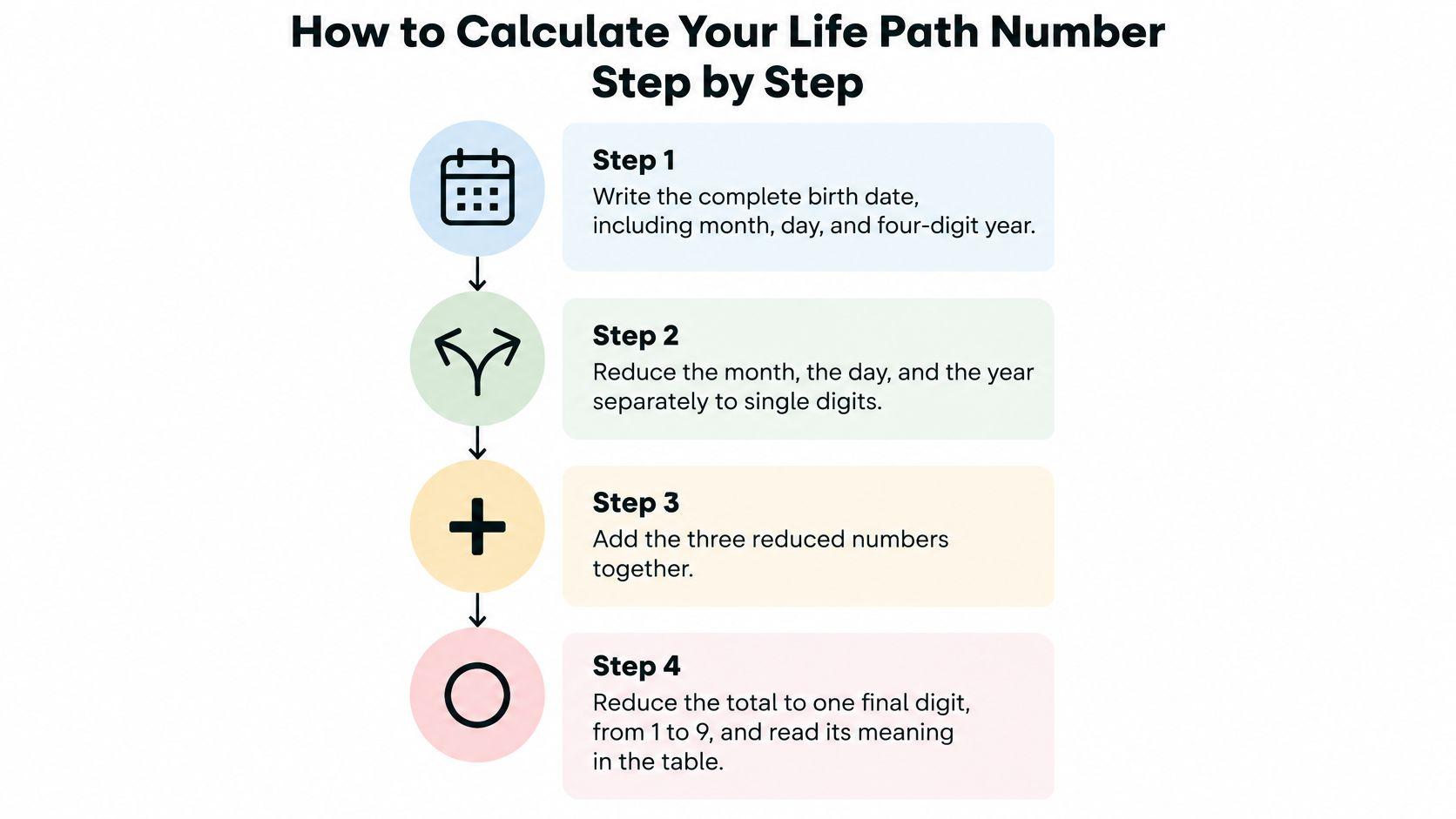
The following visual offers an overview, but its separate-reduction instructions differ from Millman's documented method. Use the written calculation above to retain the correct original total.
Check with another example
For a hypothetical birthday of 2 July 2003, write 02/07/2003. Adding 0 + 2 + 0 + 7 + 2 + 0 + 0 + 3 gives 14; adding 1 + 4 gives 5, producing 14/5.
Reducing the month, day, and year separately can leave you with the same final digit while losing the original total used for the full reading. That's why arriving at a plausible-looking single digit isn't a sufficient check.
Calculation check: Your finished note should contain the complete date, the digit-by-digit addition, the original total, and the reduced result.
If your arithmetic differs from the app's result, check the entered date and recalculate before interpreting anything. A transcription error doesn't need a spiritual explanation.
What Each Core Digit Means in Your Reading
| Digit | Primary Meaning |
|---|---|
| 1 | Creativity and confidence |
| 2 | Cooperation and balance |
| 3 | Expression and sensitivity |
| 4 | Stability and process |
| 5 | Freedom and discipline |
| 6 | Vision and acceptance |
| 7 | Trust and openness |
| 8 | Abundance and power |
| 9 | Integrity and wisdom |
These are the primary meanings of the nine single digits listed in the published description of Millman's earlier edition. They form the interpretive vocabulary of Dan Millman's The Life You Were Born to Live and the Life Purpose App, not a set of independently validated psychological traits.
Read the combination, not just the row
The book describes the entire birth number as a blend of energies, with the final digit or digits identifying the primary life purpose. In practical terms, the table is an entry point, not the complete reading.
For the worked example ending in 4, the relevant pair is stability and process. A reader might ask whether they build useful routines, rush past necessary preparation, or stay with familiar arrangements after those arrangements stop helping.
The original total still matters when locating the complete description in the book. Don't assume that everyone sharing a final digit receives an identical interpretation, or build a full reading merely by combining the table's words yourself.
Turn a theme into a question
Paired terms are more useful when you examine the tension between them. Freedom without discipline might suggest a question about follow-through; discipline without freedom might prompt a question about flexibility. Those are possible avenues for reflection, not conclusions about the person reading them.
Look for a concrete situation rather than a flattering summary. For example, being dependable at work doesn't automatically mean you maintain helpful routines at home.
- Name the fit. Write down a theme and a specific experience that seems to support it.
- Keep the mismatch. Record a theme that doesn't describe you, without trying to force an explanation.
- Choose a question. Turn the most relevant theme into something you can examine through your behavior.
Finish by noting two themes that feel accurate and one that doesn't. You're allowed to disagree with a description; your disagreement belongs in the reflection too.
Nine-Year Cycles and Where You Stand Now
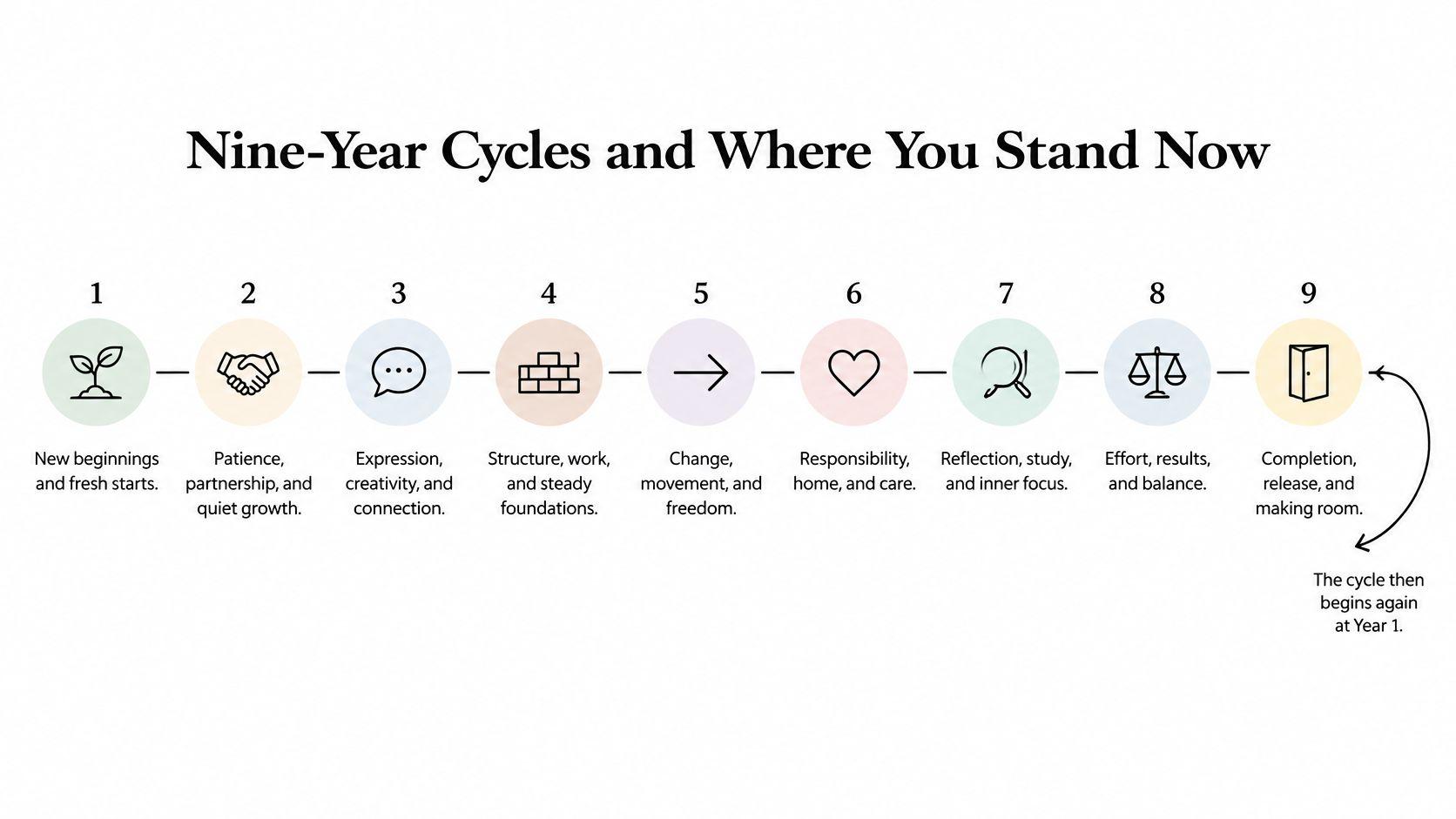
Position 1 → Position 2 → Position 3 → Position 4 → Position 5 → Position 6 → Position 7 → Position 8 → Position 9 → repeat
The revised edition's description identifies nine-year cycles as a defined part of Dan Millman's The Life You Were Born to Live, the framework followed by the Life Purpose App. It says the book explains how to identify your current position and work with the cycles.
Use timing as context
The visual summarizes a progression from beginnings toward completion. Treat its short captions as an orientation, and consult the book for its actual descriptions rather than assuming an infographic reproduces the author's full wording.
Suppose you change jobs during a period you interpret as emphasizing change. You can compare that theme with your decision, but the useful details remain concrete: your working conditions, financial needs, available opportunities, and reasons for leaving.
Your birth number stays the same while the cycle position changes. Within the system, that lets you consider a continuing personal theme alongside a changing yearly emphasis.
Work from the book's procedure
- Identify your current position using the book's cycle section. Don't substitute the birth-number calculation for the cycle-position method. They answer different questions.
- Read the matching description alongside your full reading. Cross-check the Life Purpose App's interpretation against Dan Millman's text.
- Examine a recent decision. Write down a decision from the past year and consider whether the cycle language describes it, misses it, or could fit many different events.
Our discussion of life-cycle transitions offers another place to consider change without turning it into a deadline.
A cycle description is a reflection prompt, not a timetable requiring you to resign, move, marry, or finish something.
Relationship Compatibility as a Conversation, Not a Verdict
A compatibility reading is most useful when both people can disagree with it. Dan Millman's The Life You Were Born to Live discusses a composite number and relationship path built from two birth dates; the Life Purpose App follows that book-based framework.
The practical question isn't whether a description declares you compatible. It's whether discussing it helps you understand how you treat each other.
Give both people a voice
Start with each person's individual description from the book. Let each person say what fits before interpreting them through a relationship reading.
- Read separately first. Each person should have room to respond without being corrected by the other.
- Compare agreement and disagreement. Keep both on the page instead of selecting only the similarities.
- Translate themes into behavior. Discuss communication preferences, boundaries, shared goals, and what happens after an argument.
- Ask permission. A reading about someone else shouldn't become a label imposed on them without their involvement.
Our guide to compatibility matches can provide context for that discussion. Keep the conversation focused on what each person recognizes and is willing to examine.
Make conflict repair concrete
Suppose one person wants to resolve an argument immediately, while the other needs quiet before talking. A broad description might give them language for that difference, but it doesn't resolve the practical problem.
They could agree that either person may request a pause, provided they also agree on when to return to the conversation. That arrangement can be observed and adjusted; a label such as incompatible can't tell them whether they've learned to repair disagreements.
For the evidence question, use the standards discussed under responsible use below rather than treating a feeling of recognition as proof of a match.
A partner, colleague, child, or public figure is never reducible to a calculated description. Don't use a compatibility reading to justify coercion, exclusion, hiring decisions, or ending a relationship. Consider actual conduct, consent, safety, and circumstances.
Limits of a Life Path Reading and Responsible Use
Numerology hasn't demonstrated reliable predictive ability under standards such as peer review, replication, reliability, and validity, as Africa Check's examination of numerology explains. Tests of birth-number claims discussed in such coverage have produced results consistent with chance, rather than dependable prediction.
That distinction applies when using Dan Millman's The Life You Were Born to Live and the Life Purpose App: a reproducible calculation doesn't establish a scientifically valid interpretation. Arithmetic can determine the same result each time without proving that the result predicts personality, relationships, or future events.
Why a description can feel personal
Confirmation bias can lead you to notice matching details and overlook contradictions. The Barnum or Forer effect describes how broad statements can feel uniquely applicable even when they could describe many people.
Neither reaction means you're foolish. It means a strong feeling of recognition isn't enough to establish accuracy.
Use a short test before accepting an interpretation:
- Find a specific example. Can you name an event or repeated behavior that matches?
- Look for broad wording. Could this flattering or flexible description fit almost anyone?
- Test the opposite. What experience contradicts it?
- Compare with existing knowledge. Does it add a useful question, or restate what you already believe?
Keep the benefit proportionate: A worthwhile journal entry is evidence that reflection helped you, not that your birth date caused an outcome.
The system may support journaling, values clarification, or conversation. Frame those benefits as possible effects of reflection, not proof of prediction.
A reading is never a substitute for medical, mental-health, legal, or financial advice. If you face a decision in one of those areas, speak with a qualified professional who can assess your actual circumstances.
Start Your Own Life Path Reflection This Week
Try a modest routine with Dan Millman's The Life You Were Born to Live and the Life Purpose App. You don't need to settle your purpose in a sitting; you need an honest record of what you notice.
- Calculate carefully. Write out your birth date and retain both the original total and reduced digit. Keep the arithmetic visible so you can check it.
- Read the full description. Use the table as an entry point, then consult the book rather than stopping at a pair of keywords.
- Write for ten minutes. Consider what matches your experience, what doesn't, and what surprises you. Don't edit out disagreement to make the reading seem more accurate.
- Check your cycle position. Use the book's method and connect the description with a decision you're considering. Include the practical circumstances affecting that decision.
- Invite another perspective. Share your notes with someone you trust and ask what they recognize. Ask for examples, not a simple endorsement.
Continue without forcing a conclusion
Our Life Purpose App provides a place to continue this book-based reflection while you keep your observations in a notebook or separate document. The basic version is free and will always remain free, and it includes a summary of your life path and an overview of the Life Purpose System.
Choose a small action based on what you've learned about your behavior. If you notice unfinished commitments, select something manageable to complete; if you notice difficulty expressing a need, prepare for a specific conversation.
Afterward, record what happened. Did the action help, and would you choose it again? That gives you something firmer to evaluate than whether a description sounded persuasive.
A useful life path foundation leaves room for your history, relationships, constraints, and choices. Use the reading to prompt reflection, not to replace professional advice or surrender responsibility for a decision.
Explore Life Purpose App for a birth-date reading grounded in Dan Millman's The Life You Were Born to Live. Start with your summary, keep notes on what fits and what doesn't, and choose a practical question to explore this week.
Discover your life path today
Enter your date of birth and see your life path, free.
Find your life path