If you’ve arrived at life path number 7, you’ve likely felt slightly out of step with the world for a long time. This guide, based on Dan Millman’s system, clarifies the seeker’s strengths, common traps, and practical habits that let your depth become a living practice rather than a retreat.

May 21, 2026 (6mo ago) — last updated November 13, 2026 (11d ago)
Life Path 7: Meaning, Gifts, Challenges & Purpose
A practical guide to Life Path 7: meaning, gifts, challenges, and daily practices—based on Dan Millman’s system.
← Back to blog
If you’ve arrived at life path number 7, you’ve likely felt slightly out of step with the world for a long time. This guide, based on Dan Millman’s system, clarifies the seeker’s strengths, common traps, and practical habits that let your depth become a living practice rather than a retreat.
Life Path 7: The Seeker’s Guide to Purpose
Summary: Discover the deep meaning of Life Path Number 7. This guide, aligned with Dan Millman’s system, explores your gifts, challenges, and practical steps to live with purpose.
Introduction
If you’ve arrived at life path number 7, you’ve likely felt slightly out of step with the world for a long time. You were the child who kept asking why, the friend who needed quiet after social noise, the adult who refused surface answers. Life Path 7 isn’t a label meant to confine you, it’s a map for recurring lessons, gifts, and blind spots—especially as described in Dan Millman’s work1.
This guide clarifies the seeker’s strengths, common traps, and concrete habits that let your depth become a living practice rather than a retreat.
Do You Feel a Deeper Calling?
You may listen more than you speak in a group, then ask one question that shifts the conversation. You may spend years reading psychology, spirituality, or philosophy because something inside keeps reaching for pattern and meaning. That inner pull is common for people on Life Path 7.
Many 7s notice this tendency early: you sense complexity where others see simple answers, and you need alone time to process an active inner life. Without that space you can feel overloaded, irritable, or disconnected.
Why this path often feels lonely at first
A 7 often grows up asking, “Why does everyone else accept simple explanations?” That can create self-doubt and the sense you’re too private or too serious. The issue usually isn’t that something’s wrong. Your nature is oriented toward inquiry. Millman frames the life path as developmental rather than fixed, which reframes solitude and introspection as stages of growth rather than permanent deficits1.
“You don’t need to force yourself into a more outward style to be valid. You need to learn how your nature works, then live it consciously.”
A more useful question than What am I
Rather than debating labels, ask:
- Where does my search for truth help me?
- When does my need for space become avoidance?
- How can I stay open while honoring my depth?
That turns personality description into usable practice, which is where Millman’s system and practical tools add value1.
The Core Meaning of Life Path 7
At its heart, Life Path 7 is the seeker’s path: intuition, spiritual inquiry, analysis, and inner trust. Numerology overviews often link 7 with study, introspection, and spiritual inquiry rather than outward status or material achievement2.
The spiritual detective
Think of the 7 as a spiritual detective. You gather clues, test assumptions, and look beneath appearances. That investigation happens in both outer and inner life, a balance between analytic mind and inner sensing.
A healthy 7 builds a bridge between those currents: discernment plus surrendered trust.
This is a path, not a fixed label
Millman’s perspective treats the life path like a curriculum. If you’re a 7, your lessons often center on discernment, reflection, inner trust, and honest searching. That explains common experiences:
- Why shallow conversation drains you — you want substance, not noise.
- Why solitude can feel nourishing — your mind and spirit need uninterrupted space.
- Why you may question everything — truth matters more than reassurance.
What often confuses 7s
Confusion arrives when distance is mistaken for wisdom. Insight can coexist with emotional defense. You can know many spiritual ideas and still struggle to trust life directly. Practical test: if insight helps you live more honestly, it’s wisdom; if it keeps you guarded, it’s protection dressed as wisdom.
Understanding Your Spiritual Laws
The 7 path often wrestles with caution versus surrender. Millman’s work points beyond personality to the spiritual laws you’re meant to practice: trust, rhythm, and right timing1.

Experts note that 7s do best with depth-first experiences like long-form learning and private reflection, and that they thrive with partners who respect alone time while engaging in substantive conversation3.
Trust is not the same as naivety
Trust doesn’t mean abandoning discernment. It means moving forward without absolute certainty when reflection has given you enough clarity. An unbalanced 7 can remain in observation mode and miss life while waiting for a cleaner signal.
Healthy trust sounds like, “I’ve reflected enough. Now I’m willing to participate.”
Openness is a discipline
Openness asks for risk. It may mean speaking a feeling before you’ve fully analyzed it, letting someone care without endless testing, or sharing a half-formed insight instead of hiding it until it’s perfect.
Making openness a practice helps your depth become lively rather than defensive.
How these laws look in ordinary life
Practical habits that help a 7 grow include:
- Choosing contact after reflection rather than disappearing into endless processing
- Naming a feeling directly rather than explaining it from every angle
- Letting a partner in without requiring them to decode silence
- Acting on intuition after reasonable thought, instead of distrusting intuition outright
“The 7 path softens when privacy becomes conscious solitude rather than emotional exile.”
Your Key Gifts and Challenges
Strengths and traps live close together for a 7. A gift overused becomes a liability.
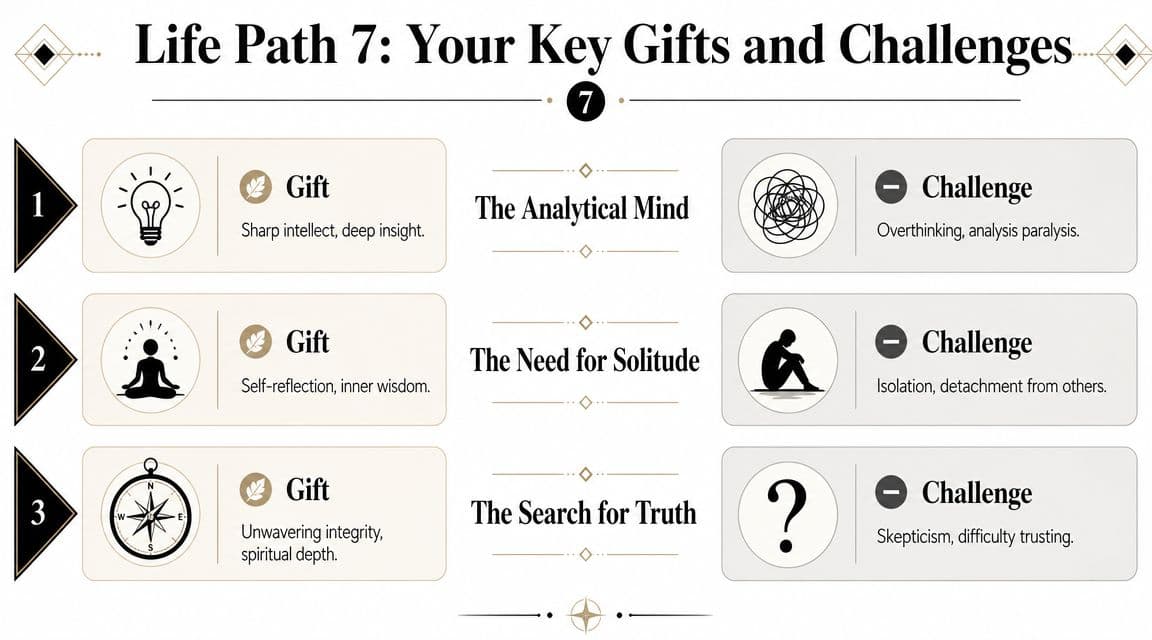
The analytical mind
Your analytical mind notices patterns and reaches insights others miss. That makes you thoughtful and precise. The problem arises when analysis replaces living: overthinking conversations, delaying decisions, or turning small choices into long internal debates.
The need for solitude
Solitude restores clarity and lets you process at the depth you need. But solitude becomes withdrawal when it avoids relationship or responsibility.
“The question is not whether you need solitude. You do. The question is whether your solitude is feeding your life or replacing it.”
The search for truth
Truth-seeking gives you integrity and depth. Left unchecked it can slide into suspicion, testing others too often or rejecting experiences that can’t be fully explained beforehand.
A simple way to spot imbalance
| Trait | Gift when balanced | Challenge when overused |
|---|---|---|
| Analysis | Discernment and insight | Paralysis and rumination |
| Solitude | Reflection and renewal | Isolation and detachment |
| Truth-seeking | Integrity and depth | Cynicism and guardedness |
Notice where you felt relief and where you felt exposed in that table; it often points to your current lesson.
Navigating Career, Money, and Relationships
7s do best where depth is respected. Career profiles for 7 often include research, investigation, teaching, and spiritual guidance — roles that reward sustained concentration and insight rather than constant outreach4.
Career that fits your wiring
Work that allows independent thinking and long-form study tends to feel meaningful: research, investigative roles, counseling, teaching, and spiritual work. Roles demanding nonstop networking or emotional performance can drain you, even if you’re capable.
See related guides on numerology basics and relationships and numerology.
Money and the 7 mindset
Many 7s prioritize meaning over status. Financial steadiness gives space for study, reflection, and choice. Think of money as structure that supports your inner life rather than identity.
Ask not “How much should I want?” but “What financial foundation helps me live truthfully and calmly?”
Relationships that breathe
Relationships test the 7 path. You may want closeness yet pull away from noise or demand. A healthier pattern includes:
- Space without punishment
- Conversation with substance
- Respect for privacy
- Warmth that doesn’t force disclosure
A 7 relationship works best when both people understand privacy isn’t rejection and silence doesn’t replace honesty.
Your Nine-Year Cycles and Compatibility
Millman’s system frames life in repeating phases. A 7 often experiences inward seasons of study and retreat followed by seasons asking for greater expression and contact. Neither season is wrong, they’re part of a larger pattern1.
Why timing matters for a 7
You may feel inconsistent if you don’t honor cycles. Some seasons demand reflection, others demand action. Recognizing the difference between a natural inward phase and a protective shutdown is essential.
Compatibility as a dynamic, not a score
Compatibility isn’t about finding a perfect number. It’s about how energies interact around meaning, privacy, and sincerity.
| Life Path Number | Dynamic with a 7 |
|---|---|
| 1 | Mutual independence possible, but communicate deliberately |
| 2 | Warmth and sensitivity, though reassurance may be needed |
| 3 | Brings lightness, may feel too outward if depth is missing |
| 4 | Practical grounding and steadiness |
| 5 | Curiosity and movement, pace may feel restless |
| 6 | Care and commitment, but 7 may need breathing room |
| 7 | Deep mutual understanding, though both may retreat |
| 8 | Structure and focus, emotional styles may differ |
| 9 | Shared idealism and meaningful conversation |
Compatibility improves when a 7 feels safe enough to stay present instead of retreating into private interpretation.
Practical Steps for a Fulfilled Life Path 7
Most writing about Life Path 7 stops at description. The practical question is how to honor inward nature without disappearing into it. The steps below translate insight into habits.
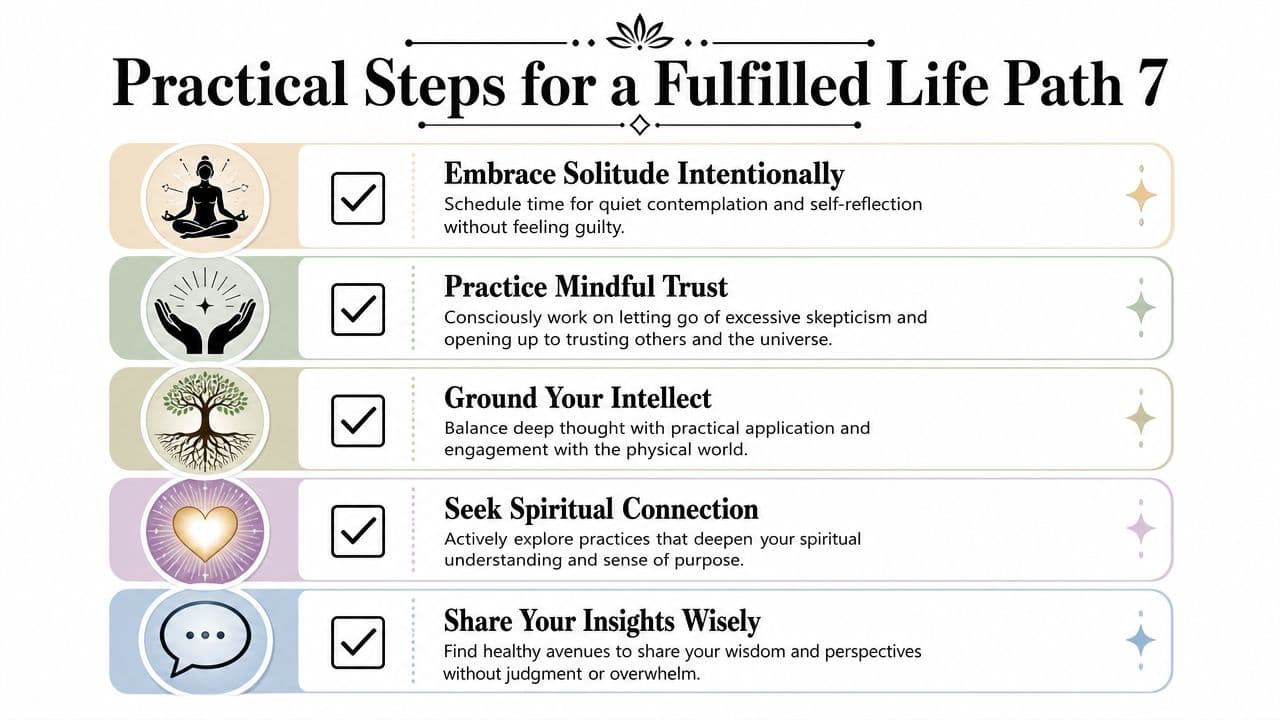
Make solitude intentional
Choose regular, honest solitude before you’re overwhelmed. A quiet walk, journaling, meditation, or device-free reflection helps. The point is conscious return rather than avoidance.
Give your mind a stopping point
Set boundaries for reflection:
- Set a decision window, then act
- Write the core question instead of circling related ones
- Move your body after deep thinking to ground insight
Practice sharing before you feel fully ready
You don’t need to reveal everything. But if you wait for perfect organization, people may never hear your truth.
Try small steps:
- Tell a partner you need quiet and why
- Say, “I’m still sorting this out, but I want to let you in”
- Offer one real sentence instead of a polished explanation
Use symbols and environments that calm you
A physical reminder can anchor inward energy: a journal, a meditation corner, or a meaningful object placed where you read or sit quietly.
Let insight become service
Share your understanding in usable ways: writing, mentoring, teaching, careful listening, or creating tools that help others see clearly.
Practical tools can help you move from description to daily observation. The Life Purpose App translates Millman’s system into a digital companion for exploring life path, spiritual laws, relationships, and nine-year cycles5. The wellness and self-care app market has grown steadily in recent years, making digital companions a common part of long-term practice6.
You don’t need to become less deep to live well as a 7. You need rhythm: solitude and contact, thought and trust, insight and embodiment.
Questions & Answers
Q: How can I tell if my solitude is healthy or avoidance?
A: Healthy solitude is intentional and restorative; it has a clear purpose and a plan for reengagement. Avoidance feels reactive, prolonged, and isolates you from responsibilities or intimacy.
Q: What careers suit a 7 without sacrificing stability?
A: Roles that reward independent thinking and long-term focus—research, investigation, counseling, teaching, or contemplative service—often fit. Look for positions that allow concentrated periods of work and fewer constant outreach demands.
Q: How do I practice openness without losing my depth?
A: Start small: speak one honest sentence, name a feeling before explaining it fully, or invite a partner into a half-formed thought. Openness is a skill practiced in low-stakes moments.
If you want to explore your path in a book-accurate, interactive way based on Dan Millman’s system, the Life Purpose App gives tools to examine life path, spiritual laws, relationships, and nine-year cycles in one place5.
1.
Dan Millman, The Life You Were Born to Live, [https://www.amazon.com/Life-You-Were-Born-Live/dp/1577314028](https://www.amazon.com/Life-You-Were-Born-Live/dp/1577314028).
2.
Astrostyle, “Life Path 7 Overview,” https://astrostyle.com/astrology/numerology/life-path-7/.
3.
Mindbodygreen, “Life Path Number 7,” https://www.mindbodygreen.com/articles/life-path-number-7.
4.
Centre of Excellence, “Life Path Number 7 Profile,” https://www.centreofexcellence.com/life-path-number-7/.
5.
Life Purpose App, https://lifepurposeapp.com.
6.
Market context for wellness and self-care apps: Statista, “Health & Fitness Apps — statistics & facts,” https://www.statista.com/topics/962/health-and-fitness-apps/.
Discover your life path today
Enter your date of birth and see your life path, free.
Find your life path