Discover life path number 6 meaning in Dan Millman's system. Learn core gifts, challenges, career, relationships, and cycles for the 6 path.

September 25, 2026 (27d ago)
Life Path Number 6: Meaning, Gifts, and Real Challenges
Discover life path number 6 meaning in Dan Millman's system. Learn core gifts, challenges, career, relationships, and cycles for the 6 path.
← Back to blog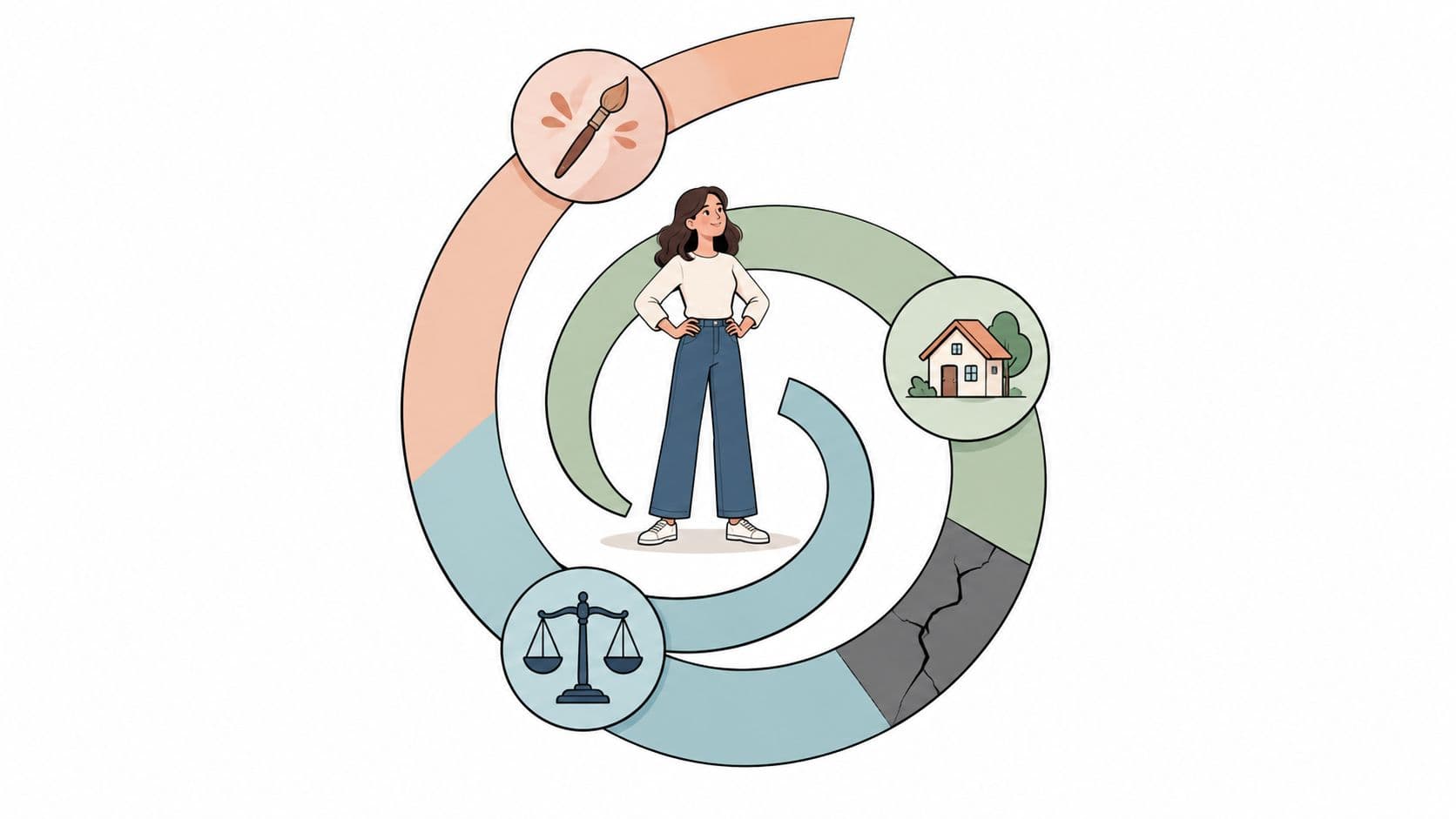
Discover life path number 6 meaning in Dan Millman's system. Learn core gifts, challenges, career, relationships, and cycles for the 6 path.
You agree to water a friend's plants while they're away, then find yourself rearranging the room, correcting the crooked shelves, and mentally redesigning the entire apartment. Your friend returns grateful for the healthy plants, but you're irritated that they didn't notice everything else you did. If this feels familiar, the important question isn't just whether you're caring. It's why your care so quickly turns into responsibility, judgment, or resentment.
In Dan Millman's The Life You Were Born to Live, life path number 6 is defined as “Vision and Acceptance.” The path isn't just about family, service, or creating harmony. It's about learning what happens when a powerful inner vision meets an imperfect world, and how high ideals can become useful without becoming a private prison. The Life Purpose App presents this system as a practical way to explore those patterns, but the most valuable reading is the one you test against ordinary choices.
When High Standards Start to Hurt
The apartment is tidy when your friend leaves, but not tidy in the way you'd arrange it. While watering the plants, you notice a chair blocking the light, books stacked unevenly, and a side table that would work better near the window. You move one thing, then another. Soon, you're reorganizing the room with the concentration of someone solving a problem no one asked you to solve.
Your friend comes home and thanks you for taking care of the plants. You smile, but part of you thinks, “After everything I did, they didn't even notice.” The resentment doesn't arrive because you helped. It arrives because you silently expanded the assignment, expected recognition for the expansion, and never told anyone what you needed.
This is a useful way to understand life path number 6 in Dan Millman's The Life You Were Born to Live. The 6 often has a finely tuned sense of how things could be. A room can feel more welcoming. A family conversation can be fairer. A workplace process can be more humane. A relationship can become more honest and balanced. That clarity can be a genuine gift, especially when it helps someone see possibilities they'd overlooked.
The gift before the strain
Early in life, this vision may feel like competence. You notice what's missing and supply it. You remember the birthday, prepare the spare meal, improve the presentation, or step into a tense conversation before it becomes a crisis. People learn that they can rely on you.
The difficulty begins when your eye for improvement becomes a measure of other people's worth. The same vision that spots disorder starts evaluating those who tolerate it. A colleague who accepts an inefficient process may look careless. A partner who doesn't anticipate your needs may seem indifferent. You may compare your own work with the most accomplished people you can find and treat one mistake as more important than many successes, a pattern described in summaries of Millman's teaching such as this overview of Dan Millman's system.
A useful distinction: Seeing what could improve doesn't automatically make you responsible for improving it.
The central tension is simple to name and difficult to practice. Vision tells you what seems ideal. Acceptance asks you to work with what exists. For a 6, growth doesn't require abandoning standards or pretending that poor behavior is acceptable. It requires separating a clear value from the demand that every person, room, and outcome satisfy your preferred design.
That distinction will shape every practical question that follows, from how you calculate the path to how you handle work, intimacy, money, and service.
How Dan Millman's 45-Path System Arrives at the Number 6
Dan Millman's The Life You Were Born to Live uses a publication-specific system of 45 distinct life paths, rather than treating every birth date as a simple journey toward one of the familiar single-digit descriptions. The revised 25th Anniversary Edition was expanded to cover all forty-five birth numbers, as described in the Apple Books edition listing. The Life Purpose App offers a fuller explanation of how this system differs from a generic single-digit reading.
The calculation begins with your full birth date. Add every digit to reach a total, then locate that result within Millman's 45-path map. The point isn't to turn self-knowledge into arithmetic. The calculation gives you a profile to examine, while the interpretation asks whether its themes describe patterns you can recognize and work with.
For example, someone born on 06/14/1986 adds the digits of the complete date:
0 + 6 + 1 + 4 + 1 + 9 + 8 + 6 = 35
That total doesn't produce life path 6 in Millman's complete 45-path method, so the example demonstrates an important caution: a final single-digit reduction isn't enough to identify a Millman path. The full total matters. A date that reaches the published 6 outcome belongs to the 6 profile because of its position in the broader map, not merely because its digits can eventually be reduced to 6.
The system also discusses three interpretive elements, commonly described as birth, growth, and essence. They provide different angles on the person's development and help place the path within a larger matrix rather than treating the number as a complete personality diagnosis.
How the three numbers build a 45-path matrix
| Element | What It Represents | How It Contributes to the 6 Path |
|---|---|---|
| Birth | The starting pattern shown by the birth date | Establishes the entry point for exploring vision, duty, and acceptance |
| Growth | The developmental movement within the path | Shows how rigid standards can become perspective and grounded action |
| Essence | The deeper quality expressed through the pattern | Connects service and fairness with authenticity and realistic commitment |
In Millman's framework, life path 6 is associated with vision, beauty, justice, fairness, authenticity, duty, and commitment. The Life Purpose App provides a fuller explanation of how this system differs from a generic single-digit reading.
The Core Gifts and the One Challenge That Shapes Everything
A 6 often notices the difference between an acceptable result and a meaningful one. That difference can show up in visual details, moral questions, or the way people treat each other. Dan Millman's The Life You Were Born to Live connects the path with Vision and Acceptance, a pairing that explains both its strengths and its friction.
Vision gives the 6 a practical imagination
You may walk into a room and immediately sense how it could feel warmer, calmer, or more functional. You might rearrange furniture until conversation becomes easier, or choose colors and objects that make visitors feel welcome. This isn't only decoration. For the 6, beauty often carries an ethical dimension. A well-considered environment can communicate dignity, belonging, and care.
The same ability applies to systems. At work, you may notice that a confusing process disadvantages new employees or leaves customers without clear support. You don't just see the inefficiency. You see the human cost and want to repair both.
Justice and fairness add another layer. A 6 may speak up when someone is overlooked, distribute responsibilities more evenly, or question a rule that protects convenience rather than people. Duty gives these ideals persistence. Once you've committed, you're inclined to follow through, even when nobody is watching.
The problem isn't caring deeply
The central challenge is the gap between the standard inside you and the capacity, priorities, or willingness of other people. You may know exactly how a project could improve, but your colleagues may have different constraints. You may understand what would make a relationship healthier, while your partner may not share your timing or approach.
Millman's teaching frames acceptance as the developmental task. The Life Purpose App summary of the 6 path describes the work as reconciling ideals with reality and reducing judgment rather than insisting that life conform to an imagined perfect version.
That gap affects confidence first. If you focus on the one mistake in an otherwise successful day, your achievements become difficult to feel. It affects relationships next, because advice can sound like criticism when the other person hasn't asked for correction. It can even affect identity. You may start believing you're valuable only when you're improving, rescuing, organizing, or being needed.
The grounded version of acceptance: Keep the value. Release the fantasy that you can control every person and outcome that matters to you.
Acceptance doesn't mean lowering every standard. It means choosing which standards express your principles and which ones merely express discomfort with difference. A 6 becomes more effective when discipline serves reality instead of trying to overpower it.
Life Path 6 in Career, Relationships, Health, and Money
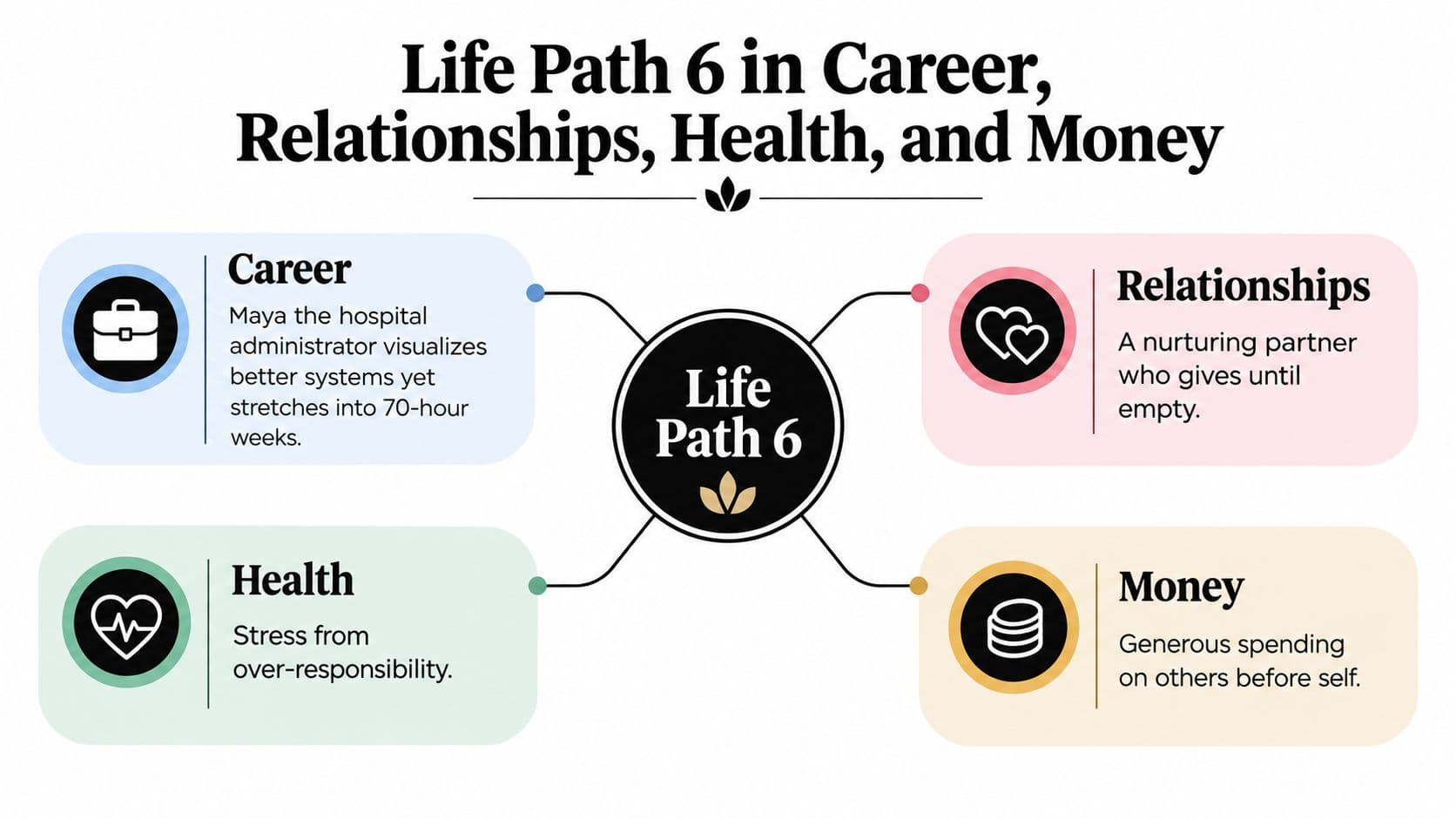
Maya works as a hospital administrator. She can see how a better intake process would reduce confusion for patients and relieve pressure on staff. She redesigns the forms, coaches the team, and fills gaps when someone calls in sick. Her work has meaning, but her sense of duty keeps expanding until she's working 70-hour weeks. The problem isn't that she chose a caring profession. It's that she made every unmet need her personal assignment.
Life path number 6 can thrive where beauty, justice, responsibility, and care meet. That may include design, counseling, teaching, healthcare, hospitality, or community leadership. The job title matters less than whether the role lets you improve real conditions without requiring you to absorb every problem around you.
Four places where the pattern becomes visible
Career. A 6 often becomes the person who notices both the broken process and the discouraged person inside it. That combination can make you a thoughtful teacher, counselor, healthcare worker, designer, host, or community leader. Protect your contribution by defining the edge of your role. “I can improve this process” is sustainable. “I must personally fix every consequence” isn't.
Relationships. Consider the loyal partner who remembers every birthday, handles practical details, and checks in after a difficult day. If they never say what they need, their generosity can turn into a private ledger. When the partner fails to offer equivalent care, affection becomes evidence in an imagined trial. A healthier pattern replaces silent scoring with direct requests, shared responsibility, and room for the other person to care differently.
If recurring resentment is affecting a partnership, professional support can help both people distinguish care from control. Someone looking specifically for local relationship support may want to find a Kelowna couples therapist who can help turn unspoken expectations into a conversation.
Health. Stress can become physical before a 6 admits they're angry or overextended. Throat tightness, shoulder tension, and skin flare-ups may accompany the strain of holding back criticism or carrying too much responsibility. These signs aren't proof of a numerological cause, and medical concerns deserve appropriate clinical attention. As a reflective prompt, though, ask what you haven't said, what you've agreed to reluctantly, and where rest has become conditional on everything being finished.
Money. A 6 may earn steadily, give generously, and spend on other people before checking what remains for personal security. The bewilderment arrives later, when generosity feels natural but an empty savings account feels inexplicable. Stabilization doesn't require becoming cold. Separate planned generosity from impulse rescue, set a personal baseline before offering more, and pause before treating someone else's emergency as your financial duty.
In each domain, the useful question is the same: Am I expressing a value, or am I trying to control an outcome?
The Shadow Side of Service That Most Profiles Skip
Many descriptions of life path number 6 stop at nurturing, responsibility, and family harmony. That portrait misses the harder question identified by an independent discussion of boundaries and life path 6: a birth-date calculation can't prove that someone is naturally nurturing, that help is wanted, or that caretaking is healthy.
Two people notice that a friend is struggling. The first asks, “What kind of support would help?” The friend says they need company, not solutions, so the helper listens and leaves the decision with them. The second helper takes over, makes calls, reorganizes the friend's schedule, and becomes exhausted while insisting it's all for love.
Both people may care. Only one has checked consent and capacity.
Three forms of service that quietly become self-erasure
Over-functioning means doing for others what they could reasonably do themselves. You answer the email, solve the disagreement, make the appointment, or take over the task because your method seems more reliable. Short-term efficiency can create long-term dependency, and it can deprive the other person of confidence.
Quiet martyrdom turns sacrifice into an unspoken claim. You give without negotiating, keep track of what you've surrendered, then feel betrayed when nobody repays a debt they didn't know existed. The suffering becomes a form of currency for belonging.
Lost boundaries begin with a harmless yes. One favor becomes a pattern, and the pattern becomes an expectation. Eventually, generosity is replaced by resentment, yet saying no still feels selfish.
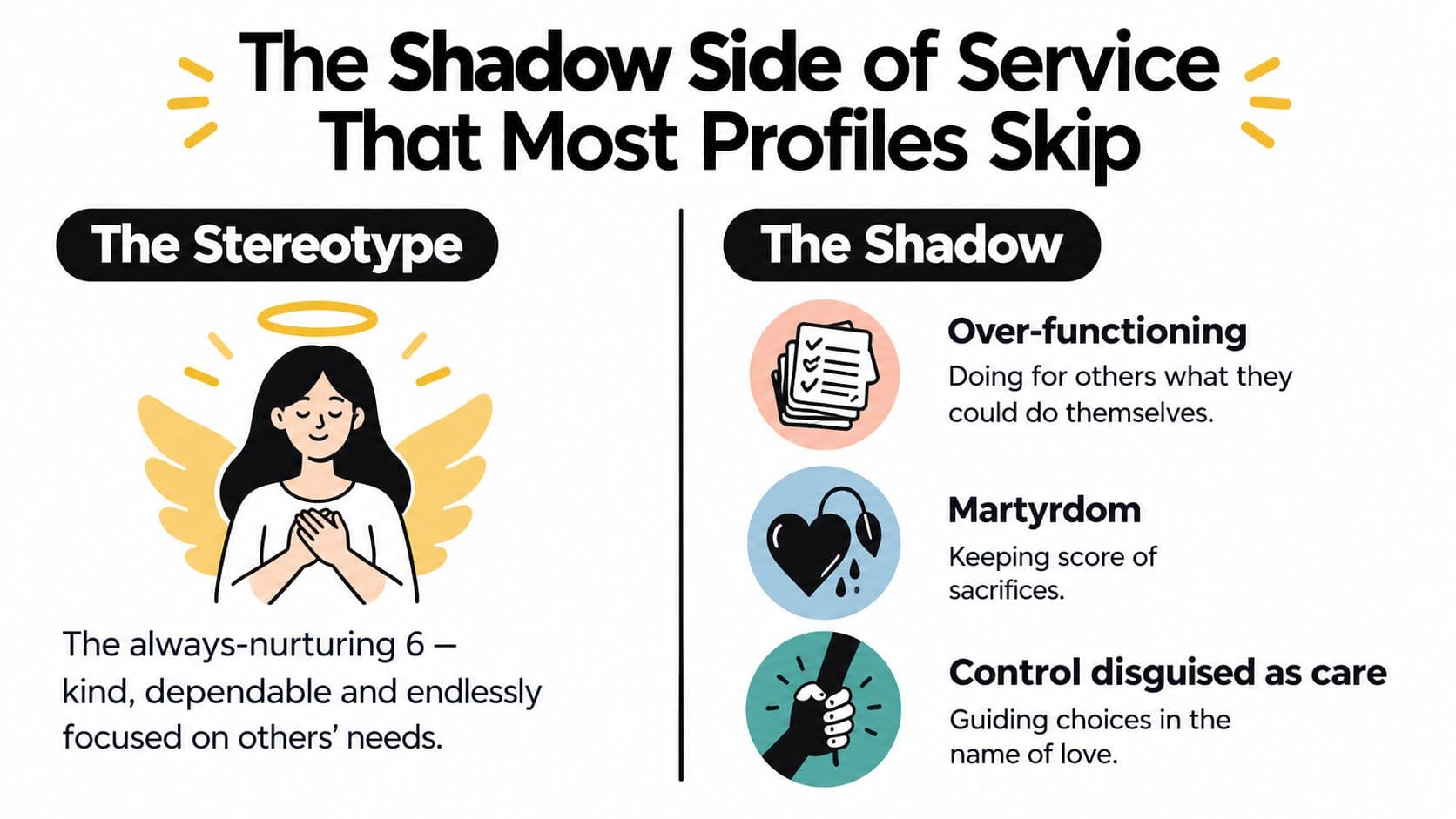
The 6's high standards can intensify all three shadows. When reality fails to match your vision, criticism may appear as concern. “I'm only trying to help” can conceal a demand that another adult make the choice you would make.
A boundary doesn't reject service. It gives service a healthier shape.
- Ask first: Find out whether help is wanted and what form it should take.
- Name the limit: State what you can offer without promising unlimited availability.
- Return responsibility: Let capable adults experience the consequences of their own decisions.
- Check the motive: Notice whether you're helping freely or trying to secure appreciation, compliance, or closeness.
Service protects dignity when it supports another person's agency, not when it replaces it.
The mature expression of 6 care comes from fullness rather than obligation. You can remain generous while allowing people to disagree, struggle, learn, and solve problems without your supervision.
Nine-Year Cycles and What 2026 Means for a 6
In Dan Millman's The Life You Were Born to Live, nine-year cycles offer a timing framework. Each year carries a different emphasis, so the same goal can feel natural in one phase and burdensome in another. Your life path describes a developmental theme, while the cycle suggests the season in which that theme is being expressed.
The sequence moves through these broad phases:
- Year 1, initiation: Begin, decide, and place a new seed in the ground.
- Year 2, planting: Build patience, cooperation, and early support.
- Year 3, growth: Develop ideas, relationships, and creative momentum.
- Year 4, foundation: Create structure and make the work durable.
- Year 5, change: Adapt, experiment, and respond to movement.
- Year 6, nurture: Tend commitments, relationships, and responsibilities.
- Year 7, reflection: Review, study, and listen before pushing forward.
- Year 8, harvest: Gather results and handle influence responsibly.
- Year 9, completion: Finish, release, and make space for what follows.
The Life Purpose App’s nine-year cycle guide gives readers a fuller explanation of how the sequence can be used for reflection.
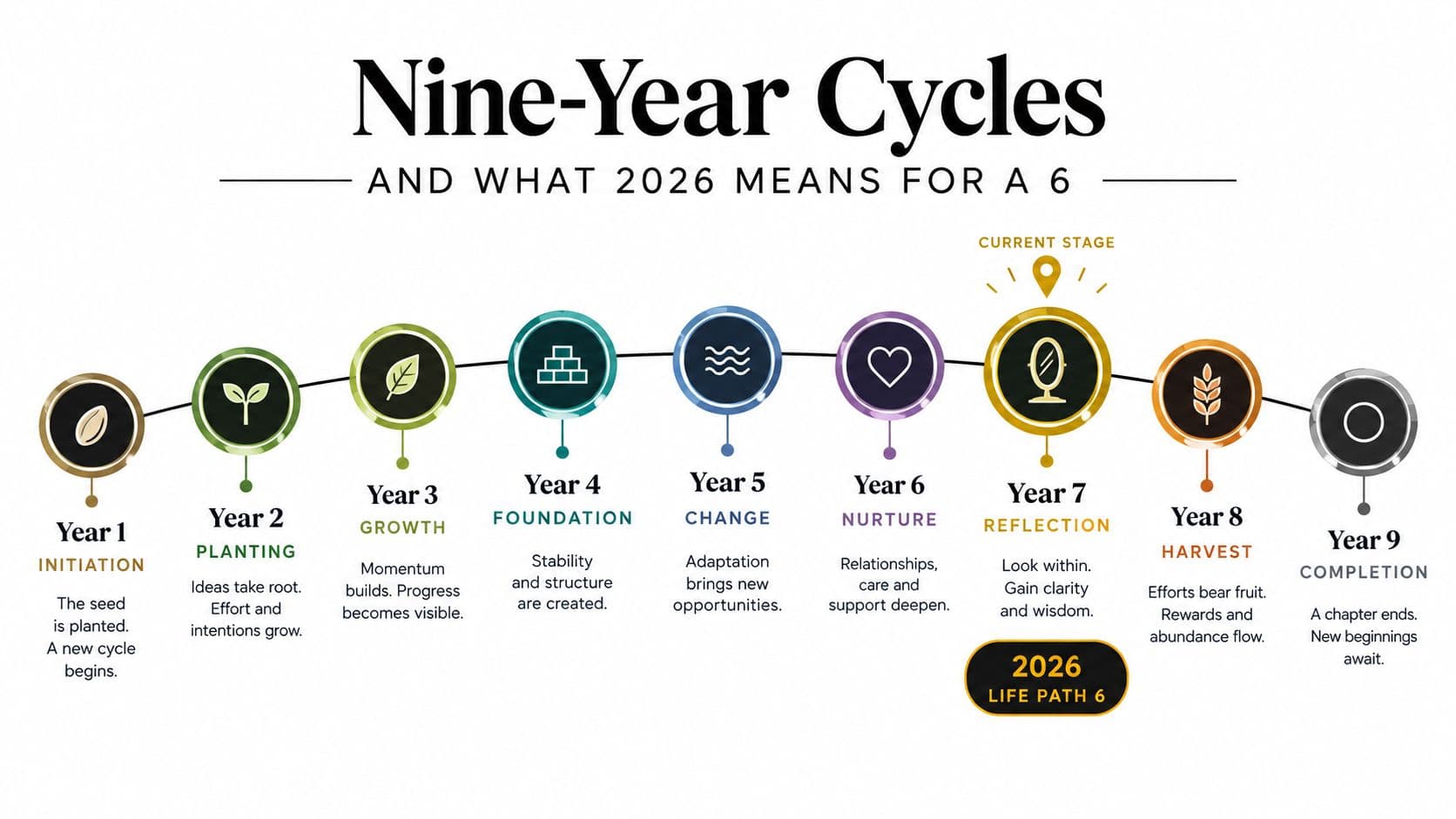
The editorial framing for 2026 here treats it as a reflection year for a 6, not as a universal prediction for every person with this path. That distinction matters because cycle timing depends on the individual calculation, while life path number 6 describes the broader pattern of vision and acceptance.
For a 6, a reflective year favors refinement over expansion. Instead of accepting every new obligation, review what already exists. Which commitments still express your values? Which ones survive only because you're afraid of disappointing someone? Where has your desire to improve life become a reason never to rest?
Early-cycle years can support planting commitments, while late-cycle years can support pruning. In a reflection phase, you can gather information before making the next promise. That may feel uncomfortable if you're accustomed to proving love through immediate action.
Use 2026 as a prompt to reconcile ideals with evidence. Let your calendar, energy, relationships, and finances show you what is sustainable. A vision that survives contact with reality becomes a plan. A vision that requires constant self-erasure needs revision.
Working With the Path Using the Life Purpose App
Self-knowledge becomes useful when it changes what you do on an ordinary morning. The Life Purpose App can serve as a journal-style companion for readers studying Dan Millman's The Life You Were Born to Live, offering a personalized life path reading, reflection prompts, and cycle-aware reminders rather than treating the profile as a fixed verdict.
Start with a simple check-in before responding to a family request. Ask yourself:
- Is help wanted: Has the person asked for support, or have I decided they need rescuing?
- What is mine: Which part belongs to my responsibility, and which part belongs to theirs?
- What will it cost: Can I offer this without abandoning sleep, money, work, or another commitment?
- What do I expect: Am I giving freely, or hoping the gesture will produce gratitude or change?
The answer doesn't need to be mystical. It needs to be honest.

Turn reflection into a repeatable practice
A weekly review can reveal where duty is crowding out personal needs. Record the moments when you said yes quickly, felt irritated later, or corrected something nobody asked you to correct. Look for repetition rather than judging yourself. The pattern is useful information.
A quarterly reset can connect your goals with the values associated with the 6 path, including fairness, beauty, authenticity, and commitment. Choose one area to improve and one area to accept. That pairing prevents the common mistake of turning every insight into another self-improvement project.
You can also use the Life Purpose App oracle overview as a prompt for reflection, but keep the interpretation grounded in your lived experience. A reading can suggest a question. It can't make a boundary, have a difficult conversation, or decide whether a commitment is sustainable.
Privacy and simplicity matter when you're tracking vulnerable patterns. Keep notes focused on observable behavior: what you agreed to, what you felt, what you asked for, and what happened next. Over time, that record can help you distinguish genuine compassion from the reflex to earn belonging through usefulness.
The point of Millman's framework isn't to give you a flattering identity. It's to help you notice where your ideals support life and where they make acceptance impossible. Knowledge becomes wisdom only after you test it in the kitchen, the workplace, the budget meeting, and the conversation you'd rather avoid.
The Life Purpose App offers personalized life path readings, cycle guidance, and reflective tools connected with Dan Millman's The Life You Were Born to Live. If you want to explore life path number 6 through practical prompts about perfectionism, service, and boundaries, visit Life Purpose App and begin with your birth date.
Discover your life path today
Enter your date of birth and see your life path, free.
Find your life path