Explore the life path seven, the way of the seeker, through Dan Millman's 'The Life You Were Born to Live.' Learn its spiritual laws, challenges, and gifts.

September 7, 2026 (1mo ago)
Life Path Seven: A Guide to the Seeker's Journey
Explore the life path seven, the way of the seeker, through Dan Millman's 'The Life You Were Born to Live.' Learn its spiritual laws, challenges, and gifts.
← Back to blog
Explore the life path seven, the way of the seeker, through Dan Millman's 'The Life You Were Born to Live.' Learn its spiritual laws, challenges, and gifts.
You may recognize the feeling before you know the name. You sit with a question long after everyone else has accepted a quick answer. Busy rooms drain you, while a quiet walk, a book, or an absorbing conversation restores something inside you. You can appear reserved, yet your inner world is active, observant, and full of questions about meaning, truth, and what exists beneath the surface.
In Dan Millman's The Life You Were Born to Live, this pattern is approached as a structured life-purpose system rather than a loose personality quiz. The Life Purpose App brings that framework into a digital format, helping readers connect birth-date analysis with the spiritual lessons, gifts, and challenges associated with their path. This guide focuses specifically on Life Path Seven, the seeker's journey, through Millman's framework.
An Introduction to the Seeker's Path
A person with Life Path Seven may spend a conversation listening more than speaking, not because they're uninterested, but because they're studying the meaning behind the words. They notice contradictions, question assumptions, and often need private time before they know what they really think. Their solitude isn't always loneliness. Sometimes it's the inner workshop where scattered impressions become understanding.
Independent numerology guides commonly call Life Path Seven the “seeker,” “truth-seeker,” or “logical mystic,” connecting the path with analysis, solitude, and trust. One such guide describes these as central developmental themes for Seven, which helps explain why the same broad image appears across modern numerology discussions. Still, Dan Millman's The Life You Were Born to Live gives the idea a more defined structure, and the Life Purpose App follows that specific approach rather than blending together unrelated interpretations.
The seeker isn't just someone who collects information. A Seven may read widely, investigate carefully, and pursue spiritual questions, but knowledge alone doesn't complete the path. The deeper movement is from suspicion toward discernment, and from guarded independence toward a trust that still honors clear thinking.
That distinction matters. A person can be analytical without becoming cynical, private without becoming unreachable, and spiritual without abandoning reason. In Millman's system, these qualities aren't random traits placed beside one another. They point toward a central life lesson, learning how to explore the depths while remaining open to life, other people, and the wisdom within.
What Life Path Seven Really Means
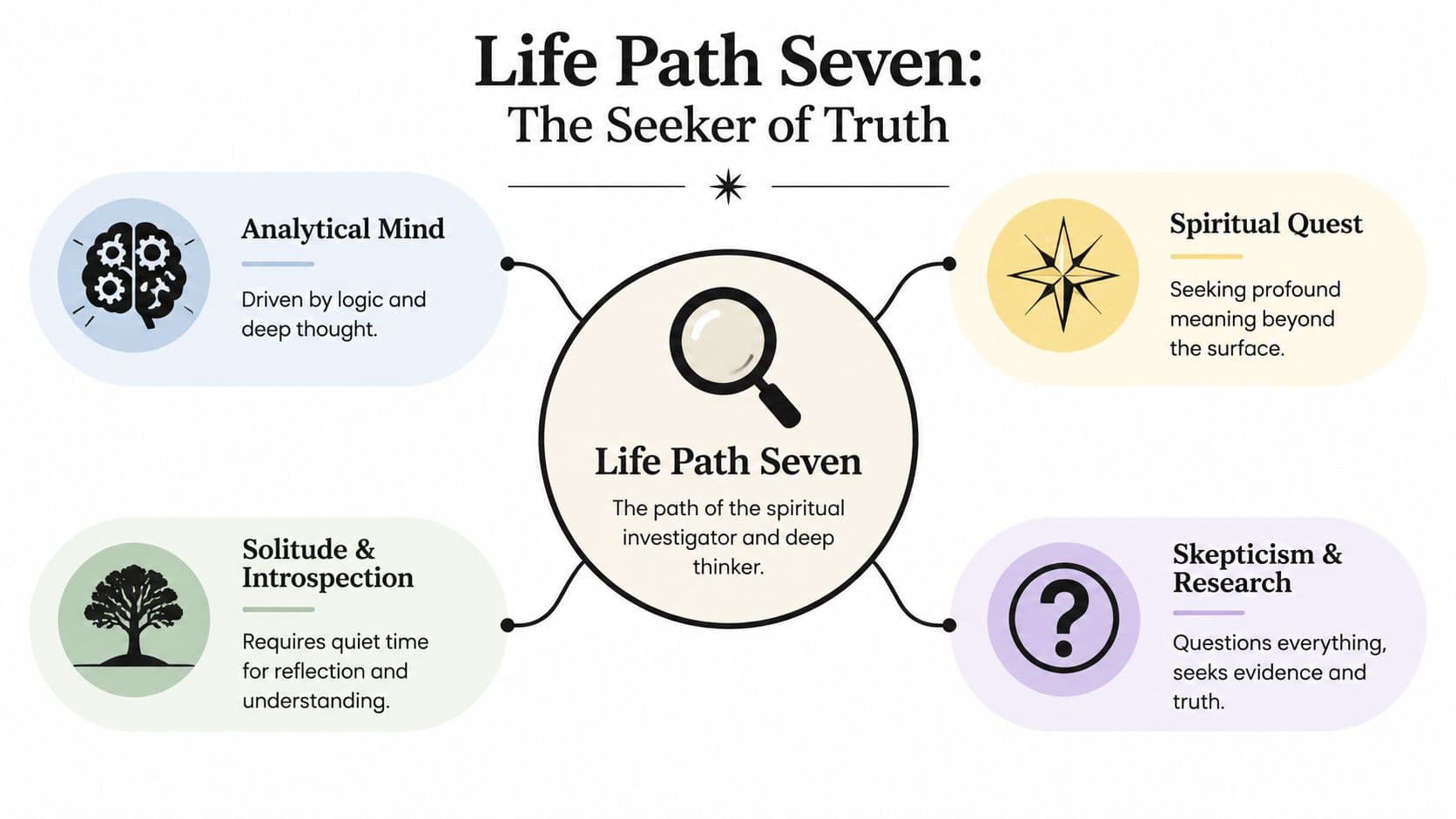
A person on Life Path Seven may spend a quiet evening questioning an idea that others accept without much thought. In Dan Millman's framework, that inward attention serves a specific lesson: “Trust and Openness.” People on this path learn to trust the spirit within themselves and others, becoming safe enough to share their inner beauty with the world. The relevant passage from The Life You Were Born to Live presents this theme directly.
A deep-sea diver offers a useful comparison. The diver descends beneath the noisy surface to observe what is hidden, using preparation and attention to stay oriented. Life Path Seven follows a similar rhythm. It turns inward to seek truth, then learns to bring its discoveries back into shared life through honest connection and useful insight. Remaining below the surface forever would make the discovery impossible to share.
How the calculation works
Millman's system calculates the Life Path number from the full birth date. Add all the digits, then reduce the total to a core single-digit essence. The result may appear as a compound path, such as 34/7. The 34 supplies context, while 7 identifies the core energy. The birth-date method can yield examples that reduce to 34/7.
The slash carries meaning. It shows that Seven holds more significance than a final digit detached from the calculation. The first number provides background, and the number after the slash names the central energetic pattern. The Life Purpose App digitizes this method, allowing users to work with the complete path instead of treating Seven as an isolated label.
Millman's book organizes the system around 37 distinct life paths, placing Seven within a broader 1–37 framework rather than a simple one-to-nine model. That structure helps prevent a common misunderstanding: Life Path Seven is not a complete personality diagnosis. It is a symbolic map of recurring lessons, especially the movement from intellectual distance toward trust, openness, and meaningful participation.
The Core Gifts and Challenges of a Seven
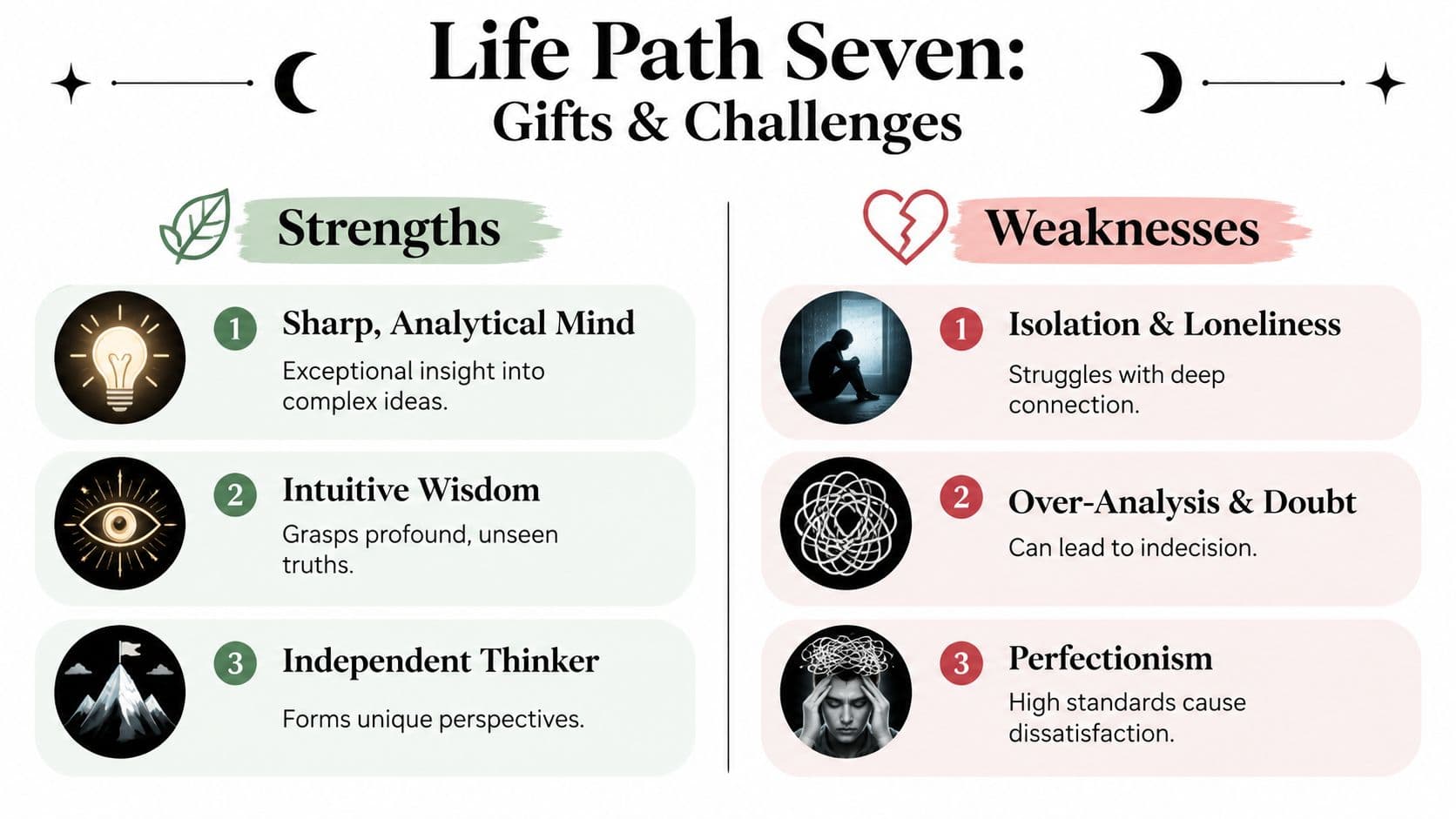
The same quality that gives a Seven unusual insight can also create distance. A sharp mind detects patterns, tests claims, and searches for what's true. That ability becomes a gift when it leads to wisdom, but it becomes a burden when every person, feeling, or opportunity must pass an endless test before it's allowed into the heart.
Numerology references characterize Seven as the sign of thought, psychic analysis, idealism, and spiritual improvement, with practical strength in research, pattern recognition, and independent problem-solving. This description connects the Seven pattern with work that rewards sustained investigation. In everyday life, that might look like a person who studies a complicated subject until the structure becomes clear, then explains it in a way others can understand.
When discernment becomes defense
A Seven's skepticism can protect them from shallow promises. It encourages careful research and helps them resist social pressure. But skepticism can harden into cynicism when disappointment is treated as proof that trust is always unsafe.
The inward turn also has two expressions:
- Solitude can restore clarity: Quiet time allows a Seven to think without interruption and reconnect with their own perceptions.
- Isolation can conceal fear: Withdrawal may become a way to avoid emotional risk, difficult conversations, or the possibility of being misunderstood.
- Perfectionism can refine work: High standards support careful research and thoughtful creation.
- Perfectionism can delay life: Waiting for complete certainty can prevent action, intimacy, and learning through experience.
Millman's central balance: Trust doesn't ask a Seven to stop thinking. It asks them to let clear thinking and openness exist together.
This is why the gifts and challenges shouldn't be treated as separate personality lists. The analytical mind must eventually investigate its own defenses. The person who questions everything also has to ask whether constant doubt is revealing truth or protecting vulnerability.
A mature Seven doesn't abandon solitude, research, or independence. Instead, they use those qualities in service of a larger purpose. They study diligently, speak candidly, and allow trusted people to see more than the polished conclusions. That's how knowledge begins to develop into wisdom.
Navigating Key Areas of Life
The principles in Dan Millman's The Life You Were Born to Live become most useful when they guide ordinary choices. For a Seven, the question isn't whether to become more like an outgoing, constantly available person. The better question is how to remain true to a reflective nature without using reflection as a substitute for participation.
Relationships and vulnerability
A Seven often needs more privacy than a partner expects. That need deserves respect, but silence can be misread as indifference. The practical answer is to communicate the need clearly, before retreat begins. Saying, “I need quiet time, and I'll come back to this conversation,” creates reassurance without demanding that the Seven abandon solitude.
Relationship guidance often repeats that Sevens are analytical and reserved, yet gives less attention to the harder task of building trust and showing vulnerability while preserving personal space. This practical relationship gap is also highlighted in a discussion of Life Path Seven. A Seven can begin with small, accurate disclosures instead of waiting for a dramatic emotional revelation. Share what you're uncertain about, name what you need, and let another person respond before deciding that they won't understand.
Career and money
A suitable career usually gives a Seven room to investigate, concentrate, and solve problems without constant social performance. Research, technology, education, writing, psychology, consulting, and spiritual counseling may appeal when they provide meaningful questions and intellectual independence. The field matters less than the quality of attention the work requires.
Money can become healthier when treated as support for freedom, learning, stability, and purposeful work rather than as a measure of identity. A Seven may overthink financial decisions, especially when trying to eliminate every possible risk. A simple written decision process can help, define the aim, identify what's known, acknowledge what isn't, and choose a reasonable next step.
Health and restoration
A crowded mind eventually needs a physical outlet. Quiet walks, regular sleep, reflective practices, and time away from constant information can help a Seven notice when deep thought has turned into mental looping. These are general self-care practices, not substitutes for professional medical guidance.
If low energy makes those habits difficult to establish, a practical resource on how to boost your energy naturally may offer ideas to discuss with a qualified professional. The key principle remains simple. A Seven's inner life needs a body that receives attention, not only a mind that receives questions.
Understanding Your Nine-Year Cycle
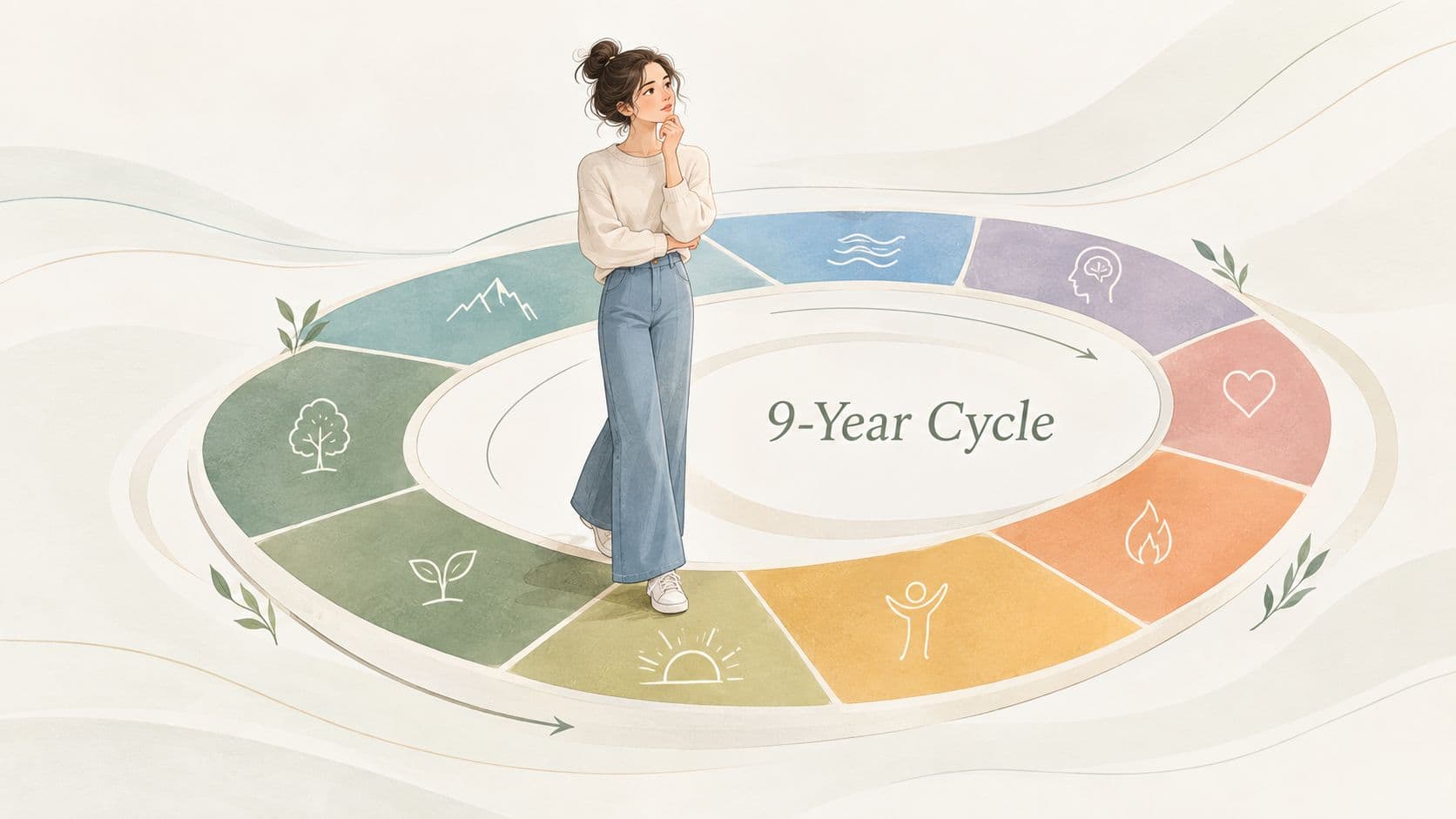
Life Path Seven describes a recurring purpose and style of learning, but it doesn't mean every season feels identical. Dan Millman's framework also includes nine-year cycles, which offer a way to observe changing emphasis over time. Some periods may feel naturally inward, encouraging study, review, and quiet understanding. Other periods may ask for more visible action, practical decisions, collaboration, or outward expression.
A cycle can be understood as a rhythm rather than a prediction. The rhythm doesn't remove choice, and it shouldn't be used to excuse avoidance. It gives language to an experience many Sevens already recognize: one phase creates a strong pull toward retreat and contemplation, while another makes connection, movement, or implementation feel more necessary.
Reading the rhythm without forcing it
During an inward period, a Seven might benefit from research, journaling, therapy, meditation, or reviewing a long-term direction. During a more outward period, the same person may need to publish the work, have the conversation, accept collaboration, or turn insight into a practical offering.
A useful reflection practice is to ask:
- What is asking for attention now? Notice whether life is drawing you toward learning, connection, completion, or action.
- What am I resisting? Resistance may reveal a genuine need for rest, or it may expose a fear of being seen.
- What would integration look like? A quiet insight becomes more valuable when it informs a decision, relationship, or contribution.
The Life Purpose App can map these personal cycles from birth-date information, making the pattern easier to review alongside the broader teaching in Dan Millman's The Life You Were Born to Live. You can also explore the numerology nine-year cycle.
For a Seven, cycle awareness can reduce self-judgment. You don't have to force constant sociability during a season of reflection, and you don't have to hide indefinitely when life calls you outward. The cycle becomes a conversation with your experience, not a rigid script.
Life Path Seven Relationship Dynamics
Compatibility for a Seven depends less on finding a supposedly perfect pairing and more on understanding how two people handle trust, communication, and space. A partner who respects quiet time may help the Seven feel safe enough to open. A partner who needs frequent emotional confirmation may bring an important lesson, but the relationship will require clearer communication from both sides.
The table below offers a practical comparison. It describes likely areas of ease or friction without declaring any pairing impossible.
| Interacting with Life Path | Core Dynamic | Key to Harmony |
|---|---|---|
| A reflective path | Shared respect for privacy and meaningful conversation | Make time for connection instead of assuming silence means agreement |
| A highly social path | One person may seek outward activity while the Seven seeks depth and quiet | Set clear expectations around social time and recovery time |
| A practical path | The relationship may balance inner exploration with concrete action | Respect different ways of making decisions |
| An emotionally expressive path | Direct feeling may meet the Seven's careful processing | Name emotions plainly and allow pauses without withdrawing |
| An independent path | Both people may value freedom and personal direction | Build trust through consistency rather than control |
These categories are deliberately broad. Dan Millman's system interprets a person through the full life path, including the compound number before the slash, rather than reducing relationship dynamics to a single isolated digit. The Life Purpose App's relationship tools can help users compare two birth dates and examine the interaction more personally.
A Seven's most important relational practice is visible consistency. Respond when you say you will, explain when you need space, and share unfinished thoughts instead of offering only perfectly reasoned conclusions. Further reflections on connection and compatibility are available in this guide to relationships.
Intimacy doesn't require a Seven to surrender solitude. It requires the Seven to make solitude understandable to the person they love.
That practice protects both sides. The Seven keeps the quiet needed for genuine reflection, while the partner receives enough clarity to remain emotionally included.
Go Deeper with the Life Purpose App
A birth-date reading becomes more useful when you can examine the full pattern behind it. Dan Millman's The Life You Were Born to Live presents a Life-Purpose System with 37 distinct life paths, using birth-date analysis to connect personal tendencies with a broader life lesson. The Life Purpose App puts that framework into a format you can explore personally.
The calculation includes the compound number before the slash. A 34/7, for example, is not treated as interchangeable with every other path that ends in 7. The app also maps nine-year cycles and creates relationship reports from the birth dates of people in your life. Those details work like a map's scale and landmarks, adding context to the general image of a seeker.

Use a reading beside ordinary self-observation. You might track your health while watching how sleep, movement, stress, and solitude influence your clarity. You can also explore it as a reflective prompt, then ask the practical question at the heart of Millman's framework: how can insight become trust and openness?
The system is most helpful as a mirror, not a timetable of guaranteed events. It can reveal a recurring pattern, while your choices shape the response. A Seven may keep questioning and learning while allowing life to become a relationship rather than a problem to solve.
Use Life Purpose App to calculate your complete Life Path Seven profile, examine the compound number behind it, and map personal cycles. Let the reading accompany your practice of trusting inner wisdom while opening more fully to people and experience.
Discover your life path today
Enter your date of birth and see your life path, free.
Find your life path