Discover the meaning of Life Path Three from Dan Millman's work. This guide explains the traits, challenges, and purpose of the creative communicator.
July 7, 2026 (20d ago)
Life Path Three: A Guide to Creative Expression
Discover the meaning of Life Path Three from Dan Millman's work. This guide explains the traits, challenges, and purpose of the creative communicator.
← Back to blog
You might be reading this because you've always felt a little split in two. One part of you comes alive when you're talking, writing, joking, singing, teaching, sharing, or turning a feeling into words. The other part gets hurt easily, second-guesses itself, or goes quiet right when it wants to be seen.
That tension sits at the heart of Life Path Three in Dan Millman's The Life You Were Born to Live. In Millman's approach, this isn't generic numerology. It's a specific life-path system with its own language, its own calculation method, and its own spiritual lessons. It gives many people a way to understand why expression feels so natural, and why honest self-expression can also feel so vulnerable.
If you've ever been told you're charming, funny, creative, or easy to talk to, yet privately felt misunderstood or emotionally overloaded, this path may feel familiar. Millman's work treats that pattern with compassion. The gift isn't only creativity. The deeper lesson is learning how to express what's real, instead of hiding behind performance, politeness, or a carefully managed image.
Are You a Life Path Three
You are halfway through a conversation, and the words are right there. You can feel the joke, the insight, or the truth you want to share. Then something tightens. You soften it, hold it back, or turn it into something safer. For many people on Life Path Three, that moment feels familiar.
In Dan Millman's The Life You Were Born to Live, Life Path Three centers on creative expression. In the Life Purpose App's interpretation of Millman's system, this path points to lessons around communication, emotional honesty, sensitivity, and the courage to express what is genuine. The heart of this path is not performing for approval. It is learning to let your inner life take form through words, art, humor, teaching, conversation, or any other channel that feels alive and true.
That distinction matters.
A Three often has a natural gift for connection. People may notice warmth, charm, wit, or creative energy long before they notice the more private side of this path. Yet Millman's teaching goes deeper than personality. A Life Path Three is here to work with expression the way a musician works with an instrument. The gift is present, but it becomes clearer through practice, honesty, and self-trust.
Signs this path may resonate
Life Path Three may feel familiar if these patterns show up in your life:
- You understand yourself by expressing yourself. Talking, writing, singing, drawing, or moving emotion through the body helps you know what you feel.
- You bring brightness to other people. Humor, playfulness, or a well-timed story can ease tension and create connection.
- You are emotionally sensitive. You often pick up the tone of a room quickly, including what others leave unsaid.
- You long for what is real. Polished interactions may work on the surface, but they rarely satisfy you for long.
- You sometimes hold back your truth. Fear of judgment, embarrassment, or rejection can cause your authentic voice to get suppressed.
A gentle reminder: Expression does not always look outgoing. Some Threes speak easily in groups. Others express themselves best in a journal, a song, a classroom, a design, or a quiet conversation with one trusted person.
People sometimes miss their Three energy because they expect creativity to look flashy or constant. Millman describes a subtler path. Creative expression can feel like both a gift and a lesson. You may know you have something to say, yet still spend years learning how to say it plainly, kindly, and without hiding.
Understanding Your Life Path Number
You enter your birth date, expecting a single digit, and the result comes back as a full number instead. That moment confuses a lot of readers, especially if they learned numerology somewhere else first. Dan Millman's The Life You Were Born to Live uses a different map, and once you see how the map is built, Life Path Three makes much more sense.
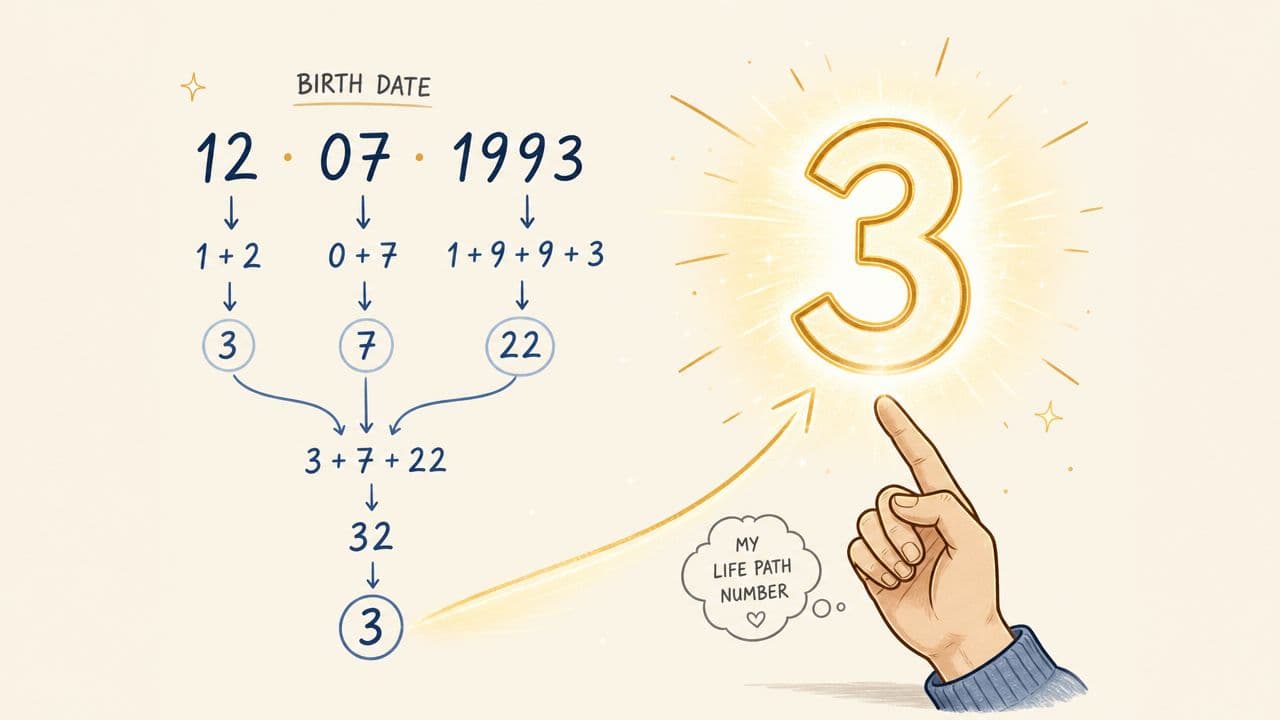
In Millman's system, you add every digit in your full birth date and keep the total. A birth date of December 2, 1985 becomes 1 + 2 + 2 + 1 + 9 + 8 + 5 = 28. As explained in the Life Purpose App guide to Millman's calculation method, that person's life path is 28, not 1.
That detail matters because Millman is not sorting people into a small set of repeating personality types. He lays out a larger framework of life paths, each with its own lessons, tests, and ways of maturing. Millman's method reframes the question from “What number are you?” to “What path of growth are you here to walk?”
A simple comparison helps here:
| Approach | How it treats the birth date | Result |
|---|---|---|
| Generic numerology | Often reduces quickly | A smaller set of repeating numbers |
| Millman's system in The Life You Were Born to Live | Adds every digit and records the full sum | A larger map of distinct life paths |
So if your total is 3, Life Path Three has a very specific meaning inside Millman's teaching. It points to a path centered on expression, honesty, and the courage to let your inner life take form in the world.
You can picture it like learning an instrument. The number does not label you from the outside. It shows where practice, friction, and growth are likely to happen. For a Three, the practice often involves giving feelings, ideas, and insight a clear channel through words, art, teaching, movement, or conversation.
This is one reason the Life Purpose App feels different from generic numerology tools. It draws directly from Millman's framework, so Life Path Three is interpreted as a lived spiritual lesson, not a loose bundle of traits. That keeps the focus where Millman keeps it. On purpose, growth, and the daily work of becoming more authentic.
The Gifts and Challenges of Creative Expression
A Life Path Three often knows this feeling well. You walk into a room, sense the mood in seconds, and somehow find the words, joke, story, or spark that helps people breathe again. Then later, a small criticism can stay with you for hours.
That mix of brightness and sensitivity sits near the heart of this path. In Dan Millman's The Life You Were Born to Live, Life Path Three is not treated as a generic “creative personality.” It is a spiritual lesson in expression. The Life Purpose App follows that same teaching, which is why it reads this path as a practice of honest emotional expression rather than a bundle of surface traits.
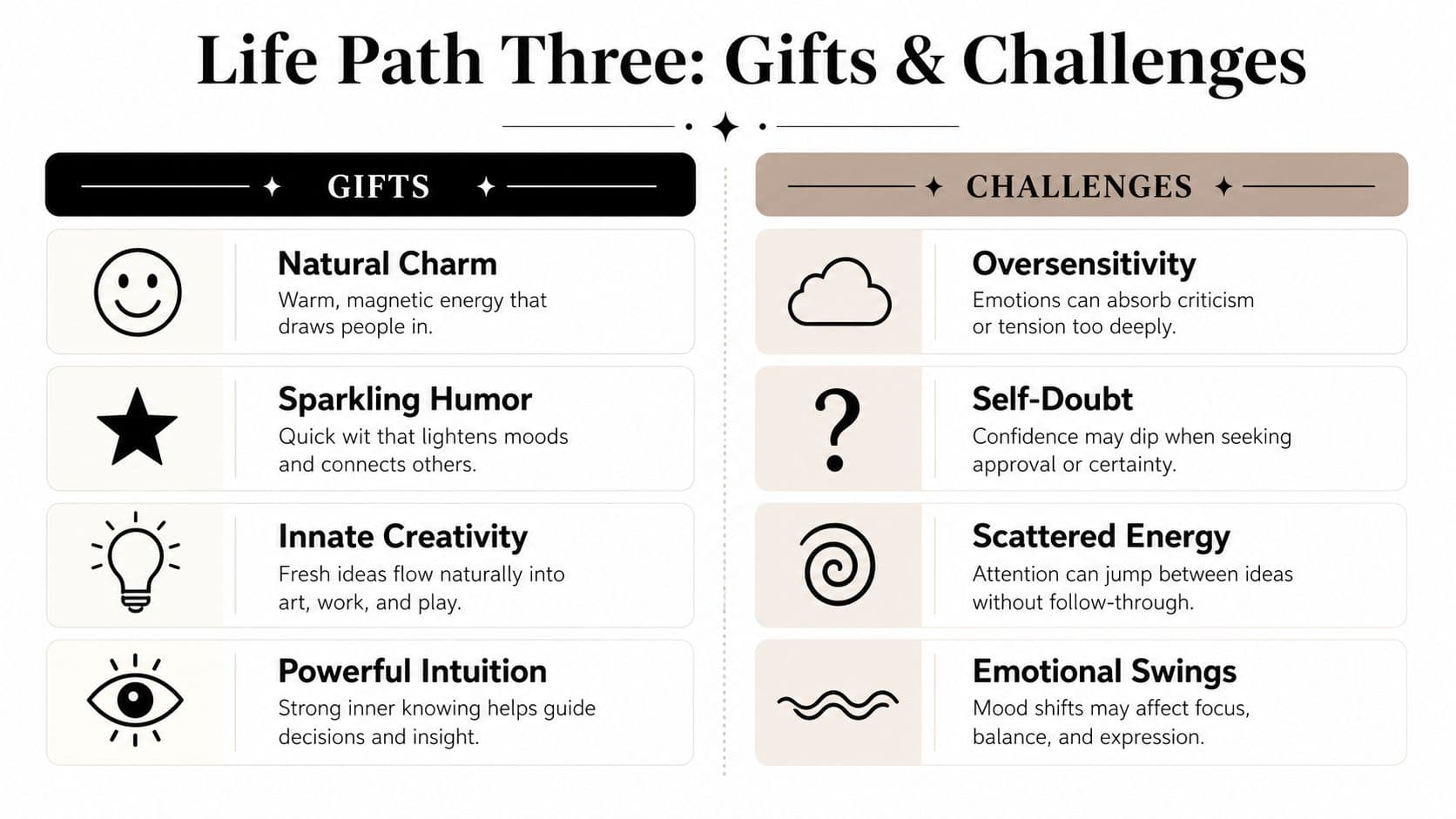
The natural gifts
At their best, Threes bring life into human connection. Their communication often carries emotion clearly, so people do not just understand the message. They feel it. A healthy Three can also use humor in a healing way. Laughter serves as a bridge between people and softens conversations that might otherwise feel heavy.
Creativity tends to move quickly here. Ideas can arrive in clusters. Words, images, movement, teaching, conversation, and performance may all become channels for the same inner current.
Another gift is emotional awareness. Many Threes pick up what others are feeling before anything is said out loud. That can make them gracious friends, engaging teachers, and natural encouragers.
The hidden struggle
The same sensitivity that feeds expression can also make expression feel risky.
Millman describes Life Path Three as closely tied to emotional sensitivity, and he notes that criticism can lead Threes to protect themselves by becoming overly controlled or overly mental. Instead of letting feelings move into speech, writing, or art, they may manage those feelings from a distance. The Life Purpose App reflects this same pattern in its interpretation of the Three path.
This helps explain why some Threes look outgoing while still feeling guarded. They may talk easily but hesitate at the moment real honesty is needed. They may seem light and playful on the surface while carrying far more than others realize.
Practical rule: Your sensitivity is part of your gift. Growth begins when you give it a clean form instead of covering it with detachment, wit, or people-pleasing.
What the shadow can look like
When a Three stops expressing honestly, the energy rarely disappears. It usually scatters.
That scattered energy can show up as inconsistency, emotional overreaction, nervous talking, avoidance, or a polished persona that says everything except what is true. Sometimes the deeper feeling gets rerouted into gossip, performance, or constant busyness. Millman's teaching helps here because it frames these habits as signs of blocked expression, not proof that something is wrong at the core.
A simple image may help. This life path works like a river. When the channel is open, the water moves, nourishes, and clears itself. When the channel is blocked, pressure builds and spills sideways.
A common pattern looks like this:
- A Three feels something strongly.
- The feeling meets discomfort, shame, or fear of criticism.
- The Three shifts into charm, logic, distraction, or performance.
- The original feeling stays stuck.
Healing begins with a gentler sequence. Feel it. Name it clearly. Express it in words, art, movement, or honest conversation. Then let the emotion pass through instead of storing it.
Applying Life Path Three Wisdom in Your Life
You might see a Life Path Three in a meeting that looks successful from the outside. They speak well, keep the mood light, and know how to read the room. Then they go home strangely drained, with a notebook full of ideas and very little peace. In Dan Millman's The Life You Were Born to Live, that pattern points back to one central lesson. A Three restores energy through honest expression.
Millman gives this path the keyword Expression. In his framework, the growth task is to bring inner experience into form through speech, writing, art, teaching, or another clear channel. The Life Purpose App builds on that same teaching by helping people see where expression becomes a practice instead of a vague ideal. For a Three, that difference matters. Strong feelings are only the beginning. Life gets clearer when those feelings are shaped, spoken, and used.
In work and vocation
A Three often does well in work that asks for communication, interpretation, or emotional intelligence. That can look creative, but it does not have to mean a conventional artistic career. Some Threes teach. Some write. Some coach, facilitate, design, market, counsel, or build community.
The better question is simple. Does your work give your inner life somewhere to go?
If the answer is no, motivation can start to scatter. A Three may appear inconsistent in a role that requires constant restraint, emotional flatness, or rigid self-censorship. In a role that welcomes voice, meaning, and connection, the same person often becomes more focused and alive.
Real expression has force. Performance without truth drains it.
In money matters
Money lessons for a Three often center on rhythm. Creative energy arrives in waves, but bills usually do not. Millman's teaching is helpful here because it brings expression back to discipline. Inspiration needs a container, the way water needs a channel if you want it to reach the garden instead of soaking the ground at random.
Helpful questions for a Three include:
- What projects am I completing?
- Which form of expression am I willing to practice steadily?
- Where am I calling avoidance spontaneity?
Financial stability often grows when a Three pairs creativity with repetition. A regular writing habit, a weekly teaching schedule, a savings system, or a clear project timeline can protect their gifts from becoming scattered effort.
In relationships and intimacy
A Three usually brings warmth, humor, affection, and encouragement into close relationships. They often sense what others feel very quickly. Yet intimacy asks for more than charm. It asks for accurate expression.
That is where many Threes grow.
Millman's work points toward honesty as a law of development, and this can be practiced in very ordinary moments. A Three may need to pause and say, “What I'm feeling is hurt,” or “I need reassurance,” or “I am excited and afraid at the same time.” Those sentences are simple, but they clear away confusion fast. They also keep connection from filling up with guesswork.
In health and emotional balance
For this path, emotions often move through the body. If expression gets blocked, tension can build physically and mentally. Many Threes feel better when they stop treating emotional release as optional and begin treating it as daily hygiene, much like sleep or movement.
A few practices often help:
- Journaling without editing. Let the first draft be honest, not polished.
- Creative release. Sing, paint, dance, write, improvise, or speak out loud.
- Naming feelings early. A clear name can reduce overwhelm.
- Stronger boundaries. Sensitivity does not mean carrying every feeling around you.
One everyday example
A Three works in a stable office job and is known for being pleasant, capable, and easy to talk to. Friends assume everything is fine. Yet by evening, they feel flat, overstimulated, and oddly invisible to themselves. They start several creative projects, abandon each one, and wonder why nothing feels satisfying.
Then one small change begins. Each morning, they spend ten minutes writing exactly what they feel before checking messages or trying to sound composed. After a few weeks, they speak more directly at work, return to one creative project, and make cleaner choices about who gets their time.
The outer life may look similar. The inner experience changes because expression is flowing again.
That is a practical way to apply Life Path Three wisdom. In Millman's terms, your path becomes lighter when your inner truth has a voice.
Life Path Three Compatibility with Others
People often want a neat compatibility chart. Dan Millman's The Life You Were Born to Live points toward something more useful. For life path three, the essential question isn't “Which number matches me perfectly?” It's “Who helps me stay honest, grounded, and emotionally open?”
A Three usually thrives around people who listen well and don't punish vulnerability. They need room to talk things through, create freely, and change their minds as they uncover what they really feel. If someone responds with constant dismissal, harshness, or emotional shutdown, the Three may retreat behind charm or become harder to read.
What supports a Three in relationship
Certain qualities matter more than any label.
| Helpful quality | Why it matters for life path three |
|---|---|
| Patience | A Three may need time to sort through feelings out loud |
| Appreciation | Encouragement helps them stay open instead of guarded |
| Steadiness | Grounded people help scattered energy settle |
| Honesty | Direct communication keeps resentment from building |
Some Threes feel drawn to more practical or stable personalities because that steadiness gives shape to their creative flow. Others connect best with fellow expressive people who understand emotional nuance. Both can work.
What can create friction
A Three often struggles in relationships where expression feels unsafe. That can happen with someone who mocks emotions, treats sensitivity as weakness, or expects constant cheerfulness. It can also happen when the Three relies too much on indirect communication and hopes the other person will just “get it.”
Healthy connection asks both sides to grow. The other person learns to welcome expression. The Three learns to speak plainly instead of hoping charm will carry the message.
Good compatibility for a Three feels like this. You can be bright without performing, sensitive without apologizing, and honest without fear.
That principle applies to friendship, romance, family, and work relationships alike. Any two people can build something strong if they bring awareness, respect, and willingness to tell the truth.
Your Nine-Year Cycle and Tips for Growth
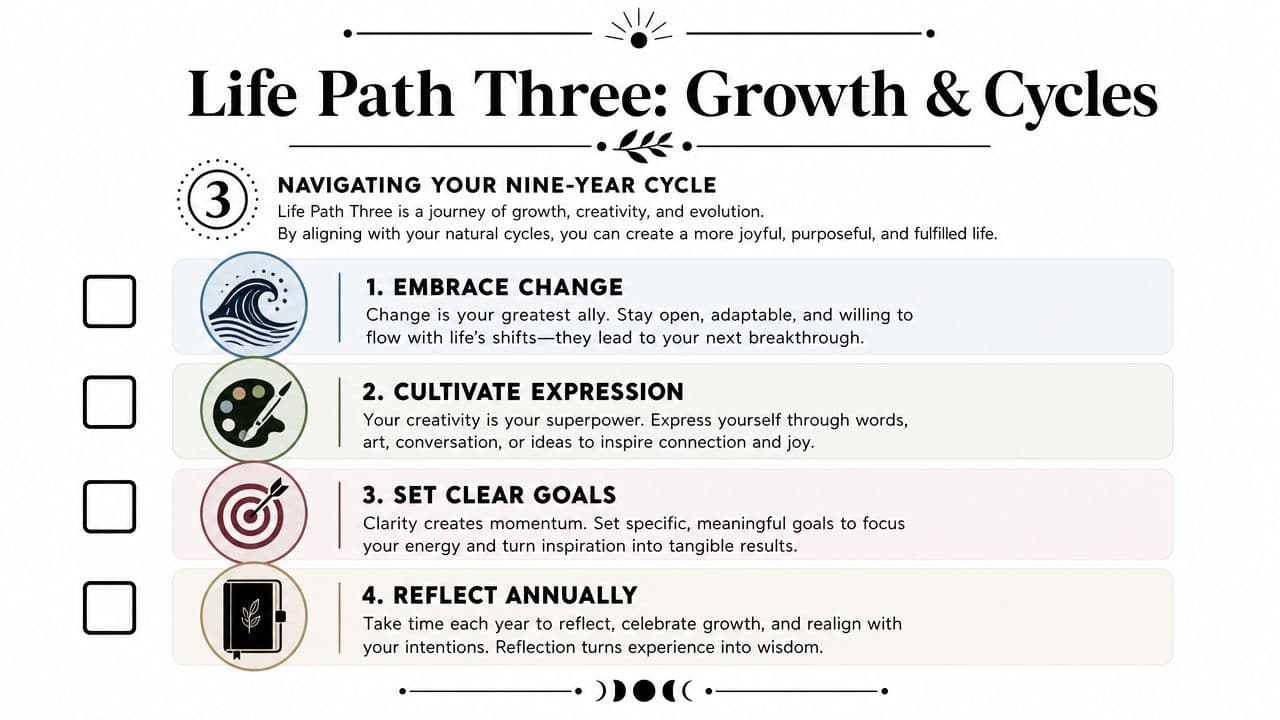
Dan Millman's The Life You Were Born to Live also places each person within nine-year life cycles. For a Three, that idea can be especially helpful because this path is so responsive to timing, mood, and inner momentum. Some stretches of life feel more outward and expressive. Others ask for emotional clearing, simplification, or a different kind of honesty.
You don't need to force every season to look the same. A cycle may invite more visibility, while another invites reflection. For life path three, growth often happens when you stop treating every quiet phase as failure and every lively phase as permanent.
How to work with your cycles
The key is observation before reaction.
- Notice repeating themes. Are you being asked to speak up, let go, reconnect, or create?
- Track emotional tone. Threes often understand their season through feeling before logic.
- Respect timing. Some years support visible action. Others support inner clearing.
- Stay with one thread. Cycles are easier to move through when attention isn't scattered in ten directions.
Four grounded growth practices
Growth for a Three doesn't have to be dramatic. It usually works better when it's steady.
Embrace emotional movement
Let feelings move without building your identity around them. You can feel strongly without making every feeling permanent.
Choose one creative channel
A Three often has many outlets. Pick one for now. A notebook, a class, a microphone, a sketchbook, a voice note practice. Depth grows where energy is repeated.
Tell cleaner truths
Say the truth sooner. Not harshly. Clearly.
Examples help:
- “That comment hurt more than I expected.”
- “I'm excited, but I'm also scared.”
- “I need encouragement, not fixing.”
Cut off the leak of gossip
When expression isn't focused, it can spill sideways. Redirect that urge into writing, honest conversation, or art. Cleaner speech usually brings cleaner energy.
Growth cue: Every time you replace performance with sincerity, you strengthen the central lesson of life path three.
A short self-check for this path
Ask yourself these questions at the end of a season or year:
- Where did I speak honestly
- Where did I hide behind image or humor
- What creative act made me feel more like myself
- Which relationships welcomed my real voice
Those answers reveal more than mood. They show whether your path is moving toward expression or away from it.
Discover Your Full Life Purpose
Life path three is a beautiful path, but it isn't always an easy one. In Dan Millman's The Life You Were Born to Live, the lesson isn't only to be creative or social. It's to let your inner life become visible in honest, constructive, life-giving ways.
That means your sensitivity has purpose. Your humor has purpose. Your urge to connect, teach, encourage, and create has purpose. Even the moments when you feel blocked can become part of the teaching, because they show you exactly where expression still wants to break through.
Life path three is only one path within Millman's larger framework of 45 unique life paths. If this guide resonates, the deeper value comes from seeing your own path in full context, including your spiritual laws, relationship dynamics, and personal cycles. That's where the wider system becomes much more personal than a simple label ever could.
If you want to explore your path more thoroughly, the Life Purpose App is the direct digital companion to Dan Millman's The Life You Were Born to Live. You can enter your birth date, discover your place within the system of 45 life paths, explore your core gifts and challenges, and look at relationship dynamics and nine-year cycles in a more personalized way.
Discover Your Life Purpose Today!
Unlock your true potential and find your life’s purpose.
