Feeling stuck? Discover life purpose coaching to find your true direction. Learn how it works & connect with a coach for meaning in 2026.
July 1, 2026 (24d ago)
Life Purpose Coaching: Find Your True Direction
Feeling stuck? Discover life purpose coaching to find your true direction. Learn how it works & connect with a coach for meaning in 2026.
← Back to blog
You can have a decent job, people who care about you, a calendar full of obligations, and still feel off. Not broken. Just disconnected. A lot of people experience that state privately. They start asking questions they can't brush aside anymore. Why does my life look fine from the outside but feel flat on the inside? Why do I keep repeating the same patterns in work, love, or money? What am I here to do?
That's where life purpose coaching enters the conversation. Not as a magic answer machine, and not as a promise that one session will reveal your destiny in neon lights. At its best, it gives structure to questions that already live inside you. It helps you sort signal from noise, name what matters, and make changes that reflect who you are instead of who you've been trying to please.
What Is Life Purpose Coaching Really About
Life purpose coaching helps people close the gap between the life they're living and the life that feels aligned. That sounds lofty until you put it in ordinary terms. It often starts with things like dread on Sunday night, a sense that success hasn't brought meaning, or the feeling that every major choice has been practical but not personal.
A purpose coach doesn't play therapist and doesn't act like a consultant with a ready-made blueprint. Therapy often looks carefully at the past and how it shaped you. Consulting usually offers expert advice about what to do next. Life purpose coaching is more collaborative. The coach asks better questions, reflects patterns back to you, and helps you make decisions you can live with.
What it is and what it isn't
Here's a simple perspective:
| Approach | Main focus | Typical role |
|---|---|---|
| Therapy | Healing, mental health, past and present patterns | A licensed clinician helps you process and recover |
| Consulting | Strategy, expertise, external solutions | An expert recommends a course of action |
| Life purpose coaching | Meaning, direction, values, action | A guide helps you uncover your own answers |
That distinction matters because many newcomers expect a coach to tell them their purpose. A skilled coach won't do that. They'll help you identify the threads that keep showing up in your life: what energizes you, what drains you, what you keep returning to, and where you feel most like yourself.
Practical rule: If someone promises to hand you your purpose in a single formula, be careful. Real purpose work usually involves reflection, experimentation, and honest change.
This field is growing because more people want that kind of guidance. The broader coaching industry is a $5.34 billion global market as of 2025, with 122,974 coaches operating worldwide, and purpose-driven and enhancement-focused specialties make up 9% of primary global coaching types, according to this breakdown of 2025 coaching industry data.
Why people seek it out
People usually don't come to life purpose coaching because everything is falling apart. They come because something inside them has become impossible to ignore.
Some common entry points look like this:
- Career success with inner emptiness. You worked hard, got the title, and still don't feel at home in your own life.
- Repeated patterns. Different jobs, same frustration. Different partners, same wound.
- A major transition. Divorce, burnout, a move, parenthood, or loss can strip away old identities.
- A hunger for meaning. You want your decisions to reflect your values, not just your obligations.
If you're curious how coaches talk about this work in lived, human terms, Insights from Harika Sachdev offers a grounded perspective on what makes coaching feel personal rather than abstract. And if part of your drift shows up in relationships or self-management, this guide can help connect purpose with day-to-day behavior.
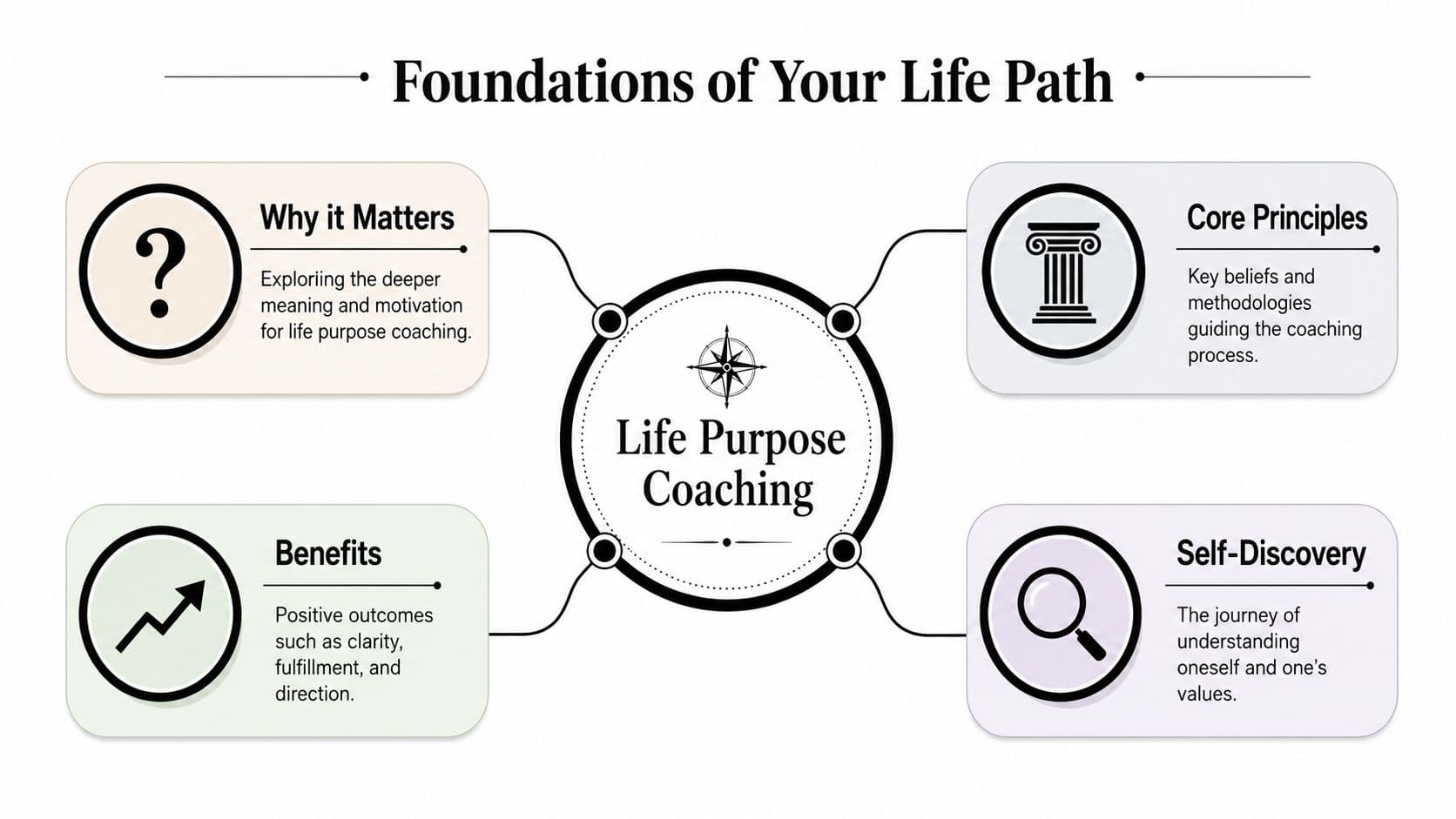
Understanding the Foundations of Your Life Path
Some people hear the word purpose and picture something vague, mystical, or impossible to prove. That confusion makes sense. Purpose can sound abstract until you place it inside a framework.
One influential model comes from Dan Millman's book “The Life You Were Born to Live” and the system used by the Life Purpose App. In that framework, life purpose coaching isn't only about chasing a dream job or finding a passion project. It's about understanding the deeper lessons and patterns that shape your whole life.
Life as a classroom
Millman's framework describes four distinct purposes. The first is especially useful because it changes how people interpret difficulty. In this view, life's first purpose is learning life's lessons. Earth functions as a school, and daily challenges in relationships, work, finances, and health become the primary classroom for growth, as described in this discussion of Dan Millman's framework.
That idea lands differently when you apply it to ordinary life. If you keep ending up in jobs where you abandon your voice, the question changes from “Why does this keep happening to me?” to “What am I here to learn about courage, boundaries, or self-trust?” If conflict follows you from one relationship to the next, purpose work asks what lesson remains unfinished.
A purpose-based lens doesn't deny pain. It asks what the pain is trying to teach before it hardens into a pattern.
For many people, that's the moment life purpose coaching starts to feel practical. It moves the conversation from blame to responsibility. Not responsibility in the punishing sense. Responsibility that enables you. You may not control every event, but you can engage with what it asks of you.
The role of life paths and spiritual laws
Dan Millman's “The Life You Were Born to Live” and the Life Purpose App also describe 45 unique life paths and the spiritual laws associated with them. In this system, those laws are presented as universal principles tied to a specific life path, helping people clarify past events and understand core talents and hurdles related to health, money, sexuality, career, and relationships with what Millman's work describes as uncanny accuracy, as outlined on Dan Millman's Peaceful Warrior site.
For readers new to this language, “spiritual laws” doesn't have to mean blind belief. Think of them as recurring themes. Some people repeatedly confront lessons around patience. Others wrestle with trust, expression, discipline, intimacy, or power. A life purpose coach may use that structure to help a client recognize the deeper pattern underneath surface events.
Why this foundation matters
Without a framework, people often treat their lives like a pile of disconnected episodes. A bad breakup. A stalled career. Money stress. Health habits they can't maintain. They look random.
A purpose framework gives those experiences coherence. It says your life may have a pattern, and that pattern can be studied.
That doesn't remove mystery. It gives mystery some shape.
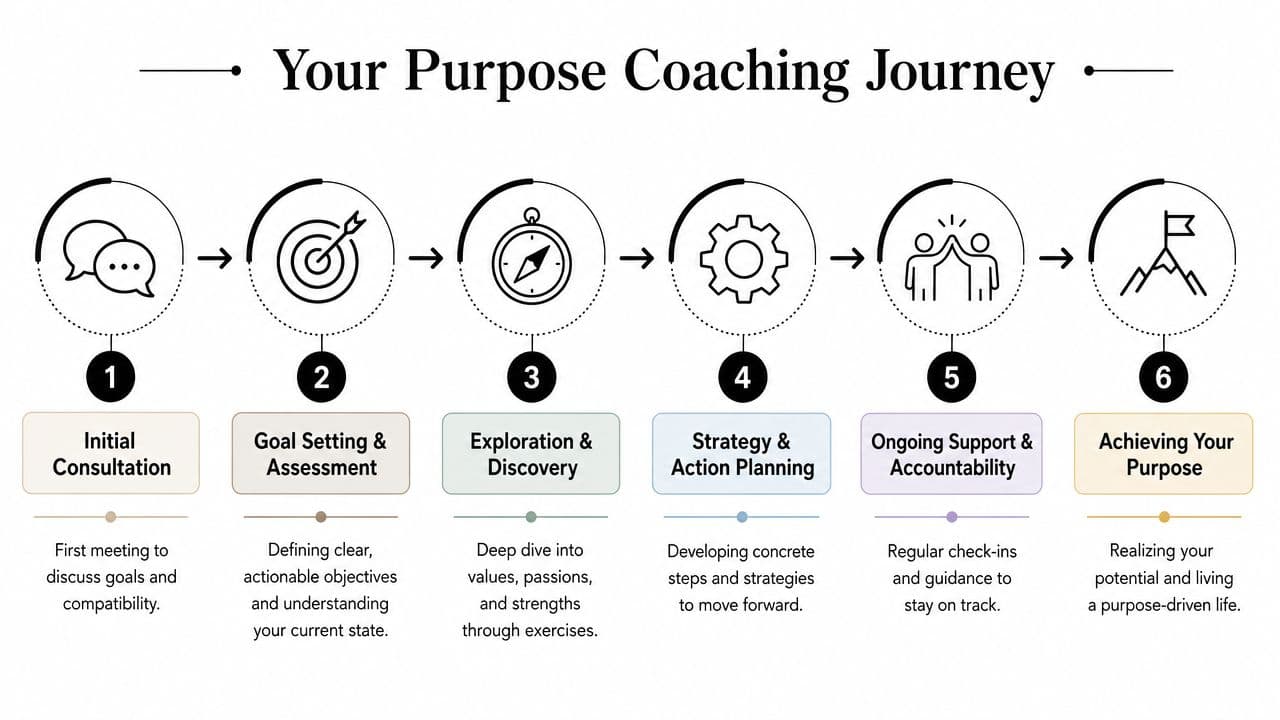
What to Expect When Working With a Purpose Coach
Apprehension is often lower regarding the idea of coaching than regarding the process. People want to know what happens once a conversation begins. That's a fair question, because life purpose coaching can sound profound and still feel fuzzy.
The process usually unfolds like a guided investigation. Not dramatic. Not theatrical. More like sitting with someone who knows how to separate what's urgent from what's important.
The first conversation
A first call often sounds ordinary. You talk about why you're reaching out now, what feels stuck, and what you'd like to understand or change. A good coach is listening for more than the presenting problem. They're listening for tension between your current life and your deeper values.
Maybe you say, “I'm successful, but I'm exhausted.” A purpose coach may hear overachievement, lack of boundaries, and a life shaped more by expectations than desire.
Maybe you say, “I can't commit to anything.” They may hear fear of choosing, fear of disappointing others, or a deeper uncertainty about identity.
The assessment phase
Once coaching begins, many coaches use structured exercises to move beyond vague conversation. One practical model comes from Dan Millman's “The Life You Were Born to Live” and tools associated with the Life Purpose App. The framework uses five life categories:
- Health
- Money
- Career
- Relationships
- Sexuality
In this model, you rate your satisfaction in each area on a 1 to 10 scale. That structure comes from Millman-based guidance on the five categories of life. The point isn't to produce a neat scorecard. The point is to reveal where your life is asking for attention.
A sample reflection might look like this:
| Life category | Example score | What it may reveal |
|---|---|---|
| Health | 4 | You're functioning, but your energy is low and your habits don't support the life you want |
| Money | 7 | Income may be stable, but your relationship with security or worth may need work |
| Career | 5 | You're capable, but the work may not feel meaningful |
| Relationships | 6 | You may be connected, yet not fully honest or nourished |
| Sexuality | 3 | Desire, embodiment, shame, or intimacy may need careful attention |
Individuals are often surprised. They came in wanting help with career direction, but the assessment shows depleted health and neglected relationships. Or they thought the problem was confidence, but what emerges is chronic self-betrayal.
Useful lens: Coaches don't just ask, “What do you want?” They ask, “What supports that life, and what keeps pulling you away from it?”
Turning insight into action
Insight alone isn't coaching. Plenty of people understand themselves well and still stay stuck. A purpose coach helps convert self-awareness into behavior.
That might mean:
- Naming a core theme. You notice your real issue isn't productivity. It's fear of being seen.
- Choosing one area to work first. You focus on health because low energy is weakening every other part of life.
- Creating small actions. You change one routine, have one overdue conversation, or stop one commitment that no longer fits.
- Reviewing what happens. Coaching tracks not only what you do, but how you respond internally.
A real coaching journey usually looks less like a breakthrough montage and more like steady alignment. You start saying yes more carefully. You stop building a life around performance. You learn to recognize when your choices are coming from fear, habit, or genuine purpose.
Practical Exercises and Digital Companion Tools
You sit down on a Sunday night with a notebook and one honest question: Why does my life look acceptable on paper but still feel off in practice? That moment is often the true beginning of purpose work.

A coach can help, but you do not need to wait for professional support to start building clarity. Purpose becomes easier to work with when you treat it less like a mystical revelation and more like a pattern you can study. The spiritual side still matters. So does method. Good exercises give shape to vague feelings so you can test what is true in daily life.
Three exercises you can try on your own
Start with observation before interpretation. Many people rush to declare a calling before they have gathered enough evidence from their own experience.
- Track your energy for one week. At the end of each day, note what gave you energy, what drained it, and what left you feeling internally satisfied. This works like checking the dashboard lights in a car. You are not fixing the engine yet. You are learning what your system is already telling you.
- Write your honest definition of success. Use this prompt: “If nobody praised my choices, what would still feel worth doing?” That question helps separate your values from roles you may have inherited from family, culture, or ambition.
- Review recurring friction. List the problems that keep returning in work, love, money, or health. Then ask, “What am I being asked to learn here?” Repetition usually points to a lesson, a boundary, or a fear you have not addressed directly.
These exercises seem simple. Simple is useful. If you feel confused, that is normal. Confusion often means you have stopped reciting old scripts and started listening more carefully.
Tools that add structure
Some people learn best through open journaling. Others need a framework that organizes reflection into clear categories. Both approaches can support purpose work, especially if you want to connect inner questions to concrete choices.
Dan Millman's book “The Life You Were Born to Live” is one example of a structured system for self-inquiry. As noted in this Shift Network profile of Dan Millman and his work, the book serves as the foundation for the Life Purpose App and presents a life-path model based on birth date. For readers who are drawn to symbolic systems, that kind of framework can offer language for patterns they have noticed but struggled to name.
A tool like this works like a map. It can help you orient yourself, spot recurring themes, and ask better questions. It cannot make choices for you, and it should not replace discernment. The practical value comes from using the framework to test what fits your lived experience.
That distinction matters in an industry with few formal standards. A structured tool is not proof of truth, and a spiritual framework is not proof of competence. Useful purpose work holds both humility and action at the same time.
One digital companion worth knowing
If you want a practical way to explore Dan Millman's “The Life You Were Born to Live” without jumping between highlighted pages and handwritten notes, the Life Purpose App is designed as a digital companion to that system. It uses a birth date to identify one of the 45 life paths and organizes themes related to health, money, sexuality, career, and relationships in one place. If you are comparing formats and trying to decide what kind of tool fits your style, this guide offers broader context.
Tools help most when they give clear language to something you have sensed for a long time but could not yet explain.
Used well, exercises and digital tools can prepare you for stronger coaching conversations. You arrive with cleaner observations, better questions, and more grounded expectations about what needs to change.
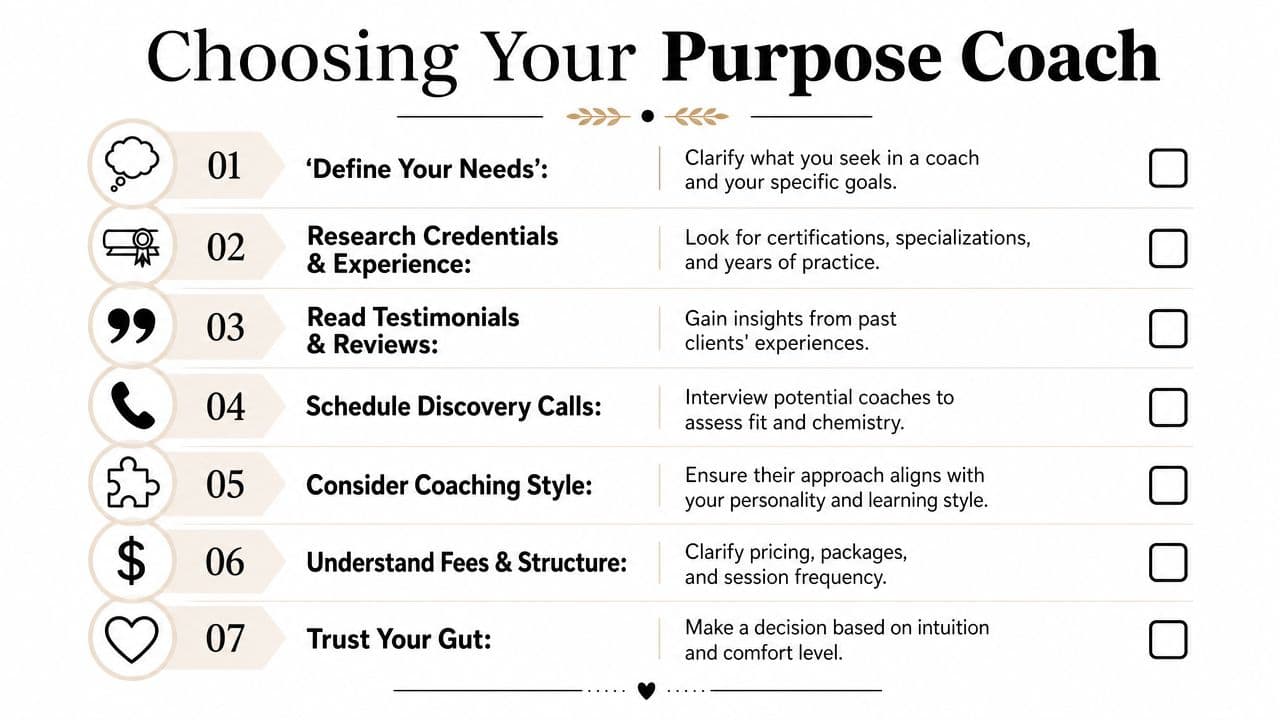
How to Find the Right Coach for You
People need to exercise caution. Life coaching is not a tightly regulated field, and that has consequences.
According to this discussion of common life coaching questions and industry realities, life coaching is an unregulated industry with no licensing requirements. The same source says 78% of clients report initial satisfaction, but a 2025 meta-analysis by the International Coaching Federation found only 34% can demonstrate sustained behavioral change beyond six months. That gap matters. Feeling inspired after a session is not the same as changing your life.
What to ask before you hire anyone
A good discovery call shouldn't feel like a sales funnel in disguise. It should help you understand how the person thinks, how they work, and whether their process fits your needs.
Ask questions like these:
- How do you define life purpose coaching? Listen for depth. You want more than vague promises about clarity.
- What methodology do you use? A capable coach should be able to describe their process in plain language.
- How do you assess progress? Not every result is easy to measure, but they should be able to name signs of movement.
- What kind of clients do you work with best? Coaches aren't for everyone, and honest ones know their lane.
- How do you handle resistance or stalled progress? This tells you whether they can stay grounded when things get messy.
- What happens between sessions? Some coaches expect reflection, exercises, or accountability. Others don't.
- What are your boundaries? Ethical coaches know when coaching is appropriate and when therapy or another kind of support may be better.
A practical resource for practitioners and clients alike is this overview of tools for life coaches, which can also help you recognize whether a coach uses real structure or mostly inspirational language.
Red flags that deserve your attention
Not every poor-fit coach is unethical, but some warning signs are easy to miss when you're eager for change.
| Red flag | Why it matters |
|---|---|
| Guaranteed outcomes | Human change doesn't work on a fixed script |
| Pressure to buy quickly | High-pressure selling often replaces thoughtful fit |
| No clear method | If they can't explain how they work, they may not work consistently |
| Grand spiritual claims with no grounded practice | Insight without integration often stays abstract |
| Dismissal of therapy or other support | Ethical coaches respect other helping professions |
The right coach should make you feel challenged and respected, not dazzled and dependent.
What a good fit feels like
A strong coach doesn't need to be flashy. Usually, the fit shows up in quieter ways. You feel understood without being managed. Their questions open something in you. They don't rush to label you. They don't need to become the hero of your story.
The coach's job is to help you hear yourself more clearly, act more authentically, and build a life with more coherence. If the relationship makes you smaller, more confused, or more reliant on their authority, keep looking.
Common Questions About Life Purpose Coaching
People usually circle around the same few questions before they begin. The questions are practical, and the answers should be too.
How is life purpose coaching different from career coaching or wellness coaching
This is one of the biggest areas of confusion. Genuine life purpose coaching explores existential purpose, not just performance, productivity, or lifestyle habits. That distinction matters because many services use similar language while doing very different work.
A 2025 APA survey found that only 29% of advertised “life coaches” use structured assessments for existential purpose, while 71% of career coaches prioritize job goals, and 45% of clients conflate the two, according to this explanation of the difference between life purpose coaching and adjacent coaching types.
If you're trying to tell them apart, ask what kinds of questions the coach relies on.
| Coaching type | Core question |
|---|---|
| Career coaching | What kind of work should I pursue or improve? |
| Wellness coaching | What habits will support my health and functioning? |
| Life purpose coaching | What gives my life meaning, and how do I live in alignment with that? |
A career coach may help you choose between two job paths. A purpose coach may help you notice that both options are built on external validation, and neither reflects your values.
How long does it take to see results
People want a timeline, but purpose work doesn't move in a straight line. Some shifts happen quickly. You may feel relief after naming a truth you've been avoiding for years. Other shifts take longer because your routines, relationships, and identity need time to catch up.
The clearest signs of progress are often subtle at first:
- You make decisions with less internal conflict
- You stop saying yes to things that violate your values
- You understand your recurring patterns more clearly
- You begin acting on insight instead of collecting it
That may not sound dramatic, but it's how meaningful change usually starts. Purpose isn't only a feeling. It's a pattern of choices that become more honest over time.
Can I do this on my own
Yes, to a point.
Some people do important purpose work alone through journaling, reflection, and structured systems. If you're drawn to life paths or numerology-based self-study, Dan Millman's The Life You Were Born to Live and the Life Purpose App offer a way to explore recurring themes, gifts, and hurdles through a defined framework.
Still, solo work has limits. You can't always see your own blind spots. You may rationalize old patterns because they feel familiar. A coach helps by holding up a clean mirror. They notice contradictions, ask the question you keep avoiding, and bring accountability to the changes you say you want.
Self-discovery can begin in private. Integration usually gets stronger when someone skilled is walking beside you.
The sweet spot for many people is a combination. Use reflection tools to gather insight. Use coaching to test that insight in real life.
If you're curious about purpose through Dan Millman's framework, Life Purpose App offers a structured way to explore one of 45 life paths, along with themes tied to health, money, sexuality, career, and relationships. It can be a useful starting point if you want language for patterns you've sensed but haven't fully mapped yet.
REQUIREMENTS:
- Remove each broken blog link completely (both the markdown link syntax and the descriptive text)
- Rewrite sentences naturally after removing references
- Preserve all other markdown formatting
- Only remove references to the specific broken blog links, don't change other content
- Process all broken URLs in a single pass
Example: After: ...for your small business.
Please return your response in the following JSON format: { "updatedContent": "the full content with all broken links removed", "removals": [ { "brokenUrl": "the broken blog URL", "explanation": "brief explanation of what was removed and how the text was adjusted" } ] }
Discover Your Life Purpose Today!
Unlock your true potential and find your life’s purpose.
