Explore 8 life purpose examples, from service and creativity to science and Dan Millman's life paths, with gifts, challenges and practical ways to start.

October 30, 2026 (23d ago)
Life Purpose Examples: 8 Paths to Meaning in 2026
Explore 8 life purpose examples, from service and creativity to science and Dan Millman's life paths, with gifts, challenges and practical ways to start.
← Back to blog
Explore 8 life purpose examples, from service and creativity to science and Dan Millman's life paths, with gifts, challenges and practical ways to start.
You've finished another busy week, answered everyone's messages, and kept the household running. Yet when someone asks what gives your life meaning, you draw a blank. You can name your responsibilities more easily than you can name your purpose.
Consider a nurse who sits with a frightened patient, a retired engineer who teaches children to build radios, or a graphic designer who volunteers for a food bank. They might not describe these choices as a calling. Still, each person is turning something they value into something another person can experience.
Purpose rarely looks like a mission statement. It can look like dependable care, a question you keep investigating, or a creative practice you return to without applause. These life purpose examples offer different ways to recognize that pattern, along with the gift each brings, the challenge that tests it, and a practical action to try.
You don't need to discover the perfect description of your purpose before doing something meaningful.
Nor does your purpose have to carry your entire identity. You can earn a living through one activity, care for people through another, and find personal meaning somewhere else. Start with the example that feels familiar, not the one that sounds most impressive.
1. Purpose Through Service and Compassion
You notice that a neighbor recovering from surgery has groceries but no energy to cook. Instead of offering an open-ended invitation to ask for help, you arrange a meal delivery they can count on. That's service made concrete.

The gift is practical attentiveness. You recognize discomfort and look for a useful response, whether that means caregiving, community support, or helping someone find their way through an unfamiliar system. Your contribution doesn't have to be dramatic to matter.
The challenge is confusing compassion with constant availability. If every request becomes your responsibility, you can become exhausted or resentful, while the person receiving help may feel obliged to accept whatever you offer.
Make Your Help Dependable, Not Unlimited
Choose a need you already understand, then agree on a specific contribution. Ask what would help before deciding what someone ought to need.
- Choose a clear commitment. Offer transport to an appointment rather than promising to handle everything.
- Name your limits. Say when you're available and what you can realistically sustain.
- Review the arrangement. Check whether your help is still useful and whether someone else should share the responsibility.
A practical approach to compassionate action starts with attention, but it also requires consent and boundaries. Helping isn't the same as taking control.
Try this: Put a recurring service commitment on your calendar and protect recovery time alongside it. At your monthly review, ask whether you're expressing care freely or trying to earn permission to feel worthwhile.
2. Finding Meaning Through Adversity (Logotherapy)
You don't have to call suffering a gift to find meaning while living through it. After bereavement, illness, or a painful separation, purpose may become smaller and more immediate: staying connected, accepting care, or protecting something you still value.
Viktor Frankl's logotherapy, associated with Man's Search for Meaning, offers a useful distinction between creating something, experiencing love or connection, and choosing a response to unavoidable hardship. The emphasis belongs on what remains possible, not on pretending that everything happens for a reason.

The gift is preserving agency under difficult conditions. Say an injury prevents you from doing work you loved. You might still mentor a colleague, record what you've learned, or maintain an important friendship without treating those activities as replacements for everything you've lost.
The challenge is forced positivity. Asking what hardship has taught you can feel intrusive when you're still trying to get through the day.
Meaning isn't an obligation you owe to pain. Sometimes the meaningful action is asking someone to stay with you.
Separate What Hurts From What You Can Choose
Use a journal to distinguish what you cannot change from what you can influence today. Then identify a value you want to protect, such as honesty, dignity, connection, or patience.
Practical reflection on overcoming life challenges should sit alongside appropriate support, not replace it. If grief, trauma, or distress is overwhelming, seek professional help rather than making purpose another demand you must meet.
3. Purpose Through Creative Expression
A parent starts recording family stories before older relatives forget them. A designer makes clearer information sheets for a local food bank. A musician writes songs that say what ordinary conversation can't.
Creative purpose is the desire to give experience a form someone else can encounter. Maya Angelou's I Know Why the Caged Bird Sings is a recognizable example of personal storytelling reaching beyond its author, but your own contribution doesn't need a public audience to be worthwhile.

Protect the Making Before Measuring the Response
The gift is expression. You may notice an image, a contradiction, or an untold story and feel compelled to work with it. The challenge arrives when you start judging every attempt by whether it earns attention, money, or praise.
A useful practice separates experimentation from publication. Keep somewhere to make unfinished work without having to explain why it matters.
- Choose a modest project. Record a family conversation, write a short scene, or sketch something from your neighborhood.
- Schedule the practice. Attach it to an existing routine instead of waiting for inspiration.
- Choose feedback carefully. Ask a trusted reader what they understood or felt, rather than whether you're talented.
For a community storytelling project, start by asking participants what they want represented and what they want kept private. Creative confidence doesn't excuse using someone else's experience carelessly.
Try this: Finish something small enough to share with a trusted person. Notice whether you want to keep exploring the subject after the initial excitement fades.
4. Purpose Through Ikigai and Finding Your Reason for Being
Not every meaningful activity needs to become a career. You might enjoy repairing bicycles, be good at explaining practical tasks, and find satisfaction in helping neighbors travel independently, without wanting to open a repair shop.
Ikigai is commonly understood as a reason for being or something that makes life feel worthwhile. The familiar exercise involving love, skill, need, and income can help organize your thinking, but don't treat a perfect overlap as an admission requirement for a meaningful life.
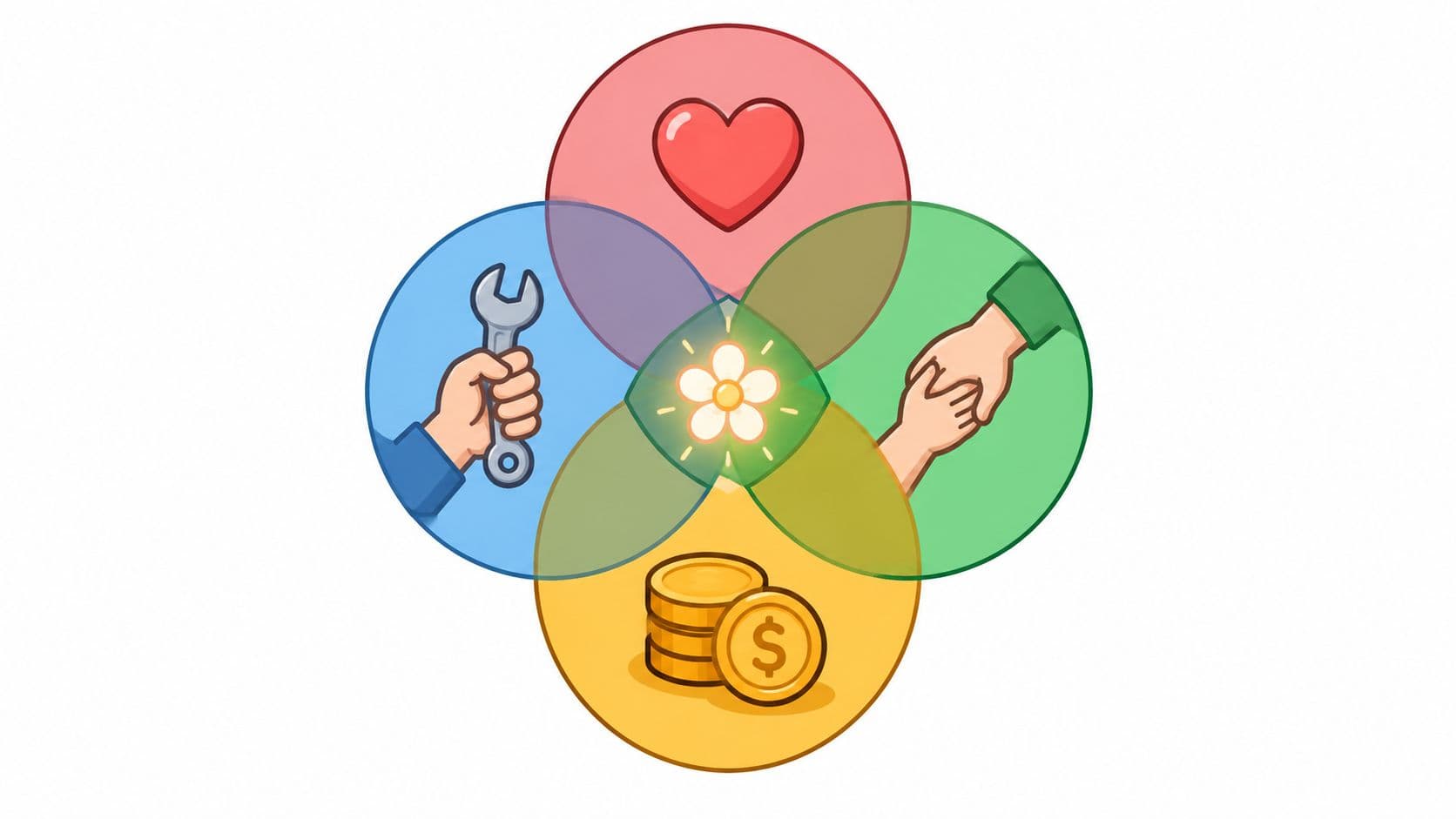
The gift is integration: recognizing how enjoyment, ability, contribution, and practical needs fit together. The challenge is expecting a single activity to satisfy them all.
Look for a Useful Overlap
Write down activities under love, skill, need, and income. Look first for places where interests connect, then decide which connections deserve an experiment.
For example, someone who loves cooking and needs stable income might keep their existing job while preparing meals for a community gathering. Another person may test paid catering and discover that customer deadlines remove the enjoyment they wanted to protect.
A meaningful activity doesn't become more legitimate just because someone pays you for it.
Try this: Choose an overlap that fits your present circumstances and test it without making an irreversible commitment. Review what you enjoyed, what others needed, and what the activity cost you.
Include ordinary sources of meaning in that review. Gardening, caring for a relative, maintaining friendships, and practicing a craft don't need to lead anywhere grand to deserve space in your life.
5. Purpose Through Values-Driven Business
The useful question isn't whether your business has an inspiring mission. It's what you'll do when keeping that promise becomes inconvenient.
Say you run a small cleaning company and want to offer dependable employment. Your purpose becomes visible in realistic schedules, understandable pay arrangements, and a willingness to turn down work you can't staff responsibly.
The gift is turning values into repeatable decisions. The challenge is remaining economically viable without using financial pressure to excuse every compromise.
Purpose matters to employees, but it doesn't mean the same thing to everyone: Deloitte's 2025 survey of 23,482 Gen Z and millennial respondents across 44 countries found that 89% of Gen Z and 92% of millennials considered purpose important to job satisfaction and well-being, with definitions ranging from social impact to income, work-life balance, and developing skills.
Translate the Mission Into an Operating Decision
A slogan such as supporting people is too broad to guide a difficult choice. Specify who you intend to support and what you're prepared to change.
- Choose a concrete promise. Explain what customers, workers, or communities should experience.
- Track the relevant behavior. Review scheduling changes, unresolved complaints, waste, or another measure connected to that promise.
- Name the trade-off. Explain where cost, capacity, or competing responsibilities limit what you can offer.
Try this: Select a recent business decision and compare it with your stated values. If they conflict, change a process rather than rewriting the mission to make the conflict disappear.
You don't need to found a company to pursue this purpose. A manager who improves working conditions can express it through ordinary authority used responsibly.
6. Purpose Through Scientific Curiosity and Discovery
Some people feel most engaged when a question won't leave them alone. Why does a local stream change color after rain? Why do patients struggle with a particular instruction? What explains a pattern everyone else seems willing to accept?
The gift is disciplined curiosity. Scientific purpose involves more than enjoying interesting facts. It means learning how to test an explanation, record what happened, and admit when your preferred answer doesn't fit.
Marie Curie and Jane Goodall are recognizable examples of sustained inquiry. For your own experiment, though, the useful comparison isn't with an exceptional career. It's with the patient work required to understand a small question properly.
Keep a Question Notebook
Choose a question you can investigate safely with accessible tools. A gardener, for example, could record plant growth under different conditions while keeping other conditions as consistent as possible.
The challenge is tolerating slow progress and inconclusive results. If you only enjoy discovery when it produces a satisfying answer, you may overlook the less glamorous work of checking, documenting, and revising.
- State the question clearly. Replace a broad interest with something observable.
- Learn the method. Ask a qualified mentor or research community how to avoid common errors.
- Record inconvenient results. Keep observations that contradict your expectation, not just those that support it.
Try this: Bring a short record of observations to someone knowledgeable and ask what you may have missed. That conversation can reveal whether you enjoy inquiry itself or mainly the idea of being someone who discovers things.
Keep amateur investigation away from unsafe experiments and personal medical decisions. Curiosity is valuable; knowing the limits of your competence is part of practicing it responsibly.
7. Purpose Through Education and Advocacy
You help a colleague understand a confusing process, and they stop needing someone else to speak for them. That moment captures something important about education: the purpose is greater agency, not permanent dependence on the teacher.
Education and advocacy can take the form of tutoring, literacy support, accessible resources, or campaigning against barriers to opportunity. Malala Yousafzai's work for girls' education is a public example, while a neighborhood reading group expresses the same broad commitment at a different scale.
The gift is making understanding and participation more accessible. The challenge is assuming you already know what learners or communities need.
Start With the Barrier, Not Your Preferred Solution
Suppose you want to start an evening literacy group. Before producing worksheets, ask prospective participants about transport, childcare, language, privacy, and the kinds of reading they want help with.
A course can be well designed and still inaccessible. Listening first may reveal that partnering with an existing organization is more useful than launching something new.
Practical rule: Don't measure your contribution by how necessary you remain. Look for signs that people can act more confidently without you.
Try this: Ask an established organization which educational gap it struggles to address, then offer a contribution matched to your actual skills. That might mean tutoring, administration, translation within your competence, or improving information materials.
Advocacy also requires boundaries around public exposure and conflict. Agree on what you'll share, whose consent you need, and who can support you when the work becomes difficult. You can contribute through careful preparation and reliable follow-through without becoming a public spokesperson.
8. Purpose Through Self-Knowledge and Life-Path Alignment
You keep volunteering to lead, then feel resentful when everyone depends on you. Or you say creativity matters while giving every spare hour to obligations you never question. Self-knowledge becomes useful when it helps you notice contradictions like these and choose differently.
Dan Millman's The Life You Were Born to Live and the Life Purpose App offer a birth-date-based framework for exploring gifts, challenges, and life-path themes. The revised anniversary edition of Millman's book, which underpins the Life Purpose App, expands the system from 37 life paths to 45 birth numbers and corresponding life paths.
The gift is a structured starting point for reflection. The challenge is mistaking a description that feels meaningful for proof of a fixed identity or future.
Compare Interpretation With Experience
When using the life-path framework in Dan Millman's The Life You Were Born to Live and the Life Purpose App, look for a concrete situation you can examine. A theme about responsibility, for example, can prompt you to review where you contribute willingly and where you overcommit.
The book's description of its scope connects the framework used by the Life Purpose App with health, money, sexuality, career, and relationships. Treat these as areas for reflection, not as a clinically validated assessment.
Try this: Write down an interpretation, an experience that supports it, and an experience that doesn't. Then discuss the pattern with someone who knows you well.
Use Dan Millman's The Life You Were Born to Live and the Life Purpose App to generate questions about life-path alignment, not to outsource decisions. Your circumstances, responsibilities, and lived experience still deserve the final say.
How the eight life purpose examples differ in driver, expression, and risk
| Item | Core Driver | Common Expression | Main Risk |
|---|---|---|---|
| Purpose Through Service and Compassion | Empathy and responsibility toward others | Hands-on care, community service, or humanitarian work | Burnout and neglecting personal needs |
| Finding Meaning Through Adversity (Logotherapy) | Discovering meaning through work, relationships, or chosen attitudes | Creating meaningful work, deep relationships, or reflecting on hardship | Feeling pressured to find positive meaning in every hardship |
| Purpose Through Creative Expression | Self-expression and making meaning through art | Art, writing, music, design, or storytelling | Financial instability and self-doubt |
| Purpose Through Ikigai: Finding Your Reason for Being | Balancing what you love, do well, the world needs, and can support you | Meaningful daily activities, hobbies, or career choices | Oversimplifying its cultural roots or forcing a rigid fit |
| Purpose Through Values-Driven Business | Aligning business decisions with social or environmental values | Building mission-led organizations and measuring impact | Mission-profit conflicts and purpose-washing |
| Purpose Through Scientific Curiosity and Discovery | Curiosity and evidence-based inquiry | Research, observation, and experiments that build shared knowledge | Long timelines, setbacks, and career pressures |
| Purpose Through Education and Advocacy | Expanding access to learning, rights, and opportunity | Teaching, campaigning, or speaking out for change | Backlash, slow progress, and emotional strain |
| Purpose Through Self-Knowledge and Life-Path Alignment | Self-awareness through a symbolic life-path framework | Reflecting on personal patterns, strengths, and life cycles | Treating unvalidated insights as fixed predictions |
Pick One Path and Test It This Month
Reading life purpose examples can make meaning seem obvious in someone else's life and strangely difficult to recognize in your own. Don't respond by trying to adopt every appealing example. Choose the one that made you pause, then select a small action you can repeat for four weeks.
Make the action specific enough to put on a calendar. Contact a volunteer coordinator, arrange a creative session, ask about a tutoring role, or begin a question notebook. Leave major career decisions out of the first experiment unless circumstances already require them.
Review the Experience, Not Just Your Mood
Keep a brief record after each attempt. You're looking for a pattern, not a constant feeling of inspiration.
- Notice engagement. What held your attention after the novelty wore off?
- Notice contribution. Who benefited, and how do you know the activity was useful?
- Notice cost. What happened to your energy, money, relationships, and other responsibilities?
- Notice willingness. Would you choose to return, perhaps with better boundaries or a smaller commitment?
A meaningful activity can be tiring. Likewise, an exciting activity may not remain important once the praise or novelty disappears, so avoid judging the experiment by whether you felt good every time.
There's a reason to take purpose seriously without turning it into a health prescription. A longitudinal study published in Psychological Science followed 7,108 U.S. adults for approximately 14 years and found that greater purpose was associated with lower mortality risk after accounting for demographic characteristics and other measures of well-being. That association doesn't prove that discovering purpose causes a longer life, and it doesn't make uncertainty a personal failing.
If you want a structured starting point for life-path reflection, read Dan Millman's The Life You Were Born to Live and explore the accompanying framework with the Life Purpose App. Compare what resonates with your actual choices, and leave room for disagreement.
At the end of the month, decide whether to continue, adjust, or stop. A useful experiment gives you clearer information, even when the answer is no. You're not choosing a permanent identity; you're learning which commitments deserve more room in the life you have now.
The Life Purpose App is a digital companion to Dan Millman's The Life You Were Born to Live, offering birth-date-based life-path interpretations and related themes for reflection. Visit Life Purpose App to explore the framework, then connect what you read with a practical purpose experiment from your everyday life.
Discover your life path today
Enter your date of birth and see your life path, free.
Find your life path