Feeling uncertain about your next step? The right assessment can clarify your values, strengths, passions, and personality so you make clearer choices in 2025. Below are seven vetted life-purpose quizzes grouped by approach—personality, strengths, values, spiritual, and passion—and practical tips for getting useful results. Treat quiz output as a starting point: run short experiments, gather feedback, and reflect to see what really matters. A strong sense of purpose is linked to better health and longevity2.
June 14, 2025 (1y ago) — last updated July 27, 2026 (28d ago)
Top Life-Purpose Quizzes for 2025
Compare seven vetted life-purpose quizzes—features, time, cost, and tips to turn results into action in 2025.
← Back to blog
Top Life-Purpose Quizzes for 2025
Summary: Find clarity in 2025 with seven vetted life-purpose quizzes—compare features, time, cost, and quick tips to turn results into action.
Introduction
Feeling uncertain about your next step? The right assessment can clarify your values, strengths, passions, and personality so you make clearer choices in 2025. Below are seven vetted life-purpose quizzes grouped by approach—personality, strengths, values, spiritual, and passion—and practical tips for getting useful results. Treat quiz output as a starting point: run short experiments, gather feedback, and reflect to see what really matters. A strong sense of purpose is linked to better health and longevity2.
Why use a life-purpose quiz?
People often find purpose hard to pin down. These curated quizzes offer different lenses—psychological, spiritual, strengths-based, and cultural—to help you uncover what matters most. Use them to:
- Identify core values and priorities
- Recognize and apply natural strengths
- Uncover passions that energize you
- Align daily actions with long-term meaning
Ready to explore? Here are seven vetted life-purpose quizzes to consider in 2025.
1. 16Personalities Life Purpose Assessment
The 16Personalities assessment uses MBTI-style typology to suggest career and life directions aligned with your preferences. It profiles how you interact with the world, process information, and make decisions, then offers type-based guidance for meaningful work and relationships.

How it works
A timed questionnaire identifies one of 16 personality types and explains typical strengths, weaknesses, and environments where that type thrives. MBTI-style assessments have reached over 100 million users1.
Common uses
- Career exploration and counseling
- Team building and communication improvement
- Student advising and personal development
Tips for taking it
- Answer honestly about how you typically behave, not how you’d like to be
- Read full type descriptions to capture nuance
- Re-test after major life shifts to compare results
Why try it
It’s accessible, widely used, and gives clear language for personality differences—useful for workplaces, campuses, and personal planning.
2. VIA Character Strengths Survey
Developed by positive psychologists, the VIA Survey identifies your top character strengths from 24 validated traits, such as curiosity, perseverance, and kindness. Its strengths-focused approach helps you apply what you already do well to build wellbeing and purpose.

How it works
You respond to items about typical thoughts and actions. The report highlights signature strengths and offers practical ideas for applying them across work, relationships, and goals. See VIA’s research and resources for more on the science behind the survey3.
Common uses
- Therapeutic and coaching settings
- Education and youth development
- Workplace wellness programs
Tips for taking it
- Reflect on recent real behavior rather than ideals
- Focus on your top five strengths first
- Create short experiments that use those strengths deliberately
Why try it
It’s research-based, strengths-focused, and actionable—helpful for improving wellbeing and aligning daily habits with what you do best.
3. Purpose Driven Life Assessment (Rick Warren)
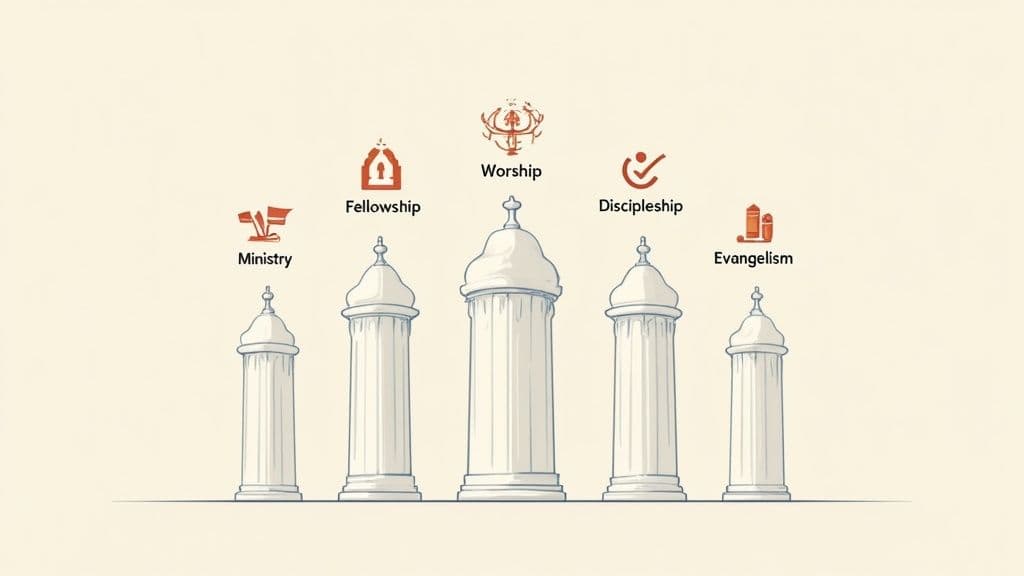
Based on The Purpose Driven Life, this faith-centered assessment frames purpose around five spiritual aims: worship, fellowship, discipleship, ministry, and evangelism. It’s designed for people seeking purpose through a Christian worldview.
How it works
A short questionnaire assesses your involvement across the five purposes, then suggests spiritual practices and service-oriented steps to deepen meaning.
Common uses
- Church small groups and discipleship programs
- Christian counseling and pastoral care
- Faith-based coaching
Tips for taking it
- Approach with openness to spiritual reflection
- Discuss results in a small group for accountability
- Apply small daily practices tied to each purpose
Why try it
If faith and community form the core of your meaning, this assessment connects belief with concrete next steps.
4. Japanese Ikigai Life Purpose Questionnaire
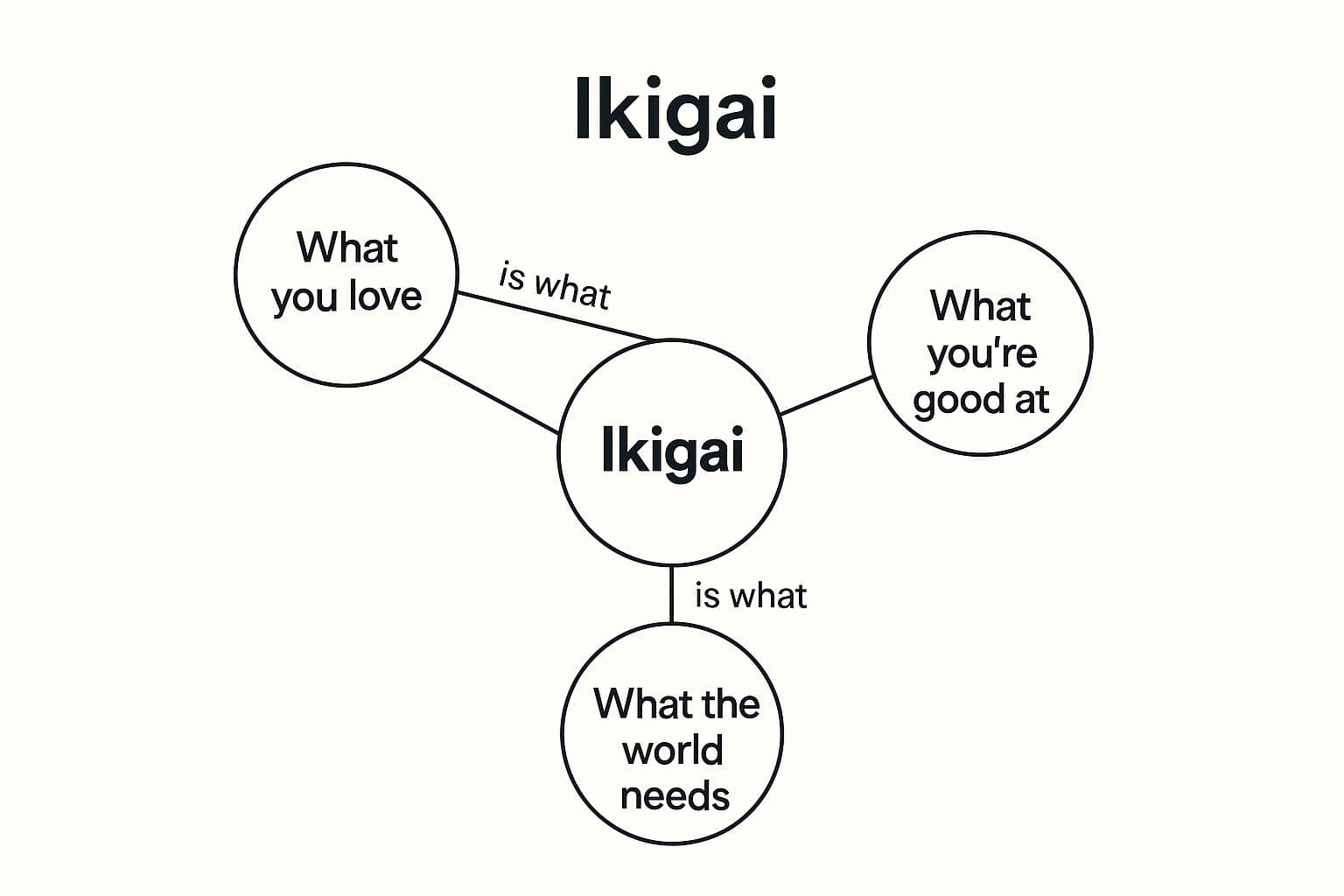
Ikigai—“a reason for being”—helps you explore where passion, skill, need, and compensation overlap. It’s a holistic framework for balancing meaning and practicality.
How it works
Through guided reflection and prompts, you map “what you love,” “what you’re good at,” “what the world needs,” and “what you can be paid for” to find overlap and next steps.
Common uses
- Career transitions and entrepreneurial planning
- Retirement and life-stage reorientation
- Executive coaching focused on meaning and legacy
Tips for taking it
- Be honest about current skills versus desired skills
- Think both locally and globally about needs
- Revisit ikigai as priorities and circumstances change
Why try it
Ikigai helps you balance passion with practicality and supports a long-term view of purposeful living.
5. StrengthsFinder 2.0 (CliftonStrengths)
Gallup’s CliftonStrengths identifies your top talent themes from 34 themes and gives development strategies so you can invest in what you do best4.
How it works
An online assessment yields your top themes and practical suggestions for growth and team application. Gallup’s materials explain how each theme tends to manifest in work and relationships.
Common uses
- Leadership development and succession planning
- Team design and role clarity
- Career coaching focused on talent maximization
Tips for taking it
- Trust first instincts when answering
- Study detailed theme reports for application ideas
- Use results to design strength-based goals
Why try it
It’s workplace-focused and designed to convert insight into actionable development plans.
6. Big Five Personality Test for Life Purpose
The Big Five—Openness, Conscientiousness, Extraversion, Agreeableness, Neuroticism—provides a research-backed personality profile that clarifies tendencies relevant to career choice, relationships, and wellbeing5.
How it works
A series of trait-based items produces scores across the five domains and helps you see how trait combinations shape preferences and likely work environments.
Common uses
- Academic and clinical settings
- Career counseling and vocational assessment
- Personal development and trait-aware coaching
Tips for taking it
- Answer for your general tendencies across contexts
- Consider trait combinations rather than single scores
- Use results to guide environment and role fit
Why try it
The Big Five is scientifically robust and offers precise language for describing personality patterns relevant to purpose and choice.
7. Passion Test by Janet and Chris Attwood
The Passion Test helps you identify your top five life passions through a structured comparison process, then uses those passions as a decision-making compass.
How it works
You rank and compare life areas until your top passions emerge, which gives clarity for priorities and goal-setting.
Common uses
- Life coaching and workshops
- Goal-setting programs and retreats
- Creative and entrepreneurial planning
Tips for taking it
- Be honest during comparisons and avoid outside pressure
- Reassess passions every 6–12 months
- Use passions to prioritize projects and commitments
Why try it
Its simplicity and directness make it an effective first step when clarity feels elusive.
Life Purpose Quiz Comparison Table
| Assessment | Time | Cost | Best outcomes | Ideal use cases | Key advantage |
|---|---|---|---|---|---|
| 16Personalities | 10–20 min | Free / Premium | Personality-driven career & life insights | Career counseling, teams | Widely used, approachable |
| VIA Character Strengths | 15–20 min | Free / Paid options | Signature strengths & application ideas | Therapy, education, wellness | Strengths-based, research-backed |
| Purpose Driven Life | 10–15 min | Free | Faith-centered life direction | Church groups, faith coaching | Integrates spirituality and practice |
| Ikigai Questionnaire | 20–30 min | Free / Guided | Holistic balance of passion and practicality | Career transitions, retirees | Culturally rich framework |
| StrengthsFinder (CliftonStrengths) | 30–45 min | Paid | Top talent themes & development | Leadership, team design | Actionable workplace focus |
| Big Five | 15–25 min | Free (many versions) | Detailed trait profile for fit | Research, counseling, coaching | Strong scientific foundation |
| Passion Test | 20–30 min | Free / Paid | Ranked passions for clarity | Personal development | Simple, prioritization-focused |
Charting your course: integrating quiz insights
Quizzes are a starting point. The value comes from applying results through small experiments, reflection, and feedback. Consider journaling, talking with a mentor, or trying short-term projects that match your quiz results. See our guide on turning insights into action for step-by-step exercises.
Practical next steps:
- Reflect on which results felt most accurate
- Design experiments that test those insights in real life, such as two-week trials
- Reassess periodically as your priorities shift
Meaningful purpose grows through action. Use these tools to guide choices, then iterate and adapt.
Three concise Q&A sections
Quick Q&A
Q: Which quiz should I start with if I’m totally unsure?
A: Start with a strengths or personality quiz like 16Personalities or VIA—these give practical language you can test quickly.
Q: How often should I retake a quiz?
A: Retake after major life changes or every 6–12 months to track evolution. Use results as a snapshot, not a final verdict.
Reader Q&A
Q: I get different results across quizzes—what now?
A: Treat differences as complementary signals. Look for overlapping themes and design experiments that test those overlaps.
Q: Can quizzes help with major life decisions like a career change?
A: Yes—use quizzes to generate options and run small trials like freelance projects, volunteering, or informational interviews before committing.
Bottomline Q&A
Q: What single step gives the best return on time spent?
A: Take one short quiz and run a two-week experiment based on one insight.
Q: How do I avoid over-relying on test results?
A: Use results as hypotheses; prioritize real-world tests and feedback.
Practical mini FAQ (concise answers to common pain points)
Q: How do I turn results into a realistic plan?
A: Pick one insight, design a two-week experiment, measure how it feels and what changed, then iterate.
Q: Are free tests worth my time?
A: Yes—if you use them for reflection and follow-up action. Paid tools often add depth, but free assessments can still provide useful direction.
1.
https://www.16personalities.com — 16Personalities notes MBTI-style tests have reached over 100 million users.
2.
https://www.ncbi.nlm.nih.gov/pmc/articles/PMC6125024/ — Systematic review summarizing links between sense of purpose and health outcomes.
3.
https://www.viacharacter.org — VIA Institute for Character: research and resources on character strengths and well-being.
4.
https://www.gallup.com/cliftonstrengths — Gallup CliftonStrengths overview and the list of 34 themes.
5.
https://www.ncbi.nlm.nih.gov/pmc/articles/PMC3589737/ — Overview of Big Five personality traits and supporting research.
Discover Your Life Purpose Today!
Unlock your true potential and find your life’s purpose.
