Struggling with the like vs love question? Our guide defines the key differences, offers self-assessment questions, and shows how to find clarity.
June 10, 2026 (1mo ago) — last updated July 1, 2026 (25d ago)
Like vs Love: How to Know the Difference for Sure
Struggling with the like vs love question? Our guide defines the key differences, offers self-assessment questions, and shows how to find clarity.
← Back to blog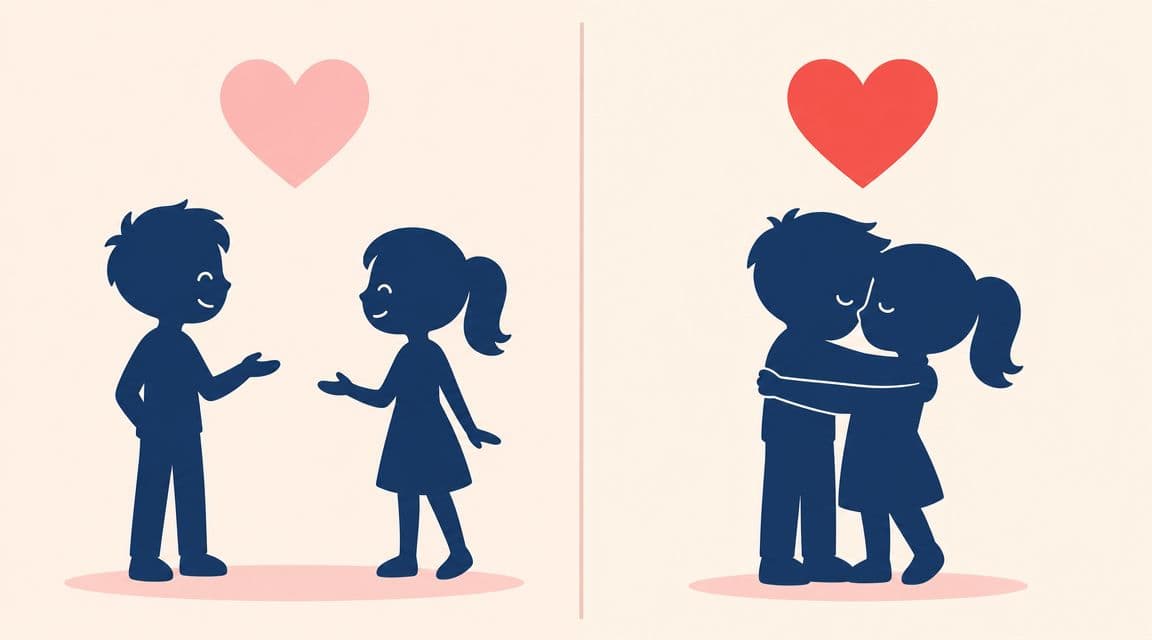
You check your phone, reread a message, smile, then immediately wonder if you're getting ahead of yourself.
Maybe you think about this person when you wake up. Maybe you miss them after one good date. Maybe you feel safe with them in a way that surprises you. Or maybe the whole thing feels exciting, intense, and a little destabilizing, which only makes the question louder. Do I like them, or am I falling in love?
That confusion is more common than often acknowledged. The line between like and love can feel blurry, especially when attraction, hope, loneliness, chemistry, and real compatibility all show up at once. It's easy to mistake strong feelings for deep feelings. It's also easy to dismiss something meaningful just because it doesn't feel dramatic.
That Confusing Feeling You Can't Quite Name
Maya had been seeing someone for a few weeks. Nothing officially serious. But she noticed little changes in herself. She cared how his day went. She remembered small details. She felt calm after talking to him, not just excited. Then he took longer than usual to reply one afternoon, and suddenly she was spiraling. Was that love? Attachment? Anxiety? Just a crush getting too big?
A lot of people are standing in that same fog.
Modern dating doesn't make this easier. On apps, people often enter with very different hopes. According to Pew Research's online dating findings, 44% of online dating users say finding a long-term partner is a major reason for using dating sites or apps, while 40% say casual dating is a major reason. That close split helps explain why your own feelings, and the other person's intentions, can feel hard to read.
Why this feels so hard
Sometimes you're not only sorting out your feelings. You're also trying to interpret theirs.
You might be asking yourself things like:
- Am I excited because this is real, or because it's new?
- Do I miss them as a person, or just the attention and possibility?
- Am I feeling attached, or am I beginning to build something deeper?
Confusion doesn't mean you're bad at love. It usually means your feelings are moving faster than your understanding.
Clarity usually comes when you stop asking one giant question and start asking better, smaller ones. What exactly do I feel around them? What changes when things get inconvenient? Do I want to know them, or do I want them to fit the story in my head?
That's where the difference between like and love begins to come into focus.
The Science of How We Attach to Others
Psychologists have been wrestling with this question for a long time, and that matters. It tells us your confusion isn't silly or immature. The boundary between liking someone and loving them has been difficult to define even in research.
In 1970, Zick Rubin made one of the first serious attempts to measure the difference. He created separate scales for liking and love, trying to distinguish respect, admiration, and similarity from deeper attachment and caring. Rubin first built a 70-item questionnaire, then reduced it to 13 items after testing it on 200 undergraduates. Later commentary and follow-up discussion showed that the distinction was useful, but still messy. Among lovers, scores on liking and love remained highly connected. A later study by Sternberg and Grajek reported a 72% correlation, which you can read about in this overview of Rubin's work on love.
What Rubin helped clarify
Rubin's framework gave people language for two experiences that often arrive together.
| Dimension | Like | Love |
|---|---|---|
| Core feeling | Respect, admiration, enjoyment | Attachment, deep caring, belonging |
| Focus | What you appreciate about them | The bond you feel with them |
| Experience | Pleasant connection | Emotional investment |
| Risk if confused | Mistaking compatibility for depth | Mistaking intensity for stability |
That doesn't mean liking is shallow. It means it's different. You can like someone a lot because they're smart, funny, kind, attractive, or easy to talk to. Love usually adds something more binding. A sense that their well-being matters to you in a deeper, more personal way.
Why your history also matters
Your attachment style can shape how fast you bond, how safe closeness feels, and how easily you confuse longing with love. If that part of the puzzle feels familiar, attachment-style guidance can help you understand your own patterns.
Practical rule: If your feelings are strong but your understanding of the person is still thin, you may be in intensity, not yet in love.
That doesn't make the feeling fake. It just means the feeling may still be developing its roots.
A Detailed Comparison of Like and Love
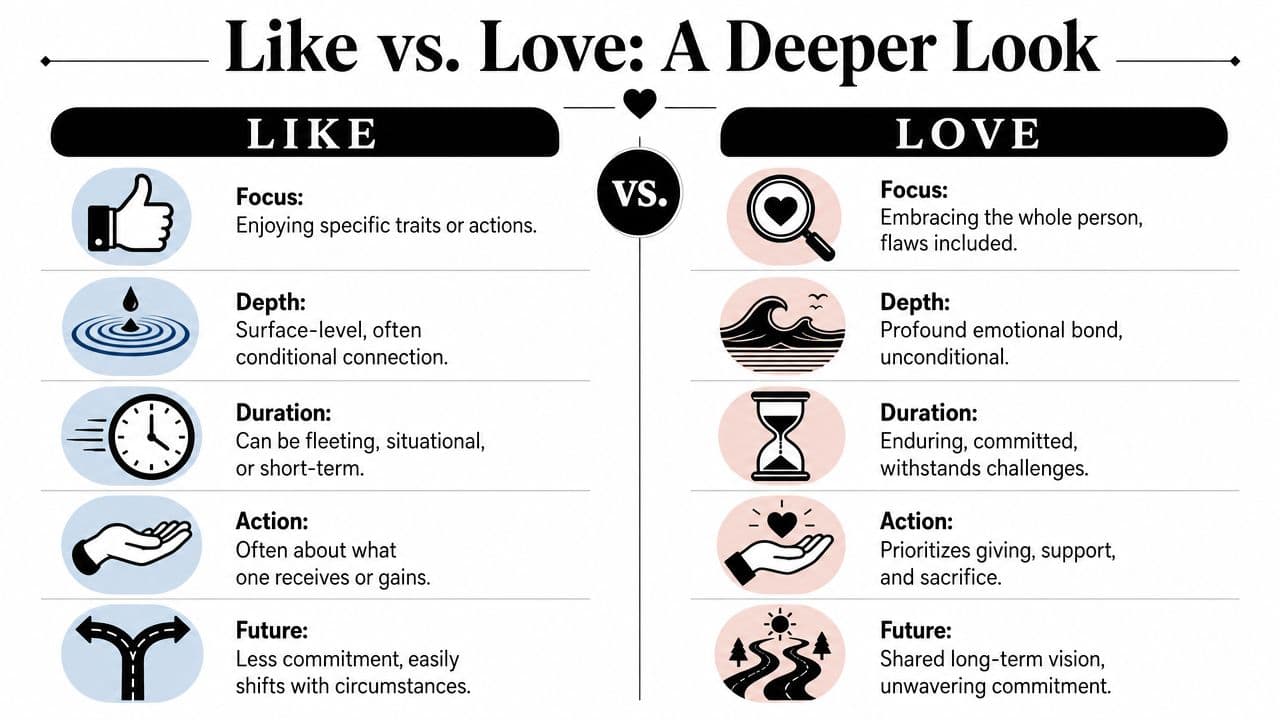
Individuals don't struggle with the words. They struggle with the signals. They assume that if something feels powerful, it must be love. But intensity and depth are not the same thing.
Relationship guidance often draws an important line here. Infatuation tends to involve urgency, idealization, and a loss of perspective, while mature love leans toward realism and conscious commitment. That distinction is explored well in this reflection on love and infatuation.
A side by side view
| Area | Like | Love |
|---|---|---|
| Focus | You enjoy certain traits | You embrace the whole person |
| Emotional tone | Excitement and interest | Care, steadiness, and investment |
| Time horizon | Often present-focused | Includes a real future picture |
| Response to flaws | Irritation can quickly cool feelings | Flaws get folded into a fuller view |
| Conflict | Can feel like a dealbreaker fast | Becomes something to work through |
Where people get mixed up
Like often starts with preference. You like how they talk, how they dress, how they text, how they make you feel. That matters. It's often the doorway.
Love expands beyond preference. It keeps growing after the early sparkle gets interrupted by reality. You see more. Sometimes you see things you don't love. Yet your care becomes more grounded, not less.
When love gets healthier, it often feels less dizzying and more dependable.
That change can be unsettling because many people have learned to equate emotional chaos with emotional depth. If it's calmer, they worry it must be weaker. Often the opposite is true.
Chemistry is real, but it isn't the whole story
You can feel consumed by someone and still not know them well. You can want them intensely and still not be able to build a life with them. If that distinction feels important, HolyJot's piece on lust vs love offers another useful lens.
A simpler way to test like vs love is to look at what happens when life becomes inconvenient.
- When plans change, do your feelings collapse fast?
- When they disappoint you, do you get curious or turned off?
- When they need support, do you feel burdened or drawn closer?
- When they succeed, do you celebrate enthusiastically, or compare?
The emotional difference
Like often says, “I enjoy being with you.”
Love says, “Your life matters to me, and I'm learning how to care for the real you.”
That doesn't mean love is always sacrificial or solemn. It can be playful, passionate, and light. But underneath, there's usually a sturdier foundation. A willingness to stay honest. A willingness to let fantasy soften so reality can enter.
For some people, that's the moment they realize the feeling has become more than a crush.
If you're also trying to sort out whether desire is clouding your judgment, this article on lust in relationships may help sharpen the picture.
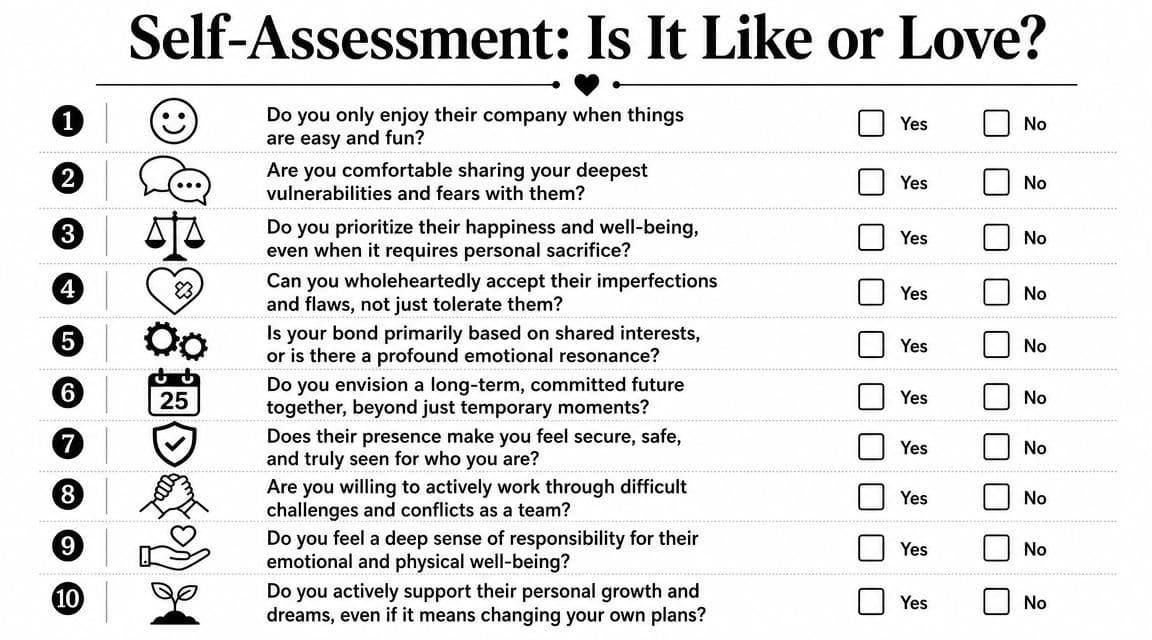
Ten Questions to Ask Yourself Right Now
Sometimes the clearest answer doesn't come from analyzing the other person. It comes from listening to your own behavior, motives, and emotional reactions.
There's no single correct pace for love. A 2023 study found that 27% of men and 15% of women reported feeling love within their first four dates, as discussed in this PMC-hosted study on falling in love. That difference is a reminder that your timeline doesn't have to match anyone else's.
Use these questions slowly
Don't score yourself. Sit with each one.
-
When I picture the future, are they there?
Not in a fantasy montage. In ordinary life. Errands, stress, illness, family, decisions. -
Do I feel safe being unpolished around them?
Love usually invites more honesty over time, not more performance. -
Do I care about who they are, or mostly how they make me feel?
Attraction focuses on experience. Love grows interested in personhood. -
How do I respond to their flaws?
Everyone has limits. But do their imperfections make you want to understand them more fully, or do they mostly break the spell? -
Do I want to support their growth, even when it's inconvenient for me?
This question reveals a lot. -
What happens when I'm disappointed?
Do you want to repair, or do you detach? -
Do I respect them?
Without respect, intense feelings don't become sturdy love. -
Am I attached to their potential, or connected to their reality?
This is one of the biggest traps. -
Do I feel calmer over time, or more activated?
Not every calm bond is love, but lasting love often becomes more regulating. -
If the chemistry dropped for a season, would I still want this relationship?
This can be a revealing question, especially in early dating.
What your answers may be telling you
If many of your answers revolve around longing, fantasy, uncertainty, and emotional highs, you may be in strong like, infatuation, or early attachment.
If your answers point toward respect, steadiness, realism, and a desire to care well for the other person, love may be taking shape.
You don't need to rush the label. Sometimes the healthiest thing you can say is, “This matters to me, and I'm still learning what it is.”
That answer is not avoidance. It's honesty.
Navigating Your Relationship Stage With Confidence
Once you see your feelings more clearly, the next question becomes practical. What do you do with that clarity?
The answer depends on what kind of bond you have, not the one you wish you had.
If it's like, that's still meaningful
Not every strong connection is meant to become lifelong love. Sometimes you like someone. You enjoy them, desire them, admire them, and feel good in their presence. That's real. It doesn't need to be downgraded or dramatized.
If that's where you are, try being direct with yourself. Enjoy what's true without forcing a bigger story too soon.
A healthy “like” can sound like this:
- I enjoy being with them
- I'm interested in seeing where this goes
- I'm not ready to call this love yet
- I want to keep learning who they are
If it's growing into love
This stage often feels quieter than people expect. You may notice less obsession and more trust. Less performing and more telling the truth. You begin caring not just about the relationship, but about how you show up inside it.
That's usually a good moment to slow down enough to protect what's forming. Speak openly. Watch for consistency. Let shared reality do its work.
If you love them but don't always like them
This is one of the most important relationship questions people ask too late.
Some long-term relationships keep commitment but lose warmth. The bond remains, but daily enjoyment fades. That matters because relationship quality isn't sustained by commitment alone. It's also shaped by ordinary interactions, responsiveness, and whether you still experience each other as good company. This tension is thoughtfully raised in this article about the difference between like and love.
Love can keep a relationship intact for a while. Liking helps make it livable.
If you love someone but don't like who you are together, don't ignore that. Ask better questions.
- Do we still treat each other with warmth?
- Do I enjoy their presence, not just their role in my life?
- Are we responsive, or only responsible?
- Is resentment replacing fondness?
Those questions aren't signs of failure. They're signs that you're paying attention to the daily texture of a relationship, which is where real happiness often lives.
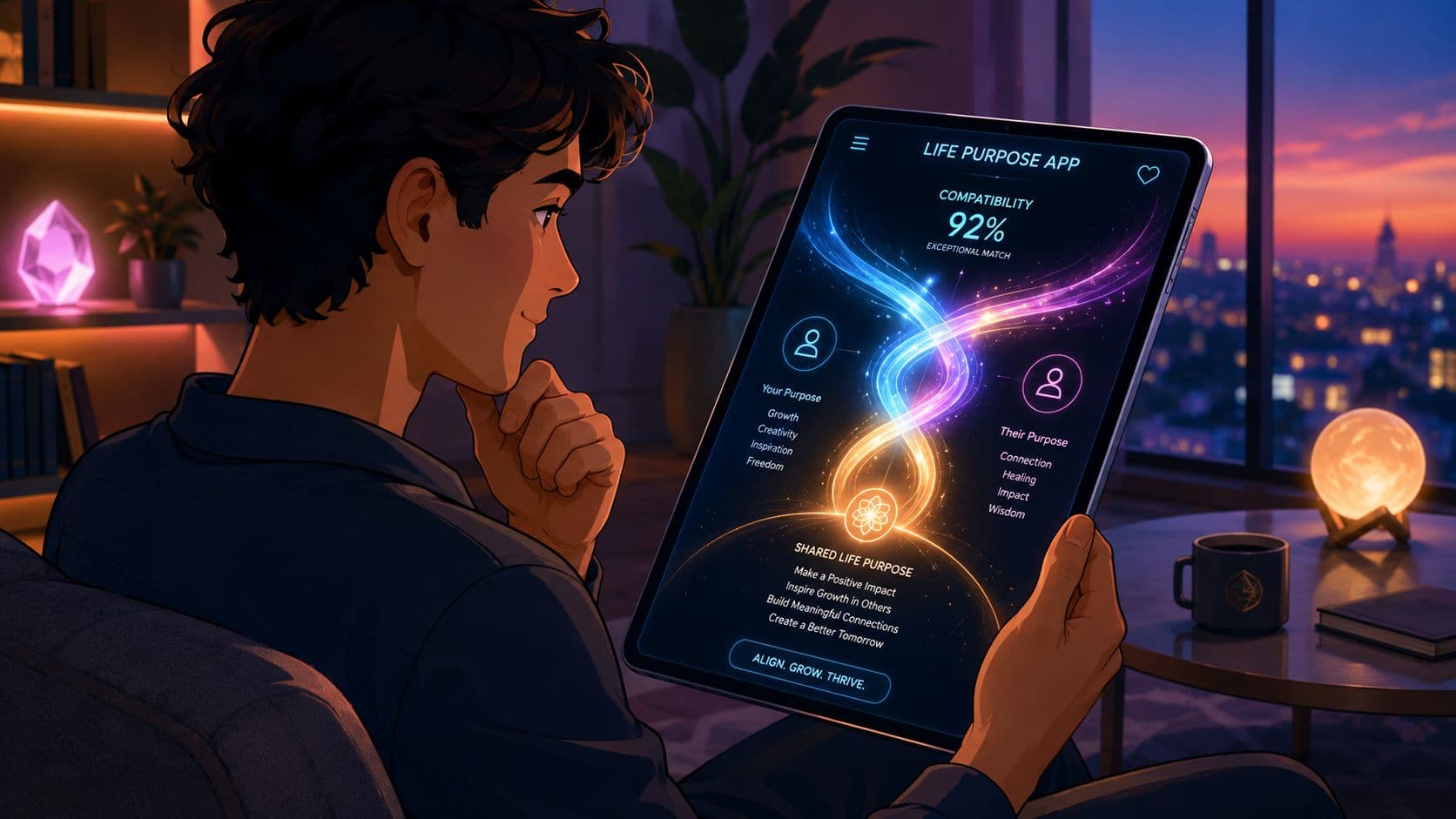
Uncovering Deeper Compatibility With the Life Purpose App
Psychology helps you understand feelings and patterns. Some people also want another lens, one that looks less at chemistry in the moment and more at deeper compatibility themes.
That's where Dan Millman's book The Life You Were Born to Live comes in. Millman's system invites people to explore life paths based on date of birth, not as fortune-telling, but as a structured way to reflect on core lessons, tendencies, gifts, and relationship dynamics. For readers who are drawn to self-discovery, that can add a different kind of clarity.
A different kind of question
Instead of only asking, “Do I feel strongly about this person?” Millman's framework encourages questions like:
- What patterns do I bring into relationships?
- What lessons tend to repeat for me?
- Where do our temperaments support each other?
- Where might friction be part of growth?
If you're curious about this perspective, the Life Purpose App offers a helpful entry point.
Why this can be useful
Feelings can be loud. Compatibility is often quieter.
You may love someone and still struggle with timing, maturity, communication style, or life direction. You may also feel uncertain about someone at first, then realize your values and rhythms fit in a durable way. Looking at a relationship through the lens of The Life You Were Born to Live can help some people step back from pure emotion and notice recurring themes more clearly.
This can be especially helpful for people who are dating with specific needs, circumstances, or life experiences that shape connection in practical ways. For example, if accessibility and shared understanding are central to your dating life, a community designed to connect with disabled singles may offer a more supportive environment than general dating apps.
None of this replaces honest communication or emotional maturity. It provides another reflective tool. Sometimes that's enough to help you stop asking, “Is this love?” and start asking, “What kind of relationship are we building?”
What to Do Next With Your Newfound Clarity
You don't need a dramatic conclusion to your feelings. You need an honest one.
If you've realized it's like, let that be enough for now. Enjoy the connection without pressuring it to become something larger before it's ready. If you sense love growing, protect it with patience, realism, and communication. If you love someone but your day-to-day relationship feels strained, take that seriously. Love without mutual enjoyment can become lonely.
Three grounded next steps
-
Name what's true today
Try one simple sentence in your journal: “What I feel right now is...” Don't edit it into something prettier or more certain. -
Have the conversation if the moment is right
You don't need a grand speech. You can say, “I care about where this is going, and I want to be honest about that.” -
Choose an experience that reveals more
Shared experiences often clarify feelings better than endless analysis. If you want a low-pressure way to learn more about each other, these NYC date suggestions from It's a Date can help turn abstract chemistry into real-world connection.
Keep this in mind. Love is rarely just a feeling that lands fully formed. More often, it becomes visible through steadiness, truth, care, and the willingness to know someone beyond the idealized version.
You don't have to force certainty. You just have to stay honest long enough for clarity to emerge.
If you want another layer of insight into your relationship patterns and compatibility, explore the Life Purpose App. Built as a companion to Dan Millman's The Life You Were Born to Live, it offers a practical way to reflect on life paths, relationship dynamics, and the deeper themes you may be bringing into love.
Discover Your Life Purpose Today!
Unlock your true potential and find your life’s purpose.
