You know this moment: shoulders tight, head aching, and you tell yourself one more coffee will get you through. Learning to read your body’s signals—breath, hunger, pain, and energy—lets you act before stress becomes injury. This guide gives practical checks, simple daily practices, and a decision framework so your body becomes a source of guidance, not background noise.

June 22, 2026 (4mo ago) — last updated August 26, 2026 (1mo ago)
How to Listen to Your Body: Practical Tips
Learn practical ways to read your body’s signals, build daily awareness habits, and decide when to act or seek care.
← Back to blog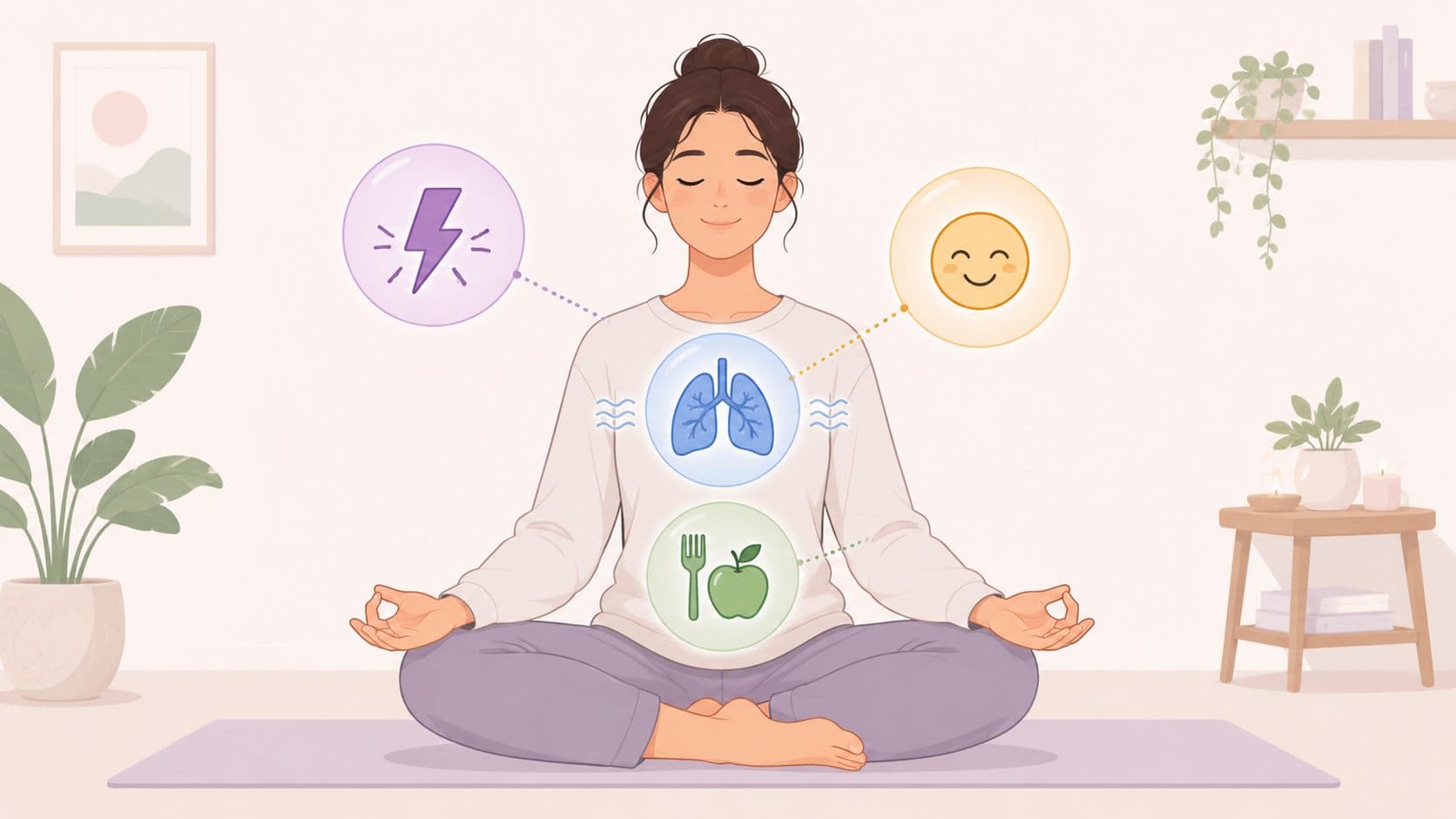
You know this moment: shoulders tight, head aching, and you tell yourself one more coffee will get you through. Learning to read your body’s signals—breath, hunger, pain, and energy—lets you act before stress becomes injury. This guide gives practical checks, simple daily practices, and a decision framework so your body becomes a source of guidance, not background noise.
How to Listen to Your Body: Practical Tips
Summary: Master how to listen to your body. Discover practical techniques to interpret signals, apply daily practices, and connect body wisdom to your life path.
Introduction
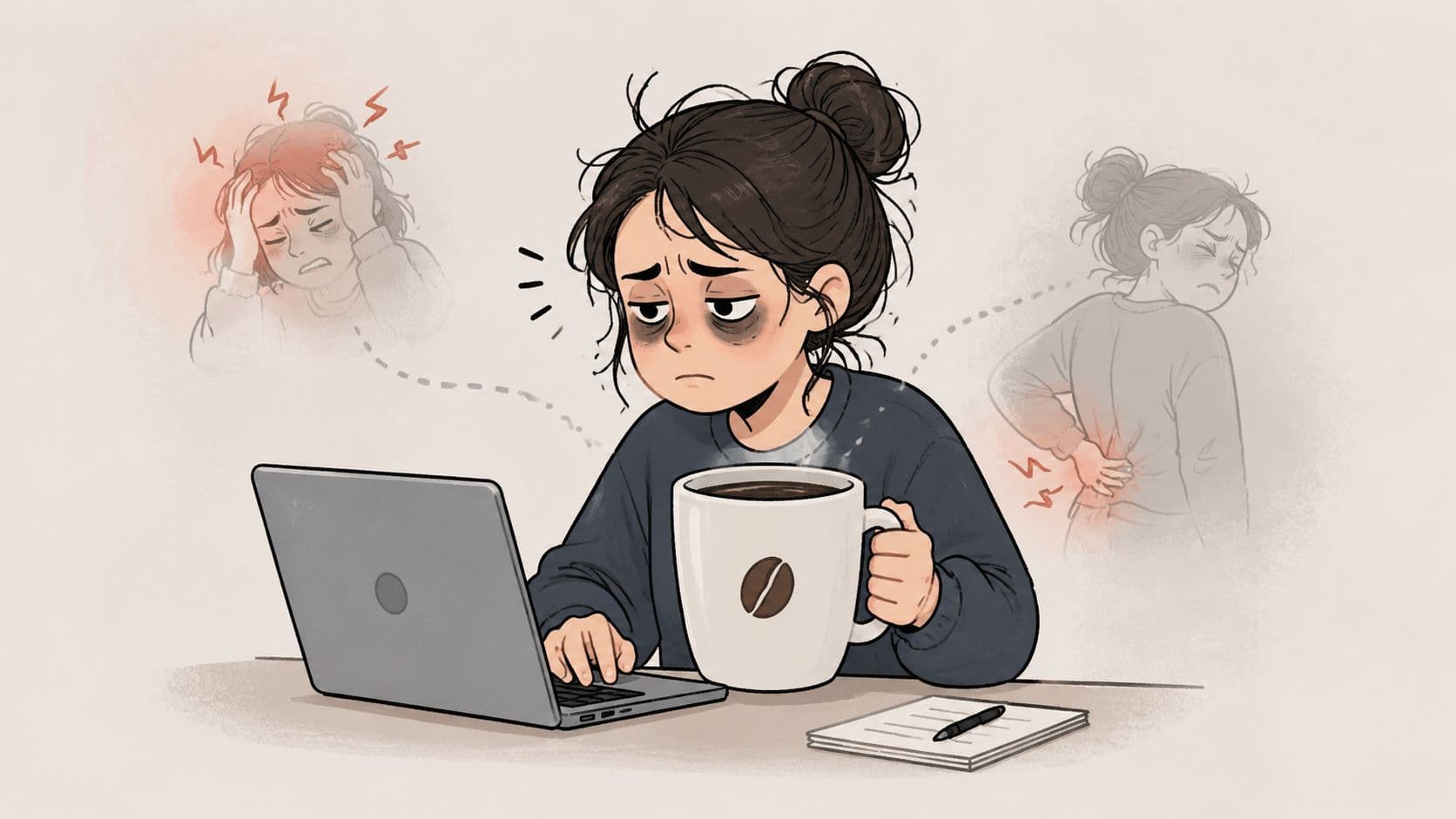
You know this moment. Your shoulders are tight, your head is starting to pound, and you tell yourself one more coffee will get you through the afternoon. Or your lower back has been complaining for days, but you keep working because the deadline feels more urgent than the ache.
People don’t ignore their body because they’re careless. They ignore it because they’ve been trained to override it. Productivity gets rewarded. Pushing through gets praised. Rest, adjustment, and honest self-checks often get treated like weakness.
Your body keeps sending information whether you pay attention or not. When you learn to read it, you stop treating discomfort as random background noise. You start using it as guidance.
What It Really Means to Listen to Your Body
“Listen to your body” can sound vague or sentimental. In practice, it’s a grounded set of skills: noticing early cues, interpreting them, and choosing appropriate responses so stress doesn’t become injury, shutdown, or illness.
In clinical and sports settings, listening maps to self-monitoring of symptoms and exertion. Tools like the Borg Rating of Perceived Exertion correlate strongly with physiological markers such as heart rate and are used in training and rehabilitation1.
That matters because it takes the idea out of guesswork. Your body isn’t speaking in riddles. It gives feedback through effort, tension, breath, pain, fatigue, and recovery.
A practical definition
Listening to your body means noticing internal cues early enough to respond before stress becomes injury, shutdown, or illness. It isn’t about obeying every fleeting sensation or becoming hypervigilant.
It looks like this:
- Notice exertion when a task or workout starts feeling harder than it should.
- Check symptoms when discomfort shifts from manageable to unusual.
- Adjust behavior by slowing down, resting, hydrating, eating, stretching, sleeping, or stopping.
- Track patterns so you can tell the difference between a hard day and a recurring issue.
“Body awareness is useful when it changes what you do next.”
Understanding sleep and recovery rhythms helps connect daytime symptoms with what may be happening overnight; many adults don’t get adequate sleep, which affects daytime energy and recovery3.
What does not work
Waiting until your body has to shout usually makes signals louder and messier. A whisper ignored often becomes a wall.
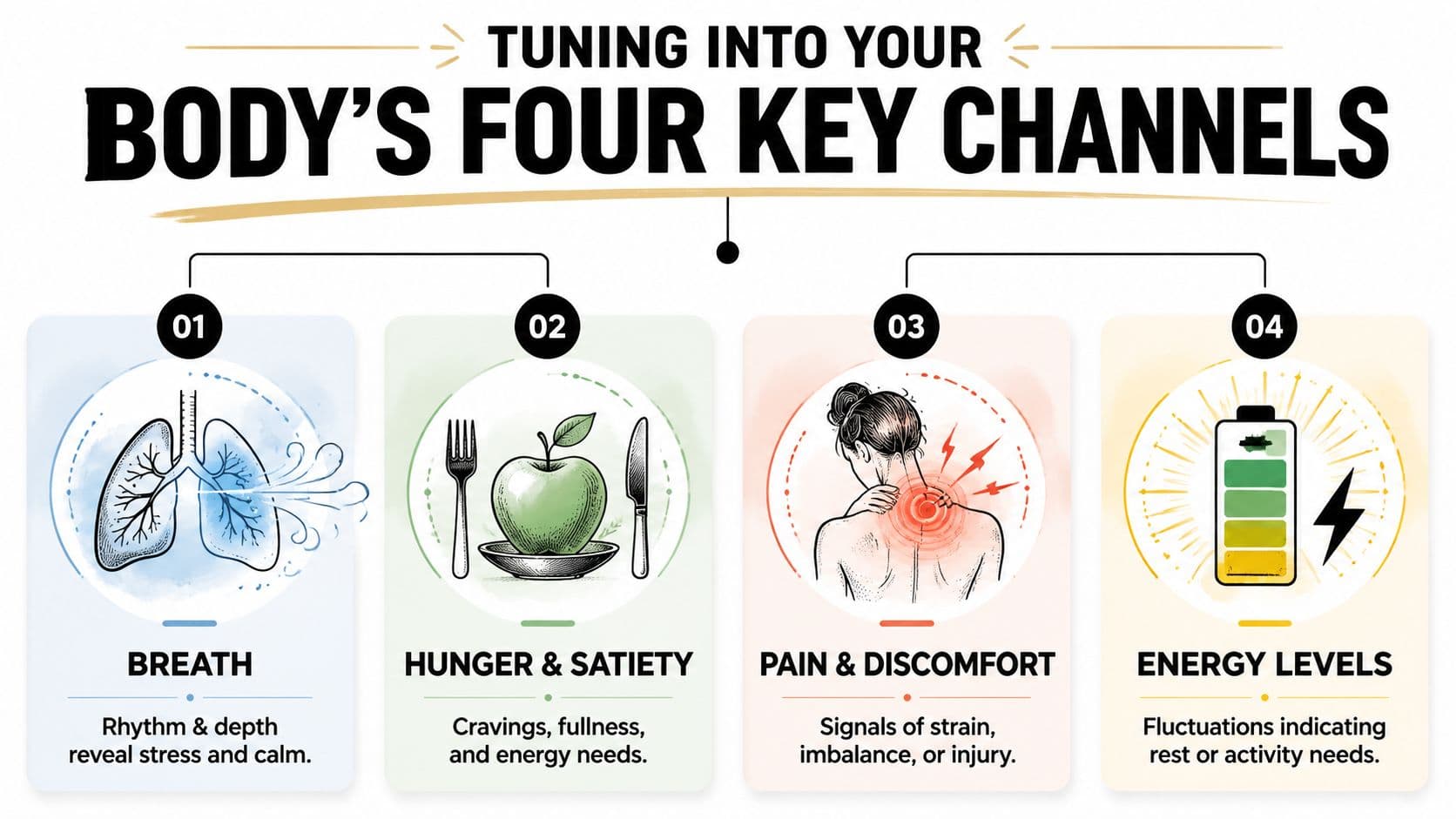
Tuning Into Your Body’s Four Key Channels
“Body signals” can feel overwhelming. Narrow attention to a few channels you can observe during ordinary life.
Breath
Breath changes quickly, so it’s one of the clearest signals you have.
Ask yourself:
- Where is it happening — chest, throat, belly, or back?
- What’s the rhythm — fast, held, shallow, smooth, or steady?
- What changed before the breath changed?
Shallow chest breathing before a presentation can show stress is already active, even if your mind says you’re fine. During movement, breath can tell you whether you’re working with your body or arguing with it. For structured practices, see a quick breathing exercise on the site: [/breathing-exercises].
Hunger and satiety
Schedules, habits, and stress distort this channel. Many people don’t feel hunger cleanly anymore. They feel edgy, foggy, craving-heavy, or suddenly overfull.
Pay attention to:
- Appetite quality — steady hunger feels different from stress cravings.
- Fullness timing — do you notice early signals to stop before discomfort?
- Energy after eating — calm and stable feels different from sluggish and wired.
If you confuse physical hunger with emotional depletion, try simple tracking for a week to see patterns.
Pain and discomfort
Pain isn’t always dramatic. Sometimes it’s a low hum you keep negotiating with. Chronic pain affects millions worldwide and is a leading cause of disability; persistent or worsening pain warrants evaluation2.
Start slowly. Notice what movement modes feel good and use a simple triage rule: adjust pace or stop when symptoms shift from ordinary exertion into warning-sign territory such as immediate sharp pain, extreme fatigue, dizziness, or nausea. Ordinary effort usually feels workable. Warning signs feel disruptive, sharp, destabilizing, or wrong for the situation.
Many people get into trouble by negotiating with a signal that needs a decision.
Energy levels
Energy has texture. You can feel flat, restless, steady, heavy, bright, scattered, or depleted.
Quick checks:
- Morning energy — did you wake with any sense of readiness?
- Afternoon drop — is it hunger, mental overload, dehydration, poor sleep, or emotional strain?
- Post-activity recovery — do you feel pleasantly used or unusually drained?
Wearables can help identify patterns, but they shouldn’t overrule direct experience; device accuracy varies by measure and context4.
Simple Daily Practices to Build Bodily Awareness
Body awareness deepens with repeatable practices, not single profound moments.
Nike recommends a repeated self-tracking approach: check in before activity, record perceived exertion and symptoms during activity, then log recovery after. Keeping a written record helps you compare sessions and spot patterns over time.
A short morning scan
Before you reach for your phone, take a few breaths and run a simple internal check.
Notice:
- Breath — free or restricted?
- Muscles — where do you feel ease, stiffness, or heaviness?
- Mood tone — calm, irritated, flat, hopeful, pressured?
- Energy — ready, slow, edgy, or exhausted?
Don’t try to fix anything. You’re gathering data.
A grounding reset in the middle of the day
Stress makes everything feel urgent. If your mind is racing, pair this physical reset with a short mental strategy.
Try this reset:
- Plant your feet and feel the surface under you.
- Lengthen the exhale without forcing a deep inhale.
- Name three sensations such as tight jaw, warm face, fluttery chest.
- Ask one question: What do I need right now — water, food, a pause, movement, or less stimulation?
If a two-minute pause changes what you feel, the signal may be stress-amplified rather than a fixed truth.
An evening pattern log
By day’s end, write a few lines. Try prompts:
- When did my body feel most open today?
- When did it contract?
- What happened before that shift?
- What helped?
- What made it worse?
Over time, notes become more valuable than memory; written records reveal patterns.
Consistency matters. Checking only when overwhelmed doesn’t build a useful baseline.
When to Act and When to Seek Professional Care
Awareness is only the first step. Decide what action fits the signal.
Clinical guidance recommends acting on persistent pain, sleep disruption, or mood changes rather than treating them as generic wellness cues. Track frequency, duration, intensity, and triggers — those details tell a clearer story than a vague sense that something feels off.
Decision checklist: body signal response
| Signal Type | Consider Self-Care If… | Consider Professional Care If… |
|---|---|---|
| General fatigue | It follows an obvious stretch of poor sleep, stress, or overwork and improves with rest | It keeps returning, disrupts daily function, or comes with other concerning symptoms |
| Muscle soreness | It’s linked to recent activity and eases with recovery | It persists, worsens, or changes how you move |
| Pain | It’s mild, brief, and clearly related to temporary strain | It’s persistent, sharp, recurring, or affects sleep, mood, or tasks |
| Mood changes | You can link them to a stressful period and they settle with support | They keep repeating, deepen, or disrupt work, relationships, sleep, or appetite |
| Sleep disruption | It’s tied to a short-term schedule issue and improves with routine | It becomes a pattern or starts affecting mood and daily functioning |
| Breath-related symptoms | Ordinary exertion recovers normally with rest | Shortness of breath feels unusual for you or appears with other warning signs |
If you minimize pain, delaying care can worsen outcomes; earlier evaluation often prevents longer-term problems5.
Connecting Body Signals to Your Life Path
Physical patterns aren’t always just physical. They can reflect how you habitually meet life. The body often reveals coping styles before the conscious mind does.
That doesn’t mean every tight shoulder is a spiritual message. It means recurring patterns deserve curiosity. If your jaw clenches whenever you take responsibility, or your stomach knots when you avoid a needed conversation, your body may be tracking a deeper pattern.

Baseline before meaning
Establish a personal baseline first, then notice changes over time. Don’t rush to assign profound meaning to every sensation. First ask:
- Is this new or familiar?
- Does it show up in specific situations?
- What happens before it?
- What changes when I rest, express myself, set a boundary, or move differently?
That sequence keeps stress noise from becoming destiny.
Using a life-path lens carefully
Dan Millman’s The Life You Were Born to Live offers a framework for reflecting on recurring gifts, lessons, and challenges. Used well, it doesn’t replace body awareness; it deepens it. If recurring physical patterns persist after addressing posture, schedule, and sleep, ask whether they also point to a life theme.
Your body often reveals where your life is out of alignment before your language catches up.
Making Body Awareness a Lifelong Dialogue
Learning to listen to your body is like learning a language. At first you catch the loudest words: hunger, fatigue, pain, stress. Over time you hear subtler phrases: the difference between anxiety and intuition, healthy effort and self-abandonment, discipline and care.
Fluency comes from repetition: notice, respond, track, adjust, then repeat.
Keep the relationship simple
Habits that support a strong body relationship:
- Check in early before discomfort becomes a crisis.
- Track patterns instead of trusting memory alone.
- Respond truthfully even when the response is inconvenient.
- Stay curious when signals repeat.
“Bodies tend to become clearer when they learn you’ll actually listen.”
The goal isn’t self-absorption. It’s responsiveness. A responsive person can work hard, rest well, move wisely, seek help sooner, and make better decisions about what their life is asking of them.
Your body isn’t an obstacle to your purpose. It’s one of the ways you find it.
If you want to connect physical patterns with deeper self-knowledge, the Life Purpose App complements Dan Millman’s The Life You Were Born to Live and can help you explore life-path themes in a structured way.
Frequently Asked Questions
Q: How do I know when to rest versus push through?
A: Track frequency, duration, intensity, and triggers. Rest when symptoms reduce performance or recovery. Seek evaluation when pain is persistent, worsening, or interferes with daily life.
Q: What simple daily practices build better body awareness?
A: Try a short morning scan, a midday grounding reset, and an evening pattern log. Consistency matters more than length.
Q: When should I see a professional?
A: See a clinician if symptoms persist despite reasonable self-care, if pain is sharp or changing your movement, or if sleep and mood are chronically disrupted.
1.
G. Borg, Perceived Exertion and Pain Scales, and review on RPE correlations with physiological markers. https://www.ncbi.nlm.nih.gov/pmc/articles/PMC6463160/
2.
World Health Organization, “Musculoskeletal conditions,” describing the global burden and disability related to chronic pain. https://www.who.int/news-room/fact-sheets/detail/musculoskeletal-conditions
3.
Centers for Disease Control and Prevention, data on sleep and public health; many adults do not get sufficient sleep, which affects daytime function. https://www.cdc.gov/sleep/data_statistics.html
4.
Review of wearable device accuracy and limitations for physiological monitoring. https://www.ncbi.nlm.nih.gov/pmc/articles/PMC6083751/
5.
American Psychological Association and clinical resources on stress and the risks of minimizing pain; earlier evaluation often improves outcomes. https://www.apa.org/topics/stress
Discover your life path today
Enter your date of birth and see your life path, free.
Find your life path