Discover what living your purpose really means with this practical guide. Learn exercises, daily practices, and tools that turn insight into aligned action.

September 15, 2026 (1mo ago) — last updated September 16, 2026 (1mo ago)
Living Your Purpose: A Practical Guide to Clarity
Discover what living your purpose really means with this practical guide. Learn exercises, daily practices, and tools that turn insight into aligned action.
← Back to blog
Discover what living your purpose really means with this practical guide. Learn exercises, daily practices, and tools that turn insight into aligned action.
You've read the books, saved the quotes, and perhaps even written a promising purpose statement. Yet Monday arrives, your inbox fills, and the life you're living looks almost unchanged. That gap doesn't mean you lack purpose. It means insight alone rarely changes behavior.
Dan Millman's framework gives purpose a more practical shape. The Life You Were Born to Live presents life as a discoverable path, with recurring gifts, challenges, and developmental cycles. The Life Purpose App translates that framework into a usable profile and daily prompts. Together, they offer a way to move from abstract self-discovery to living your purpose through ordinary choices.
Why Most People Never Actually Live Their Purpose
The “find your passion” message sounds inspiring, but it often gives people an impossible assignment. You're told to locate one perfect interest, build a life around it, and trust that motivation will carry you forward. When clarity doesn't arrive, you assume something is wrong with you.
Stalling happens in predictable ways.
First, they chase novelty instead of studying patterns. A new course, career idea, or spiritual practice creates temporary energy, but it doesn't answer the deeper question: What themes keep returning in the way I solve problems, support people, create, lead, or learn? Purpose usually becomes visible through repetition, not constant reinvention.
Second, people mistake comfort for alignment. A stable routine can protect you from risk while separating you from the work, relationships, or contribution that makes you feel engaged. Comfort isn't proof that you're on the right path. It's only proof that your current arrangement is familiar.
Third, people treat purpose as a thought experiment rather than a behavioral commitment. They journal about service but don't make the call. They identify creativity but never reserve time to create. They understand their values but keep allowing every interruption to outrank them.
The pattern behind the stall
Dan Millman's premise in The Life You Were Born to Live is more structured than the usual inspiration hunt. Your birth date points toward a life path, and that path describes recurring lessons, strengths, and challenges. The system doesn't ask you to wait for a bolt of inspiration. It asks you to recognize a pattern and practice it consciously.
That matters because fear often appears when purpose becomes specific. You may fear losing income, disappointing family, or discovering that your current identity no longer fits. A vague definition of purpose protects you from those decisions, but it also keeps you circling the question.
Practical rule: Don't ask only, “What do I want to do?” Ask, “What pattern am I repeatedly being asked to develop?”
Purpose work becomes useful when you research your pattern, notice where it already appears, and build habits that reinforce it. You don't need another affirmation. You need a method for turning recognition into action.
Finding Your Life Path with Dan Millman's System
Dan Millman's method in The Life You Were Born to Live begins with your full birth date. Reduce the month, day, and year separately by adding their digits until each component becomes a number from 1 to 9. Then combine those three results and reduce the total again.
Take May 14, 1991.
- Month: May is the fifth month, so it becomes 5.
- Day: 1 + 4 = 5.
- Year: 1 + 9 + 9 + 1 = 20, then 2 + 0 = 2.
- Final total: 5 + 5 + 2 = 12, then 1 + 2 = 3.
This example produces a final life path number of 3 within the calculation method used by The Life You Were Born to Live. Some numerology systems treat 11, 22, and 33 as exceptions that aren't reduced further, but this article stays focused on Millman's framework and its path profiles.
What the number is for
The calculation isn't the destination. It's a starting point for examining the specific path profile associated with your result. Millman's descriptions connect each path with recurring gifts and challenges, helping you compare the framework with your actual behavior rather than using a number as a fixed identity.
For a separate walkthrough of the arithmetic and terminology, my life path number guide offers useful supplementary context. You can also read a closer look at how the system is presented digitally.
The Life Purpose App automates the calculation after you enter your birth date, then pairs the result with the relevant path profile from The Life You Were Born to Live. That removes arithmetic from the process and leaves you with the part that matters: testing the description against your life.
Start with two anchors. Identify your path's gift, the quality you can develop and contribute, and its challenge, the pattern that tends to distort or block that gift. Every practical exercise that follows should connect to one of those anchors.
The Five Dimensions Every Path Reveals
Millman's framework doesn't reduce purpose to a job title. Each of the 45 life paths described across the current framework carries a pattern across five dimensions: health, money, sexuality, career, and relationships. These categories create a broader diagnostic map for how your path expresses itself.
Health concerns the way you sustain energy, manage stress, and respect the body that carries your work. Money isn't income. It includes your relationship with value, resources, security, generosity, and choice. Career describes contribution and responsibility, not merely the position printed on a business card.
Sexuality concerns intimacy, desire, boundaries, and the way you relate to embodiment. Relationships show how your gifts and challenges surface with partners, family, friends, clients, and colleagues. None of these dimensions is “off” for any path. Each becomes a training ground for the others.
The same event can demand different growth
Consider two hypothetical paths, 6 and 9. The point isn't to assign a complete profile without reading the relevant material in The Life You Were Born to Live. The comparison shows why identical events can call for different responses.
| Life Event | Path 6 Response | Path 9 Response |
|---|---|---|
| Job offer | Examine whether the role lets responsibility serve people without becoming over-responsibility. | Examine whether the role supports meaningful contribution without creating attachment to recognition. |
| Breakup | Study boundaries, care, and the difference between support and rescuing. | Practice release, compassion, and learning without carrying the relationship indefinitely. |
| Health scare | Restore balance and address the tendency to put others first. | Return attention to the body instead of escaping into broad ideals or unfinished concerns. |
This is why generic advice often fails. “Take the opportunity” may be wise for one person and reckless for another. “Move on” may help one person release the past while causing another to avoid necessary accountability.
Use the five dimensions as questions, not labels. Where does your gift become useful? Where does it become excessive? Which challenge appears in more than one area? A career pattern may expose a relationship pattern, while a money decision may reveal a health issue involving exhaustion and poor boundaries.
Purpose becomes coherent when you stop isolating these areas. Your path isn't something you perform at work and abandon at home. It’s a pattern you learn to express with greater balance across your life.
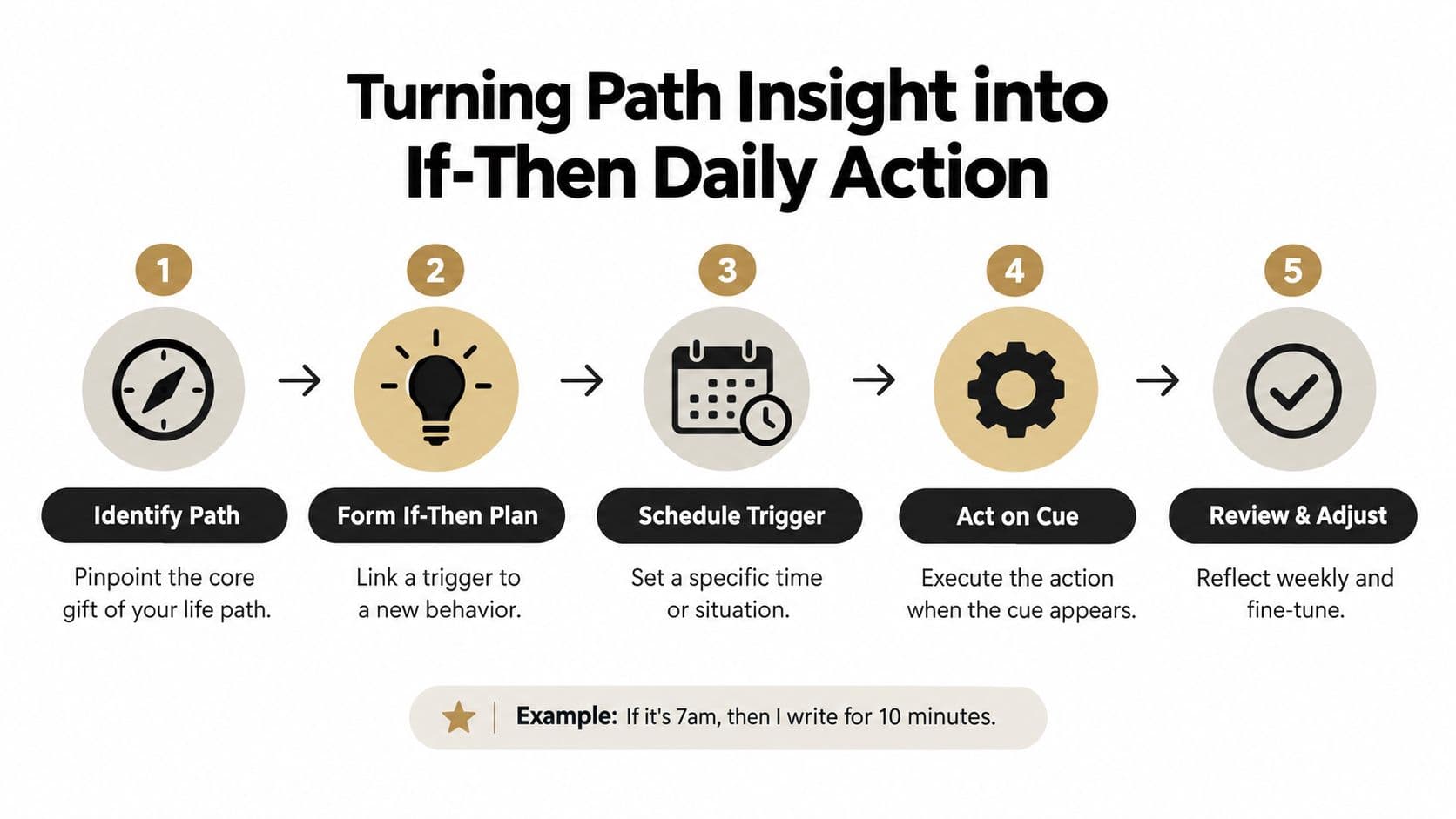
Turning Path Insight into If-Then Daily Action
Knowing your life path doesn't mean you're living it. A statement such as “I want to serve others” or “I need to be more creative” is too vague to guide you when the day gets crowded. Purpose needs a cue, a behavior, and a place on the calendar.
Implementation intentions provide that structure. An if-then plan specifies what you'll do when a particular trigger appears. A meta-analysis of 94 independent studies found that implementation intentions produced a medium-to-large improvement in goal attainment, with an effect size of d = .65; a foundational study also found difficult goals were completed about 3 times more often when participants added this structure, with one task rising from 32% to 71% after implementation intentions were added (implementation intentions research).
Build the mini-script
Take one gift from The Life You Were Born to Live, name the obstacle pattern that interferes with it, and attach a cue-action pair.
- If it's 7:15 a.m. after coffee, then I'll write one page that develops my teaching idea.
- If it's Tuesday evening, then I'll make the mentoring call instead of postponing support until I feel fully prepared.
- If I notice myself solving everyone else’s problem before naming my own need, then I'll pause and state one clear boundary.
- If Saturday morning begins without a fixed commitment, then I'll practice storytelling for twenty minutes before opening social media.
The Life Purpose App can help by keeping the path gift and challenge visible while you turn them into prompts. For a broader structure for organizing goals, this approach can help you place these behaviors into a routine.
Log the result briefly. Did the cue appear? Did you act? What got in the way? This turns purpose into a daily operating system rather than an annual revelation.
Where the Life Purpose App Fits in Your Toolkit
No single purpose tool does every job well. The Life Purpose App is useful for quick structure. Enter your birth date, receive a path profile, and use the daily insights and challenge prompts as reminders for practice. It fits between discovery and execution, especially when you're busy and unlikely to reread several chapters of The Life You Were Born to Live.
Journaling serves a different function. It gives you room to notice emotion, contradiction, memory, and resistance. Coaching is stronger when you need help unpacking grief, fear, family expectations, or a decision that carries real consequences. Meditation creates stillness, while reading Millman’s book supplies the conceptual context behind the path system.
Choose the tool that matches the problem
| Tool | Best For | Time/Day | Cost |
|---|---|---|---|
| Life Purpose App | Fast path access, daily prompts, and cycle reference | Short, repeatable check-ins | Free and paid options |
| Journaling | Emotional depth and pattern recognition | Flexible, often daily | Notebook or app cost |
| One-on-one coaching | Difficult decisions and emotional excavation | Scheduled sessions | Coach-dependent |
| Group circles | Shared reflection and accountability | Recurring meetings | Group-dependent |
| Meditation | Stillness and attention training | Short or extended practice | Free or provider-dependent |
| The Life You Were Born to Live | Framework, path descriptions, and broader context | Reading sessions | Book price |
A beginner should start with The Life You Were Born to Live, the Life Purpose App, and a simple nightly journal. A skeptic should test one path description against observed behavior for a limited period instead of debating the system abstractly. A veteran Millman reader should combine the app's reminders with coaching or a group that can challenge blind spots.
Use the app for structure, the book for context, journaling for honesty, meditation for quiet, and coaching when the pattern has emotional weight. That division of labor keeps purpose work practical.
Living Purpose Through the Nine-Year Cycles
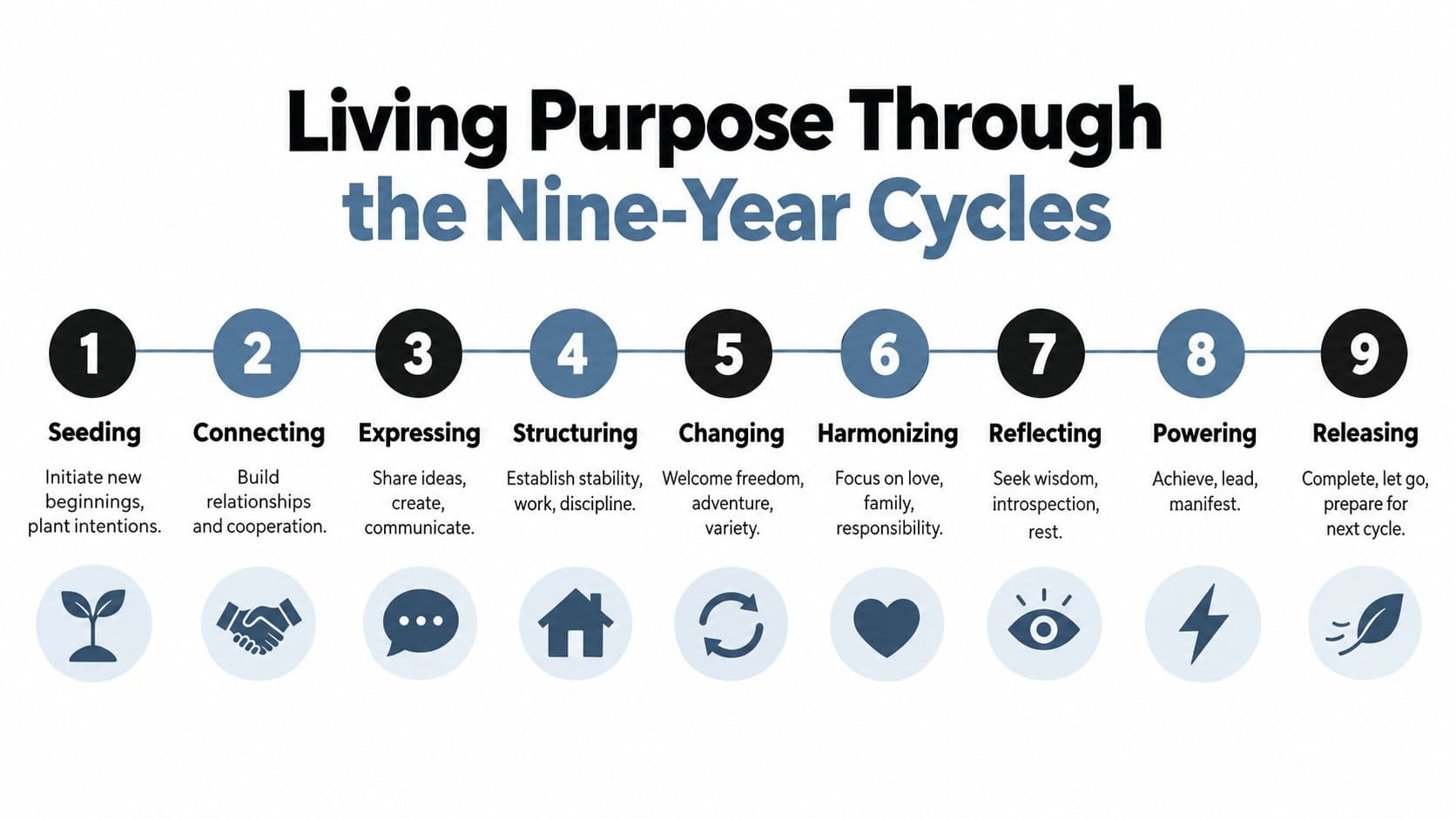
Dan Millman's framework describes life as moving through recurring nine-year cycles, with a personal-year rhythm that repeats over time. The revised description expands the original framework from 37 life paths to 45 life paths while retaining the birth-date-based method, and the cycle model remains central to understanding how a path unfolds (revised edition overview).
The cycle isn't a command to stop living your purpose until the “right” year arrives. It's a way to adjust the expression of your purpose to the season you're in. The reference sequence moves through seeding, connecting, expressing, structuring, changing, harmonizing, reflecting, powering, and releasing. The book's summaries describe these as recurring rhythms and frame the work as learning to live in harmony with life's cycles (book summary).
Match the season to the work
Identify your current age, locate the corresponding personal-year cycle using the method in The Life You Were Born to Live, and name its central theme. Then translate that theme into three levels:
- Quarterly focus: Choose the developmental quality that deserves attention.
- Monthly project: Select one visible project that expresses that quality.
- Weekly ritual: Reserve a recurring time to act on it.
Someone in a seeding phase shouldn’t demand a finished harvest. They should plant, test, and begin. Someone in a releasing phase shouldn’t keep forcing expansion when completion, simplification, and preparation are the wiser work.
Consider two readers. One has an early-stage idea and keeps demanding public proof before building foundations. The other has completed a major chapter but keeps adding commitments to avoid letting go. Their path gifts may be valuable, yet both are fighting the season.
For a practical review of how cycles can inform planning, see the nine-year cycle numerology guide. Your task isn’t to predict every event. It’s to make choices that respect development, timing, and the next honest step.
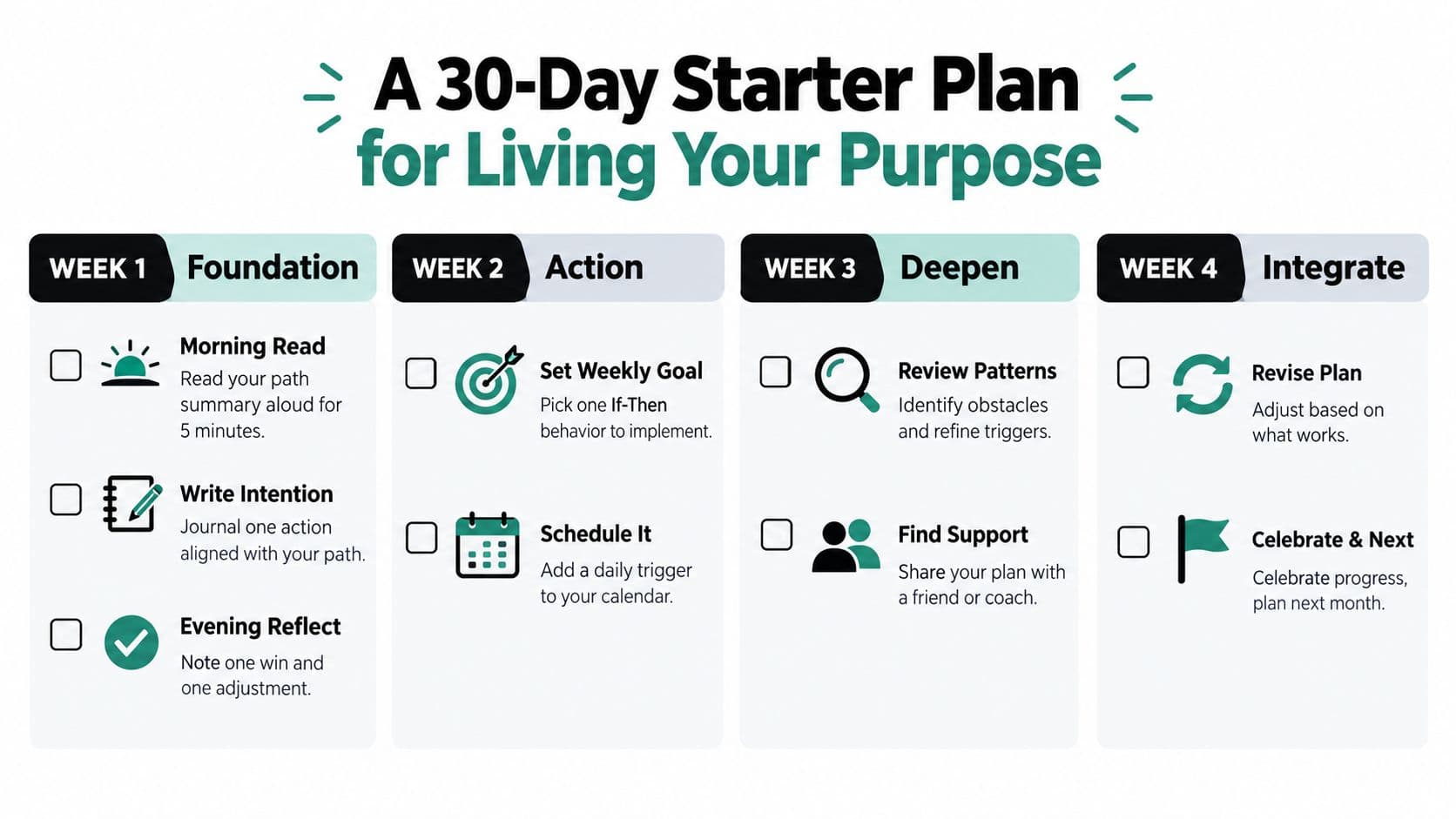
A 30-Day Starter Plan for Living Your Purpose
Purpose becomes credible when it survives a normal month. Use this plan without waiting for perfect clarity.
Week one, foundation: Each morning, read your Millman path summary aloud for five minutes. Write one if-then commitment. Each evening, record one moment when you acted on purpose and one moment when you didn't.
Week two, relationships: Identify the two people who amplify or drain your path gifts. Schedule a specific conversation with one person, and create one boundary with the other if a boundary is needed. Don't turn this into a judgment exercise. Look for repeated behavior.
Week three, career and money: Run one path-aligned experiment at work. It might be a project, a conversation with a manager, a contribution to a team, or a skill practice. Keep the experiment small enough to complete and concrete enough to evaluate.
Week four, integration: Spend ten minutes each day asking, “What is my path asking for today?” Then connect the answer to your current nine-year cycle and choose one action. Track the behavior using a simple log or a resource on habit tracking for mindset shifts.
My strongest recommendation is the nightly three-line log. Write what you did, what you avoided, and what you'll repeat tomorrow. Reflection without a record decays quickly because memory edits the day to protect your self-image.
Small daily deposits build the platform for the next cycle. You don't need to reinvent your life this month. You need to prove that your path can shape one ordinary day, then another.
The Life Purpose App gives you a birth-date-based path profile, gift and challenge prompts, and access to the nine-year cycle framework drawn from Dan Millman's The Life You Were Born to Live. Visit Life Purpose App to explore your path and turn one insight into a specific if-then action today.
Discover your life path today
Enter your date of birth and see your life path, free.
Find your life path