Discover the true difference between love and compassion. Cultivate both with practical exercises for stronger relationships & a deeper purpose.
June 1, 2026 (1mo ago) — last updated July 3, 2026 (23d ago)
Cultivate Love and Compassion: Strengthen Relationships
Discover the true difference between love and compassion. Cultivate both with practical exercises for stronger relationships & a deeper purpose.
← Back to blog
Some days you can feel surrounded by people and still feel alone. You answer messages, do your work, make dinner, maybe even say “I love you,” yet something in you still aches for warmth, depth, and a clearer sense that your life means something.
That ache matters.
Many people think love and compassion are moods that arrive when life is going well. But they're also skills, practices, and ways of relating that can be learned. They shape how you speak to your partner, how you respond to your own mistakes, how you care for a grieving friend, and how you choose your direction when life feels confusing.
They also have a quiet power. They don't just soften hard moments. They help organize a life.
Embarking on the Path of the Heart
When people talk about love, they often speak in abstractions. They describe it as a mystery, a blessing, or a feeling you either have or don't. Compassion gets treated the same way, as if it belongs only to saints, healers, or unusually patient people.
That view leaves many readers stuck. If love is only a feeling, what do you do when you don't feel warm? If compassion means endless giving, what happens when you're exhausted?
A more grounded approach helps. Love and compassion can be practiced in small, repeatable ways. You can learn to pause before reacting. You can listen with your full attention. You can speak affection aloud instead of assuming people already know. You can also learn to care without disappearing.
Love grows when it becomes visible in behavior, not only cherished in private feeling.
This path starts inward. If your inner life is tense, defended, or numb, it's harder to offer steady care to anyone else. That's one reason many spiritual traditions speak about an open heart, not as sentimentality, but as a state of presence. If that idea speaks to you, this reflection offers a useful doorway into the emotional side of heart-centered living.
Three gentle shifts can begin today:
- Name what you long for: Are you craving closeness, forgiveness, meaning, rest, or all of these at once?
- Treat love as a verb: Send the text. Offer the apology. Sit in silence with someone who's hurting.
- Include yourself in the circle: Self-criticism hardens the heart. Kind honesty softens it.
A loving life rarely appears all at once. It's built choice by choice, conversation by conversation, breath by breath.
Understanding Love Versus Compassion
People often use love and compassion as if they mean the same thing. They're closely related, but they're not identical.
Love is the wider field. It's the sense of connection that says, “You matter.” Compassion is love in motion when suffering is present. It says, “You matter, and I want to respond to your pain wisely.”
One image helps. Love is like sunlight. It warms, includes, and nourishes. Compassion is like carrying water to a thirsty person. It's specific, responsive, and practical.
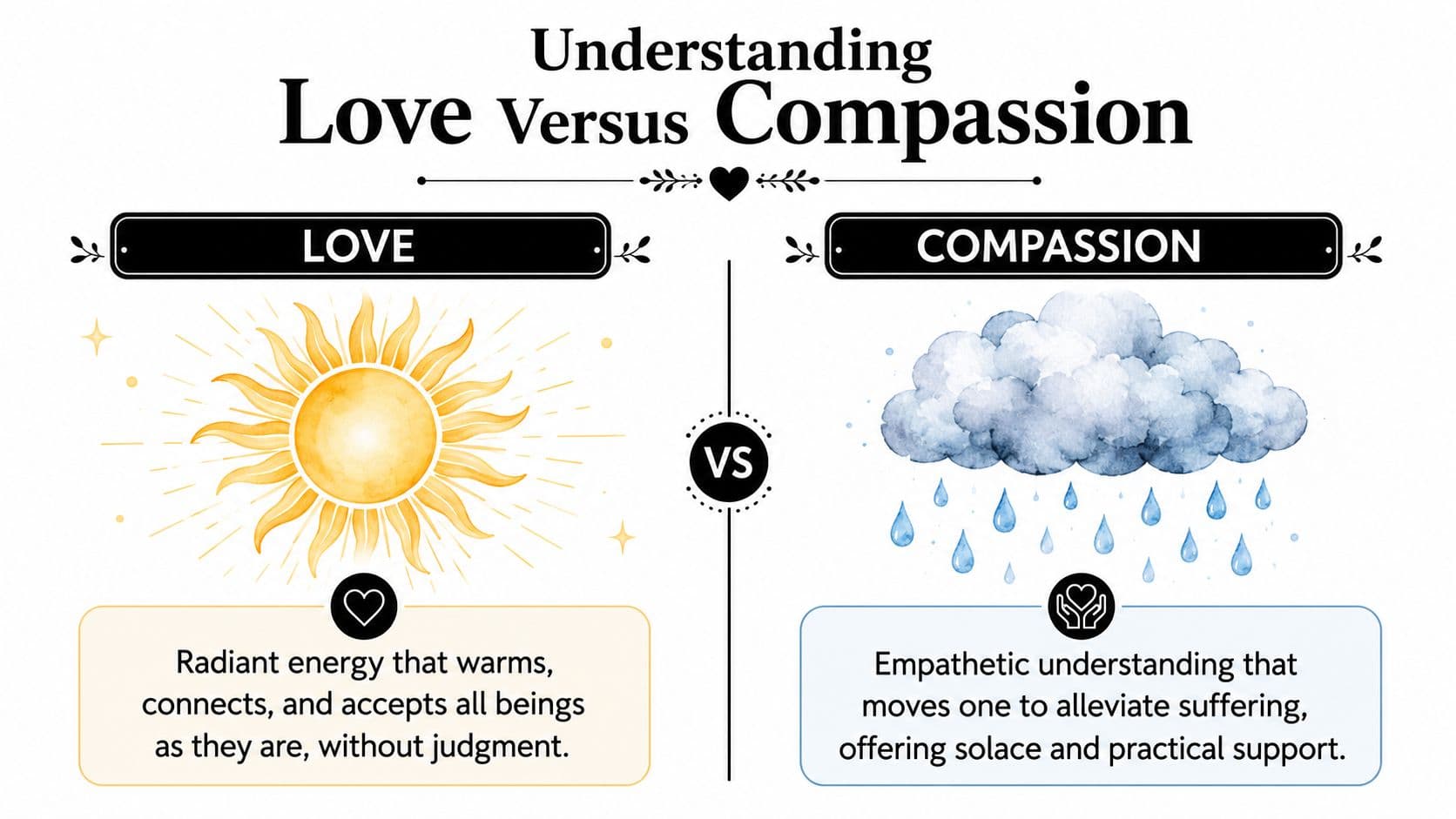
Love holds the whole person
Love sees value before performance. It doesn't require someone to be polished, cheerful, or easy. In everyday life, love may look ordinary. Making tea for your tired spouse. Checking in on a friend. Sitting beside your own grief without contempt.
Love also includes appreciation. It notices goodness. It blesses what is alive in another person.
Compassion responds to pain
Compassion begins with contact. You sense suffering, in yourself or someone else, and you don't turn away.
But compassion is not the same as absorbing everything another person feels. It's not over-identifying, rescuing, or fixing at any cost. In fact, a more mature understanding of compassion includes boundaries. As noted in this reflection on healthy limits within compassion, caring for someone can include taking their needs seriously without sacrificing necessary limits, and sometimes it means not meeting one person's needs in a way that blocks someone else's.
That matters because many caring people confuse compassion with self-erasure.
Practical rule: If your help feeds harm, drains your integrity, or abandons your real responsibilities, it may be empathy without wisdom.
Love vs. Compassion at a Glance
| Aspect | Love | Compassion |
|---|---|---|
| Core quality | Connection and appreciation | Responsive care in the presence of suffering |
| Main feeling tone | Warmth, acceptance, belonging | Tenderness, concern, willingness to help |
| Typical expression | Affection, gratitude, presence | Comfort, support, protection, wise action |
| Focus | The whole person and their inherent worth | The pain, need, or vulnerability of the moment |
| Risk when confused | Becoming vague or sentimental | Becoming overextended or boundaryless |
| Healthy form | Steady, honest, generous | Caring with limits, discernment, and respect |
A helpful companion idea here is empathy. Empathy helps you sense another person's inner world. If you want a clearer breakdown, a deeper discussion of the different kinds of empathy can deepen the distinction.
And when compassion is applied in settings where people have experienced hardship, safety matters as much as kindness. That's why a trauma-informed approach for children can be so valuable. It reminds adults that care should support trust, choice, and emotional safety, not just good intentions.
The Life-Changing Benefits of an Open Heart
Some truths feel ancient, but it still helps when modern research confirms them. Love and compassion are not soft extras added after the “real work” of life. They shape the quality of life itself.
A long-running example comes from Harvard. A 2017 summary of the Study of Adult Development reported that the project had tracked participants for nearly 80 years, and found that close relationships were better predictors of long, healthy lives than money, fame, social class, IQ, or even genes. It also noted that people who were most satisfied in their relationships at age 50 were the healthiest at age 80. You can read that summary in the Harvard Gazette's report on the study.
That's a striking correction to the way many of us are trained to live. We're taught to optimize status, income, or image. Yet relationship quality keeps emerging as a deeper measure.
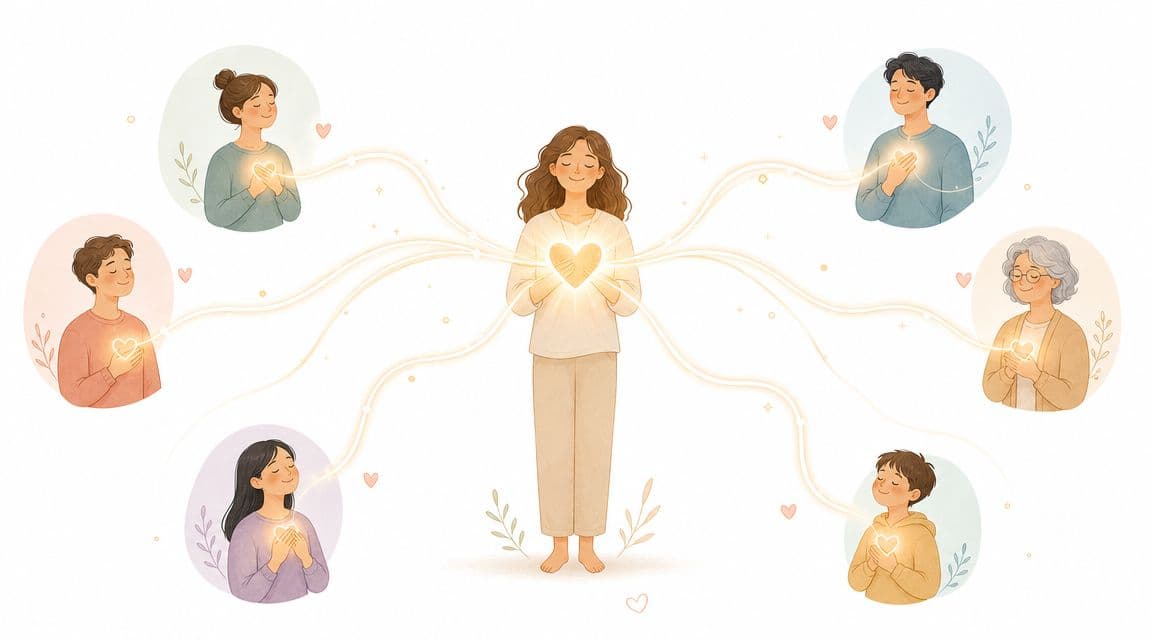
What changes when the heart opens
An open heart doesn't mean a life without sorrow. It means you meet life with less armoring.
Here are some of the shifts people often notice:
- Relationships become steadier: You listen more carefully and defend yourself less quickly.
- Conflict becomes more workable: Love doesn't erase disagreement, but it makes repair more possible.
- Self-talk becomes less punishing: Compassion gives your inner life room to breathe.
- Purpose feels less abstract: Caring for others and living truthfully start to point in the same direction.
There's also a spiritual dimension that's easy to overlook. People often search for purpose as if it were hidden in a perfect career or a dramatic breakthrough. But an open heart changes perception first. You begin to notice where you're needed, where your gifts naturally flow, and where fear has been closing doors that love would open.
Why this matters in ordinary life
The deepest benefit of love and compassion may be this. They make a human life more inhabitable.
You can feel that in simple moments. A home where people speak gently. A friendship where you don't need to perform. A family member who tells the truth without cruelty. A partner who remains emotionally available in hard seasons.
A meaningful life is rarely built from grand emotional peaks. It's built from repeated moments of trustworthy care.
That's why cultivating the heart isn't a side project. It changes the climate around you. It affects how people feel in your presence, and how you feel in your own.
Daily Practices to Cultivate Love and Compassion
Beautiful ideas need a body. If love and compassion stay in the realm of intention, they won't change much. Daily practice is what turns them into character.
A useful modern finding supports this. In a 2025 daily-diary study, researchers found that expressing love predicted feeling loved later, with the strongest cross-influence appearing at about a 3-hour lag. The reverse path was much weaker, which suggests that outward expression can be a primary driver rather than a mere result of feeling secure first. The study is summarized in this open-access research article on love expression and felt love.
In plain language, don't wait endlessly to feel full before you act lovingly. Loving action can help create the very connection you long for.
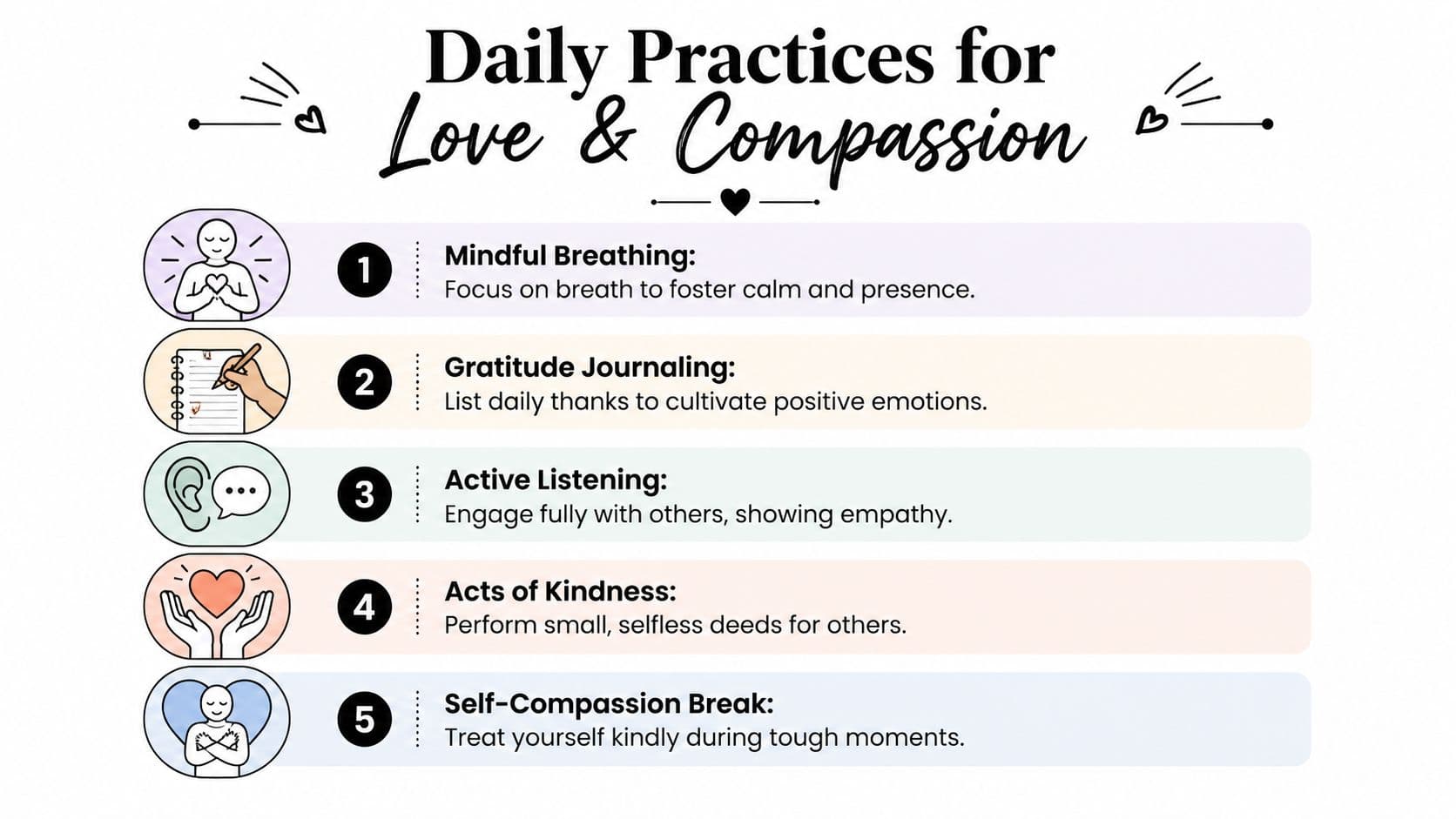
A simple meditation practice
Try this for a few quiet minutes. Sit comfortably. Let your breath settle. Then repeat inwardly:
May I be held in kindness.
May I meet this day with a soft and steady heart.
May others be safe, cared for, and free from unnecessary suffering.
If that feels natural, bring one person to mind. Then someone neutral. Then someone difficult. Don't force emotion. Offer the phrases gently.
This practice works because it trains direction, not performance. You're teaching the heart where to turn.
Journaling that builds tenderness
Some journal prompts help you think. These help you soften.
Write on one of these:
- Where am I asking myself to be superhuman instead of human?
- What pain in me needs kindness, not correction?
- Who has shown me quiet love lately, and how can I acknowledge it?
- Where do I need firmer boundaries so my care can stay clean?
Keep the writing simple. A few honest lines are enough. The goal isn't literary beauty. The goal is contact with the truth.
Relational practices that actually change things
Love grows through expression. Here are concrete ways to practice it in daily life.
- Say the caring thing aloud: Don't assume people know. Tell your child, friend, partner, or parent what you appreciate.
- Listen without preparing your defense: If you want to deepen this skill, empathic listening offers a practical foundation.
- Repair quickly: When you've been sharp, distracted, or dismissive, circle back and own it.
- Offer one small act of relief: Bring food, make the call, handle the errand, send the note.
If you're trying to nurture these habits in family life, it can help to learn age-appropriate ways of teaching care. Soul Shoppe shares thoughtful strategies for building kid's empathy that fit naturally into everyday interactions.
One practice for boundaries
Compassion needs structure or it burns out.
Try this sentence frame when someone asks for something you can't fully give: “I care about what you're going through. I can't do that, but I can offer this.” That response keeps the heart open while protecting honesty.
Over time, these practices do more than improve mood. They train you to become someone whose care is visible, grounded, and trustworthy.
Aligning with Your Life Purpose Through Love
Many people separate spiritual purpose from relational life. They imagine purpose as a mission “out there” and love as something personal and private. In lived experience, they belong together.
The way you love reveals the way you're meant to serve. The way you practice compassion reveals the lessons your soul may be here to learn.
Dan Millman's book The Life You Were Born to Live becomes especially helpful. Millman presents a structured system for understanding life paths, core lessons, and spiritual laws through a birth-date based framework. Used carefully, it gives language to patterns many people feel but can't easily name. Why do I keep meeting the same challenge? Why is one gift natural while another area feels painfully slow to develop?

Love supports your gifts
Every path includes capacities that want expression. For one person, that may be disciplined leadership. For another, creative sensitivity. For someone else, deep intuition or service.
Love is what helps those gifts become generous rather than self-protective. A creative person who doesn't love their own process may hide their work. A natural helper without self-respect may overgive. A strong communicator without compassion may use truth as a weapon.
Love doesn't only make you feel better. It makes your gifts safer for the world.
Compassion helps you work with your lessons
Your life path also points toward recurring challenges. Self-doubt, impatience, control, avoidance, emotional guardedness. Whatever the pattern, harshness rarely transforms it.
Compassion creates enough inner safety for real growth. If your lesson involves fear, compassion lets you acknowledge fear without surrendering to it. If your lesson involves responsibility, compassion helps you stop collapsing into shame every time you fall short.
That's why purpose work isn't just analysis. It's relationship. You are learning how to stand beside your own unfinished self with honesty and care.
Your spiritual path isn't proven by perfection. It's revealed by the quality of attention you bring to your gifts, your wounds, and the people around you.
A concrete way to use purpose work
Read The Life You Were Born to Live with two questions in mind:
- What qualities in me are asking to be strengthened through love?
- What struggles in me are asking to be met with compassion instead of judgment?
For readers who want a practical tool alongside the book, the Life Purpose App offers access to Dan Millman's life-path framework by letting users enter a birth date to explore one of the system's paths, along with related themes in relationships, career, health, and life cycles.
The point isn't to label yourself and stop there. The point is to recognize where loving effort belongs. A path becomes clearer when you stop trying to become someone else and start caring faithfully for the life that is yours.
Living a Life Guided by Love and Compassion
A loving life isn't built in a dramatic leap. It's built in the way you answer a text, the way you speak to yourself after a mistake, the way you stay present when someone else is in pain, and the way you refuse to confuse care with self-abandonment.
That's the quiet shift that changes everything. Love and compassion are not passive emotions that visit only when conditions are perfect. They are practices that shape health, relationships, character, and purpose.
Some readers will begin with meditation. Others will start with a boundary, an apology, a journal page, or a more honest conversation at home. Any of those is a real beginning. Small actions count because they train the heart to become more available.
And when life brings losses that ordinary advice can't hold, compassionate support matters even more. For families moving through grief after pregnancy or infant loss, this resource on gentle guidance after baby loss offers a humane example of what care can look like in tender circumstances.
Start with one practice. Keep it simple. If you forget, begin again without scolding yourself.
The path of love and compassion doesn't ask you to be flawless. It asks you to return.
If you want a structured way to connect heart-centered growth with your deeper path, the Life Purpose App can help you explore Dan Millman's system from The Life You Were Born to Live in a practical format. Use it as a mirror, not a shortcut. Let it show you where your gifts ask for love, where your struggles ask for compassion, and how your daily choices can become part of your life's purpose.
Discover Your Life Purpose Today!
Unlock your true potential and find your life’s purpose.
