Understand what a love compatibility percentage actually measures, how to calculate one, and how to use it as a reflection starting point

October 15, 2026 (Today)
Love Compatibility Percentage: What It Really Means
Understand what a love compatibility percentage actually measures, how to calculate one, and how to use it as a reflection starting point
← Back to blog
Understand what a love compatibility percentage actually measures, how to calculate one, and how to use it as a reflection starting point
Are you really asking whether two people are compatible, or are you hoping a number will remove the uncertainty that every relationship requires you to face?
A love compatibility percentage can feel reassuring because it turns a complicated relationship into something easy to read. Yet a score can't tell you whether two people will choose honesty during conflict, repair hurt after an argument, or keep learning about each other as life changes. Used carefully, it can be a useful reflection tool. Used as a verdict, it can create false confidence or unnecessary fear.
The most helpful approach combines a numerology interpretation with observable relationship behavior. In Dan Millman's The Life You Were Born to Live and the Life Purpose App, life-path comparisons can give language to possible strengths and tensions. Your conversations, boundaries, expectations, and daily choices still determine how those possibilities become real.
What Does a Love Compatibility Percentage Actually Measure
Could a relationship score tell you whether two people will stay together? A love compatibility percentage cannot answer that directly. No universal, scientifically validated percentage measures lasting love. In a longitudinal study of 4,464 romantic couples, personality similarity explained only a small amount of variation in partners' well-being compared with each person's personality and the partner's personality considered separately (longitudinal relationship research).
The score becomes clearer when you separate three relationship lenses:
- Perceived chemistry, the felt experience of attraction, ease, or curiosity.
- Trait similarity, the extent to which people appear alike in preferences, values, or personality descriptions.
- Longitudinal satisfaction, the quality of a relationship as support, stress, conflict, and change accumulate over time.
A numerology score usually summarizes selected symbolic patterns. It does not observe chemistry in person, compare every relevant trait, or track satisfaction across years.
| Lens | What it captures | What it misses |
|---|---|---|
| Perceived chemistry | Immediate attraction, curiosity, and the distinctive feeling between two people | How attraction responds to conflict, stress, or disappointment |
| Trait similarity | Shared preferences, values, or described personality tendencies | How differences function in real conversations |
| Longitudinal satisfaction | Relationship quality shaped by behavior, support, and circumstances | A complete explanation for different responses to the same event |
Why the first impression is only one piece
Profiles cannot replace interaction. In an American Psychological Association discussion, researcher Samantha Joel described a speed-dating study in which her team predicted exactly 0% of the compatibility component from information participants provided before meeting. The same discussion reported that roughly 20% of people with strongly positive first impressions later formed relationships, while approximately 30% to 40% of people who initially felt little interest became more attracted over time (APA discussion of finding love).
A reflection tool still has a practical role. A score may prompt questions such as, “Where might we understand each other easily?” and “Which differences need patient communication?” It cannot predict whether two people will feel close after a difficult year.
Practical rule: Treat the percentage as a prompt for better questions, not as a probability of lasting love.
The distinction is explained further in this guide. An Acheloa Wellness Enneagram workplace guide offers another example of how a profile can provide useful vocabulary without explaining a whole person.
The number gains meaning only after you name the pattern it represents. It might describe communication fit, shared themes, or a symbolic relationship between two life paths. It cannot measure safety, commitment, emotional maturity, or willingness to repair. Those qualities become visible through behavior, especially when pressure exposes how partners listen, respond, and grow.
How Millman's Life Path System Builds the Percentage
How can two individual life paths become one relationship score? Dan Millman's The Life You Were Born to Live starts with two separate birth-date calculations, one for each person. The revised 25th Anniversary Edition describes 45 life paths for people born from 1750 to the present. Each path centers on themes such as innate talents, special needs, health, career, relationships, money, and sexuality, as described in the Open Library description of the revised edition.
The sequence resembles comparing two personal maps. First, calculate one person's path. Then calculate the other's. Only after both paths are identified can the system examine possible harmony, tension, and shared relationship themes.
- Start with one person's date of birth.
- Identify that person's life path.
- Repeat the process for the second person.
- Compare the two paths and selected relationship dynamics.
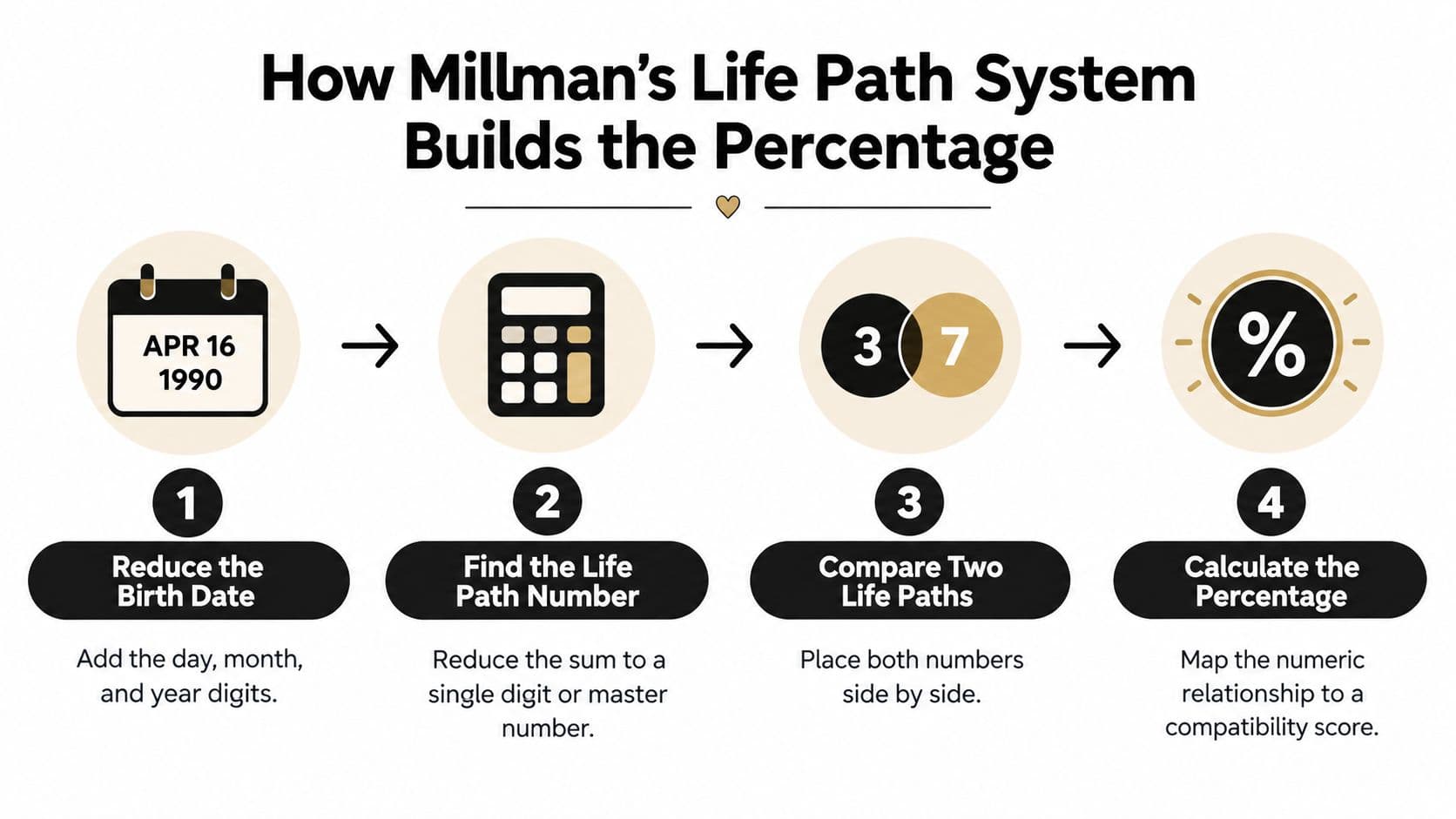
The Life Purpose App presents this comparison digitally, placing two birth-date-based life paths side by side and converting selected dynamics into a percentage-style summary. The percentage belongs to the interpretive system. The book's descriptions do not establish a scientifically validated threshold at which 70% becomes good or 90% becomes ideal, as indicated in this description of the compatibility mechanics.
That limitation gives the score its proper role. It can highlight a possible pattern, then prompt a conversation about listening, expectations, or growth. It cannot decide whether partners will build trust, repair conflict, or sustain care. The useful question is how each person responds to the dynamic the score suggests.
Calculating a Love Compatibility Percentage Step by Step
How can a percentage become useful without pretending to predict a relationship's future? Start with the two people, not with the final score. In Dan Millman's The Life You Were Born to Live, each person's life path is calculated separately. The Life Purpose App applies those birth-date-based paths to a relationship comparison, then presents selected dynamics as a percentage-style summary.
Use this sequence:
- Enter both dates of birth. Each date provides the basis for one individual life-path calculation.
- Identify both life paths. The Life Purpose App maps the dates to the relevant paths described in Millman's book.
- Compare relationship themes. Examine possible areas of ease and tension, including communication, shared outlook, emotional needs, and expectations.
- Read the percentage as a summary. The number condenses selected relationship-dynamics indicators into one accessible figure.
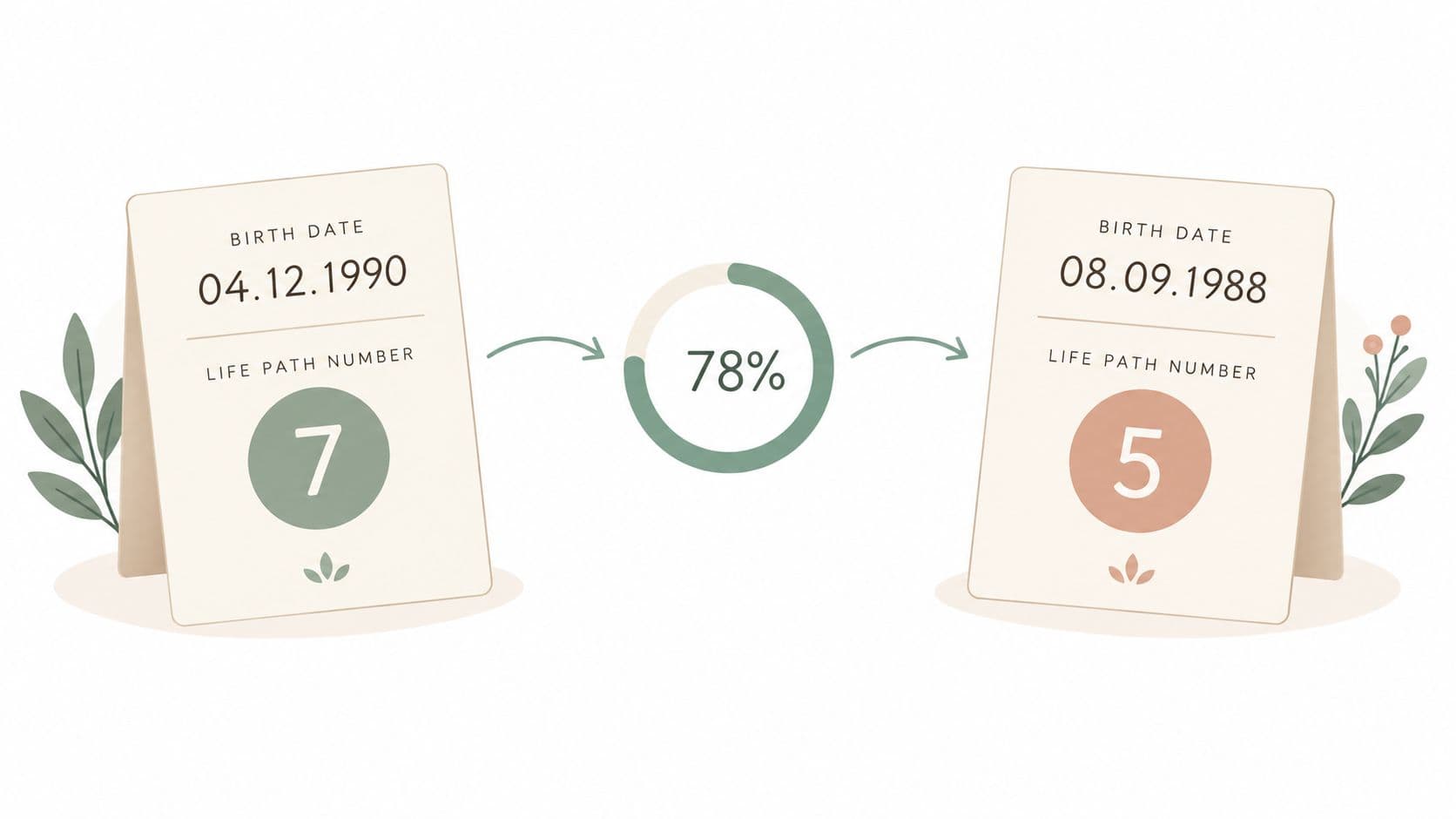
The score works like a summary on a map. It can point toward themes worth exploring, but it cannot show every road a couple may take. An invented example might combine communication fit, shared themes, and core dynamic indicators. The useful result is not the most flattering number. It is a clearer explanation of what the number represents and which behavior deserves attention.
A couple might phrase the interpretation this way: “We may share a strong outlook, but we could misunderstand each other when one person wants immediate discussion and the other needs time.” That statement offers a practical conversation starter. “We scored well” does not.
For help understanding the method, use this birth-date love compatibility calculator guide. After receiving a result, write down three questions:
- What does the score appear to capture?
- What important relationship quality does it leave out?
- What conversation could test the interpretation in real life?
The final question turns a symbolic percentage into a relationship practice. It encourages listening, clarification, and observation instead of treating the number as an opaque label or a verdict.
Reading the Percentage Bands Without Overreacting
What should a percentage change about the way two people treat each other? It can organize reflection, but it cannot rank people or declare a relationship worthy. In an interview with Dan Millman, Millman explains that each life path has distinct strengths and hurdles. No path, person, or relationship is better or worse. The meaningful question is how people respond to their pattern.
Use each band as a prompt for practice:
- 0–20%, low harmony: Identify recurring friction without treating the result as a sentence. Discuss core values, emotional needs, and the situations that create misunderstanding.
- 21–40%, moderate challenge: Slow down assumptions. Reflect back what you heard, clarify requests, and agree on how to pause and resume difficult conversations.
- 41–60%, balanced: Notice natural strengths alongside growth areas. Ask where patience, clearer expectations, or more direct communication would help.
- 61–80%, strong harmony: Protect the habits that make connection easy. Hold honest check-ins before small frustrations become unspoken resentment.
- 81–100%, high harmony: Appreciate the resonance without assuming permanence. Boundaries, repair, and curiosity still matter.
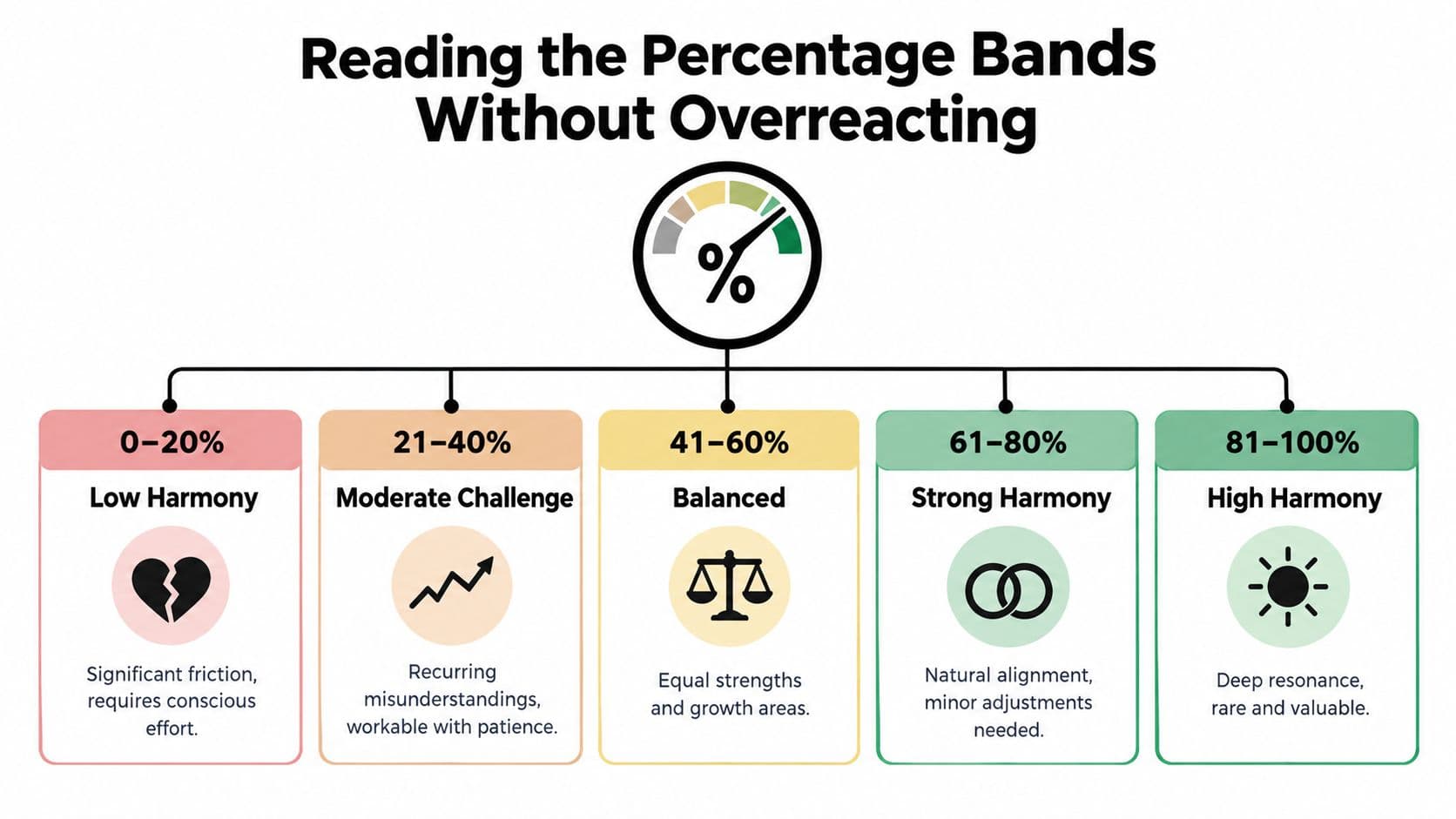
These ranges are interpretive, not scientific cutoffs. A cross-cultural study of ideal-partner preferences across 43 countries found that matching preferences explained only about 2% to 4% of relationship variance, even when researchers combined many traits (cross-cultural study of ideal-partner preferences). That finding supports humility about any profile-based score.
A low number can open a conversation. A high number can invite gratitude. Neither number can do the relationship work for you.
Ask, “What response would make this dynamic healthier?” Learning about relationship dynamics helps name the interaction itself rather than reducing either person to a fixed type. The percentage becomes useful when it leads to listening, clarification, and observable change.
Two Scenarios That Bring the Score to Life
What does a mid-range result look like in daily life? Consider a couple who shares humor and a broad vision for the future, while handling conflict differently. One partner thinks aloud. The other needs quiet before finding the right words.
They choose a weekly check-in, address one topic at a time, and treat a pause as a defined break with an agreed time to return. The percentage cannot predict whether this plan will succeed. It gives them language for why connection feels easy in some moments and effortful in others. Their reflection question is: What could we practice consistently so that difference becomes easier to work through?
A high-range result creates a different risk. Two partners may understand each other's humor, routines, and priorities with little explanation. Because daily life feels smooth, they can stop asking deeper questions and assume they already know what the other needs. A job change or family pressure may then reveal expectations they never discussed.
Their practice is continued attention. Their reflection question is: What have we stopped asking because we think we already know the answer?
The belief attached to a score can shape how partners respond when difficulty appears. Research on relationship beliefs found that couples with aligned growth beliefs reported higher satisfaction, while couples who both held strong destiny beliefs experienced the strongest declines over time. The finding does not mean a percentage causes an outcome. It shows why a result works better as a reflection tool than as a verdict.
A score can support curiosity or encourage passivity, depending on the story partners give it. Use each band to choose a behavior: speak clearly, pause with a return time, ask fresh questions, or examine assumptions before pressure exposes them.
Why Compatibility Is Dynamic and How to Recheck It
Could a percentage remain accurate while the relationship around it changes? A score captures a moment. Work, health, family responsibilities, distance, stress, and personal growth can alter what partners need and how they respond. Treat the result like a snapshot, not a permanent verdict.
A 10-year study of 300 couples found that stable and declining satisfaction trajectories were distinguished mainly by negative communication at the outset and deterioration in dyadic coping. Some couples who began with low satisfaction improved as their relationship skills developed (10-year study of 300 couples). The practical lesson is clear: relationship behavior can change the meaning you attach to a symbolic score.
A useful recheck
Compare the percentage with current experience. Ask:
- Communication: Do we express needs clearly, listen accurately, and return to unresolved topics?
- Stress: Have work, health, money, family, or major transitions changed how we interact?
- Shared expectations: Do we still agree about commitment, time together, independence, and the future?
- Repair: After conflict, do we apologize, adjust behavior, and restore trust?
- Curiosity: Are we still learning who the other person is now?
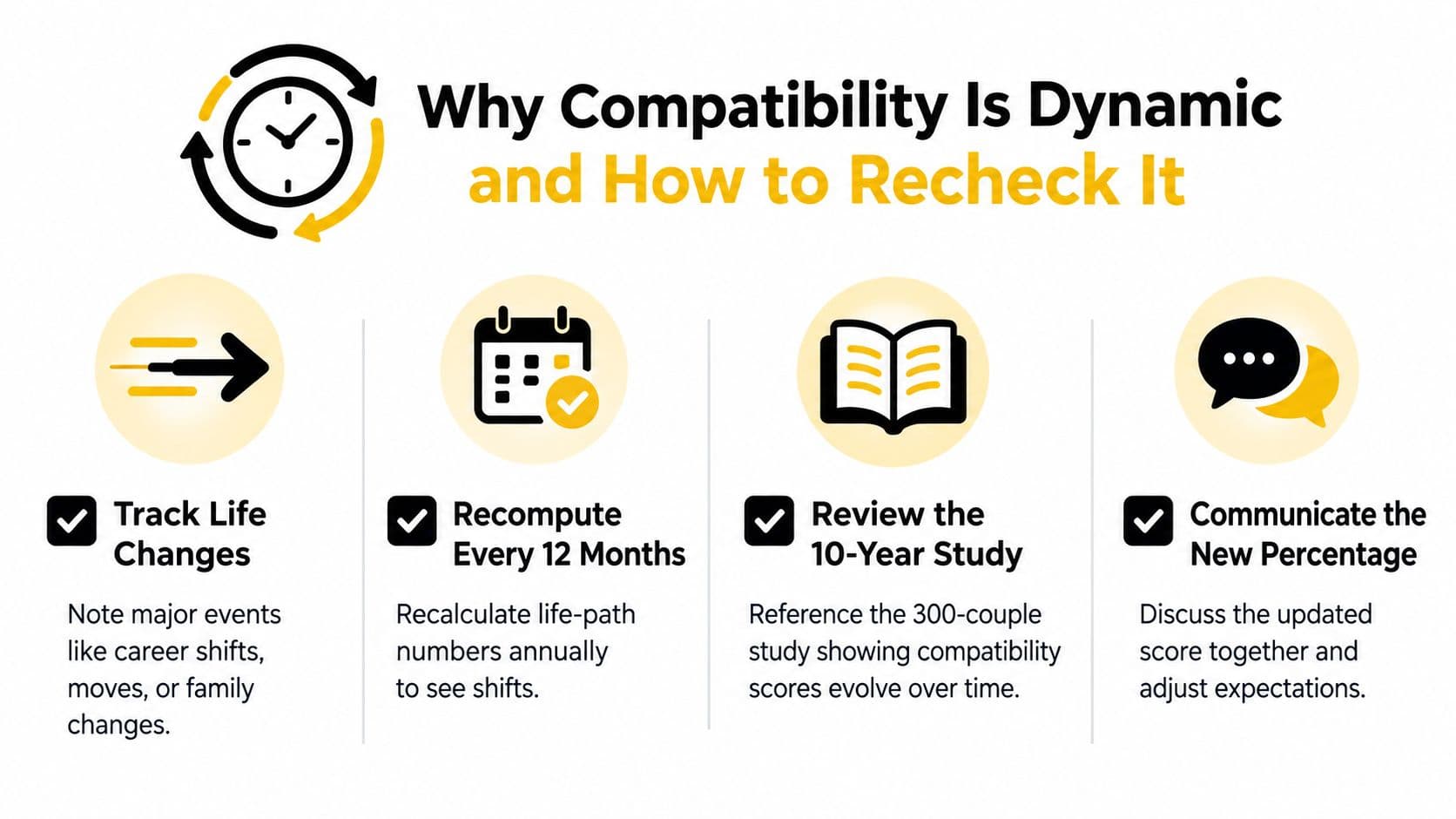
The Life Purpose App maps nine-year life cycles, offering a symbolic prompt to revisit relationship reflections at meaningful intervals. Use that timing alongside ordinary check-ins. A cycle does not determine a relationship's future.
Communication also needs context. A synthesis of observed-couple research found that its effects can depend on the topic, stressors, and identities involved. If attachment patterns raise questions, anxious attachment from Refresh Psychiatry & Therapy offers useful language. Serious distress may call for qualified professional support.
Turning Your Score Into a Relationship Practice
A percentage becomes useful when it changes a conversation or habit. Read it as a reflection tool, not a verdict. In Dan Millman's The Life You Were Born to Live and the Life Purpose App, comparing life paths points to possible patterns in motivation and relationship dynamics. It does not predict whether two people will stay together.
Ask your partner which themes feel accurate, incomplete, or wrong. A symbolic label can start inquiry, while daily behavior shows how the relationship functions. Choose one weekly question, such as, “Where did you feel supported this week?” Each person answers without interruption. Then ask, “Where did we misunderstand each other?” End by choosing one small behavior to repeat or change.
Research on initial romantic impressions found that relationship-specific and partner-specific effects predicted later romantic desire and dating outcomes, while general desirability and perceived compatibility also contributed (study of initial romantic impressions). Separate research on German couples linked loneliness in either partner with lower relationship satisfaction and faster declines in satisfaction. Similarity in loneliness also influenced how satisfaction developed. These findings support a practical focus on attention, connection, and repair rather than fixed labels.
Use the Life Purpose App to calculate and compare birth-date-based life paths, explore relationship dynamics, and guide self-reflection. Revisit the score after meaningful changes in habits or circumstances, then discuss what the number suggests and what your experience shows. Only the two of you can build the attention, trust, and repair that give a percentage practical meaning. Visit Life Purpose App to explore your life path and begin that conversation.
Discover your life path today
Enter your date of birth and see your life path, free.
Find your life path