What a love compatibility report includes, how to read its life path, cycle and dynamics sections, and how to use the results wisely.

October 25, 2026 (24d ago)
Love Compatibility Report Explained: Reading Every Section
What a love compatibility report includes, how to read its life path, cycle and dynamics sections, and how to use the results wisely.
← Back to blog
What a love compatibility report includes, how to read its life path, cycle and dynamics sections, and how to use the results wisely.
The popular advice is to check your compatibility result first, then decide whether the relationship has potential. I'd suggest the opposite. Read the descriptions slowly, turn them into questions, and see whether your actual experiences support them.
A love compatibility report can give you language for conversations you've been avoiding or haven't known how to start. It shouldn't decide whom you love, excuse hurtful behavior, or persuade you to overlook what's happening between you. The useful question isn't whether the report approves of your relationship. It's whether you can use it to understand each other more clearly.
What a Love Compatibility Report Includes
A compatibility report can sound like a verdict when read from the final pairing first. Its parts make more sense in order: the individual profiles provide the background, and the pair analysis applies that framework to two people. Use each interpretation as a prompt to compare with what you both experience, not as a ranking of the relationship.
In the birth-date framework used by the Life Purpose App, the report draws on two birth dates and Dan Millman's book, The Life You Were Born to Live. It covers each person's life path, gifts, challenges, current nine-year cycle, and the interaction between their paths.
The structure works like a building: individual profiles are the foundation, and the pair analysis is a room built on top. If a claim about the relationship feels convincing, check which profile details support it and whether those details match what you have observed together.
The Parts and Their Purpose
The components below belong to the framework in Dan Millman's The Life You Were Born to Live and the Life Purpose App. They are connected interpretations, not independent test results. The table shows what each part describes and a question to bring to a real conversation.
| Component | What It Covers | Where It Appears | How to Read It |
|---|---|---|---|
| Life path | Core path from your birth date, one of 45 in the system | Profile header | Read your own path first |
| Spiritual laws | Principles that frame how your path operates | Profile summary | Use them as context, not rules |
| Gifts | Strengths in health, money, sexuality, career and relationships | Each person's profile | Look for overlaps and complements |
| Challenges | Tendencies to watch in the same five life areas | Each person's profile | Name them as topics, not faults |
| Nine-year cycles | The phase each person is currently moving through | Cycle section | Compare phases side by side |
| Relationship dynamics | How the two life paths interact | Pair analysis | Read as prompts to discuss |
The free tier offers a foundational summary and system overview. Paid options provide the full text of the 25th Anniversary Edition of Dan Millman's The Life You Were Born to Live, detailed life-path analyses, unlimited contacts, and full cycles through the Life Purpose App.
How Much Weight to Give the Reading
A birth-date reading describes a symbolic framework. The cited research does not validate that framework or show that birth dates can predict relationship outcomes. A preregistered investigation of romantic interest examined whether matching people's stated ideal-partner preferences could reliably produce romantic interest. It found no support for that approach. This study tests preference matching, not birth-date readings, so it cannot confirm or disprove the report's claims. Treat the report as a set of ideas to test in conversation, not a forecast.
A separate study of algorithmic inclusivity and transparency concerns dating-app algorithms. It is relevant only as a general reminder that transparency and inclusivity matter when people assess algorithmic systems. It does not establish what a birth-date report can or cannot represent.
Before relying on any interpretation, ask what information produced it and what the method leaves out. Then compare its claims with what each of you has actually noticed. If the report offers no clear basis for a claim, treat it as a question to discuss rather than a conclusion.
How Life Paths Form the Foundation of Each Profile
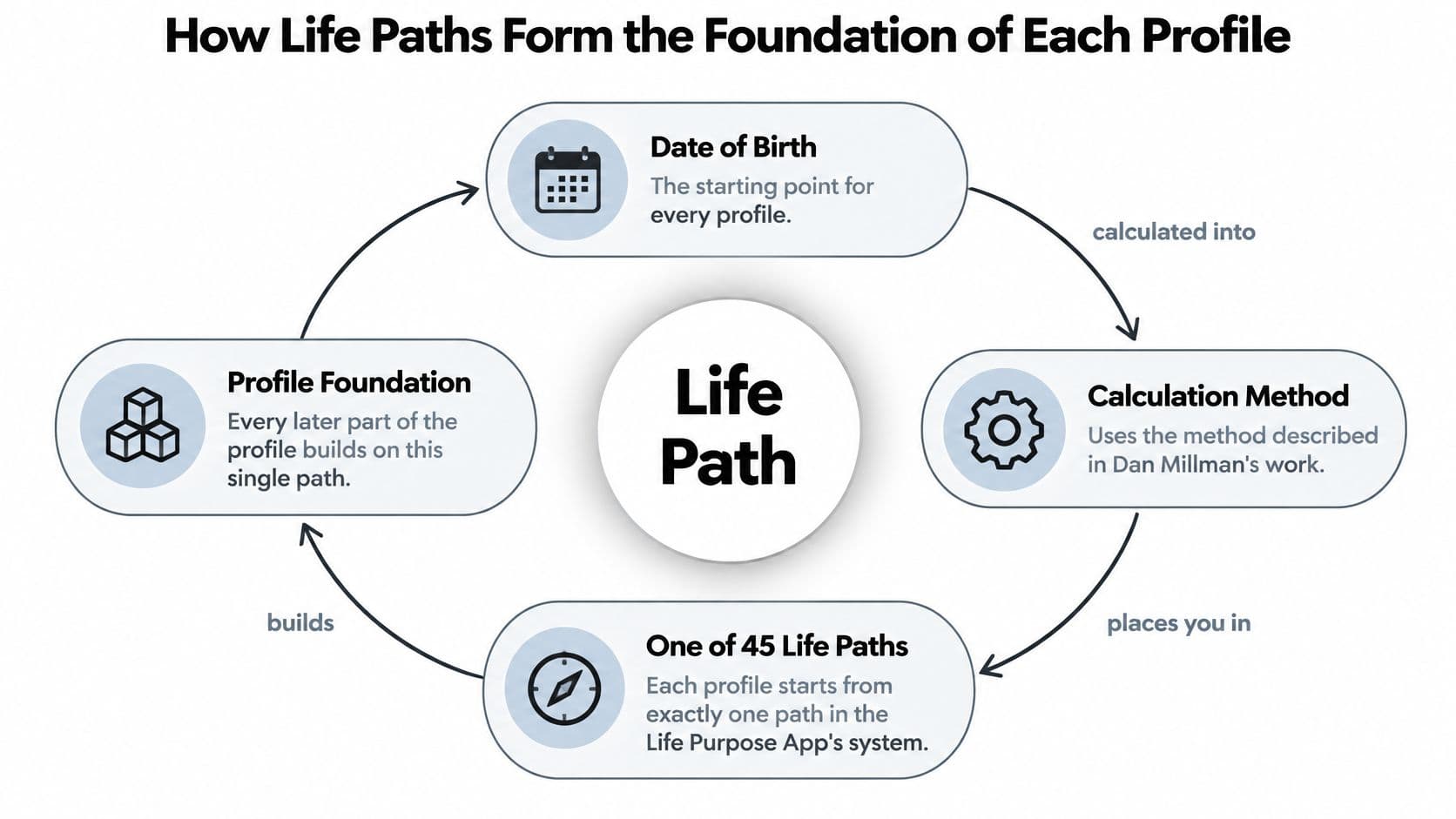
A compass points in a direction, but it doesn't describe every hill, road, or obstacle ahead. That's a useful analogy for a life path in Dan Millman's The Life You Were Born to Live and the Life Purpose App: it provides the organizing theme for the interpretation, not a complete account of a person.
Each profile starts with a birth date and the calculation method described in the book. The resulting life path is the reference point for the spiritual laws, gifts, challenges, cycles, and paired interpretations in Dan Millman's The Life You Were Born to Live and the Life Purpose App.
Read the Theme Before Applying It
Suppose a description emphasizes independence. Before applying that word to your relationship, ask what you think it means: time alone, financial autonomy, freedom to make plans, or reluctance to ask for help? Those are different experiences, even though someone might describe all of them with the same word.
Check the passage's exact wording rather than stretching a short label to fit whatever happened yesterday. The free summary can introduce the idea, but the full text provides more context before you act on an interpretation.
For background on the symbolic framework, the Life Purpose App's explanation of numerology and personality can accompany your reading of Dan Millman's The Life You Were Born to Live. Keep the distinction clear: an interpretive description isn't a validated personality assessment.
Practical rule: Mark passages as fitting, partly fitting, or not fitting. You don't have to make your experience agree with the page.
Leave Room for Disagreement
A useful reading leaves room for recognition and rejection. You might recognize a tendency at work but not at home, or your partner might describe you differently from the way you describe yourself. That disagreement can become a question about context rather than a contest over who understands you correctly.
Life paths in Dan Millman's The Life You Were Born to Live and the Life Purpose App cannot establish whether a relationship will last. Read each person's profile separately before comparing them, so the first interpretation doesn't become a filter through which you judge the second person.
Comparing Gifts and Challenges Across Five Life Areas
A profile can describe a strength in one person and a challenge in the other, suggesting a possible way to support each other. Shared challenges may point to a subject worth planning for. Treat those patterns like entries on a household planning sheet: each offers a question to test in daily life, not a grade for the relationship.
Dan Millman's The Life You Were Born to Live, mirrored in the Life Purpose App, groups its descriptions into five areas: health, money, sexuality, career, and relationships. Compare the areas one at a time, then check what each description means to both of you.
| Life Area | What to Compare | Question to Bring to Your Partner |
|---|---|---|
| Health | Energy, routines and habits named as gifts and challenges | Which routines keep us both steady? |
| Money | Spending, saving and risk tendencies | How will we handle an unplanned expense? |
| Sexuality | Desire, intimacy and self-expression | What does each of us need, and how do we say it? |
| Career | Ambition, pace and work style | Whose goals come first when they clash? |
| Relationships | Communication, commitment and conflict style | How do we repair after an argument? |
Check Whether a Complement Is Welcome
A person who enjoys planning might offer to organize shared appointments. That offer could help, provided the other person wants the support and the planner does not end up managing everything.
Ask whether the arrangement respects both people's autonomy. Being more comfortable with a task does not make it a permanent responsibility, and finding a task difficult does not remove the need to take part. Check the arrangement through a real conversation, not just the profile.
Use the same care with the sexuality area. A description cannot establish anyone's desires, boundaries, or consent. Ask your partner directly, and respect their answer even if it differs from the reading.
Give Money a Concrete Conversation
Money can become a source of disagreement when couples make different choices about spending, saving, or risk. A broken appliance gives those differences something concrete to discuss.
Would you use savings, delay another purchase, or consider borrowing? What would each person need to know before agreeing? The answers show how broad profile descriptions meet an actual decision, and whether the proposed approach feels fair to both of you.
A challenge is a topic to plan around, not a character flaw to assign to your partner.
Turn each apparent overlap into a question with an answer you can act on. Instead of “we're both bad with money,” ask, “what would make a shared spending check-in manageable?” Instead of “our careers clash,” ask, “how will we decide whose opportunity takes priority this time?”
The aim is a workable agreement, not identical preferences. A useful conversation ends with a choice both people understand and can reasonably carry out. Treat the report as a prompt: compare its descriptions with what you each observe, and keep what helps you discuss your real life.
Reading Nine-Year Cycles Side by Side
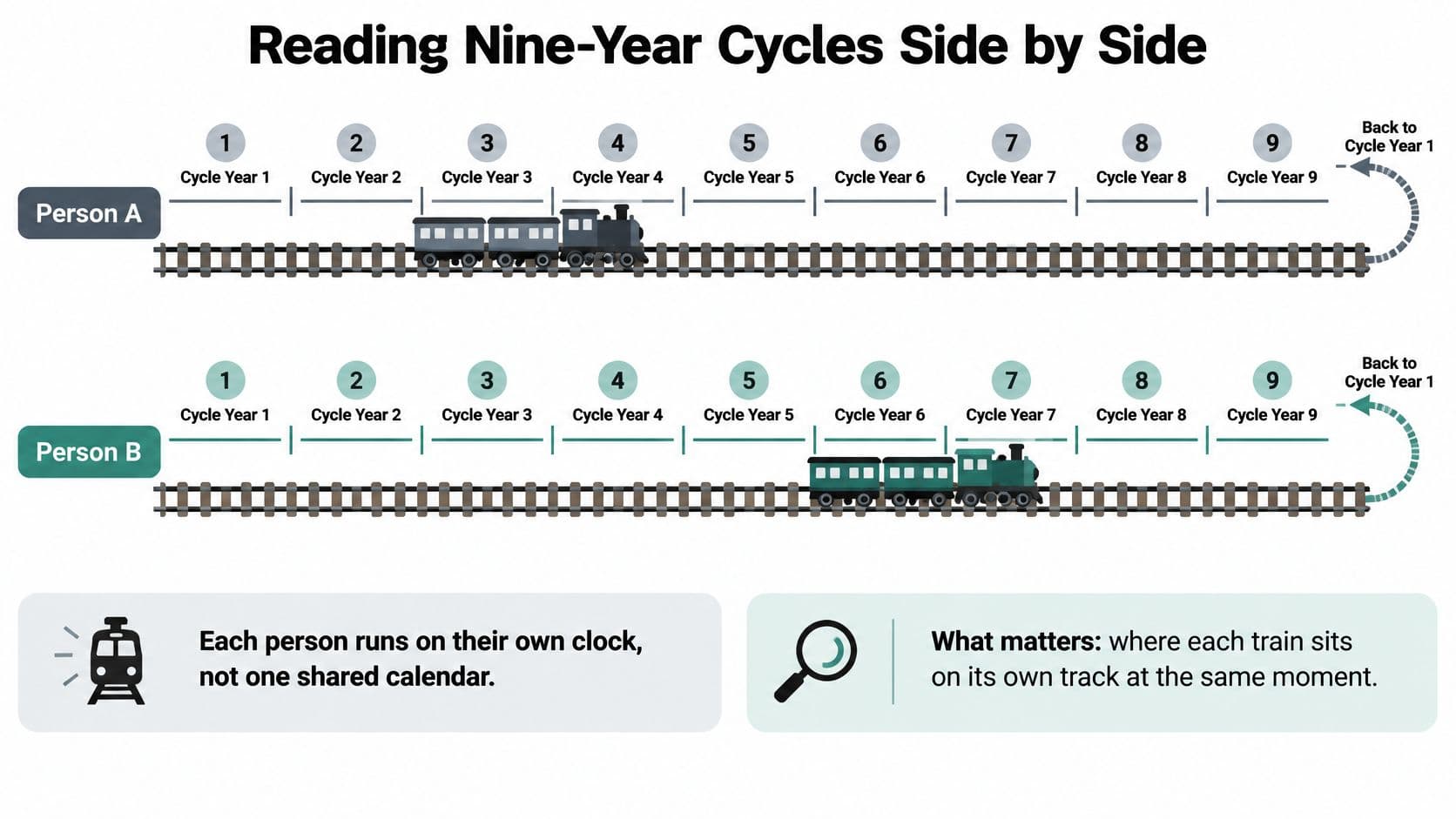
Imagine trains on parallel tracks. Each has its own position and journey, so looking across at the other train doesn't tell you where yours should be. Nine-year cycles in Dan Millman's The Life You Were Born to Live and the Life Purpose App work as separate symbolic clocks, not a shared relationship calendar.
The Life Purpose App maps these cycles, with full access in its paid tier. Check phase meanings against Dan Millman's The Life You Were Born to Live, and use the accompanying life-cycle chart explanation to orient yourself before interpreting an apparent alignment.
Use Alignment to Ask About Timing
The patterns below are conversation prompts within the framework, not tested predictions of what will happen.
| Cycle Pattern | What It May Suggest | Conversation to Have |
|---|---|---|
| Both in a growth phase | Shared momentum and new demands on time | Agree on priorities for this phase |
| Phases in step | Similar pace and similar blind spots | Check whether you are both avoiding the same issue |
| Phases opposite | One pulls forward while the other steadies | Decide who sets the pace on big decisions |
| One near a turning point | Shifts in mood, priorities or plans | Ask what each person needs before committing |
Suppose one person wants to relocate while the other wants stability. Don't assume the cycle description explains the difference. Ask about work, caring responsibilities, money, and what each person hopes a move would change.
A timing metaphor can help you introduce that discussion. It cannot replace the reasons your partner gives.
Keep Forecasts Separate From Observations
Research on measured relationship characteristics offers a useful boundary. A synthesis of 43 longitudinal datasets from 29 laboratories found that relationship-specific variables explained up to 45% of baseline variance in relationship quality but up to 18% at later measurements, and no assessed combination reliably predicted improvement or decline.
That research did not validate symbolic cycles. It shows why explaining current satisfaction is different from forecasting change.
Note the cycle-change date shown in your reading, alongside what you expect at the time and what you observe later. Include mismatches, not just apparent confirmations. Use the comparison to reconsider an interpretation, rather than rewriting events to make it seem accurate.
Relationship Dynamics and What Similarity Really Shows
A compatibility report cannot rank two people by counting how many traits they share. Similarity is more like matching notes in a song: it may create harmony in one passage, while the way the notes fit together matters more than how many are the same. Research on relationship traits does not establish that similarity automatically leads to better relationship quality. It also does not validate readings based on birth dates.
Look at the Configuration, Not Just the Match
The relationship dynamics section describes how the two life paths may interact within Dan Millman's The Life You Were Born to Live and the Life Purpose App. It offers possible reinforcing strengths and friction points. Treat each description as a prompt to check against what you both observe, not as evidence that a pattern must be present.
The Life Purpose App's relationship dynamics are interpretive tools grounded in Dan Millman's The Life You Were Born to Live, not validated measures of marital satisfaction. Its relationship dynamics explanation provides context for the paired interpretation. Keep that language distinct from what you learn through actual conversations and behavior.
Read Each Dynamic With a Different Question
- A strong dynamic needs discussion. If the report suggests mutual encouragement, ask when each of you last felt supported and what the other person did.
- A weak dynamic needs testing. If it points to tension around independence, compare your actual expectations about friendships, private time, and shared plans.
- A single dynamic needs perspective. One appealing or uncomfortable description cannot define the whole relationship.
For example, two people might both dislike confrontation. That shared tendency could make daily interactions feel easy, while leaving an important disagreement unspoken. Ask whether you can raise concerns respectfully. The answer matters more than whether the resemblance sounds favorable.
Different decision-making styles may also work well if both people feel heard. Compare how much time each person needs to think, when an answer is expected, and how you agree on a deadline. These are observable questions, unlike a label that can mean different things to each partner.
Use the report's wording to start a conversation, then test the claim against specific experiences. What did each person do? How did the other respond? Was an agreement kept when it became inconvenient? Clear examples help you decide whether a described dynamic fits, where it falls short, and what you want to discuss. The report can suggest questions; your shared experience supplies the answers.
Reading the Report in Order and Testing What It Says
Consider a hypothetical couple, Priya and Tom, who open their reports on the same evening and jump straight to the relationship dynamics. After reading about possible friction, they begin interpreting every description as proof that the friction must exist. They've started with a conclusion instead of an observation.
Treat the report like a worksheet rather than a judgment. For the foundational reading, use Dan Millman's The Life You Were Born to Live alongside the Life Purpose App, whose paid tier provides the full text and detailed analyses.
A Reading Order That Limits Assumptions
- Confirm your access. Check which sections open in full. A common slip is treating a preview as the complete explanation.
- Read your own life path and summary alone. In Dan Millman's The Life You Were Born to Live and the Life Purpose App, note a gift and a challenge you recognize. Don't select only flattering passages.
- Read your partner's profile separately. Give them room to say what fits before offering your interpretation. Avoid reading it as a list of their shortcomings.
- Compare gifts across the five-area sheet. Look for overlaps and possible complements, without assigning permanent responsibilities.
- Compare challenges. Mark shared areas for discussion. Don't mistake a shared label for evidence that you struggle in the same way.
- Check the cycle phases. Compare the descriptions with current circumstances. Don't invent an explanation when the fit is weak.
- Read the dynamics last. Turn each relevant statement into a question. Resist treating it as a conclusion.
- Write three questions for each other. Make them specific enough to answer with examples, preferences, or a proposed agreement.
Priya and Tom notice a shared money challenge. Rather than calling themselves financially incompatible, they ask whether a monthly budget review would help, what they would cover, and how to keep it from becoming an interrogation. Their next task is to try the arrangement, not celebrate the interpretation.
Take the Questions Into Daily Life
- Talk within a week. Bring the three questions to a conversation when neither person is rushed. Agree that either person can disagree with the reading.
- Observe over several weeks. Notice how you handle an actual expense, scheduling conflict, or request for support.
- Revisit after a major change. A move or new job gives you a reason to reassess agreements against changed circumstances.
- Keep an honest record. Log which suggested patterns appeared, which didn't, and which remain unclear.
Keep the decision yours: An uncomfortable section is an invitation to ask questions, not an instruction to reject the relationship.
A favorable passage shouldn't override repeated disrespect, either. Let the report inform your thinking while your experiences, boundaries, and mutual choices guide the decision.
The Life Purpose App offers birth-date-based profiles, cycles, and relationship dynamics drawn from Dan Millman's The Life You Were Born to Live. Visit Life Purpose App, explore the available reading, and choose a question you can bring to your partner with curiosity rather than a conclusion.
Discover your life path today
Enter your date of birth and see your life path, free.
Find your life path