Unlock the secrets of love compatibility zodiac signs with real tips on elements and star signs. Find your perfect match today.

October 4, 2026 (8d ago)
Love Compatibility Zodiac: Signs, Elements & Tips
Unlock the secrets of love compatibility zodiac signs with real tips on elements and star signs. Find your perfect match today.
← Back to blog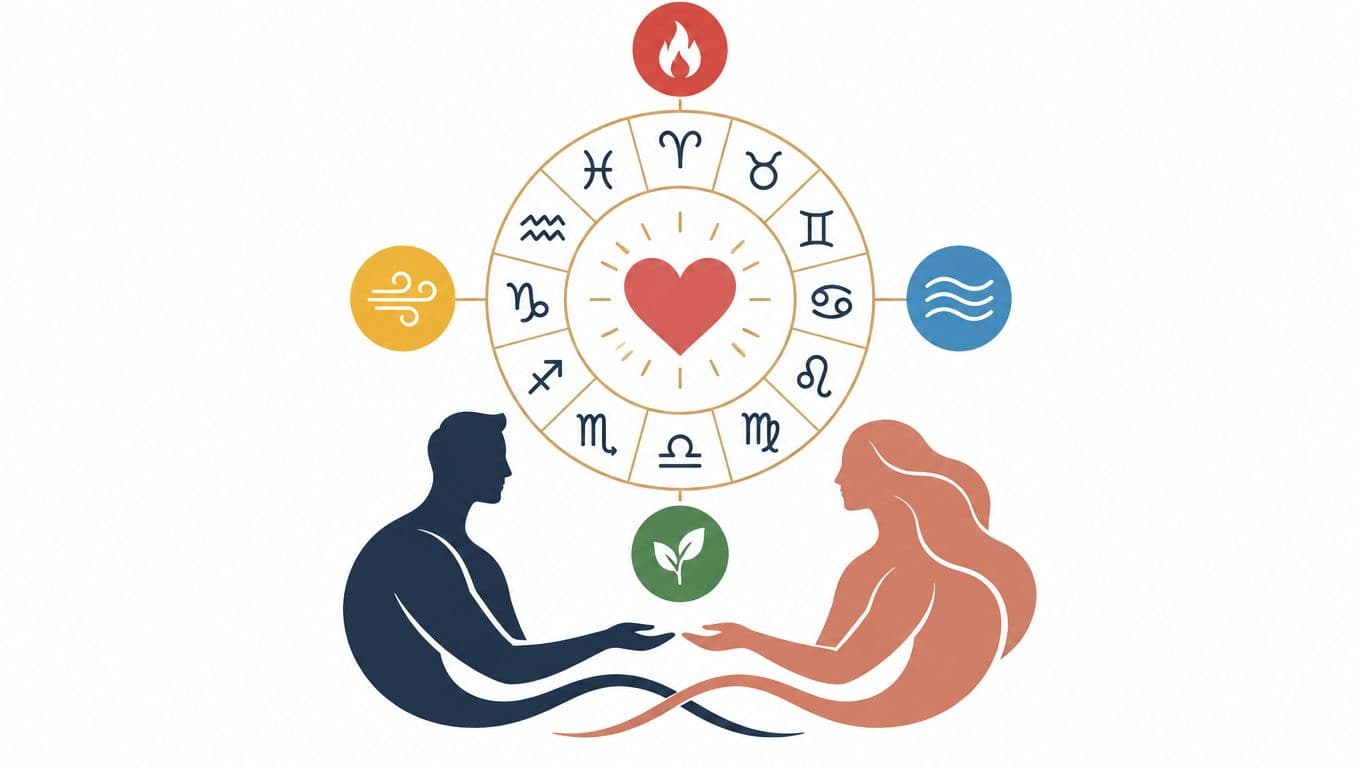
Unlock the secrets of love compatibility zodiac signs with real tips on elements and star signs. Find your perfect match today.
Why can a zodiac pairing feel personally meaningful even when two people's actual habits, values, and communication styles tell a more complicated story? That question sits at the heart of love compatibility zodiac readings. Astrology can give people a memorable language for attraction and difference, but a sign match isn't a relationship guarantee.
A helpful approach treats zodiac compatibility as a conversation starter, not a verdict. You can use it to ask better questions about emotional needs, independence, conflict, and shared direction. You can also enjoy the symbolism while keeping predictive claims in proportion to the evidence.
Why People Use Zodiac Love Compatibility
People often check zodiac love compatibility because it offers a quick way to describe an experience that otherwise feels difficult to name. One person may seem expressive and spontaneous, while another appears cautious and steady. A sign-based framework gives those impressions familiar labels and can make an early conversation feel easier.
That usefulness doesn't require treating astrology as a scientific personality test. A birth sign can serve as a prompt: How do you show affection? What helps you feel secure? Do you need more space or more reassurance? Those questions can reveal far more than a simple “good match” or “bad match” label.

A map rather than a verdict
Think of a zodiac reading as a map of possible themes, not a route that forces two people toward a destination. If a reading describes one partner as direct and the other as sensitive, the useful response isn't to assume conflict is inevitable. It's to ask how directness and sensitivity can work together without either person feeling dismissed.
The same sign pairing can look completely different in real life. Two people may share a traditionally harmonious combination and still struggle with dishonesty, avoidance, or incompatible goals. Two people with a supposedly difficult pairing may build a strong partnership because they listen carefully, repair mistakes, and respect each other's boundaries.
Practical rule: Use a sign match to start a conversation, then judge the relationship by observable behavior.
This guide separates the symbolic system from predictive outcomes. It will explain how elements and modalities shape common interpretations, what familiar pairings may suggest, why sun-sign analysis is incomplete, and how research changes the way we should use these ideas. Trust, communication, emotional safety, and shared values remain more important than a favorable chart summary.
Elements and Modalities That Shape Compatibility
Western astrology groups the 12 zodiac signs into four elements, and compatibility is commonly judged first by shared elements or traditionally harmonious pairings such as fire with air and earth with water, as described in this overview of zodiac compatibility by elements. Elements work like emotional climates. They don't describe every detail of a person, but they provide a broad image of how energy may be expressed.
Four emotional climates
- Fire is associated with passion, initiative, confidence, and visible expression. Fire pairings may feel lively because both people enjoy movement, enthusiasm, or direct action.
- Earth suggests practicality, patience, consistency, and attention to tangible needs. Earth connections may value reliability, routines, and building something that lasts.
- Air is linked with communication, ideas, curiosity, and social exchange. Air pairings often focus on conversation, mental stimulation, and freedom to explore different viewpoints.
- Water represents emotional depth, intuition, sensitivity, and bonding. Water connections may seek trust, empathy, and a strong sense of emotional recognition.
These descriptions are symbolic tendencies, not fixed psychological measurements. A person associated with an earth sign can be adventurous, and someone associated with a fire sign can be quiet or cautious. The framework becomes useful only when you compare it with what the person does.
Fire and air are often paired because air can give fire oxygen, while fire can give air direction and warmth. Earth and water are commonly paired because water nourishes the ground, while earth can offer structure to flowing emotion. Those images describe potential cooperation, not automatic harmony. Too much fire can feel overwhelming, too much air can feel detached, too much earth can feel rigid, and too much water can feel emotionally heavy.
Three ways energy moves
Astrology adds a second layer called modality. The three modes are cardinal, fixed, and mutable. They describe whether a sign tends to initiate, stabilize, or adapt, and compatibility readings often use element and modality together, as explained in this modality-based compatibility guide.
| Modality | Relationship tendency | Possible strength | Possible friction |
|---|---|---|---|
| Cardinal | Starts and leads | Momentum and initiative | Competing agendas |
| Fixed | Sustains and stabilizes | Loyalty and persistence | Resistance to change |
| Mutable | Adjusts and transitions | Flexibility and problem-solving | Inconsistency or indecision |
A cardinal person may ask, “What should we do next?” A fixed person may ask, “How can we protect what we've built?” A mutable person may ask, “What needs to change?” None of these approaches is superior. A relationship may need all three, especially when one partner begins a project, another maintains it, and both adapt when circumstances shift.
Common Sun Sign Pairings and What They Suggest
Popular pairing lists are easiest to understand when you treat them as examples of elemental rhythm rather than promises about destiny. A fire sign and an air sign may be described as energizing because one brings enthusiasm and the other brings ideas. Two earth signs may appreciate dependability, while an earth and water pairing may balance practicality with emotional awareness.
Consider an Aries and Gemini pairing. In symbolic terms, fire brings drive and air brings curiosity. The combination may feel fast-moving and playful, especially when both people enjoy independence and new experiences. The challenge is that excitement doesn't automatically create consistency. They may need to discuss follow-through, attention, and what commitment looks like in daily life.
A Taurus and Cancer pairing offers a different image. Earth can provide steadiness, while water can contribute emotional care. This may suggest a relationship where one person values practical security and the other emphasizes emotional belonging. Yet even a gentle combination can become difficult if one partner avoids change and the other expects constant reassurance.
Ease and growth are different benefits
A Gemini and Libra pairing is often interpreted through shared air qualities. Conversation, social connection, and intellectual interest may become central to the bond. The risk isn't necessarily open conflict. It may be indecision, avoidance of uncomfortable feelings, or an overreliance on talking instead of making clear choices.
An Aries and Capricorn pairing highlights contrast. Fire may prefer immediacy and bold action, while earth may favor planning, patience, and measurable progress. That difference can create frustration, but it can also create balance. One partner may encourage movement, while the other helps turn ambition into a sustainable plan.
| Pairing example | Symbolic emphasis | Useful real-life question |
|---|---|---|
| Aries and Gemini | Momentum, curiosity, independence | How will you balance spontaneity with follow-through? |
| Taurus and Cancer | Security, care, emotional grounding | How will you handle different needs for reassurance and routine? |
| Gemini and Libra | Communication, social ease, ideas | Can you discuss difficult topics as directly as enjoyable ones? |
| Aries and Capricorn | Action versus structure | How can speed and planning support the same goal? |
A supposed “perfect match” can still contain tension, and a challenging match can still contain complementary strengths. The more mature question isn't “Are these signs compatible?” It's “What does this pairing make easier, and what will require conscious effort?”
For a broader reflection on how zodiac interpretations can sit alongside relationship questions, use a prompt for discussion instead of treating the result as evidence that a relationship must succeed or end.
Understanding Synastry Basics Beyond Sun Signs
Sun-sign matching compares only one visible layer of a birth chart. That can be a useful introduction, but it resembles judging an entire film from one actor's role. Astrology's relationship method, called synastry, attempts to compare two complete charts rather than relying on a single sign.
Synastry compares two birth charts by examining elemental flow, house overlays, and aspects between planets. One explanation of the method describes these three layers as tools for assessing attraction, fit, and tension between people in this synastry overview.
Three layers of comparison
Elemental flow asks how the broader energies interact. This is the layer most readers recognize from sun-sign compatibility. It considers whether the charts appear to emphasize similar or complementary emotional climates.
House overlays focus on where one person's planets fall in the other person's chart. In astrological terms, this may suggest which areas of life feel activated, such as communication, home, romance, work, or long-term partnership. The interpretation depends on the chart context, so a single placement shouldn't be treated as a standalone verdict.
Planetary aspects examine the angular relationships between planets in the two charts. Astrologers use these relationships to discuss attraction, ease, pressure, and recurring themes. The important takeaway is that synastry presents compatibility as layered and dynamic rather than as a simple list of matching signs.
Why the snapshot matters
Suppose two people share a sun-sign pairing that looks harmonious. Their wider charts may still suggest different approaches to affection, conflict, privacy, or independence. Conversely, a pairing that looks awkward at the sun-sign level may contain other chart factors that astrologers interpret as supportive or compelling.
That doesn't make a detailed chart automatically predictive. It means only that a one-sign comparison is a narrow snapshot. If you enjoy astrology, the richer framework can help you ask more precise questions, such as whether both partners feel heard, how each handles pressure, and whether attraction is supported by compatible everyday expectations.
Readers who want to compare birth-date approaches can also use this birth-date love compatibility calculator as a reflective exercise. The result should remain secondary to direct knowledge of the person in front of you.
What Research Says About Zodiac Compatibility
Astrological compatibility becomes a much stronger claim when it moves from symbolism to prediction. Saying that fire and air create an interesting metaphor is different from saying that certain signs reliably marry each other more often or divorce less frequently. The second claim can be tested against real-world outcomes.
A large Swedish longitudinal study covering marriage and divorce outcomes from 1968 to 2001 found no consistent evidence that astrologically more compatible couples were overrepresented among marriages or had lower divorce risk, according to the published study on marriage and astrology. In practical terms, sun-sign-style matching didn't show predictive power for relationship outcomes at population scale.
Personality and pairing claims
A personality study of more than 15,000 subjects found no correlation between Sun sign and the Big Five traits, which include openness, conscientiousness, extraversion, agreeableness, and neuroticism, as summarized in this review of zodiac compatibility and psychology. The same source describes broader research summarized in 2003 as finding that astrology's claims weren't supported beyond chance.
Many love compatibility zodiac systems rely heavily on Sun-sign categories. If Sun signs don't reliably track major personality traits, they have a weak foundation for predicting whether two people will communicate well, manage conflict, or remain committed.
A separate analysis examining more than 10 million couples from England and Wales found no astrological effect on romantic pairing patterns, according to coverage of large-scale tests of astrological compatibility. A predictive system would need to produce observable patterns, such as non-random pairings or consistently lower breakup risk. Those benchmarks weren't observed in the cited analysis.
Astrology can still be meaningful without functioning as a forecasting instrument.
These findings don't make personal interest in astrology pointless. They clarify the appropriate role. A chart can help someone reflect on expectations, language, and relationship patterns, but it shouldn't decide whom to date, whether to trust someone, or whether to leave a relationship. For those decisions, behavior, consent, honesty, safety, and shared values offer stronger guidance.
Practical Ways to Use Zodiac Insights in Relationships
Use zodiac insights as prompts for conversations you might otherwise postpone. If a pairing is described as freedom-loving and security-seeking, ask each other what independence and commitment look like in practice. If one person identifies with emotional depth and the other with direct action, discuss how each wants support during conflict.
A simple approach keeps the symbolism grounded:
- Start with curiosity. Ask whether the description feels accurate rather than assuming it is true.
- Name the practical issue. Translate “fire and earth tension” into a real question about pace, planning, or risk.
- Listen for needs. Let both people explain what helps them feel respected and secure.
- Check behavior. Compare the reading with how each person communicates, apologizes, and keeps promises.
For broader self-discovery, read Dan Millman's book The Life You Were Born to Live and explore the Life Purpose App, which offers birth-date-based life-path insights and relationship-dynamics tools connected with Millman's system. Treat that material as a complementary reflection method, not as a replacement for honest conversation or professional support when a relationship involves serious harm.
You can also make the ritual personal without treating objects as proof of compatibility. For example, a symbolic gift such as luxury crystal trees from Astro West may give a couple a tangible reminder of an intention they discussed together. The meaning comes from the conversation and shared choice, not from a promise that a stone can control an outcome.
For practical communication prompts, try these relationship prompts. The strongest use of astrology is the one that brings two people into clearer, kinder dialogue.
Key Takeaways for Smarter Zodiac Compatibility Thinking
Love compatibility zodiac readings work best as a reflective language. The elements offer broad emotional climates, while modalities describe different approaches to initiative, stability, and change. Sun signs can suggest themes, but they provide only a small part of an astrological comparison.
Research hasn't shown that astrologically compatible signs reliably predict marriage formation, divorce risk, personality traits, or romantic pairing patterns. That doesn't prevent you from enjoying astrology. It means you should hold its interpretations lightly and test them against lived experience.
Look for the qualities that sustain real relationships: mutual respect, honest communication, emotional safety, accountability, and shared effort. Use a sign description to open a thoughtful question, then listen to the answer rather than forcing a person into a category. Self-knowledge tools, including Dan Millman's The Life You Were Born to Live, can add another reflective lens when used responsibly.
The Life Purpose App offers birth-date-based life-path insights, relationship-dynamics comparisons, and access to ideas from Dan Millman's The Life You Were Born to Live. Visit Life Purpose App to explore those tools and use astrology-inspired curiosity as part of a wider practice of self-understanding.
Discover your life path today
Enter your date of birth and see your life path, free.
Find your life path