Explore mandala therapy art for healing and self-discovery. Our guide offers step-by-step instructions, session plans, and prompts to unlock your inner world.
April 27, 2026 (4mo ago) — last updated July 5, 2026 (1mo ago)
Mandala Therapy Art: A Guide to Self-Discovery
Explore mandala therapy art for healing and self-discovery. Our guide offers step-by-step instructions, session plans, and prompts to unlock your inner world.
← Back to blog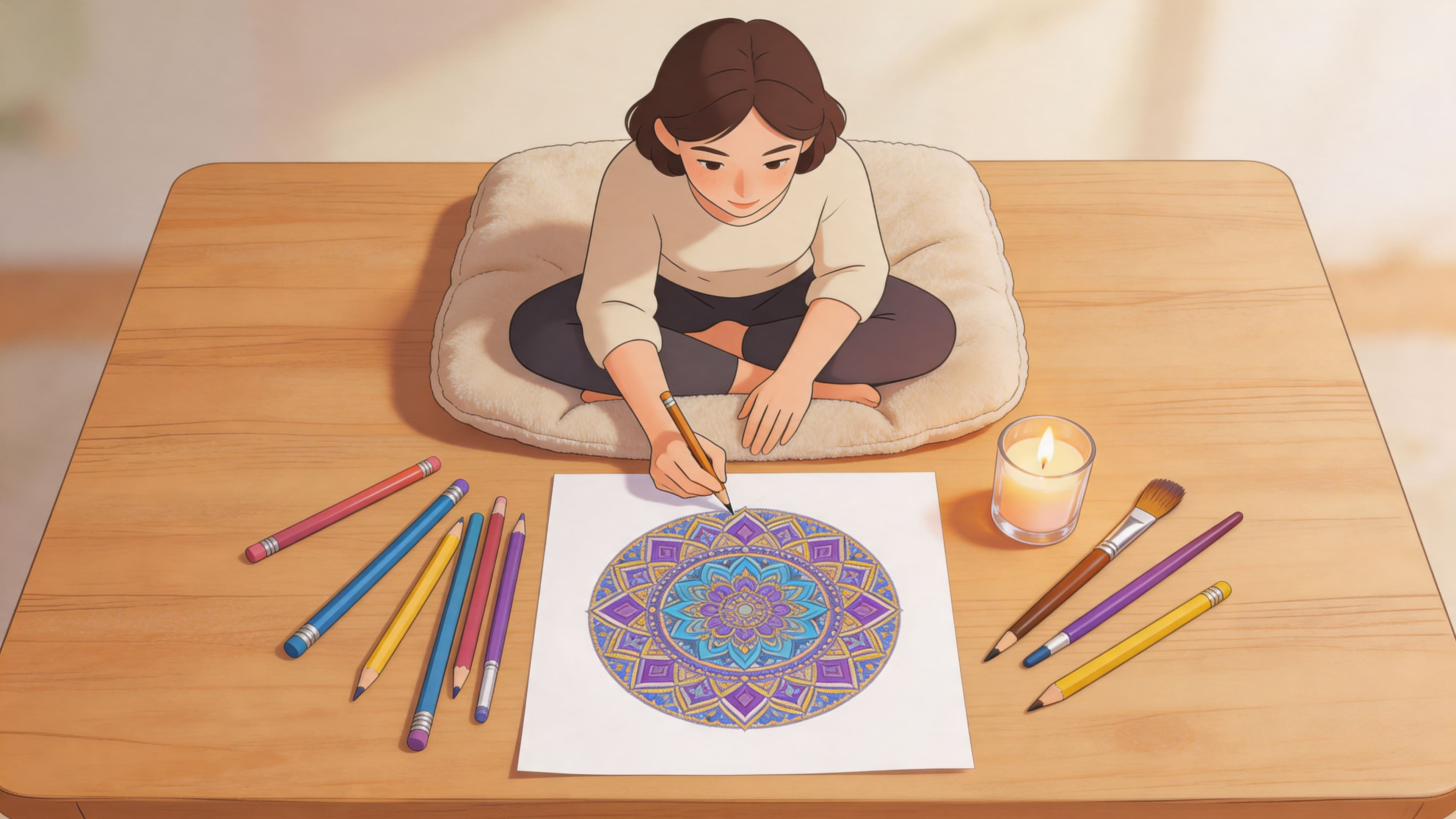
Some days you don’t feel dramatically lost. You just feel spread thin. Your tabs are open, your thoughts are noisy, and even the things meant to help you slow down can start to feel like more input. That’s often the moment people reach for mandala therapy art. Not because they want to make something impressive, but because they need a center.
I’ve seen this practice help people who struggle to meditate in silence, people who overthink every journal prompt, and people who feel a lot but can’t yet name what they feel. A circle gives the mind a boundary. Repetition gives the nervous system something steady to follow. Color and form let emotion move without forcing it into words too soon.
The Circle of Self and What is Mandala Therapy Art
When someone sits down with paper, a pencil, and a simple circle, something subtle changes. The scattered mind gets a container. The body often softens before the person even notices it. That’s one reason mandala therapy art has lasted across spiritual and therapeutic settings. It offers structure without demanding performance.
Essentially, mandala therapy art is the practice of creating or coloring within a circular form as a way to support attention, emotional expression, and inner organization. It isn’t just decorative coloring. In therapeutic use, the circle acts like a safe boundary. What you place inside it often reflects your current inner state more directly than a polished explanation ever could.
Why the circle matters
Carl Jung famously worked with mandalas as expressions of the self, and that understanding still holds weight in practice today. The circle suggests wholeness. It also gives just enough containment for difficult material to emerge without flooding the page.
A mandala can be orderly, chaotic, radiant, spare, crowded, playful, or tense. None of those is wrong. The image isn’t graded for beauty. It’s read for relationship. How the center feels, how the edges hold, whether the pattern breathes or compresses, all of that can tell you something useful.
Mandala work is often most helpful for people who need both freedom and form at the same time.
A spiritual tool with practical value
Many people first meet mandalas through spiritual traditions, meditation spaces, or sacred art. That makes sense. The circular form has long been used to symbolize order, devotion, and connection. In modern practice, art therapists and spiritual coaches often use mandala work in a grounded way. You don’t need to adopt a specific belief system for it to be meaningful.
What matters is presence. You begin with a center, make choices around it, and watch what appears.
That process becomes a mirror.
For some people, the mirror shows exhaustion. For others, it shows longing, conflict, grief, relief, or a renewed sense of direction. Even a very simple mandala can reveal whether you’re craving spaciousness, stronger boundaries, more movement, or more rest.
What mandala therapy art is not
It’s not about drawing perfectly symmetrical sacred geometry from memory. It’s not a test of artistic talent. It’s also not a shortcut that replaces therapy when someone needs clinical support.
What it does offer is a reliable, low-pressure way to slow down and notice yourself. That alone can be powerful. When people say they feel disconnected from themselves, I often find they don’t need more information first. They need a practice that helps them come back into relationship with what’s already there.
The Science of Symmetry and Therapeutic Benefits
The strongest argument for mandala therapy art isn’t that it looks calming. It’s that structured mandala work has shown meaningful therapeutic effects in clinical settings.
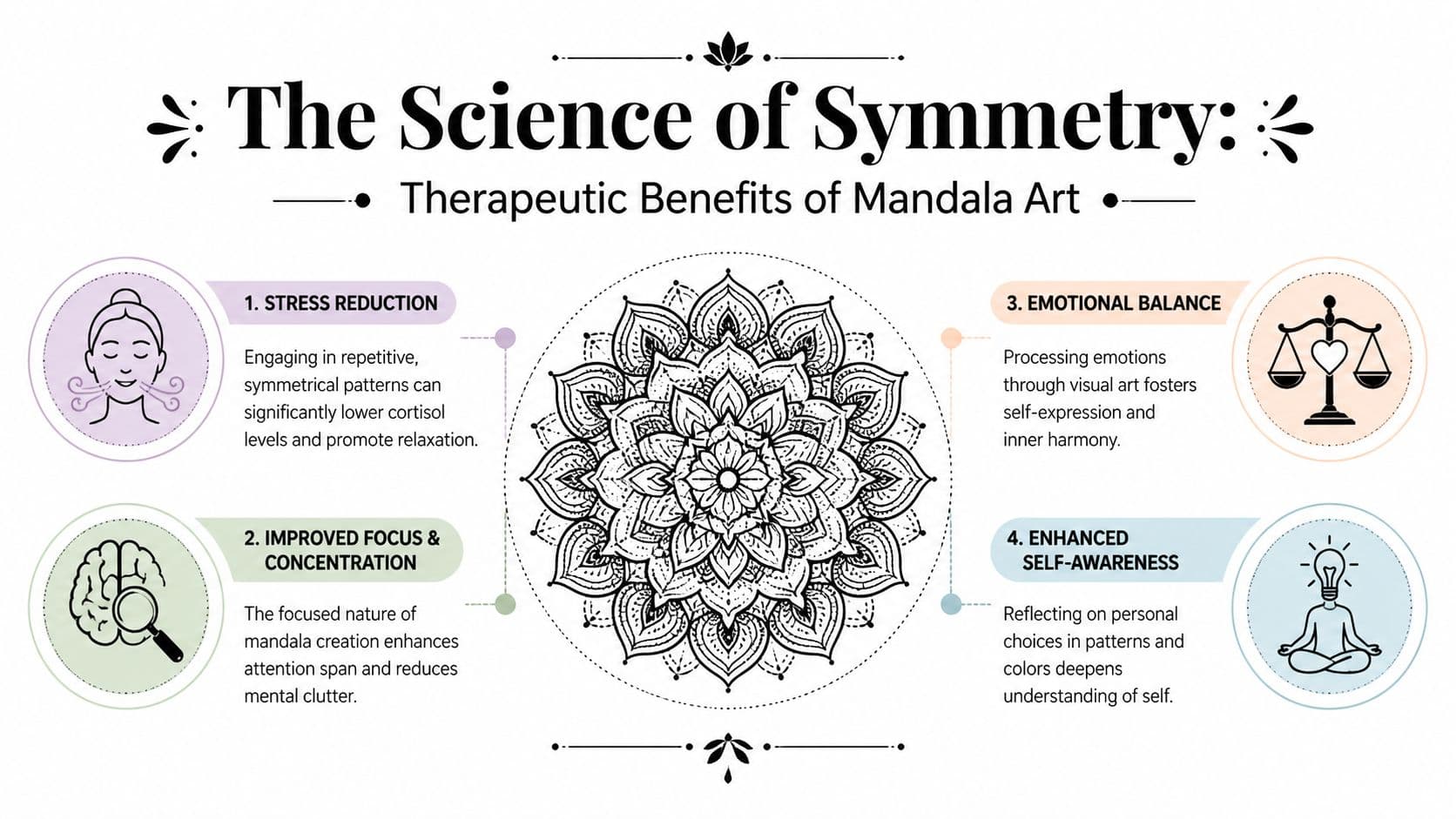
One of the clearest examples comes from a 2019 randomized controlled trial with 15 breast cancer patients in Israel, where eight weekly mandala art therapy sessions led to statistically significant improvements in emotional awareness and affect regulation, with large effect sizes observed for those measures and for depressive symptoms, as reported in this review of mandala-based interventions in oncology settings. In that same review, the authors discuss a broader body of 14 studies involving over 500 participants across countries including Turkey, Korea, and the US.
That matters because it moves mandala therapy art out of the “pleasant hobby” category. The structured use of shape, repetition, and visual focus can support real psychological processing.
Emotional regulation is one of the clearest strengths
People often come to mandala work because they feel overwhelmed but don’t have language for the overwhelm. The circular frame helps because it narrows the field. Instead of trying to manage everything at once, the person works with one bounded space.
In practice, that can help with:
- Naming emotion indirectly through color, pressure, spacing, and repeated forms
- Staying with feeling safely because the page offers structure
- Reducing internal chaos by organizing marks around a center
The oncology study is useful here because emotional awareness and affect regulation improved under a structured, therapist-led format. That matches what many practitioners observe. Free expression is important, but too much openness can leave a distressed person feeling more scattered. A circle gives enough containment to make expression tolerable.
Resilience grows when the process feels doable
Another important piece of evidence comes from caregivers under chronic stress. A randomized controlled study in Turkey with 51 mothers of children with special needs found that 16 hours of mandala art therapy significantly increased general comfort and resilience levels, with higher change in the intervention group and regression analysis confirming effectiveness at P < 0.05, according to the published study on mandala art therapy for mothers of children with disabilities.
That finding lines up with a practical truth. People under sustained stress usually don’t need an elaborate healing ritual first. They need something accessible enough to repeat. Mandala work is often repeatable because the entry point is simple. A page, a circle, and a few tools are enough.
Clinical takeaway: The benefit often comes from the combination of repetition, containment, and mindful attention, not from making a visually complex piece.
What works better than vague creativity
In therapeutic settings, some approaches help more than others.
A blank page can be liberating for one person and dysregulating for another. Mandala work tends to help when the process includes a few anchors:
| Approach | Why it tends to help |
|---|---|
| A defined circular boundary | Gives the nervous system a sense of containment |
| Repeating shapes or motifs | Reduces decision fatigue and builds focus |
| Working from center outward | Supports orientation and pacing |
| Reflection after creating | Turns the image into usable insight |
This doesn’t mean every session needs to be clinical or serious. It means the structure itself is part of the medicine.
Trade-offs worth understanding
Mandala therapy art isn’t magic, and it doesn’t work the same way for everyone.
A few common trade-offs show up repeatedly:
- Too much perfectionism can block the benefit. If someone treats the page like a performance, the process tightens instead of opening.
- Too little structure can backfire. A person in crisis may need simple guidance rather than total freedom.
- Coloring a pre-drawn mandala and creating one from scratch are not identical. Coloring often supports soothing and focus. Original creation usually reveals more about inner organization and emotional themes.
That last distinction matters. If your goal is calm, coloring may be enough. If your goal is self-discovery, creating your own mandala usually goes deeper.
Your Sacred Space and Preparing for Mandala Creation
Before the first line is drawn, the session has already started. Preparation shapes the outcome more than most beginners realize. If your body is rushed, your environment is cluttered, and your mind is bracing for judgment, the mandala will often carry that strain.
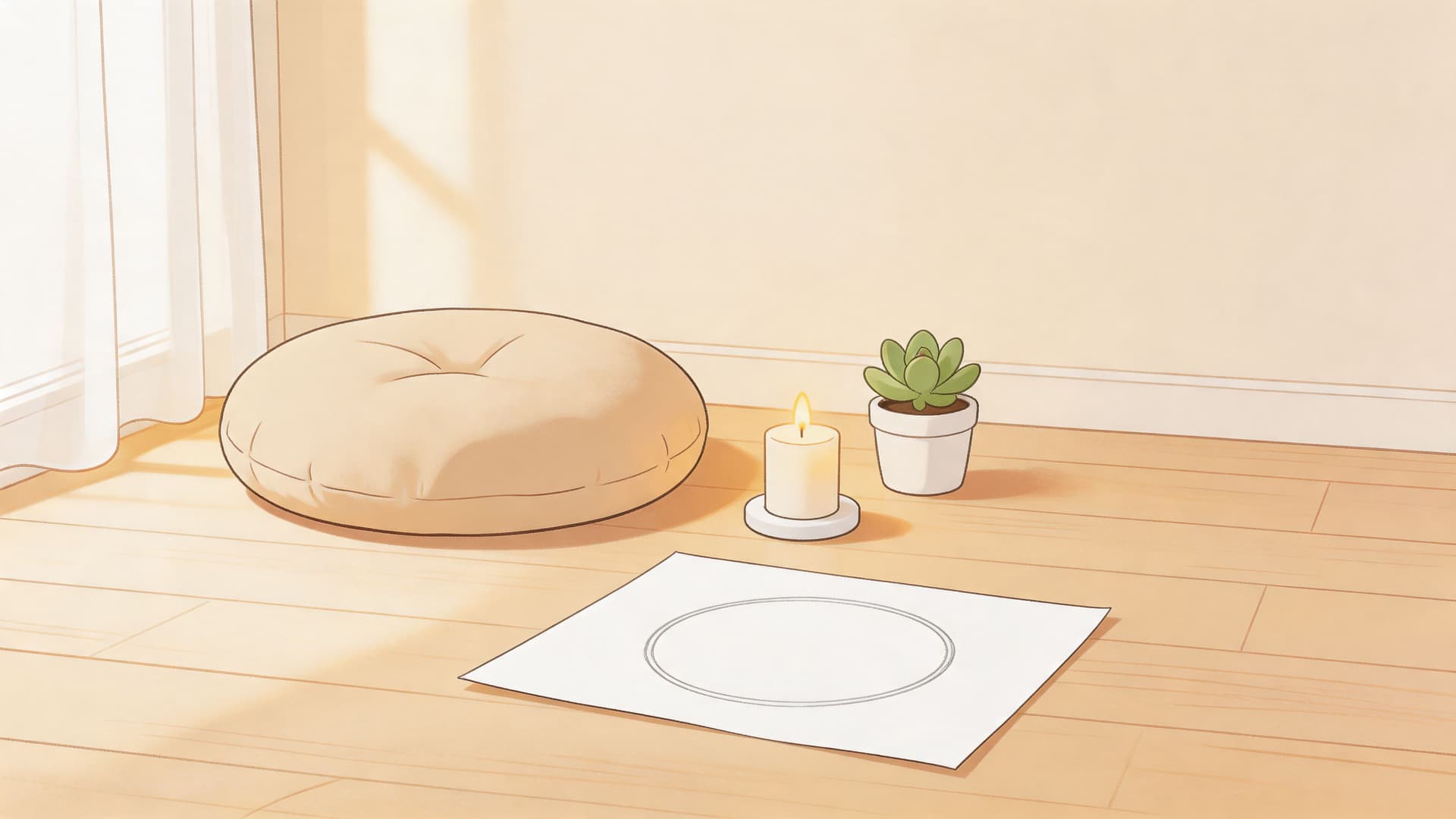
A simple ritual works better than an elaborate one. The point isn’t to create an Instagram-worthy altar. The point is to tell your nervous system, “We’re safe enough to pay attention now.”
Build a space that reduces friction
Choose a surface where your arm can move comfortably. Sit upright, but not stiffly. Keep only the tools you plan to use within reach. Too many materials can create unnecessary decision fatigue.
A practical setup often includes:
- Paper that can hold layers if you want to erase or build color gradually
- A graphite pencil and eraser for the initial structure
- Colored pencils or markers if you want control and clean edges
- Pastels or watercolor if you’re comfortable with looser, more emotional marks
- A compass, plate, or bowl for making the circle
If scent helps you settle, use it gently. Some people like a candle, incense, or plant ally as a transition into practice. If that’s part of your ritual, this guide on herbs for smudging offers grounded ideas for creating a cleansing atmosphere without turning the moment into a performance.
Prepare the inner space too
Mental preparation matters just as much as physical setup. I usually recommend entering mandala work with an intention, not an agenda. An intention is open-ended. An agenda tries to force a result.
Useful intentions sound like this:
- “I want to notice what I’m carrying.”
- “I want to create from steadiness rather than pressure.”
- “I want to give this grief a shape.”
Then do a short body scan. Start at the head and move to the feet. Notice where you’re bracing. Exhale and soften each area you can soften. Some practitioners use simple internal phrases such as “my jaw can unclench” or “my shoulders can drop.”
Let the body arrive before the pencil does. If the hand starts drawing before the breath slows, the mandala often mirrors the rush.
Why preparation deserves respect
This isn’t extra. It’s part of the therapeutic value.
A study on caregivers of children with special needs found that 16 hours of mandala art therapy significantly increased general comfort and resilience levels, showing how supportive this practice can be for people carrying chronic stress. If someone lives in a near-constant state of demand, the transition into art needs to be gentle and repeatable. Preparation creates that bridge.
What doesn’t help
Some habits make mandala sessions less effective:
| Common mistake | Better choice |
|---|---|
| Starting while multitasking | Give the practice even a short protected window |
| Using materials you dislike | Pick tools that feel pleasant and manageable |
| Forcing a spiritual mood | Enter honestly, even if you feel irritated or numb |
| Expecting insight immediately | Let the image speak after it’s made |
A good session doesn’t require serenity. It requires willingness.
Creating Your Mandala A Practitioner Guide
Once you’re settled, the drawing itself becomes a conversation between structure and intuition. During this interaction, many people either overcomplicate the process or become so loose that the mandala loses its holding power. The sweet spot sits in the middle.
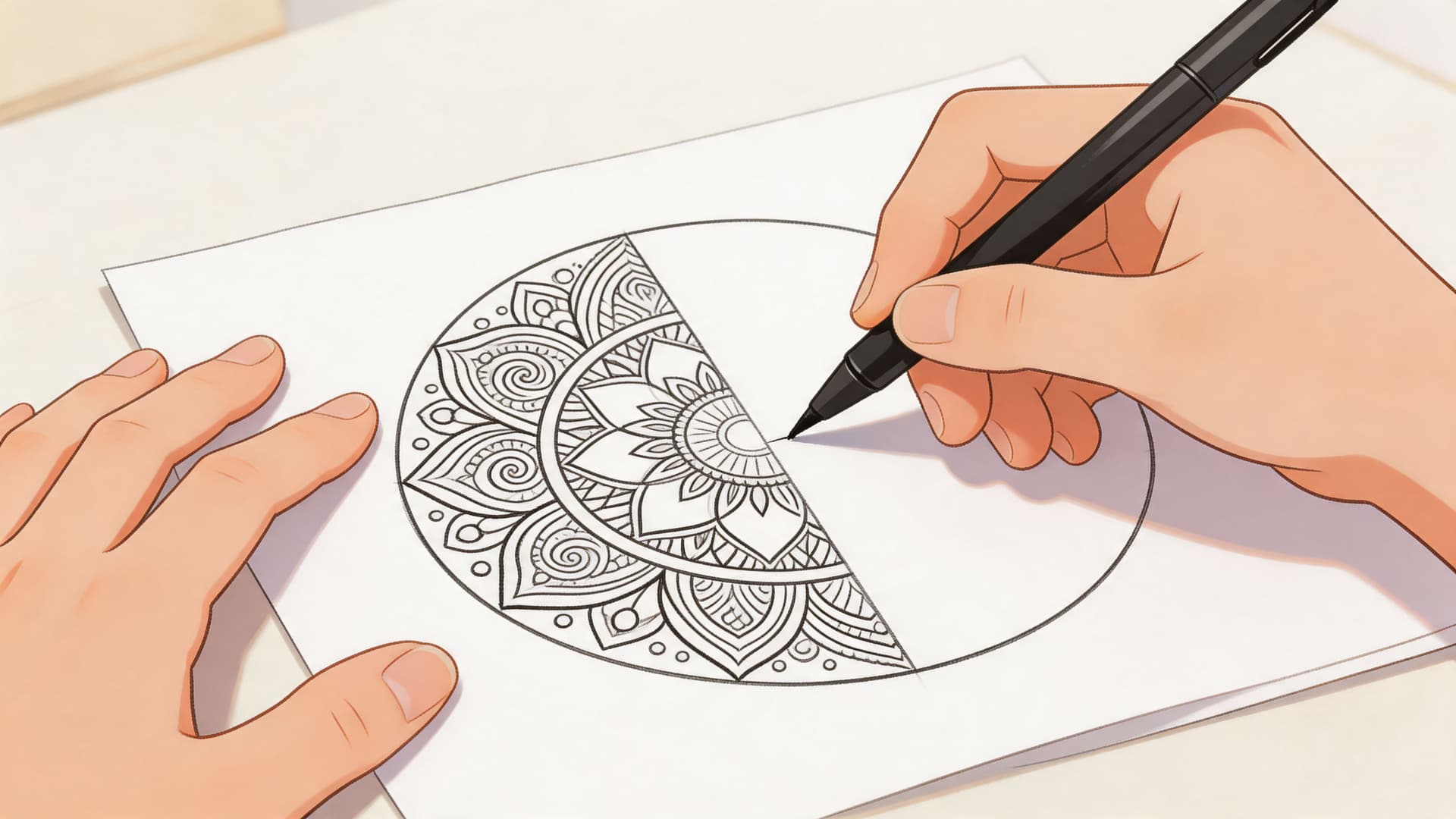
A precise method used in therapeutic and Jungian-informed settings involves drawing a central circle with a compass, dividing it into 6, 8, or 12 equal radial segments, and sketching repeating shapes from the center outward to support balance and symmetry, as described in this practical guide to making a mandala design for coloring and art therapy.
Start with the center
Begin by drawing your main circle. A compass gives clean accuracy, but a traced bowl or plate works perfectly well for home practice. Mark the center point lightly.
The center matters because it sets the relational tone of the whole image. Some centers feel open. Others feel dense, guarded, radiant, or unresolved. Don’t overthink that before you begin. Just notice what wants to happen there.
If you like to work with color symbolism before drawing, a chakra color chart can offer inspiration for emotional or energetic themes. Use it as a prompt, not a rulebook.
Create the underlying structure
Divide the circle into 6, 8, or 12 equal sections using light pencil lines. These lines are guides, not prison bars. Their job is to help you distribute energy across the page instead of dumping it into one corner.
A basic structure might include:
- A vertical and horizontal axis to orient the page
- Additional radial lines to create equal segments
- Concentric rings if you want more layers to work within
This is the stage where patience pays off. If the foundation is rushed, the whole mandala can start feeling cramped or uneven before you understand why.
Practical rule: Draw lightly at first. Heavy early lines make correction harder and often lock you into choices that don’t actually fit the emerging image.
Build the pattern from the inside out
Now begin adding forms. Work from the center outward rather than jumping randomly around the page. That progression usually creates a steadier experience and a clearer visual rhythm.
Common starting shapes include petals, dots, waves, triangles, leaves, circles, arches, and teardrops. Repeating a shape through each segment creates coherence. Changing one small thing at a time keeps the image alive without losing balance.
Here’s a useful way to think about the layers:
| Layer | What to focus on |
|---|---|
| Inner ring | Establish the emotional tone |
| Middle rings | Develop movement and relationship |
| Outer ring | Create containment and completion |
If you’re feeling frozen, choose one simple form and repeat it all the way around. Repetition often facilitates flow faster than inventing complexity.
Let symmetry support you, not control you
In mandala therapy art, symmetry usually helps because it gives the eye and body a sense of order. But perfect geometry isn’t the goal. Healing doesn’t depend on ruler-straight execution.
What matters is whether the pattern feels balanced enough to hold what you’re expressing.
There’s a difference between intentional variation and accidental collapse. If one side becomes visually much heavier than the rest, pause and ask whether that imbalance feels meaningful or merely rushed. Sometimes the answer is profound. Sometimes you just need to distribute the pattern more evenly.
Add color with restraint first
Color changes the emotional atmosphere fast. Start more lightly than you think you need to. You can always deepen a hue, but it’s harder to recover from pressing too hard too early.
A few guidelines help:
- Use light pressure first with pencils or markers so the page stays workable.
- Build depth gradually by layering similar tones.
- Repeat color in more than one place so the image feels integrated.
- Watch the center carefully. Strong color at the center changes the entire emotional gravity of the mandala.
Some people intuitively know their palette. Others need a prompt. If you don’t know where to begin, choose one color for how you feel now and one for what you need more of.
Know the common pitfalls
The cause of struggle is not a lack of talent. It is instead a result of falling into predictable traps.
One is rushing the symmetry. Another is over-darkening too soon. A third is trying to make the mandala look “spiritual” instead of letting it be honest.
These are the mistakes I see most often:
- Overfilling every space. Empty areas can breathe. Not every ring needs decoration.
- Changing tools too often. Constant switching interrupts rhythm.
- Erasing every imperfection. Too much correction pulls you out of contact with the process.
- Judging the image before it’s finished. Midway awkwardness is normal.
A useful check is to stop briefly every so often, put the pencil down, and look at the whole page from arm’s length. This helps you notice whether the mandala is expanding, tightening, or losing coherence.
When to stop
Finishing is part of the discipline. Many people keep adding because they’re afraid to meet what the image already says.
A mandala is often complete when the center, middle, and edge feel in relationship. It doesn’t have to be crowded or polished. It just has to feel held.
Sign and date it when you’re done. If you keep a mandala journal, number the pieces in sequence. Over time, the series can reveal themes you’d never catch from a single page.
The Mandala as a Mirror for Interpretation and Self-Reflection
The drawing isn’t finished when the coloring ends. The final phase is reflection. In this phase, mandala therapy art becomes more than a regulating activity and turns into a practice of self-discovery.
A useful interpretive method from sensorimotor art therapy is to rotate the mandala to find its “top,” give it an intuitive name, and look at its overall type, such as a fragmented core that may signal crisis or a radiating structure that may suggest transcendence, as discussed in this article on interpreting mandalas in sensorimotor art therapy.
First, let the image orient itself
Place the mandala in front of you and slowly rotate it. At some point, one direction usually feels more settled than the others. Mark that as the top. This small act matters because orientation changes meaning.
Then name the mandala quickly. Don’t workshop the title. The first true phrase is usually better than the clever one.
Names like “Holding Pattern,” “Soft Return,” “Walled Garden,” or “Too Much Fire” often reveal the emotional core faster than analysis does.
If you have to force the title, stop and listen again. The image usually knows what it’s called before the mind approves of the answer.
Look at structure before symbolism
People often rush to color meanings first, but structure usually tells the stronger story.
Ask yourself:
- Is the center open, dense, hidden, fractured, or radiant?
- Does the pattern move outward easily, or does it stall?
- Do the edges contain the image well, or do they feel weak?
- Is there tension between one area and another?
A fragmented center can reflect distress, disorganization, or a major life threshold. A radiating design may point to clarity, release, or spiritual openness. Strong boundaries can show healthy containment, but they can also show defensiveness. Interpretation works best when it stays curious rather than absolute.
Then consider symbols and recurring themes
Once the structure is clear, study the details. Spirals may suggest emergence or movement. Squares can imply order, stability, or the need for grounding. Triangles often bring energy, direction, or conflict depending on how they appear. Waves can signal feeling, change, or instability.
Color matters too, but context matters more. Red in one mandala may speak of vitality. In another, it may signal strain or anger. Blue may soothe one image and flatten another.
This is why I encourage people to ask not “What does this symbol mean universally?” but “What is it doing here, in this mandala, today?”
A bridge into life path reflection
This is also where readers interested in deeper self-inquiry sometimes notice a second layer. Certain numbers, shapes, and repeated themes recur across their mandalas over time. A person may repeatedly divide the circle into the same number of sections, favor the same directional movement, or return to the same tension between order and freedom.
That can be a useful opening into the life path system described in Dan Millman’s book The Life You Were Born to Live. Millman’s work gives language for core life themes, recurring lessons, and developmental patterns. Some people find that their mandalas reflect those themes visually before they can explain them conceptually.
If symbolic language is part of your path, this piece on powerful symbols with deep meanings can broaden the vocabulary you bring to reflection without forcing a fixed interpretation.
Reflective prompts for your mandala practice
| Focus Area | Prompt |
|---|---|
| Center | What does the center of this mandala seem to protect or reveal? |
| Boundaries | Do the edges feel safe, rigid, porous, or unfinished? |
| Repetition | Which shape or color keeps returning, and what might that repetition be asking for? |
| Emotion | What feeling became clearer while I was drawing? |
| Body response | Where in my body do I feel this mandala when I look at it now? |
| Life theme | Does this image echo a lesson or pattern I’ve been living recently? |
What interpretation should not become
Interpretation shouldn’t become self-judgment dressed up as insight. A chaotic mandala is not a personal failure. A sparse mandala is not proof that you did it wrong. The image records a moment in relationship with yourself. That’s all, and that’s plenty.
If you work with a therapist, coach, or spiritual director, sharing the mandala can deepen the dialogue. If you work alone, keep your notes simple and honest. Over time, patterns become visible. Not because the mandalas predict your life, but because they document how you move through it.
Integrating Mandalas into Your Spiritual Practice
A single mandala can calm an afternoon. A regular mandala practice can shape a whole season of inner work.
That’s where this art form becomes especially useful. It adapts well. You can use it as a morning check-in, a closing ritual after a difficult day, a visual prayer, or a way to track the emotional tone of a longer spiritual cycle. The flexibility is one of its strengths.
Ways practitioners and seekers actually use it
For personal practice, the simplest rhythm is often the best. Choose one recurring time and one recurring prompt. You might create a mandala each week around a question like “What wants steadiness now?” or “Where am I resisting change?”
For therapists, coaches, and group facilitators, mandalas work well as a nonverbal check-in tool. A client who can’t summarize their week may still be able to show its texture through shape, space, and color. Children often respond to the containment of the circle. Adults who think they’re “bad at art” usually relax once they understand there’s no realism required.
Useful applications include:
- Client check-ins that reveal state without requiring polished verbal insight
- Family or group practice where each person creates a separate mandala in shared silence
- Retreat integration as a way to process what surfaced during meditation, breathwork, or prayer
- Cycle reflection tied to personal seasons of growth and challenge
Pairing mandalas with spiritual retreat and renewal
Some people do their best mandala work at home. Others need distance from routine before they can hear themselves clearly. If you want to reset your environment and give this practice more room, it can help to plan your spiritual getaway somewhere designed for reflection, rest, and contemplative rhythm.
The important part isn’t travel itself. It’s uninterrupted attention.
Bringing in Dan Millman’s life path framework
If your spiritual practice includes symbolic self-study, mandalas pair naturally with the life path approach in Dan Millman’s The Life You Were Born to Live. Millman’s system looks at recurring lessons, gifts, and developmental themes across a lifetime. A mandala can become the visual counterpart to that work.
For example, some people create a mandala for their current nine-year cycle theme, then sit with the image during meditation through the month. Others make one when they feel stuck in a repeating pattern and want to see the pattern before trying to solve it.
This works well because mandalas don’t force a verbal answer. They reveal orientation. Sometimes that’s the deeper need.
A spiritual practice is more sustainable when it includes something the hands can do, not just something the mind is asked to understand.
Frequently Asked Questions About Mandala Therapy Art
Do I need to be artistic to do mandala therapy art
No. You need willingness, not drawing talent. Repeating simple shapes inside a circle is enough. The therapeutic value comes from attention, rhythm, and reflection.
Is coloring a printed mandala still helpful
Yes. It can be soothing and focusing, especially when you’re tired or overstimulated. Creating your own tends to reveal more about your inner state, but coloring still has value.
What if my mandala looks messy
That’s often useful information, not a failure. A messy mandala may reflect fatigue, urgency, grief, activation, or a need for less control. Don’t judge it too quickly.
How long should a session take
Long enough for you to arrive. Some sessions are brief and grounding. Others want more spaciousness. Consistency matters more than length.
Should I keep my mandalas
Usually, yes. Date them. Title them. Review them later. A series often tells a deeper story than a single image.
Can mandalas replace therapy
No. They can support therapy beautifully, but they aren’t a substitute for professional care when someone needs clinical help.
If you want to connect your mandala practice with a deeper system of self-inquiry, the Life Purpose App is a practical companion to Dan Millman’s The Life You Were Born to Live. It helps you explore your life path, recurring lessons, and nine-year cycles in a way that can bring added meaning to the symbols, patterns, and themes that show up in your art.
Discover Your Life Purpose Today!
Unlock your true potential and find your life’s purpose.
