Learn what manifestation of wealth really means, the evidence behind it, and practical techniques to align mindset with real financial action in 2026.
August 1, 2026 (6d ago)
Manifestation of Wealth: A Practical Guide to Real Results
Learn what manifestation of wealth really means, the evidence behind it, and practical techniques to align mindset with real financial action in 2026.
← Back to blog
Most advice about wealth manifestation gets the order backward. It tells you to think richer, feel richer, and wait for money to show up, even though the difference usually comes from what you notice, what you repeat, and what you do when money feels tight. That is why a serious conversation about manifestation of wealth has to respect both the spiritual impulse and the practical result, because mindset without structure can drift into wishful thinking.
Wealth does not appear in a vacuum. In the U.S., it has been shaped by asset ownership, policy, and long historical cycles, not just private optimism, and the concentration of wealth has changed dramatically over time. Saez and Zucman found that the share of wealth owned by the top 0.1% rose from 7% in 1978 to 22% in 2012 source PDF, which is a useful reminder that any honest wealth practice has to account for the system around you.
A grounded approach can still leave room for ritual, symbolism, and inward work. If a crystal tree or altar object helps you focus your attention, that can be part of the practice, and something like hand-selected feng shui crystals may serve as a visual anchor for intention. But the anchor is not the outcome. The outcome depends on what you do next.
Why Manifestation of Wealth Is Not What Most People Think
The biggest confusion is simple. People hear manifestation and think it means sitting still, repeating a phrase, and letting the universe do the rest. That version is too passive to build wealth, because wealth usually comes from habits that compound, like saving consistently, investing steadily, and refusing risky impulses when emotions run high.
A better way to think about manifestation of wealth is as a change in attention and behavior. You start noticing money leaks faster. You become more honest about spending. You follow through on the actions you keep postponing, even when you don't feel inspired. That does not make the practice less spiritual, it makes it more usable.
Practical rule: if a wealth practice never changes your calendar, your bank behavior, or your follow-through, it's probably entertainment, not a method.
The spiritual tradition matters here because it gives people language for hope, trust, and alignment. The skeptical view matters because it keeps you from confusing inner comfort with external proof. A ritual can calm your nervous system, but calming down is not the same thing as building assets. The article on abundance mindset makes a similar distinction between inner orientation and daily practice, and that distinction is what keeps this topic honest.
A strong practice can include a notebook, a quiet room, or even a symbolic object on a desk. It can also include reviewing bills, setting an auto-transfer, or deciding what not to buy. The point is not to strip away meaning, it's to connect meaning to action.
What Manifestation of Wealth Actually Means
At the everyday level, manifestation of wealth means using intention, visualization, gratitude, and affirmation to shape your financial behavior. People use it to stay focused on goals, to reduce panic, and to keep a better inner posture while they make money decisions. That's the practical face of the idea, and it's the only version that can be tested in real life.
At a deeper level, the practice is about cultivating sufficiency, clarity, and right action. In contemplative traditions, prosperity is rarely treated as a magic event that drops from nowhere. It is more like a field you prepare, a garden you tend, and a harvest that depends on conditions as much as desire. If the soil is ignored, the seed doesn't matter much.
A usable working definition
A practical definition is this. Wealth manifestation is a set of mental and emotional practices that help you think clearly about money, regulate fear, and behave in ways that support long-term financial health. That definition keeps the spiritual tone without pretending that a thought alone changes your account balance.
If a method helps you become calmer, clearer, and more consistent, it has value. If it asks you to ignore debt, ignore budgeting, or ignore reality, it's not wisdom.
Many people get tangled up here. They want the emotional lift of a money ritual, but they also want the discipline of a financial system. Those two things don't conflict. They work best together, like a compass and a map.
The Spiritual Model and the Psychological Model
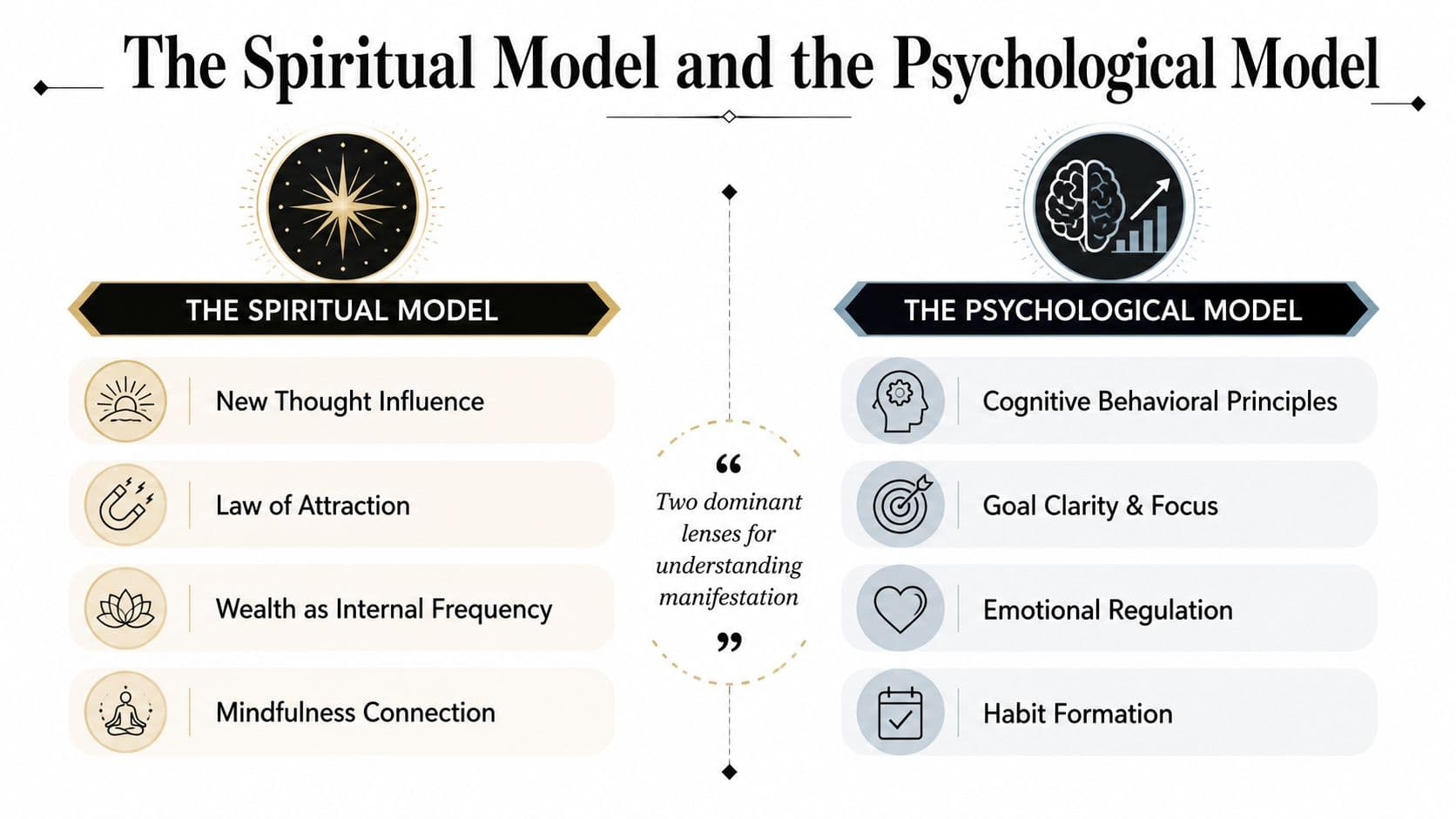
The spiritual model treats wealth as a sign of alignment. It uses words like vibration, frequency, abundance, and divine order because those words give shape to experiences that are hard to measure directly. For some readers, that language helps. It can make money stress feel less chaotic, and it can nudge a person toward gratitude, steadier attention, and better self-control.
The psychological model explains wealth through attention, self-efficacy, emotional regulation, and repeated behavior. It asks what people do after the feeling of inspiration fades. That includes how they respond to income, whether they follow a plan, and whether they keep their commitments when stress shows up. In that framework, visualization matters only if it leads to different choices in daily life.
These models overlap more than their supporters sometimes admit. Both care about focus. Both care about identity. Both care about the stories people tell themselves about what is possible. The difference is simple enough to miss at first. The spiritual model starts with meaning. The psychological model starts with mechanics.
What history adds to the picture
The long view matters because wealth has never been spread evenly. Saez and Zucman found that U.S. household wealth followed a long U-shaped pattern, with concentration high in the early 1900s, falling from 1929 to 1978, and then rising again from the 1980s onward. They also note that household wealth was about 400% of national income in the early 20th century before declining and then rebounding. That history puts a boundary around the conversation. Mindset lives inside structure. A person can be disciplined, hopeful, and spiritually grounded, and still face limits that come from the wider economy, family background, and timing. Serious practice has to hold both truths at once.
The strongest approach is to use symbolic language when it helps you focus, while keeping the behavioral side clear enough to measure. Tools that support action rather than replace it can fit, as long as they serve that purpose. The same logic applies if your aim is to build wealth and cut debt. The spiritual frame can give direction, and the psychological frame can keep you honest about what is changing.
Evidence-Based Techniques That Move the Needle
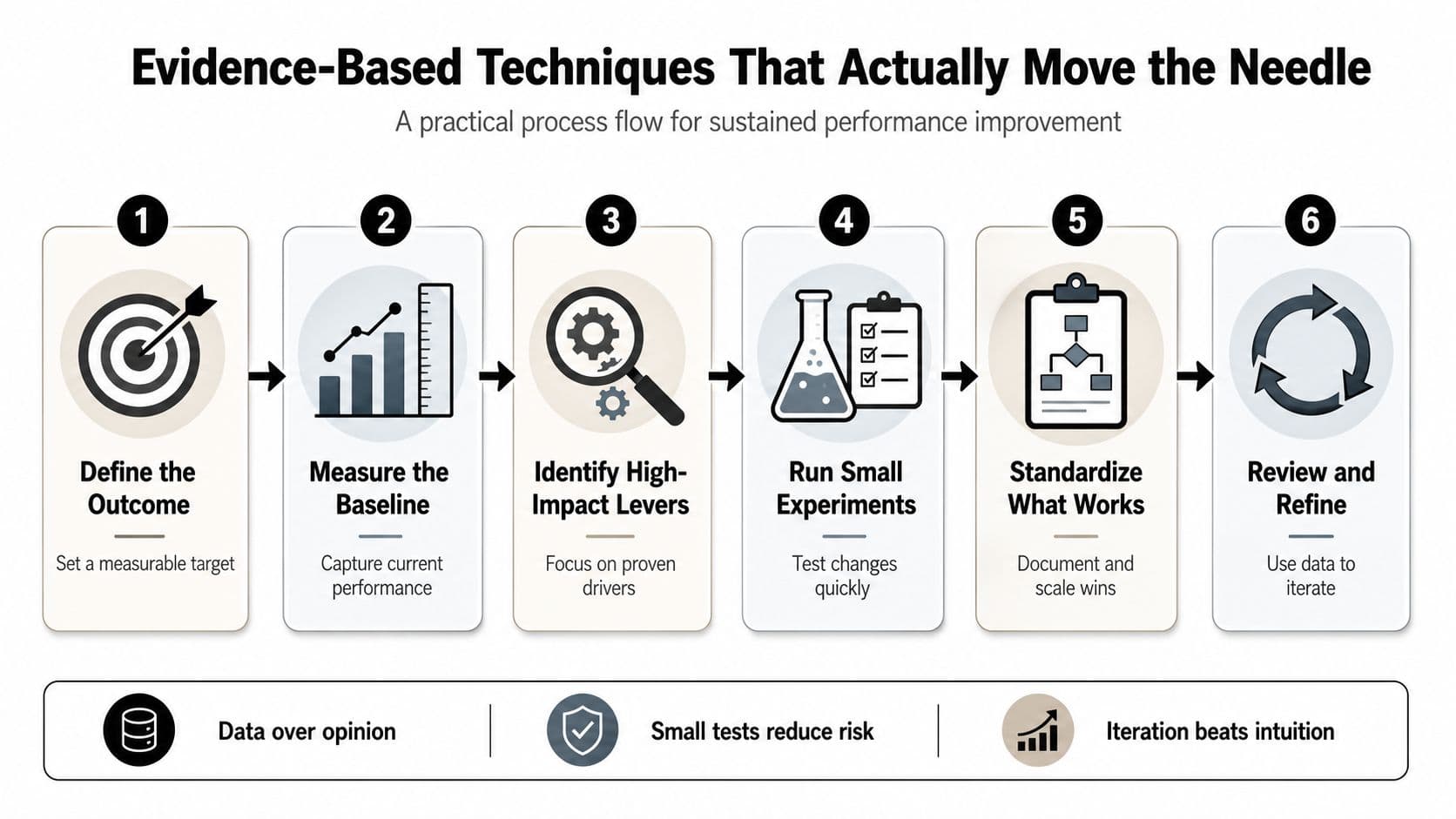
The most useful wealth practices are unglamorous. They look like goal setting, habit design, and follow-through. The language of manifestation can still be part of the process, but the engine is ordinary behavior, repeated until it becomes reliable.
Start with a specific financial target
A vague wish like I want more money is hard to act on. A specific goal gives the mind something concrete to work with, almost like setting the destination before you start driving. Independent guidance on money manifestation emphasizes that structure, a specific measurable goal with a deadline, plus implementation intentions and review manifestation and money. If the goal is to build a cash cushion, define the target and the date you want to reach it.
Use if-then plans
The practice becomes behavioral once it is tied to a trigger. The cleanest version is an implementation intention, an if-then rule linked to a real-life cue. For example, if income arrives, then a fixed amount moves to savings or investment before there is a chance to spend it. That is not mystical language, but it is a manifestation habit that changes outcomes by changing what happens next.
Review it once a week
A weekly check keeps intention from drifting. Ask whether the action happened, not whether inspiration showed up. If the transfer was skipped, money was spent impulsively, or the review was avoided, name it and adjust. Small feedback loops matter because they keep the practice connected to reality instead of to wishful thinking.
Add visualization that supports action
Visualization works better when it includes detail and emotion, not just an imaginary bank number. Picture yourself opening the account, making the transfer, or paying off a bill on time. Then tie that picture to a concrete action you can take within 24 hours.
For readers who want to align the inner side of the work with the outer side, such practices can sit alongside these steps, as long as they support action rather than replacing it. The same logic applies if your aim is to build wealth and cut debt. The spiritual frame gives direction, and the psychological frame keeps you honest about what is changing.
Real-World Scenarios Across Different Income Lives
Money practice changes when income changes. The method should flex with the person, not the other way around. A salaried employee and a freelancer may both use visualization, but they need different triggers, different reviews, and different financial guardrails.
A stable income makes consistency easier, but it also creates room for complacency. Irregular income creates more urgency, but it can also make planning feel chaotic. In both cases, the work is the same, which is to reduce confusion and turn intention into routine.
| Technique | Stable Income Scenario | Irregular Income Scenario |
|---|---|---|
| Visualization | Maya pictures her next automatic transfer and her debt balance moving down. | Jordan pictures a week where he invoices early and leaves money untouched when it lands. |
| Affirmation | Maya repeats a sentence about being consistent with long-term wealth. | Jordan repeats a sentence about staying calm even when cash flow is uneven. |
| Gratitude | Maya writes down one thing she's grateful for about her pay cycle and one financial habit she kept. | Jordan notes one payment he handled well and one expense he postponed on purpose. |
| If-then plan | If Maya gets paid, then her transfer happens first. | If Jordan receives a payment, then he separates operating money from personal spending money immediately. |
| Weekly review | Maya checks whether her saving habit happened without fail. | Jordan checks whether he protected his cash through the week and adjusted spending quickly. |
For someone with more assets or more complexity, professional estate planning advisors guidance may become relevant as part of the broader wealth picture. That doesn't replace manifestation practices, it grounds them in the realities of ownership, legacy, and coordination. The key is tone. Maya doesn't need to pretend she's broke. Jordan doesn't need to pretend his cash flow is predictable. Both can use manifestation language, but the words have to match the life they're living.
Aligning Manifestation With Your Life Path Number
Dan Millman's The Life You Were Born to Live describes 45 unique life paths, and the Life Purpose App draws on that system to surface a person's life path and the themes around money, gifts, and challenges Life Purpose App. That matters because a wealth practice lands differently depending on the patterns a person is working with.
A person whose path emphasizes creativity may need a wealth practice that supports scattered energy, pricing hesitation, or inconsistency. A person whose path emphasizes service may need to notice overgiving, undercharging, or guilt around receiving. A person whose path emphasizes leadership may need to examine control, urgency, or the pressure to carry everything alone. The number doesn't force a destiny, it sharpens attention.
Use the number as a mirror, not a script
The best use of a life path reading is honest self-observation. Read the money chapter and ask what sounds uncomfortably familiar. Then translate that insight into a practical money decision, like raising a rate, tracking expenses, or setting clearer boundaries. That's where spiritual self-knowledge becomes useful.
The financial numerology conversation can get fuzzy when people treat a number like a promise. The number gives you a language for recurring themes, and recurring themes can point you toward the money habits that need the most care.
A life path insight is useful only if it changes what you notice tomorrow morning.
The reason this fits the broader topic is simple. Manifestation works best when it personalizes attention. If your life pattern already leans toward avoidance, urgency, or self-doubt, the practice should not pretend that fact doesn't exist. It should help you meet it more directly.
Common Misconceptions and Costly Pitfalls
A lot of manifestation content sounds encouraging until money enters the picture. Then the weak spots show up fast. The largest mistake is treating thought as a substitute for behavior, which is how people end up feeling motivated and financially unchanged.
The myths that cause the most damage
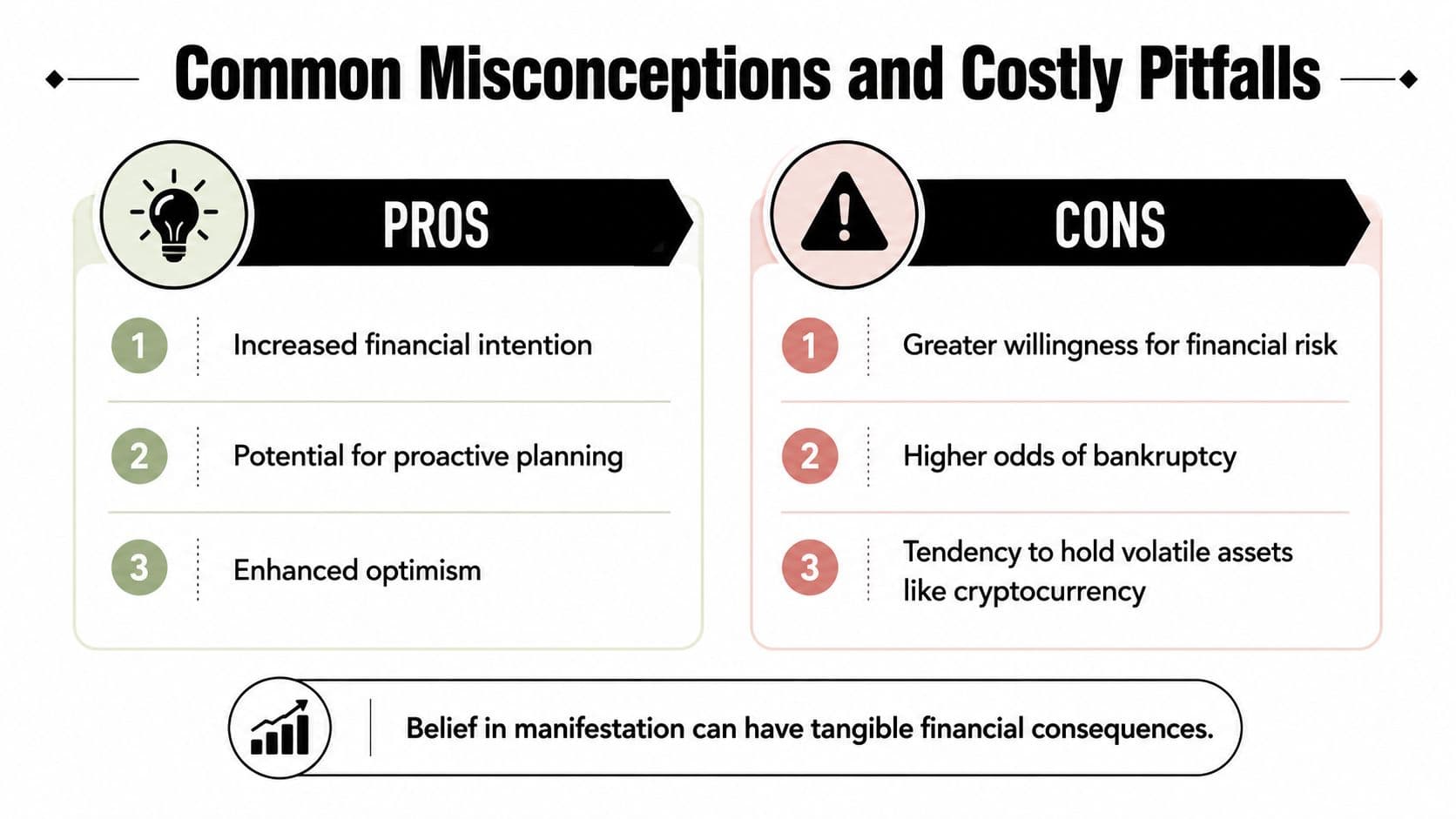
- Thinking alone produces wealth: Belief can support action, but belief by itself does not create financial success. A recent manifestation outcomes report found no objective evidence that manifestation leads to more money, and people who scored higher on manifestation were more likely to take financial risks.
- Debt means you failed spiritually: Debt can be painful, but it is still a financial condition that needs a plan, not shame. Shame tends to freeze people, while structure helps them move.
- Visualization should replace budgeting: Visualization can support discipline, but it cannot tell you what you spent or what you owe. A budget does that.
- More affirmations always mean better results: Repetition without behavior change can become emotional wallpaper. It feels good and changes little.
- A specific number guarantees the outcome: A target matters, but a target is not a contract with reality. Markets shift, jobs change, and life happens.
The same manifestation outcomes report linked higher manifestation scores with roughly 42% higher odds of having declared bankruptcy and about 33% higher odds of currently holding cryptocurrency for each one-unit increase on the manifestation scale. That does not prove causation, but it does explain why blind optimism is risky.
The practical correction is simple. Use manifestation to strengthen intention, then back it with saving, planning, and measured risk. If a method encourages reckless spending, dismisses debt, or treats volatile bets as spiritual courage, it is not a wealth practice. It is a gamble wearing a positive slogan.
A 90-Day Plan to Integrate Wealth Manifestation
A useful wealth practice should get simpler as you use it. Start by choosing one financial target and one spiritual anchor, then keep the system light enough that you can repeat it without burnout. The point is not to perform wealth, it's to train yourself into steadier behavior.
| Phase | Focus | Weekly Check |
|---|---|---|
| Days 1 to 30 | Define one financial goal, read the money chapter tied to your life path, and write one if-then plan. | Did I name the goal clearly and set the trigger? |
| Days 31 to 60 | Use a brief daily visualization, then track the actual action you took. | Did I do the action after the trigger appeared? |
| Days 61 to 90 | Review what moved, what stalled, and what felt performative instead of useful. | What should I keep, adjust, or stop? |
The easiest sentence to use this week is the one that ties feeling to action. If I receive income this Friday, then I automatically move ten percent into a separate account. That's a manifestation sentence, but it's also a financial behavior rule.
Keep the practice humble. If the ritual helps you act, keep it. If it doesn't, simplify it. Wealth grows more reliably from consistency than from intensity.
If you want a clearer way to connect your inner pattern to your financial decisions, the Life Purpose App can help you explore your life path and the money themes tied to it. It's a practical companion for readers who want spiritual insight without losing sight of real-world action. Visit it, read your path with honesty, and use that insight to shape one money decision you can make this week.
Discover Your Life Purpose Today!
Unlock your true potential and find your life’s purpose.
