Combine meditation and journaling to deepen self-awareness, reduce stress, and build a sustainable daily practice with practical prompts and a simple workflow.

January 27, 2026 (8mo ago) — last updated May 9, 2026 (5mo ago)
Meditation & Journaling for Self-Discovery
Combine meditation and journaling to deepen self-awareness, reduce stress, and build a sustainable practice with practical prompts and workflows.
← Back to blog
Combine meditation and journaling to deepen self-awareness, reduce stress, and build a sustainable daily practice with practical prompts and a simple workflow.
A Guide to Meditation & Journaling for Self-Discovery
Discover how the powerful combination of meditation and journaling can unlock deeper self-awareness. Learn a practical approach to building a lasting practice.
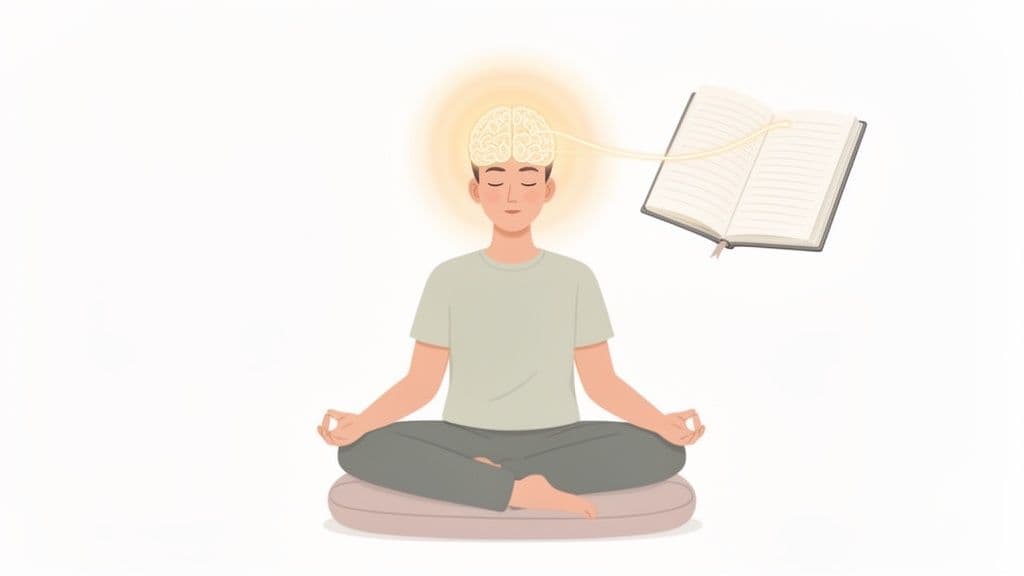
Pairing meditation and journaling is one of the most effective ways to fast-track self-discovery. Meditation quiets mental noise so deeper thoughts and feelings can surface, and journaling captures those insights so you can make sense of them. Reviews show meditation programs reduce psychological stress and improve well-being1, and expressive writing supports emotional processing and clarity2.
Think of the pair as a conversation with your truest self: meditation opens the line of communication and journaling records what you hear. Together they create a simple, repeatable path to personal growth.
The Power of Stillness and Reflection
Have you ever had a clear insight during a quiet moment, only for it to vanish before you could capture it? Meditation brings things up from the depths of awareness. Without a way to record them, those discoveries can drift away.
Your journal is the net.
Writing translates subtle, often abstract messages that arise in stillness into concrete words. With curiosity you can examine those notes, turning vague feelings into actionable ideas. That’s where real insight begins.
Why the Combination Works
Meditation and journaling create a feedback loop: meditation produces material for reflection, and journaling preserves it. Over time this loop builds self-knowledge you can return to and refine.
Benefits include:
- Mental clarity: meditation reduces mental clutter so you can write about what matters most.1
- Deeper self-understanding: journaling helps you ask “why?” and connect meditation insights to daily life.2
- Emotional release: putting heavy emotions on paper is cathartic and aids healthy processing.2
“Meditation opens the line to your truest self, and your journal is where you listen and respond.”
Bring Frameworks Into the Practice
To deepen the practice, add tools designed for self-knowledge. The Life Purpose App, based on Dan Millman’s book The Life You Were Born to Live, offers insights into strengths and recurring challenges so you can craft focused journaling prompts. For guidance on using meditation with self-discovery, see the Life Purpose App guide on meditation for self-discovery.
Finding the right environment also matters. Quiet, restorative settings support this work and help you go deeper. Interest in meditation and mindfulness has grown worldwide, with market and usage trends reflecting broad adoption across regions34.
Build a Simple, Sustainable Ritual
The best practice is the one you actually do. Don’t wait for perfect conditions or long stretches of silence. Create a ritual that supports you, not another chore.
Choose a consistent spot that signals your brain it’s time to tune in: a corner chair, a park bench, or even the parked car before work. Consistency beats intensity — a focused five-minute daily practice is more effective than an occasional long session.
A Practical Three-Part Workflow
This sequence works well for busy lives. The real benefit comes in the transition from stillness to writing, when the mind is calm and receptive.
- Set an intention: Ask, “What do I need from this time?” A brief intention gives gentle focus.
- A short sit: Meditate for a few minutes. A guided breath meditation or simply noticing the breath is enough; even two minutes can calm the nervous system.
- Smooth transition to journaling: Open your eyes slowly and write. Let your first thoughts spill onto the page without editing.
The most insightful notes often appear right after meditation, before the inner critic steps in.
Tools and Timing
Your setup can be very simple: something to sit on and a notebook or app. Physical notebooks offer a tactile connection; apps provide convenience, searchability, and security.
Try different times. A morning practice sets an intentional tone for the day; an evening session helps process events and release stress before sleep.
Examples:
- Morning ritual (10 minutes): 3 minutes breath awareness, 7 minutes journaling intentions and priorities.
- Weekly reflection (30 minutes): 10 minutes meditation, 20 minutes journaling about wins, challenges, and lessons.
Flexibility is key. Missed a day? Pick it back up tomorrow. The aim is a sustainable personal ritual.
Journaling Prompts for Deeper Self-Awareness

After meditation your mind is quieter and more receptive. Use prompts that go beneath surface-level summaries to uncover feelings, images, and nudges that often come through in stillness. Your journal is a judgment-free space for honest inquiry, helping you organize inner experience and cultivate emotional wellbeing2.
Prompts to Reveal Subconscious Patterns
- What feeling was just beneath the surface during my meditation? Where in my body did I feel it?
- A recurring image or thought came up today. What might it be trying to tell me?
- If my anxiety (or frustration, or joy) could speak right now, what would it say in one sentence?
Emotional hygiene like this clears mental clutter and creates space for insight.
Interest in these tools is rising worldwide, reflecting a larger shift toward prioritizing mental wellness and self-knowledge3.
Weaving Your Life Path Into Prompts
If you’ve used the Life Purpose App and know your life number from Dan Millman’s system, tailor prompts to your path’s themes. Personalization turns journaling into a targeted tool for growth.
Examples:
- Considering the core challenges of my life path, how did today’s meditation offer a new perspective?
- Which of my life path strengths did I lean on today? How can I use them more intentionally tomorrow?
- How does my current situation relate to the main themes of my life number?
When journaling aligns with your life path, insights become more relevant and actionable. For more prompts, see the Life Purpose App’s self-discovery journal prompts.
Sample Prompts by Intention
| Focus Area | Beginner Prompt | Life Purpose App Prompt |
|---|---|---|
| Gaining Clarity | What one thing is taking up the most space in my mind right now? Why? | How is my confusion related to a lesson my life path is asking me to learn? |
| Emotional Healing | If I could give my younger self one piece of advice about this feeling, what would it be? | In what ways does this wound hold me back from my life path’s strengths? |
| Finding Direction | What activity made me feel most alive this week? | How can I align daily actions with my life number’s purpose? |
| Cultivating Gratitude | Describe a small moment of peace or joy from today. | What aspect of my life path am I most grateful for, even if it challenges me? |
Use these as springboards and follow the threads that emerge.
Using Your Life Path to Guide Practice
While any meditation and journaling is beneficial, the practice becomes more powerful when it’s personal. The Life Purpose App helps you identify natural strengths and recurring challenges so your meditations and prompts focus on the themes that matter most.
Examples by path:
- Creativity path: Meditate to connect with creative energy, then journal about blocks and next steps.
- Leadership path: Meditate on grounded confidence, then journal about a leadership challenge.
- Cooperation path: Meditate on empathy, then journal about improving a relationship.
The app also breaks down cycles and themes you can use to shape meditations and journal questions. If you’re in a year of endings, your journaling might focus on what to release; at the start of a new cycle, it might focus on planting intentions.
For a guide to finding your life path number, see the Life Purpose App’s guide on finding life path number.
Overcoming Common Hurdles
Building a new habit isn’t a straight line. Expect days when meditation feels like a wrestling match and the journal stays blank. That’s normal.
When Your Mind Is Too Busy
Simplify to one anchor point. Try a sixty-second reset: set a timer for one minute, close your eyes, and focus on the breath. Label wandering thoughts as “thinking” and return to the breath. Each notice-and-return is progress.
When You Don’t Know What to Write
Lower the stakes. Try a five-minute brain dump: write everything that comes to mind, without editing. This clears clutter and often reveals the thread you need to explore.
Digital vs. Pen and Paper
Both work. Apps add convenience, search, and security; physical writing can slow you down and deepen the mind–body connection. Try both and choose what you’ll keep using.
Quick Q&A — Practical Answers
Q: How long should my session be?
A: Whatever you can do consistently. A useful starting point is 10 minutes — 3–5 minutes of meditation followed by 5–7 minutes of journaling.
Q: What if I feel nothing during meditation?
A: That’s normal. The practice is about noticing and returning attention. Benefits often show up in daily life, not always during the sit.
Q: Is it okay to use a journaling app?
A: Yes. Choose the tool you’ll use regularly. Apps offer convenience; pen and paper can feel more intentional.
Three Concise Q&A Sections
Q: How do I start when I'm short on time?
A: Use a two-minute breath anchor, then spend three minutes on a brain dump. Short, consistent practice builds momentum.
Q: How do I keep insights from fading after meditation?
A: Write immediately after your sit. Even a few quick bullet points preserve the thread you can explore later.
Q: How can I make journaling more focused?
A: Use a prompt tied to your intention or life path. Narrowing the question produces clearer, more actionable notes.
Ready to add a focused layer of personal insight to your practice? The Life Purpose App helps you understand your unique life path based on Dan Millman’s book, The Life You Were Born to Live, and offers prompts to guide your meditations and journaling. Find your purpose at the Life Purpose App website: https://lifepurposeapp.com.
1.
K. Goyal et al., “Meditation programs for psychological stress and well-being: a systematic review and meta-analysis,” JAMA Internal Medicine (2014). https://jamanetwork.com/journals/jamainternalmedicine/fullarticle/1809754
2.
Baikie and Wilhelm, “Emotional and physical health benefits of expressive writing,” Journal of Clinical Psychology (2005). https://www.ncbi.nlm.nih.gov/pmc/articles/PMC2443300/
3.
MarketDigits, “Meditation Market,” overview of adoption and usage trends. https://www.marketdigits.com/meditation-market
4.
Grand View Research, “Meditation Market Size, Share & Trends Analysis Report.” https://www.grandviewresearch.com/industry-analysis/meditation-market
Discover your life path today
Enter your date of birth and see your life path, free.
Find your life path