Discover how meditation for chakra balancing can align your energy. This guide offers practical meditations to help you find clarity, stability, and well-being.
March 8, 2026 (3d ago) — last updated March 9, 2026 (2d ago)
Your Guide to Meditation for Chakra Balancing
Discover how meditation for chakra balancing can align your energy. This guide offers practical meditations to help you find clarity, stability, and well-being.
← Back to blog
Chakra meditation is a powerful practice that lets you tune into your body's core energy centers. By using focused breathwork, visualization, and intention, you can bring your physical, emotional, and spiritual selves back into alignment, fostering a much deeper sense of self-awareness and inner peace.
What Are Chakras and How Do They Affect You?

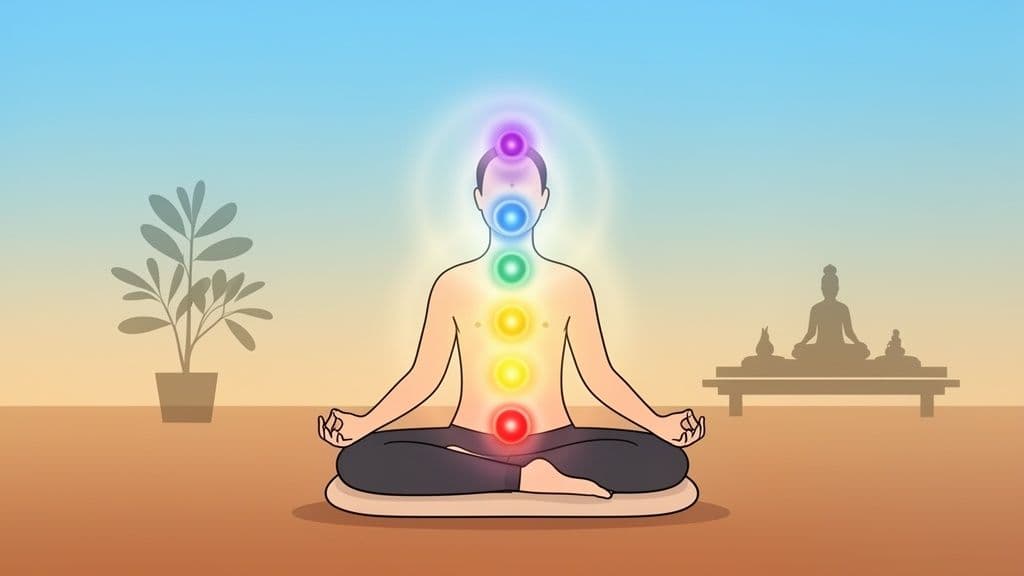
It’s helpful to think of chakras as a practical map to your inner world. Far from being just some abstract spiritual idea, the seven primary chakras are energy centers running along your spine, each one directly influencing a different aspect of your day-to-day life. This system gives you a tangible framework for understanding what's going on inside you.
This concept isn't new; it has incredibly deep historical roots. The earliest descriptions of these energy flows date back thousands of years, first appearing in ancient Indian scriptures like the Vedas around 1500-500 BCE. The seven-chakra system that's popular today was more fully detailed in the 16th century and eventually introduced to the Western world in 1919 through Sir John Woodroffe's translation of The Serpent Power.
The Seven Chakras at a Glance
To really get a handle on this, it helps to have a quick reference. This table breaks down each of the seven main chakras, showing you where they are and what parts of your life they're connected to.
| Chakra Name | Location | Associated With | Balanced State |
|---|---|---|---|
| Root (Muladhara) | Base of the spine | Security, survival, stability | Grounded, safe, secure |
| Sacral (Svadhisthana) | Lower abdomen | Creativity, pleasure, emotions | Creative, joyful, emotionally fluid |
| Solar Plexus (Manipura) | Upper abdomen | Personal power, self-esteem | Confident, self-assured, decisive |
| Heart (Anahata) | Center of the chest | Love, compassion, connection | Loving, empathetic, peaceful |
| Throat (Vishuddha) | Throat | Communication, self-expression | Expressive, clear, truthful |
| Third Eye (Ajna) | Between the eyebrows | Intuition, imagination, wisdom | Intuitive, insightful, clear-sighted |
| Crown (Sahasrara) | Top of the head | Spiritual connection, consciousness | Connected, blissful, aware |
Think of this as your personal energy blueprint. When a chakra is open and balanced, you feel its positive qualities shine through. When it's blocked or imbalanced, you might feel stuck in that specific area of your life.
Connecting Chakras to Your Everyday Life
Each chakra governs specific physical, emotional, and psychological functions. When they are humming along nicely, you feel centered and in flow. When one is out of sync, you'll likely notice it in very common, real-world struggles.
-
Root Chakra (Muladhara): This is your foundation—all about feeling secure and stable. If you're constantly worried about money or just feel disconnected and "floaty," your root chakra might need some attention.
-
Sacral Chakra (Svadhisthana): Found in the lower abdomen, this is your hub for creativity, pleasure, and emotional expression. Hitting a creative wall or feeling emotionally overwhelmed can often point to a blockage here.
-
Solar Plexus Chakra (Manipura): Located in your upper abdomen, this is your personal power center. A classic sign of an imbalanced solar plexus is a nagging lack of confidence or feeling like you have no control over your life.
This process of understanding your energy centers is a profound form of self-discovery. It’s not unlike the frameworks for self-understanding you might find in Dan Millman's book, “The Life You Were Born to Live,“ which helps you map out your innate strengths and life challenges, or the Life Purpose App.
By learning to recognize what's happening in these energy centers, you're gaining an incredible tool for self-awareness. You can start connecting physical sensations—like that lump in your throat before a difficult conversation—to a specific chakra (in this case, the throat chakra).
This guide will walk you through how to use chakra meditation to tune into these centers. The goal isn't to achieve some kind of spiritual perfection. It’s about using this ancient wisdom as a practical tool for finding more balance, clarity, and well-being in our very modern lives. For a deeper visual connection, you can also explore our guide on the chakra color chart.
Creating Your Personal Meditation Space
Before you even think about starting a chakra meditation, it’s worth taking a few moments to set up your space. This isn't about building a perfect, Instagram-worthy altar. It's simply about carving out a little pocket of the world that's just for you, signaling to your brain and body that it's time to quiet down and go inward.
Having a dedicated spot, no matter how tiny, can make a huge difference. It could be a specific corner of your bedroom, a comfy armchair, or even just the yoga mat you roll out each day. The real magic is in the consistency—returning to the same place helps build a powerful mental shortcut to relaxation and focus.
Designing Your Sanctuary
First things first, find a place where you're least likely to be interrupted. The goal isn’t total silence, which is often impossible, but rather a space where you can feel secure and at ease for your entire session.
Next, let's talk about posture. Forget any rigid ideas you have about the "right" way to meditate. Your comfort is what matters most.
- Sitting: You can sit cross-legged on a cushion or sit upright in a chair with your feet planted firmly on the floor. The key is to keep your spine comfortably straight, which allows energy to move freely.
- Lying Down: If sitting just isn't working for your back or hips, lying down is a fantastic option. A little tip: bend your knees and place your feet flat on the floor to help you stay awake and present.
Once you’re settled, setting an intention can be a real game-changer. This is just a simple, clear purpose for your practice. It might be something direct like, "My intention is to connect with my heart," or a broader feeling, like "I want to feel more grounded today."
This simple act of setting an intention is a powerful theme you see across many systems of self-discovery. It’s the same focused approach you’d use when exploring your unique life path with tools like Dan Millman's book, “The Life You Were Born to Live,” or the Life Purpose App. In all cases, focused self-inquiry is the key that unlocks deeper personal understanding.
Adding Sensory Elements
You can make your space feel even more special with a few sensory touches. For example, playing some gentle meditative music in the background can work wonders for quieting a busy mind and deepening your practice.
Many people, myself included, also find that clearing the energy of a room before meditating is incredibly helpful. You can learn more about this ancient practice by reading our guide on the different herbs for smudging and how to use them to prepare your environment.
Here's something that might help you relax and let go of getting everything "perfect." The popular rainbow color system we associate with chakras—red for the root, orange for the sacral, and so on—is actually a pretty modern invention. These colors were introduced by Western esotericists in the 1970s to make the concepts more visual and accessible. Early texts described the chakras without specific colors, focusing on other elements for spiritual growth instead.
Knowing this little piece of history can be freeing. It gives you permission to take a more intuitive and personal approach. This space is for you, so fill it with what makes you feel calm, centered, and ready to begin your journey inward.
A Practical Meditation for Each Chakra
Alright, this is where the theory meets practice. Let’s walk through a series of straightforward meditations, one for each of the seven chakras. Think of these not as rigid rules, but as invitations to connect with your own energy. You don't need any special experience—just a few quiet moments and the willingness to listen to what your body is telling you.
For each energy center, I'll guide you through the process. We'll use specific visualizations, simple breathing techniques, and the traditional bija (or seed) mantras that correspond to each chakra. The whole point is to make this practice feel natural and grounded, not abstract or out of reach.
Before you begin, setting the stage can make a world of difference. It’s less about creating a perfect "zen" space and more about giving yourself permission to focus inward.

Getting these three elements right—a quiet spot, a supportive posture, and a clear intention—builds a powerful container for your practice. It signals to your mind and body that it’s time to tune out the noise and go inward.
Root Chakra Meditation (Muladhara)
Your Root Chakra is your anchor. It connects you to the earth and provides a deep sense of security and stability. When you feel anxious, ungrounded, or worried about your fundamental needs, a Muladhara meditation can bring you back to solid ground.
Start by finding a comfortable seat, whether on a cushion or in a chair with both feet planted firmly on the floor. Let your spine grow tall without being rigid, and rest your hands gently on your knees.
Close your eyes. Start to deepen your breath, taking slow, deliberate inhales through your nose and releasing them with a soft sigh through your mouth. With every exhale, feel your body getting heavier, sinking into the support beneath you.
Visualization and Sensation: Draw your awareness to the very base of your spine—the perineum. Here, imagine a warm, spinning ball of ruby-red light. Feel its energy radiating downward, as if you're growing roots deep into the earth, anchoring you completely.
On your inhale, picture this red light glowing brighter. On your exhale, feel the sensation of stability spreading down through your hips, legs, and into your feet. Really sense the solid ground holding you. You are supported.
Breath and Mantra: As you continue this deep, even breath, you can begin to silently or softly chant the bija mantra LAM. Pronounce it like a long "lahm."
Feel the subtle vibration of the sound at the base of your spine. Let it reinforce that feeling of being grounded, safe, and fully present. Stay here for a few minutes, just breathing and being.
Sacral Chakra Meditation (Svadhisthana)
Moving up, we arrive at the Sacral Chakra, located in your lower abdomen, about two inches below your navel. This is your hub for creativity, emotion, and pleasure. If you're feeling uninspired, emotionally constipated, or just plain "stuck," this meditation can help get your energy flowing again.
Stay in your comfortable seat. Do a quick posture check—is your spine still long? Are your shoulders relaxed? You might turn your palms to face upward on your lap, a small gesture of openness and receptivity.
Bring your attention back to your breath, but this time, just observe it. Notice the gentle rise and fall of your lower belly as air moves in and out.
Visualization and Sensation: Shift your focus to your lower abdomen. Here, visualize a vibrant, warm orange light, swirling gently like water. This is the fluid, creative energy of your Sacral Chakra.
Imagine this orange glow expanding with each inhale, filling your entire pelvic bowl with warmth and vitality. As you exhale, consciously release any emotional tension or creative blocks you’re holding onto. Feel a sense of ease washing over you.
A Note on Feeling: Sometimes during a chakra meditation, you might not "feel" much at all, and that is perfectly fine. The practice is about bringing gentle, non-judgmental awareness to a part of your body. Consistency will always be more valuable than intensity.
Breath and Mantra: As you breathe into this space, you can introduce the mantra VAM (pronounced "vahm"). Feel the soft vibration of the sound in your lower belly, encouraging any stuck energy to move freely.
Allow yourself to connect with whatever emotions arise, without needing to label or fix them. This is an invitation to embrace your own inner world and creative impulses. Spend a few minutes here, just breathing into that warm, flowing energy.
Solar Plexus Chakra Meditation (Manipura)
Your Solar Plexus Chakra, or Manipura, sits in your upper abdomen, right above your navel. This is your power center, the seat of your self-esteem, willpower, and confidence. When you feel powerless or are wrestling with self-doubt, this meditation helps you reclaim your inner fire.
Remain seated, keeping your spine long and your shoulders drawn back slightly. You can even place your hands over your upper abdomen to create a direct physical connection to this energy center.
Take a deep breath in, and on the exhale, imagine releasing any feelings of inadequacy or self-criticism. Let your breath become steady and purposeful.
Visualization and Sensation: Bring your full awareness to your solar plexus. Picture a brilliant, radiant yellow light, like a small sun, glowing brightly within you. Feel its warmth and dynamic power emanating from your core.
With each inhale, see this golden-yellow light getting stronger and more vibrant. Feel it building a sense of purpose and self-assurance inside you. With each exhale, release the fears and doubts that hold you back.
Breath and Mantra: The bija mantra for the Solar Plexus is RAM (pronounced "rahm"). As you chant this, feel its potent vibration right in your center, stoking the fire of your personal will.
Imagine yourself standing tall, confident, and capable of meeting any challenge. Connect with the feeling of being the author of your own life. This practice is about owning your power, which can feel quite different from other self-discovery tools like exploring your innate path with Dan Millman's life numbers or the Life Purpose App. Those methods tell you about your path; this meditation helps you walk it with confidence.
Heart Chakra Meditation (Anahata)
Located right at the center of your chest, the Heart Chakra is the beautiful bridge between your lower, more physical chakras and your upper, more spiritual ones. It is the center of love, compassion, and connection. If you've been feeling resentful, isolated, or walled-off, an Anahata meditation can gently open you back up to love—for yourself and for others.
For this one, feel free to stay seated or lie down, whichever feels more open and expansive for your body. If you're seated, you might rest your hands over your heart.
Start with a few soft, easy breaths. Imagine you are breathing directly into and out of your heart space, softening any armor you’ve built around it.
Visualization and Sensation: Focus your attention on the center of your chest. From this spot, visualize a beautiful, glowing emerald green light expanding outward in all directions. This light is warm, gentle, and imbued with unconditional love.
With each inhale, feel this green light growing, filling your entire chest and radiating beyond your body. As you exhale, intentionally send this loving energy out into the space around you. Feel any tightness or pain in your chest beginning to dissolve.
Breath and Mantra: The mantra for the Heart Chakra is YAM (pronounced "yahm"). Chant this sound softly, and notice its gentle, airy vibration in your chest. Let it feel like a soothing balm for your heart.
Allow feelings of compassion, forgiveness, and gratitude to surface. You might bring to mind someone you love, a pet, or simply rest in the feeling of profound self-acceptance. Bathe in this gentle energy for as long as you like. This is your space for healing.
Focusing on a specific energy center is a practice found in many traditions. Ancient sound healers, for example, knew that certain frequencies could resonate with different parts of the body. Modern research has even shown how specific tones, like those from a gong, can create vibrations that affect us physically. Some believe the deeper tones help ground the lower chakras, while higher-pitched sounds can open the upper ones.
Bringing Chakra Awareness into Your Daily Life

The real magic of a meditation for chakra balance isn't confined to the 20 minutes you spend on the cushion. It’s what happens after—when you carry that awareness into your meetings, your conversations, and your quiet moments. This isn't about adding another "to-do" to your day. It's about learning to listen to your body's energetic language in real-time.
Think about it. Have you ever felt a tightness in your chest (Heart Chakra) when arguing with someone you love? Or that familiar flutter in your stomach (Solar Plexus Chakra) before a big presentation? These aren't just random physical quirks. They’re direct messages from your energy centers, telling you what's really going on beneath the surface.
Integrating Awareness into Action
Once you start recognizing these signals, you can respond with tiny, intentional shifts throughout your day. It’s like having a series of mini-conversations with yourself.
- Facing a tough conversation? Try taking three slow, deep breaths while consciously relaxing your throat and jaw. This small gesture brings loving attention to your Throat Chakra, helping you speak your truth with more clarity and compassion.
- Feeling anxious or scattered? Step outside for a short walk. Pay attention to the solid feeling of your feet hitting the pavement. This simple action grounds your Root Chakra and can instantly soothe feelings of instability.
- Stuck in a creative rut? Gently place a hand on your lower belly, just below the navel, and breathe into that space. This gentle touch and focused breath can help stir the creative, flowing energy of your Sacral Chakra.
These moments of mindfulness are what bridge the gap between your meditation practice and your actual life. If you want to go deeper, our guide on how to practice mindfulness offers some great starting points.
Connecting Chakra Work to Your Life Path
This daily awareness gets even more potent when you connect it to your personal growth journey. For instance, you might be working with insights from a tool like the Life Purpose App or a book like Dan Millman's "The Life You Were Born to Live."
Maybe your life path points to a core challenge around self-expression. With that knowledge, you can intentionally direct your awareness and meditation practice toward your Throat Chakra. This creates a beautiful synergy where your spiritual practice is directly fueling your real-world growth.
This transforms meditation from a passive, relaxing activity into an active tool for self-development. You’re no longer just "clearing" your chakras; you're consciously working with your energy to overcome real challenges and step more fully into your gifts.
And this isn't just theory—the benefits are well-documented. Modern research into meditation, which really took off in the 1950s, has produced thousands of studies. One landmark 8-week mindfulness program revealed measurable growth in brain regions tied to memory, empathy, and emotional regulation. Other research shows consistent practice can reduce stress hormones by up to 20-30% and improve focus by 16%. You can dive into some of this research yourself over at the National Center for Biotechnology Information.
Even ten minutes a day spent on a meditation for chakra alignment can make a world of difference in how you manage your emotions and focus your mind. It’s proof that small, consistent efforts truly do create the most profound shifts.
Noticing Your Progress and Deepening Your Practice
So you’ve been doing the work, sitting for your chakra meditations. But how do you know if it’s actually working? It’s a common question, and a good one. We often expect some kind of sudden, dramatic breakthrough, but the truth is, real progress is usually far more quiet.
The signs that your energy is shifting don't typically show up as flashes of light or grand epiphanies on the cushion. Instead, they unfold in the small, tangible moments of your everyday life.
Tracking Your Inner Shifts
Think of it less like a final exam and more like learning a new language—the language of your own body and energy. The best way to become fluent is to pay attention. This is where journaling comes in, and it's a non-negotiable for me and many people on this path.
You don't need to write a novel. Just a few notes after your meditation or at the end of the day can reveal incredible patterns. You start to connect the dots between your inner work and your outer world.
Try jotting down answers to these questions:
- Mood & Emotions: What was my emotional baseline today? Did I find a bit more patience in traffic? Did I feel a wave of anxiety, and if so, where did I feel it in my body? Was joy a little easier to access?
- Communication: Did I speak up in that meeting when I normally would have stayed silent? Did I feel like my partner actually heard me today? (A clear sign of a happy Throat Chakra)
- Creativity & Joy: Was I struck by a new idea out of the blue? Did I actually enjoy washing the dishes instead of just going through the motions? (Hello, Sacral Chakra!)
- Security & Grounding: How solid did I feel on my feet today, literally and figuratively? Was I less worried about that looming deadline and more focused on the present moment? (That’s your Root Chakra talking.)
Keeping a journal creates a powerful feedback loop. You’re not just meditating into a void; you’re actively gathering the data that proves your efforts are making a difference. The simple act of observing is the practice.
This kind of self-inquiry is really what all spiritual development is about. It's the same principle behind tools like Dan Millman's book, "The Life You Were Born to Live," or the Life Purpose App. You're looking for themes and insights to guide you. Journaling about your chakra work applies that same process to your energetic health.
Keeping Your Practice Fresh and Alive
Here’s a secret that takes most people years to learn: consistency trumps intensity, every single time. A beautiful, hour-long meditation once a month simply can’t compete with five dedicated minutes every single day. The goal is to build a sustainable habit that can bend and flex with the realities of your life.
On days when you feel totally swamped, try a "chakra check-in." All it takes is one minute. Seriously. Just close your eyes, take three deep, intentional breaths, and mentally scan your body from your feet to your head. Where’s the tension? Where do you feel open and at ease? Send your next breath to a spot that feels tight. That's it. It’s a potent little reset button you can press anytime.
As you get more comfortable, you can start to play with other senses. Sound, for example, has a profound effect on our energy centers. Sound healers have known this for centuries. The deep, resonant vibrations of a gong, for instance, are incredible for grounding the lower chakras. You can learn more about the science and art of using sound for energy work on sites like Olli Hess.
Ultimately, your chakra meditation practice should feel less like a chore and more like a lifelong conversation with yourself. It's a relationship that will ebb and flow, deepen over time, and continuously guide you back to a more centered, authentic, and vibrant way of being.
Common Questions About Chakra Meditation
When you first dip your toes into meditation for chakra work, it's natural for a bunch of questions to surface. It can feel a little abstract at first, but don't worry—that's part of the process. Let's walk through some of the most common uncertainties I hear, so you can move forward with more confidence.
A lot of people get stuck right at the beginning, wondering, "How am I supposed to know which chakra is blocked?" Honestly, you don't need a special power for this. It’s all about learning to tune into the signals your body and emotions are already sending.
Think of it as gentle self-inquiry. Do you feel a knot in your stomach before a big presentation? That could be your Solar Plexus. Do you often feel disconnected or lonely, even when you're with people? Your Heart Chakra might be calling for attention. It’s not about diagnosing a problem, but simply noticing where your energy feels stuck.
What If I Don't Feel Anything?
This is the big one. I get emails all the time from people saying, "I'm doing the meditations, I'm visualizing the colors, but I don't feel anything! Am I doing it wrong?" Absolutely not. Feeling a massive, cinematic rush of energy is incredibly rare, especially when you're just starting.
The real point of chakra meditation isn't to create a fireworks show in your body. It's about bringing your gentle, focused awareness to a specific energy center. That act of paying attention—of just being present with that part of yourself—is the practice.
Your mind and body are learning a new language together. Some days, you might feel a distinct warmth, a subtle hum, or a tingling sensation. Other days, you might feel nothing at all. Both are perfectly fine. The real work is in showing up without being attached to a specific feeling or outcome.
Trust me, consistency is so much more valuable than intensity. The shifts are subtle and they build over time. You won't necessarily have a huge epiphany on the cushion; instead, you'll notice you're a little more patient in traffic, you feel more grounded during a tough conversation, or creative ideas start showing up out of nowhere.
How Often Should I Practice?
So, what’s the magic number for practice frequency? How often do you need to do this to "get results"? The best schedule is the one you can actually stick with. Forget the pressure to meditate for an hour every single day. For most people, that’s just a recipe for burnout.
Start small. I mean it. Even five minutes a day of focused chakra work can be incredibly powerful. The goal is to build a sustainable habit. A short, consistent daily practice will always beat a long, infrequent one.
Here are a few ways to fit it into your real life:
- The Daily Scan: Spend a few minutes each morning scanning your energy body and sending your breath to any spot that feels a little "off" or tight.
- The Weekly Deep Dive: Dedicate a full week to one chakra. Do a slightly longer meditation (maybe 10-15 minutes) for that specific center each day and see what you notice.
- The "As-Needed" Tool: When a specific feeling pops up—like a bout of anxiety (Root Chakra) or a creative block (Sacral Chakra)—use the corresponding meditation as a direct response.
This is a deeply personal journey of self-discovery. It reminds me of the work you do when exploring systems like the one in Dan Millman's book, “The Life You Were Born to Live,“ or using the Life Purpose App. Both are frameworks that reveal profound insights, but they require your consistent, gentle attention over time to unlock their full potential.
The journey into your energetic self is a rewarding one. To gain even deeper clarity on your life's core purpose and challenges, consider exploring the Life Purpose App. It's a powerful companion for anyone on a path of self-discovery, offering insights that can perfectly complement your meditation practice. Discover your life path today.
Discover Your Life Purpose Today!
Unlock your true potential and find your life’s purpose.