Discover the mind-body connection. Learn how thoughts impact your health and get practical strategies to strengthen this link for a purposeful life.
July 18, 2026 (1mo ago)
Mind-Body Connection: Boost Health & Life Purpose
Discover the mind-body connection. Learn how thoughts impact your health and get practical strategies to strengthen this link for a purposeful life.
← Back to blog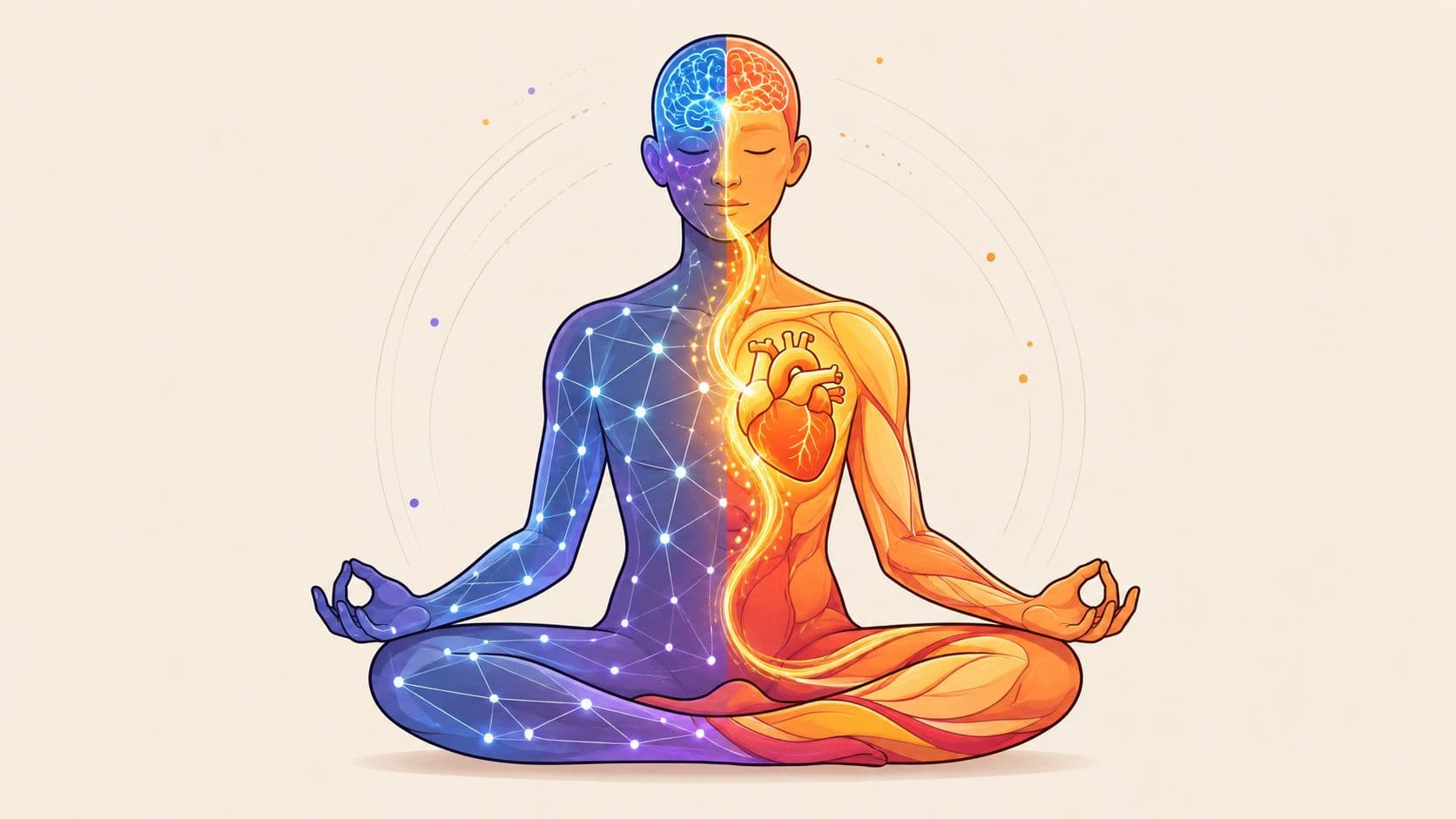
You know this connection already, even if you've never called it the mind-body connection.
It shows up when your stomach tightens before a hard conversation. When your shoulders creep upward during a stressful workday. When a grief-heavy season leaves you tired in your bones, or when one peaceful walk clears your head enough that your whole body seems to exhale.
Many don't require proof that the mind affects the body. They need help understanding how it works, why it happens so fast, and what to do with that knowledge in daily life. They also need reassurance that this isn't just vague wellness language. It's a real biological process.
Ancient healing traditions have treated mind, body, and spirit as inseparable for a long time. Modern neuroscience is catching up. What matters for you is simple. Your thoughts, emotions, attention, habits, and relationships are not floating above your physical life. They are part of it.
Your Body Is Always Listening
Think about the last time you had to do something emotionally loaded. Maybe you opened an email that changed your plans. Maybe you were waiting for a medical result, stepping into a difficult family visit, or preparing for an interview. Before your mind found the words, your body probably reacted first.
Your pulse shifted. Your jaw tightened. Your breathing got shallow. Maybe your appetite disappeared, or maybe all you wanted was comfort food and sleep. That's not weakness, and it's not “just in your head.” It's your system responding exactly the way a connected system does.
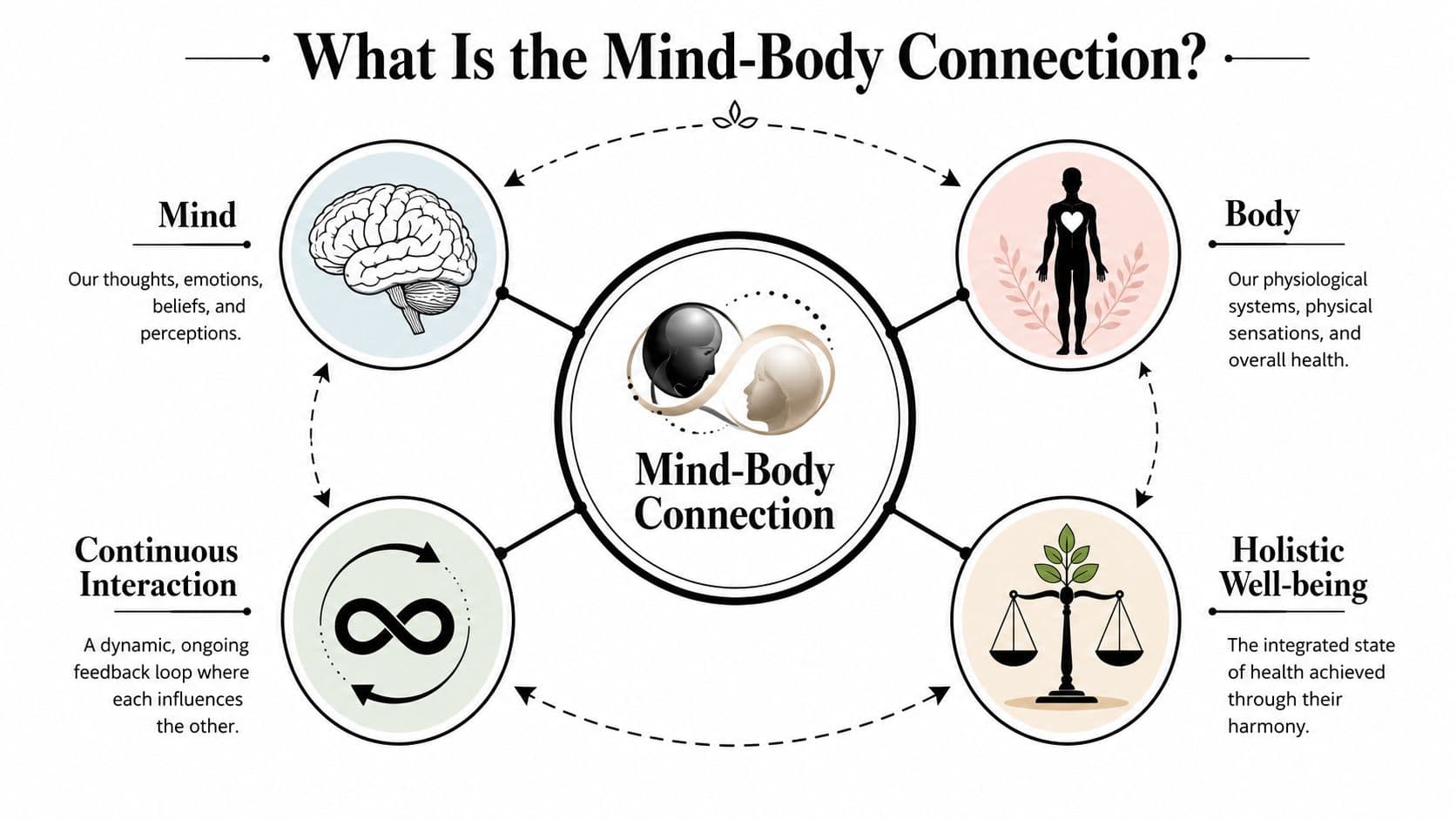
The mind-body connection means your thoughts, emotions, beliefs, and memories are in constant conversation with your physical state. That conversation isn't occasional. It runs all day. The body sends signals upward through sensation, tension, fatigue, pain, and ease. The mind sends signals downward through interpretation, expectation, fear, hope, and attention.
Everyday signs people often dismiss
A lot of common experiences make more sense when you stop separating mind from body.
- Stress headaches often arrive after emotional overload, not just screen time.
- Digestive discomfort can flare when you feel unsafe, rushed, or conflicted.
- Muscle tension may reflect unspoken frustration as much as poor posture.
- Exhaustion sometimes comes from emotional vigilance, even when you've technically rested.
Your body often says what your conscious mind hasn't admitted yet.
That's why body awareness matters. If you're used to pushing through discomfort, start smaller. Notice what happens in your chest when you say yes but mean no. Notice what happens in your stomach when you feel pressured to perform. If you want a gentle place to begin, this reflection on how to listen to your body offers a useful starting point.
What Is the Mind-Body Connection Really
The cleanest definition is this. The mind-body connection is a two-way communication system between your brain, nervous system, hormones, immune responses, physical sensations, and conscious experience. Your body affects your mental state, and your mental state affects your body.
That's why a calm breath can settle racing thoughts, and a fearful thought can make your heart pound. It's not metaphor. It's physiology.
It's built into the brain
One reason this topic feels more concrete today is that brain research has identified a structural network linking mental and physical processes. The brain contains a literal, structural linkage between mind and body called the Somato-Cognitive Action Network, or SCAN, which connects motor-control areas directly to networks governing thinking, planning, and involuntary functions like heartbeat and blood pressure, showing that the connection is built into brain architecture rather than being just an abstraction, as described by Washington University School of Medicine.
That finding matters because it challenges an old habit of thinking. Many of us were taught, directly or indirectly, that the mind is one thing and the body is another. SCAN points in the opposite direction. Thinking, sensing, moving, and regulating aren't isolated jobs. They overlap.
What that means in real life
If your body and mind are intertwined at the level of brain structure, then everyday self-care changes too. Movement isn't only for muscles. Thought patterns aren't only “mental.” Breath isn't only automatic. Each can influence the others.
A simple way to picture it is to think of one shared control room rather than separate departments. Fear can affect blood pressure. A sense of safety can soften muscle guarding. Intention can alter posture, and posture can alter mood.
For readers who want another grounded explanation, Ben's guide to total well-being offers a helpful companion perspective on how emotional and physical health shape each other.
Key idea: You do not have a mind on one side and a body on the other. You are one integrated system.
The Science Behind the Bridge
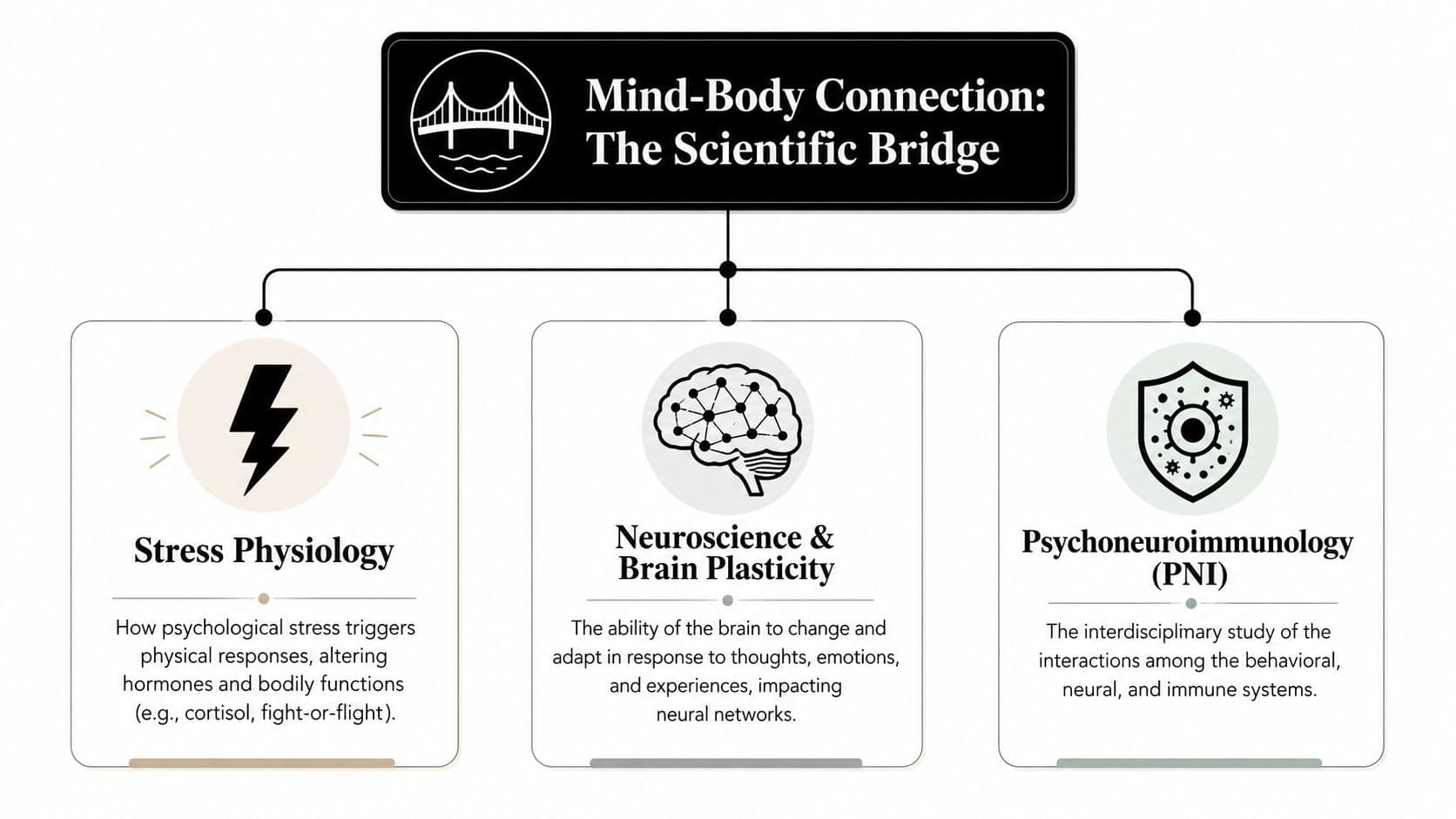
If the mind-body connection is real, how does the signal travel? Three ideas make it easier to understand. Stress physiology explains how the body reacts to perceived threat. Psychoneuroimmunology looks at how mental and emotional states influence immune function. Neuroplasticity explains how practice changes the brain over time.
Stress physiology in plain language
Your body has a fast-response alarm system. One major part of that system is the Hypothalamic-Pituitary-Adrenal axis, usually shortened to the HPA axis. When you perceive stress, this system helps your body mobilize energy and prepare for action.
That response can be useful in short bursts. The trouble starts when stress becomes chronic. Chronic psychological stress can dysregulate the HPA axis and contribute to increased pro-inflammatory cytokines, linking mental states to physical illness processes such as heart disease, type 2 diabetes, and cancer, as explained by the Mayo Clinic Press discussion of the mind-body connection.
That's a lot of terminology, so here's the simpler version. Repeated stress tells the body to stay on alert. Over time, that can disrupt sleep, strain recovery, and make inflammation harder to regulate.
The immune system is listening too
Psychoneuroimmunology offers a useful perspective. The name sounds technical, but the idea is straightforward. It studies how the mind, nervous system, and immune system affect one another.
Clinical research summarized in the Journal of the American Board of Family Practice found that mind-body therapies had a moderate positive effect on pain intensity, with an effect size of 0.62 (95% confidence interval 0.25–0.98) compared with wait-list controls or usual medical care, and high-quality randomized trials still showed benefits for pain and functional status (effect size = 0.35) and behavioral outcomes (effect size = 0.40) in the aggregated data reviewed in this article on mind-body medicine.
You don't need to memorize those figures. The practical takeaway is that mental and emotional interventions can create measurable physical effects.
If you've ever noticed that certain feelings seem to settle in particular areas of the body, tools like an organ-emotion chart can offer a reflective framework for noticing patterns, even though they shouldn't replace medical care or diagnosis.
The brain changes with practice
The third pillar is neuroplasticity, meaning the brain can change in response to experience and training. This understanding often instills hope, as it signifies that individuals are not perpetually bound to a single default pattern.
A 2023 meta-analysis of 24 neuroimaging studies confirmed that mind-body exercises changed resting-state brain activity by modulating attention networks, and the duration of practice was directly correlated with neural enhancement, showing that sustained engagement can physically rewire brain architecture, according to Scientific Reports.
That matters because self-regulation is trainable. Attention is trainable. Emotional steadiness is trainable.
For readers curious about one specific nervous-system-oriented approach, this article on understand limbic system retraining gives additional context for how repeated practice may influence threat responses and regulation patterns.
A stressed mind doesn't stay in the mind. It becomes chemistry, tension, habit, and physiology.
Practical Ways to Strengthen Your Connection
You don't need a total life overhaul to improve your mind-body connection. You need repeatable practices that help your system notice, regulate, and recover. Start with the method that feels most doable, not the one that sounds the most impressive.
Mindfulness and meditation
Mindfulness trains attention. Instead of getting swept away by every thought or sensation, you learn to notice what's happening without immediately reacting to it. That pause changes a lot.
Randomized controlled trials show that as few as 10 hours of mindfulness training can increase the volume of brain regions associated with self-awareness and emotional regulation, according to this summary of mind-body connection science. That's encouraging because it gives people a realistic entry point.
Try this first. Sit for five minutes. Notice your breath without trying to perfect it. When your mind wanders, return to the sensation of breathing. The skill isn't “empty mind.” The skill is return.
Breathwork and downshifting
Breath is one of the fastest ways to influence your internal state because it sits at the border of automatic and conscious function. You breathe without thinking, but you can also guide the breath deliberately.
Use breathwork when you feel activated, scattered, or emotionally flooded. Start with a longer exhale than inhale. Don't force it. The point is signaling safety, not winning a breathing contest.
Practical rule: If a technique makes you feel more panicked, dizzy, or shut down, make it gentler or stop. Regulation should feel supportive, not punishing.
Conscious movement and somatic awareness
Yoga, tai chi, walking meditation, and slow mobility work can help reconnect attention to sensation. This is useful for people who live mostly from the neck up. Movement gives the body a voice.
Somatic practices are less about performance and more about tracking experience. Where do you brace? Where do you collapse? What changes when you soften your jaw, unclench your hands, or stand with both feet grounded?
People dealing with work strain often need very practical recovery tools. If your nervous system feels fried by constant screens and blurred work-life boundaries, these effective ways to fight remote burnout can complement mind-body practices well.
Journaling and emotional processing
Some stress stays active because it has no place to go. Journaling helps move experience from vague internal pressure into language. Once feelings are named, they often become more workable.
Try one of these prompts:
- Body check prompt Write, “Right now my body feels...” and list sensations before thoughts.
- Emotion prompt Ask, “What feeling am I avoiding?”
- Needs prompt Finish the sentence, “What I need but haven't admitted is...”
Mind-Body Practices at a Glance
| Practice | Primary Focus | Key Benefit |
|---|---|---|
| Mindfulness meditation | Attention and awareness | Better self-observation and emotional regulation |
| Breathwork | Nervous system regulation | Faster calming and grounding |
| Yoga or tai chi | Mindful movement | Greater body awareness and tension release |
| Somatic tracking | Sensation awareness | Earlier recognition of stress signals |
| Journaling | Emotional processing | More clarity and less inner buildup |
| Walking in silence | Rhythm and settling | Gentle integration for busy minds |
How to choose the right starting point
Don't choose based on what looks spiritual or disciplined. Choose based on what your system can trust.
- If you're mentally busy start with walking, yoga, or breath.
- If you're emotionally flooded use short grounding and simple journaling.
- If you feel numb or disconnected try somatic awareness before long meditation.
- If you're highly self-critical pick the gentlest option and do less than you think you should.
Consistency matters more than intensity. A small daily practice teaches your body that connection is safe.
Connecting Your Mind Body and Life Purpose
For some people, general wellness advice helps. For others, it stays too general. They can tell that stress hits hardest in certain life themes, but standard guidance doesn't explain why one person unravels around career pressure while another gets activated most in intimacy, family, or self-expression.
That's where a more personalized lens can be meaningful. In Dan Millman's book The Life You Were Born to Live and in the Life Purpose App, life paths are described in terms of recurring gifts, lessons, and challenges. Used thoughtfully, that framework can deepen how you understand your mind-body patterns.

Why personalization matters
An underserved angle in current research is mapping how distinct life-path challenges, such as career versus relationship cycles, uniquely modulate neurobiological stress pathways. Existing research confirms mind-body links but rarely connects them to individualized spiritual life cycles, as found in systems like Dan Millman's, as discussed in this review of mindfulness and neurobiological mechanisms.
That gap is easy to feel in real life. Two people can both be “stressed,” but the stress may arise from very different inner conflicts. One may struggle with control. Another with trust. Another with self-worth, boundaries, or emotional expression. The body often mirrors the theme.
A more tailored way to interpret symptoms
This doesn't mean reducing every ache to symbolism or ignoring medical care. It means asking better questions.
Someone whose path emphasizes communication challenges might notice throat tightness, shallow breathing, or jaw tension when they withhold truth. Someone whose lessons cluster around relationship dynamics might feel stress first in the gut, chest, or sleep cycle when conflict appears. Someone driven by achievement may not notice distress until the body forces a pause through fatigue or persistent tension.
The body often highlights the lesson the personality is trying to avoid.
That's where self-study becomes practical. Instead of asking only, “How do I calm down?” you might ask, “What kind of life situation reliably dysregulates me?” Then, “What is that situation asking me to learn?”
Matching practices to the lesson
Different patterns may respond to different practices.
- For relationship-triggered stress slow breath, grounding, and body-based awareness can help before difficult conversations.
- For overthinking and control conscious movement may work better than sitting still at first.
- For suppressed emotion journaling and somatic tracking can help feelings move without forcing positivity.
- For purpose confusion regular quiet reflection can help separate social pressure from inner direction.
If you're exploring the deeper question of why certain themes keep repeating, this guide on how to find your life purpose offers a useful reflective next step.
Dan Millman's The Life You Were Born to Live and the Life Purpose App are valuable here because they give people a language for recurring patterns. Not to box them in, but to help them notice where their energy gets tangled and where their growth often begins. When you combine that kind of self-knowledge with mind-body practice, well-being becomes more than stress reduction. It becomes a way of participating consciously in your own development.
Beginning Your Journey to an Integrated Life
The mind-body connection is not a trendy add-on to “real” health. It is part of real health. Your brain, nerves, hormones, immune responses, emotions, habits, and beliefs are in continuous relationship. That's true whether you pay attention to it or not.
The good news is that attention helps. A few minutes of mindfulness. One honest journal entry. A slower exhale. A walk without your phone. A moment of noticing that your body tenses every time you betray your own needs. These aren't small things when repeated. They are how trust is rebuilt between mind and body.
You don't need perfect self-awareness to begin. You just need willingness. Pick one practice from this guide and do it for a few minutes each day. Stay curious. Notice what shifts. Notice what resists. Notice what brings relief.
A more integrated life usually starts subtly. Not with a breakthrough, but with a conversation. Your body has been speaking to you for a long time. You can start listening today.
If you want a more personal lens on the patterns shaping your growth, the Life Purpose App offers a practical companion to Dan Millman's The Life You Were Born to Live. It can help you explore your life path, recurring challenges, and deeper gifts so your mind-body work becomes more specific, grounded, and meaningful.
Discover Your Life Purpose Today!
Unlock your true potential and find your life’s purpose.
