Discover the mindset of a winner through psychology, spirit, and small daily habits. Build traits that turn ambition into lasting, grounded success.
August 16, 2026 (1mo ago)
Mindset of a Winner: Traits and Daily Practices
Discover the mindset of a winner through psychology, spirit, and small daily habits. Build traits that turn ambition into lasting, grounded success.
← Back to blog
Maya had the résumé, the promotions, and the reputation for always delivering. Yet after each success, she felt only relief, followed by fear about the next test.
That tension captures the central question behind the mindset of a winner. Is winning about defeating other people, or about becoming someone who can keep learning, contributing, and living with purpose?
What the Mindset of a Winner Really Means
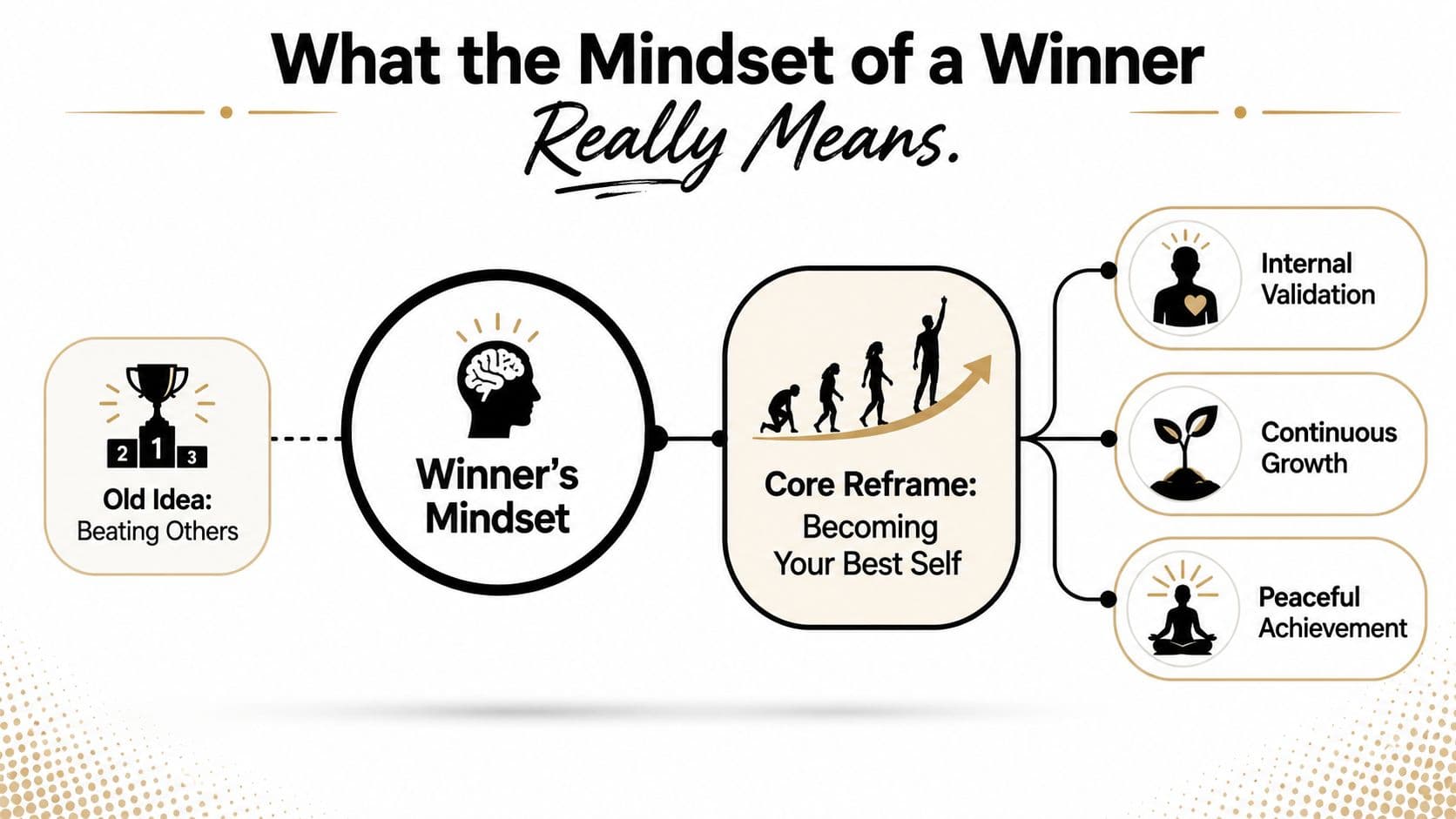
The old picture of a winner is easy to recognize. A winner stands on the highest platform, collects approval, and proves that everyone else was wrong. This model can produce impressive results, but it often makes peace dependent on the next result. Maya's achievements didn't satisfy her because she had trained herself to treat achievement as evidence that she was acceptable.
A more durable definition starts inside. A winner's mindset is the ability to pursue meaningful goals while staying open to learning, responsible for your choices, connected to other people, and grounded enough to continue after disappointment. The aim isn't to avoid competition. It's to stop competition from becoming your entire identity.
Two lenses for one durable idea
Psychology gives us one useful lens. Growth-mindset research examines whether people see ability as capable of development or as largely fixed. In a major cross-national analysis of PISA 2018, students across OECD countries who disagreed or strongly disagreed that intelligence cannot change very much scored 32 points higher in reading, after accounting for socio-economic profile, than students who agreed or strongly agreed. Without that adjustment, the difference was 41 points. The association was larger for disadvantaged students, with a 39-point advantage compared with 27 points for advantaged students. These findings come from the OECD-related analysis of PISA 2018.
The spiritual lens in Dan Millman's The Life You Were Born to Live asks a different question: what kind of person are you here to become, and how can your challenges develop your deeper gifts? Life-path awareness can give ambition a direction. Instead of asking only, “How can I win?” you begin asking, “What kind of contribution is worth my effort?”
That question connects achievement with self-knowledge. Readers exploring self-actualization from the Life Purpose App's perspective, while anyone who wants a structured starting routine may find a 30-day growth mindset plan useful.
Working definition: Winning means growing your capacity without sacrificing your values, health, or relationships.
Trophies are visible. The inner conditions that make achievement meaningful are patience, honest feedback, courage, and purpose. A person with those qualities can succeed without becoming dependent on applause, and can recover when the scoreboard turns against them.
The Psychology Behind How Winners Think
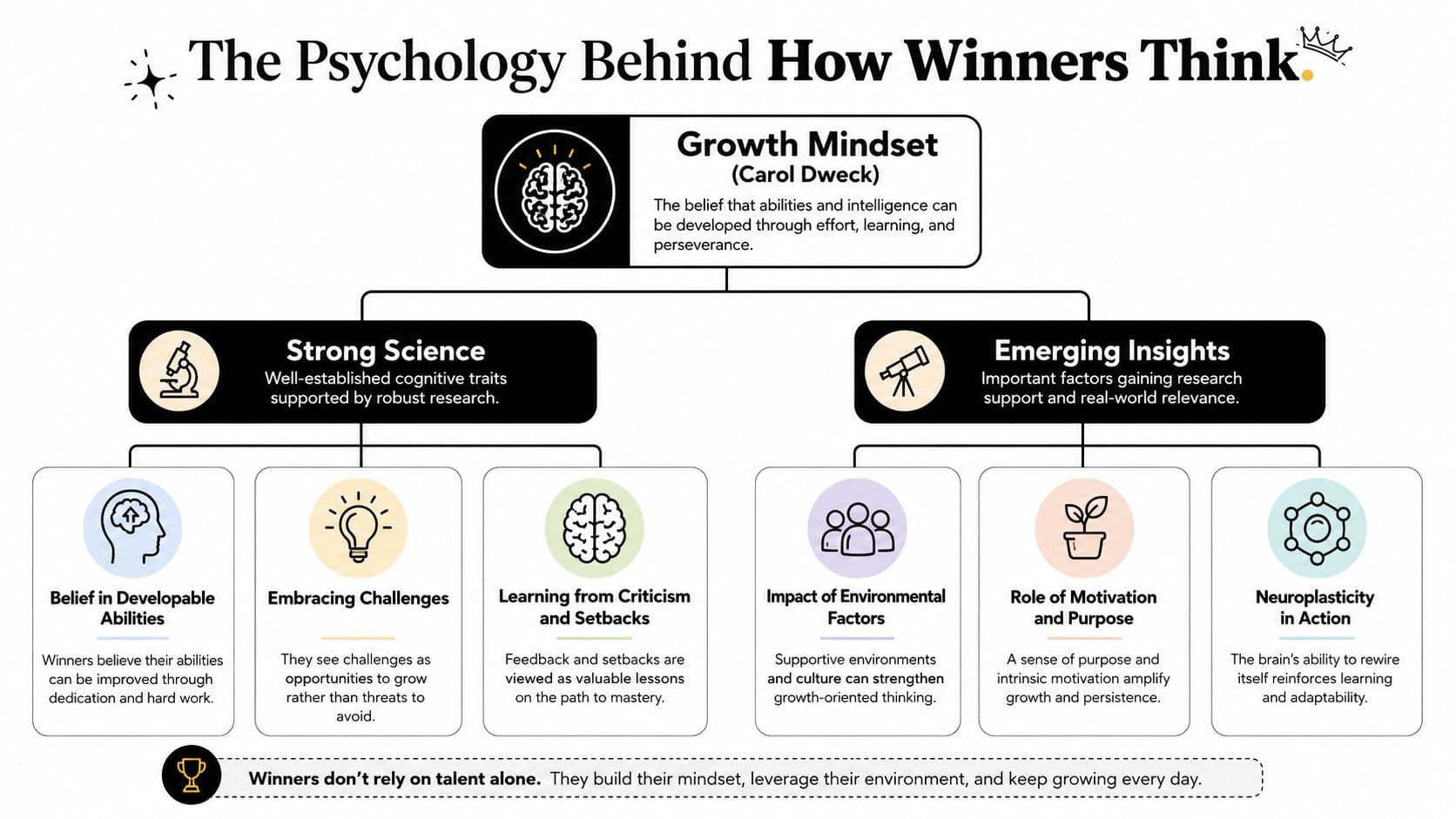
A student receives a disappointing grade, closes the notebook, and decides the result is information rather than an identity. That response captures a growth mindset more accurately than repeating positive statements. Abilities can develop, effort can support learning, and feedback can guide the next attempt.
What the evidence supports
The PISA analysis described earlier found an association between beliefs about intelligence and reading performance. That association does not prove that belief alone causes achievement. Students also learn within classrooms, families, institutions, and social conditions that influence what effort can accomplish.
A large U.S. national school experiment published in Nature examined a growth-mindset intervention among lower-achieving adolescents. It included 5,650 students across 65 schools and reported an unstandardized effect of B = -0.38, with a standardized mean difference of 0.33. The findings are summarized in the reported discussion of mindset intervention findings.
Later evidence supports a measured conclusion. A 2022 meta-analysis reported a small overall academic effect of d̄ = 0.05. Its highest-quality subset, comprising 6 studies with 13,571 participants, showed a nonsignificant effect of d̄ = 0.02. Beliefs can change, yet academic outcomes also depend on context, age, support, and how an intervention is implemented.
The capacities beneath the belief
A durable winner's mindset rests on three capacities:
- Resilience: Difficulty becomes an event to work through, not a final verdict.
- Self-efficacy: You trust that your actions can influence a situation, even when you cannot control the result.
- Cognitive flexibility: You change strategy when the current approach stops working.
A student who says, “I can improve my writing,” still needs useful feedback, time, instruction, and a safe opportunity to revise. Belief without a pathway becomes wishful thinking. A pathway without belief can feel like punishment.
Dan Millman's The Life You Were Born to Live adds a purpose-oriented interpretation. A setback may identify a skill that needs development, while life-path reflection can help you decide whether the goal deserves continued devotion. This distinction separates persistence from stubbornness. Readers exploring mindset shifts for expats can apply the same question to change across cultures and circumstances.
Automatic reactions and deliberate choices are easier to examine through the difference between the subconscious and conscious. Together, self-observation and life-path awareness turn a generic desire to win into purposeful development.
A fixed mindset treats one result as a definition of the self. A durable winner's mindset treats it as information about what happened, what support is needed, and what choice comes next.
Core Traits That Define a Winner's Inner Game
A winning inner game shows up in ordinary behavior. It appears when nobody is handing out medals and when the outcome remains uncertain.
Ownership
Ownership means separating responsibility from blame. The runner who keeps showing up on cold mornings doesn't control the weather, competitors, or every physical sensation. They can control whether they prepare, adjust, and return.
Ownership also means accepting honest limits. A person who takes responsibility doesn't claim total control over life. They ask, What part belongs to me? and act there.
Purposeful ambition
Ambition needs a reason. An entrepreneur whose product launch fails can chase another launch to erase embarrassment, or study what customers misunderstood and decide whether the product still serves a worthwhile need.
Dan Millman's The Life You Were Born to Live encourages readers to view personal development through a life-path framework. Used carefully, that framework can turn ambition from a demand for status into an inquiry about gifts, challenges, and contribution.
Comfort with discomfort
A winner doesn’t need to enjoy difficulty. They learn to remain present while difficulty is happening. A musician practices the passage that exposes a weakness instead of replaying the section they already perform well.
Discomfort becomes useful when it has boundaries. Rest, recovery, and support aren’t signs of softness. They keep challenge from becoming self-destruction.
Generous focus
Winning can narrow attention until every person becomes an obstacle. Generous focus keeps attention on the work while leaving room for other people's dignity. A parent may let a child struggle with a puzzle rather than solving it immediately, offering support without stealing the learning.
Teams trust people who want excellence and share credit. Generosity doesn't lower standards. It makes high standards easier for others to meet.
Quiet self-trust
Self-trust is not loud certainty. It's the willingness to make a thoughtful decision, observe the result, and revise without collapsing into shame.
| Trait | What it looks like | Where it gets tested |
|---|---|---|
| Ownership | Taking responsibility for the next useful action | When circumstances feel unfair |
| Purposeful ambition | Pursuing goals connected to meaning | When status is easier to measure |
| Comfort with discomfort | Staying engaged during difficult practice | When progress feels slow |
| Generous focus | Supporting others while pursuing excellence | When competition becomes personal |
| Quiet self-trust | Adjusting without abandoning yourself | When feedback challenges your identity |
Use the table as an inventory, not a scorecard. You may already have strong ownership but need more flexibility, or intense ambition but too little rest. The mature goal isn't to maximize every trait. It's to bring the traits into balance.
The Hidden Costs Most Winner Content Skips
Ambition can build a life, but ambition without recovery can consume one. The danger often begins when a person stops saying, “I want to do excellent work,” and starts saying, “I am only worthwhile when my work is excellent.”
Perfectionism shows the difference clearly. Recent evidence links maladaptive perfectionism negatively with resilience, cognitive flexibility, job satisfaction, and academic performance, while adaptive striving appears helpful only under conditions such as strong hope, effective emotion regulation, lower self-efficacy barriers, and less procrastination. These findings are discussed in research on perfectionism, cognitive flexibility, uncertainty, and resilience.
When standards become brittle
Consider a student who has always earned top marks. A difficult assignment threatens the identity built around being exceptional, so the student delays starting, hides confusion, and avoids classmates who might notice uncertainty. The pursuit of excellence has reduced learning, connection, and engagement.
The same pattern appears at work. A team captain who corrects every detail may raise performance briefly, but teammates can stop sharing ideas because mistakes feel unsafe. A leader who treats every error as a character flaw creates silence, not excellence.
Recent school-stress research involving gifted students connects higher stress with more burnout and less engagement, while related work suggests perfectionism can predict interpersonal sensitivity partly through resilience, peer relationships, and core self-evaluation. The pattern matters because performance pressure doesn't stay inside the individual. It changes how people communicate, collaborate, and recover.
A standard is healthy when it guides practice. It becomes harmful when it decides whether you deserve rest, friendship, or respect.
A better definition of discipline
Brittle discipline asks, How can I force myself to continue? Durable discipline asks, What conditions help me continue well? The second question includes sleep, boundaries, emotional regulation, honest conversations, and the ability to stop pursuing a goal that no longer reflects your values.
A mature winner's mindset protects three things:
- Health: Your body isn't disposable equipment for your ambitions.
- Relationships: People aren't supporting characters in your achievement story.
- Long-term motivation: A single result doesn't get to consume the reason you began.
Excellence remains demanding. It stops requiring self-punishment as proof of seriousness.
Daily Practices and Reflection Prompts to Build the Mindset
A useful practice stack should fit inside a real life. You don't need a productivity shrine, an elaborate dashboard, or a perfect morning. You need small moments that help you notice intention, behavior, and meaning.
Begin with two minutes
Before checking messages, write one sentence:
Today I intend to practice…
Complete it with a behavior, not an outcome. I intend to listen before answering, or I intend to revise the proposal after feedback, gives you something you can enact. I intend to succeed is too vague to guide a difficult moment.
If an overloaded day makes planning feel impossible, this guidance on planning when overwhelmed can help you reduce the task to a manageable intention.
Turn setbacks into information
Once a week, conduct a loss audit. Choose one disappointment and answer:
- What happened, without exaggeration?
- What part did I control?
- What did the result teach me?
- What will I test next?
- What support or boundary would make the next attempt wiser?
This exercise doesn't force a positive interpretation. Some losses are painful, unfair, or final. The purpose is to stop pain from becoming the only meaning available.

Add purpose to the routine
Dan Millman's The Life You Were Born to Live offers a life-path framework for reflecting on personal gifts, challenges, and direction. The Life Purpose App states that it contains the complete text of all 45 life paths, and its description says users enter a date of birth to reveal life-path insights, as explained on the Life Purpose App site.
A concise exercise takes less than five minutes and works with or without an app:
- Write your date of birth if you want to explore the framework digitally, or write three moments when you felt useful and alive.
- Identify a repeated quality in those moments, such as teaching, organizing, creating, protecting, or connecting.
- Name one current goal where that quality could serve someone beyond yourself.
- Choose one action for the next day.
Use life-path reflection as a prompt, not a verdict. It can help you ask better questions, but it can't make decisions for you. Pairing it with meditation and journaling practices can create space for the answers to emerge without forcing them.
End each evening with three questions: What did I do well? Where did I act from fear? What deserves another attempt tomorrow?
A Realistic First Week Plan for a Stronger Winner Mindset
The first week should feel almost modest. If the plan adds pressure, it has misunderstood the purpose. Repetition matters more than intensity, and a quiet week still counts.
Seven low-friction days
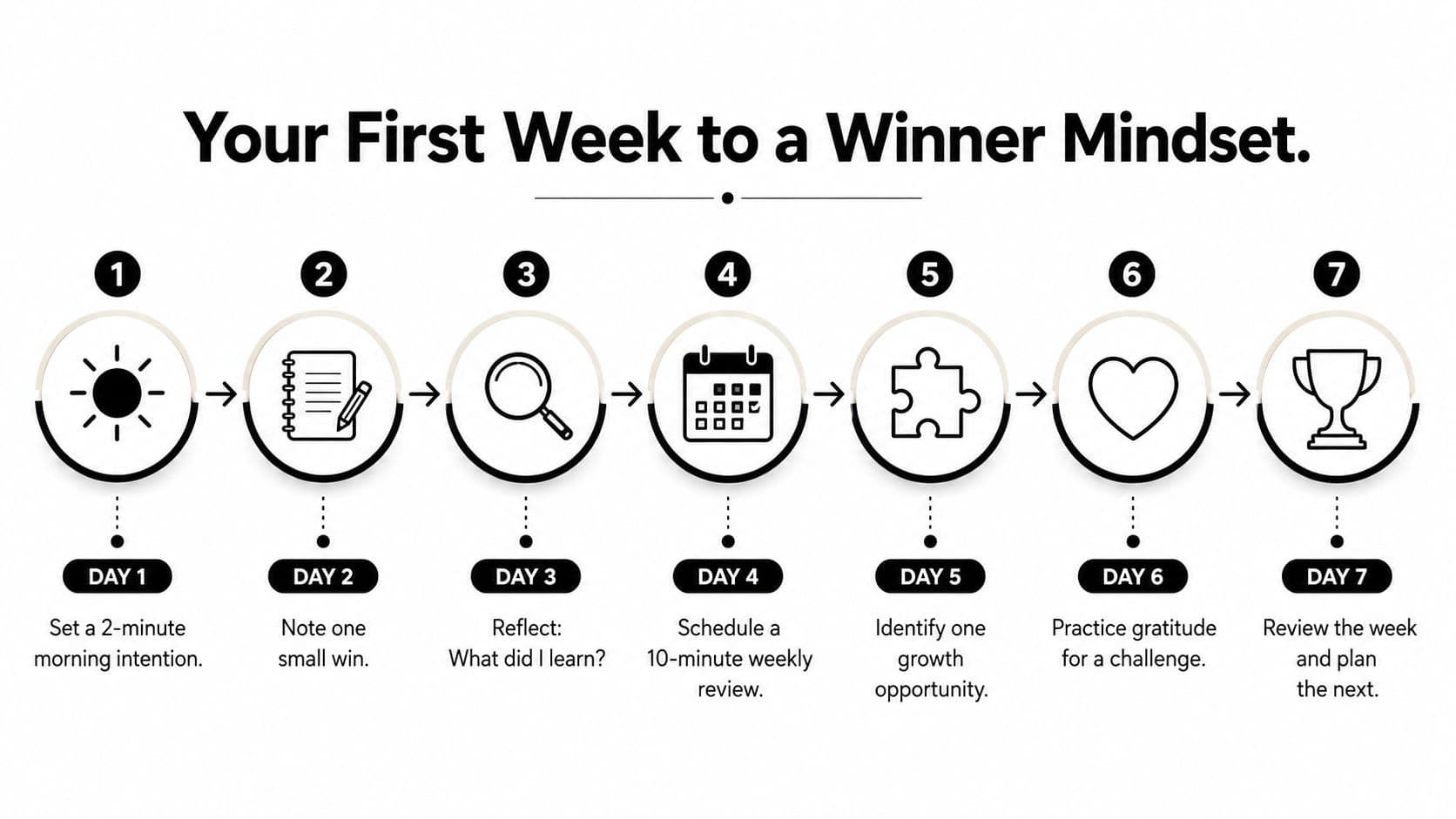
Day 1: Write the two-minute intention. Choose a behavior that reflects the person you want to be, such as patience, courage, or focused practice.
Day 2: Record one small win. It might be sending the difficult email, asking for clarification, or stopping work before exhaustion made the decision for you.
Day 3: Ask, What did I learn? Apply the question to a mistake, a conflict, or an ordinary task. Keep the answer specific.
Day 4: Schedule a short weekly review. Put it somewhere visible, and give yourself permission to keep it simple.
Day 5: Identify one growth opportunity. Choose a skill, conversation, or habit that would expand your capacity. Don't select the most impressive challenge. Select the one you can approach.
Day 6: Practice gratitude for a challenge. This doesn't mean pretending the difficulty was good. Acknowledge what it revealed, demanded, or helped you clarify.
Day 7: Review the week and plan the next one. Look for evidence of practice, not evidence of perfection.
Track identity, not just output
A traditional performance log asks how much you achieved. A growth-oriented log also asks who you practiced becoming. Did you respond more truthfully? Did you recover sooner? Did you allow someone else to contribute?
Keep the record to a few lines. If you miss a day, restart without adding punishment. A winner's mindset grows when you treat inconsistency as information rather than proof that you're incapable.
The plan also works at different scales. On a demanding day, complete only the intention and evening question. On a spacious day, add the loss audit or life-path exercise. The practice remains valuable because it trains return.
Questions Readers Ask About a Winner's Mindset
How long does it take to change a mindset?
There isn't a universal timetable. Beliefs can shift through repeated experiences, useful feedback, and supportive conditions, but lasting behavior also requires practice and opportunity. Treat change as a direction you reinforce, not a finish line you reach once.
What if my family or colleagues don't share my ambition?
You don't need everyone to want the same goals. Explain what matters to you, ask for specific support, and keep your standards from becoming demands that others must adopt. A strong mindset includes respect for different definitions of a good life.
Can life-path awareness replace effort?
No. Dan Millman's The Life You Were Born to Live can provide a symbolic framework for reflection, but it shouldn't become an excuse to avoid responsibility or experimentation. Use it to ask what kind of contribution fits your values, then test that insight through ordinary action.
What does the revised life-path system include?
Dan Millman says the original edition described 37 life paths, while the revised 25th Anniversary Edition expanded the system to 45 birth numbers and life paths. He also says the updated book covers people born between 1750 and the present, including some children born after 2000, according to Dan Millman's description of the book.
The mindset of a winner is built in small moments, especially the moments nobody applauds. You can begin today by choosing one meaningful action, learning from its result, and returning tomorrow with a little more honesty.
The Life Purpose App contains the complete text of all 45 life paths and lets you enter a date of birth to explore life-path insights. Visit Life Purpose App to use that framework as a reflection tool while you build a more purposeful, resilient approach to achievement.
Discover Your Life Purpose Today!
Unlock your true potential and find your life’s purpose.
