Explore money and values, why alignment matters, the signs of mismatch, and practical frameworks to align your financial choices with what truly matters to you.
August 30, 2026 (23d ago)
Money and Values: A Practical Guide to Alignment
Explore money and values, why alignment matters, the signs of mismatch, and practical frameworks to align your financial choices with what truly matters to you.
← Back to blog
You can earn a good salary, pay your bills on time, and still feel uneasy whenever you open your banking app. Perhaps your calendar is full of travel, your home looks successful, and your income gives you options, yet something feels absent. The discomfort may not mean you need more money. It may mean your money isn't clearly serving what matters most to you.
Money and values become useful as a subject when they move beyond abstract ideas. The question isn't just whether you should spend less, save more, or earn more. It's whether your financial choices support the person and life you're trying to build.
What Money and Values Really Mean
Money is a neutral resource. You can use it to trade for goods and services, protect your time, create security, buy choices, support other people, or contribute to causes you care about. Money doesn't automatically create meaning. Its meaning comes from the work you ask it to do.
Values are the principles that help you rank what matters. Family, freedom, craft, faith, health, contribution, and learning may all matter to you, but they won't always compete equally in a real decision. A value becomes practical when it helps you choose between a larger home and a shorter commute, a luxury purchase and a course, or overtime and time with your children.
Money is the medium. Values provide the direction. If you accumulate money without deciding what it should support, you can end up measuring progress through salary, assets, or visible consumption while feeling disconnected from your own priorities. If you hold strong values without directing money toward them, those ideals may remain sincere but difficult to live.
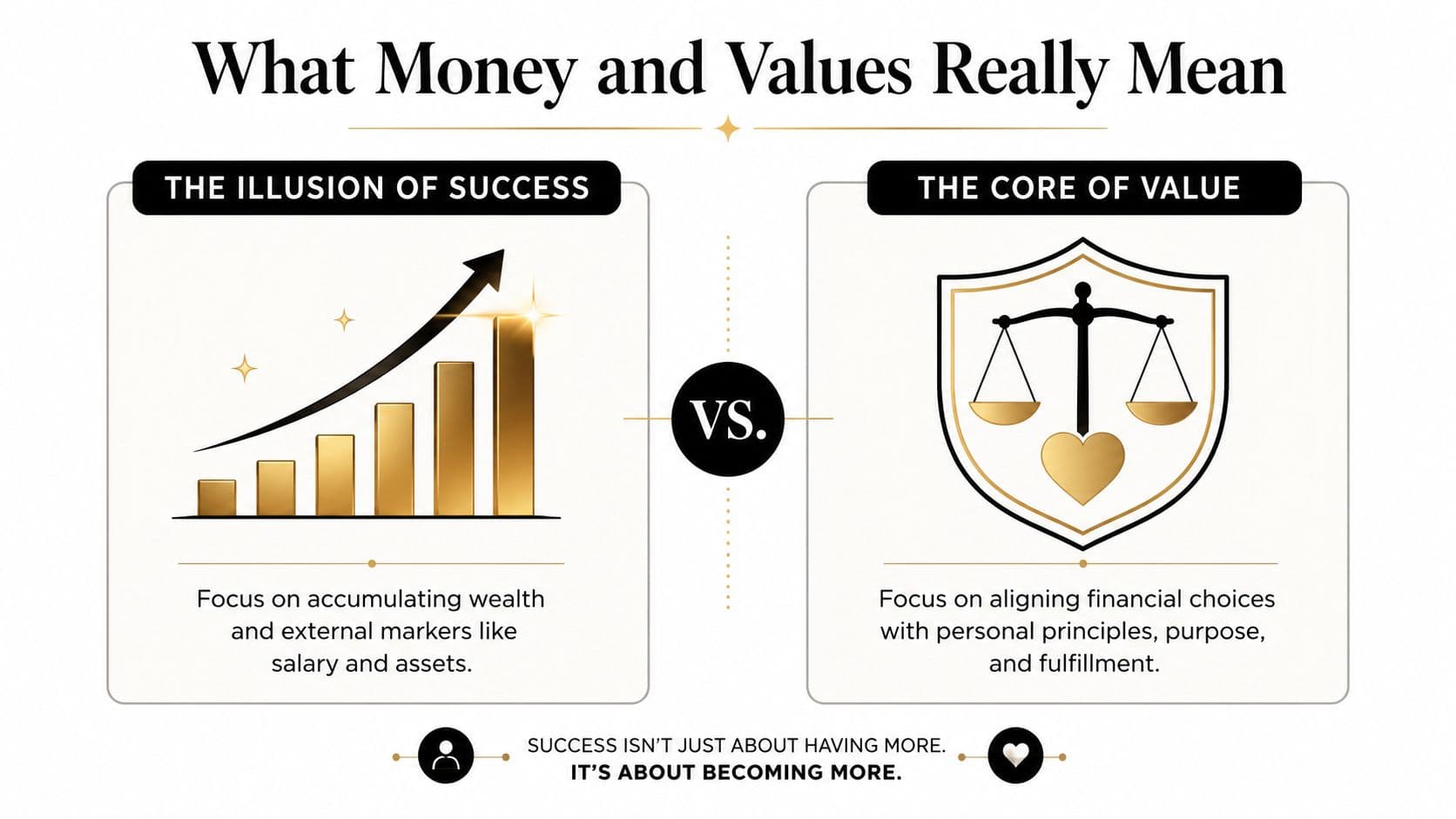
The resource and the direction
Try separating the two layers when you review a financial choice:
- The resource: What does this money make possible?
- The direction: Which principle does that possibility serve?
- The evidence: Will the choice show up in your ordinary life, not only in your intentions?
A high income can support freedom, but it can also fund a schedule that leaves no time for living. A modest purchase can support health, learning, or connection more directly than an expensive status symbol. The amount matters, but the relationship between the amount and your priorities matters more.
This distinction becomes especially important in shared finances. Partners may disagree about a purchase because they attach different values to it, not because one person is irrational. Conversations about shared priorities can make money less adversarial. If that question is part of your relationship, you can explore marriage and money through the lens of shared goals, individual needs, and mutual care.
Why Alignment Between Money and Values Matters
Misalignment rarely announces itself with one dramatic mistake. It usually appears as a low-level tension that repeats across ordinary days. You spend in ways that don't feel like you, work toward goals you didn't consciously choose, and then wonder why financial progress hasn't produced much peace.
The psychological cost
A person who values simplicity may feel quiet guilt after buying things to keep up with peers. Someone who values security may receive a paycheck and immediately feel anxious because no plan turns that income into stability. Someone who values freedom may build a lifestyle that requires constant work to maintain.
These reactions aren't proof that every uncomfortable purchase is wrong. They can be useful signals. The question is whether the discomfort points to a genuine tradeoff you chose knowingly or to a pattern that keeps contradicting your stated priorities.
Research also gives money a more nuanced place in well-being. A study by Daniel Kahneman and Angus Deaton found that day-to-day emotional well-being rose with income up to about $75,000 per year in the United States and Canada, then leveled off, while life evaluation continued improving at higher incomes. Later summaries described a broader plateau of roughly $60,000 to $90,000, with life-evaluation scores peaking around $105,000. These findings are summarized by Wharton's review of the money and happiness research. The point isn't that one income makes everyone content. It's that money can improve security and daily well-being, but its emotional returns aren't linear.
The relational and existential cost
Partners often experience conflict when one person prioritizes experiences and the other prioritizes savings. The surface argument may involve a holiday, a car, or a restaurant bill. Underneath, one person may be protecting connection while the other is protecting safety. Naming those values creates a better starting point than accusing each other of being careless or controlling.
Children also learn financial meaning from what adults repeatedly do. They notice whether money conversations involve secrecy, panic, generosity, planning, or status. A family doesn't need perfect finances to model healthy values. It needs honest explanations and decisions that connect resources to care.
Work can create a similar divide. When daily effort funds a life that feels unrelated to your principles, success may feel strangely hollow. Alignment won't remove every difficult task, but it can help you understand what the task supports.
A useful test: If your financial behavior became visible to someone you love, would it tell the same story as your stated values?
Alignment isn't reserved for wealthy people with flexible budgets. It can begin with deciding what a small amount of money should protect, strengthen, or make possible. That decision turns money from a recurring source of confusion into a steady expression of identity.
Everyday Signs Your Money and Values Are Out of Sync
Start with a normal week rather than a grand financial plan. Notice the moments when your spending, saving, or earning contradicts what you say matters.
You might value simplicity and health, yet repeatedly buy premium convenience products because you're too tired to plan. The issue isn't the product itself. The mismatch appears when convenience consumes money you hoped to direct toward nourishing food, rest, or medical care.
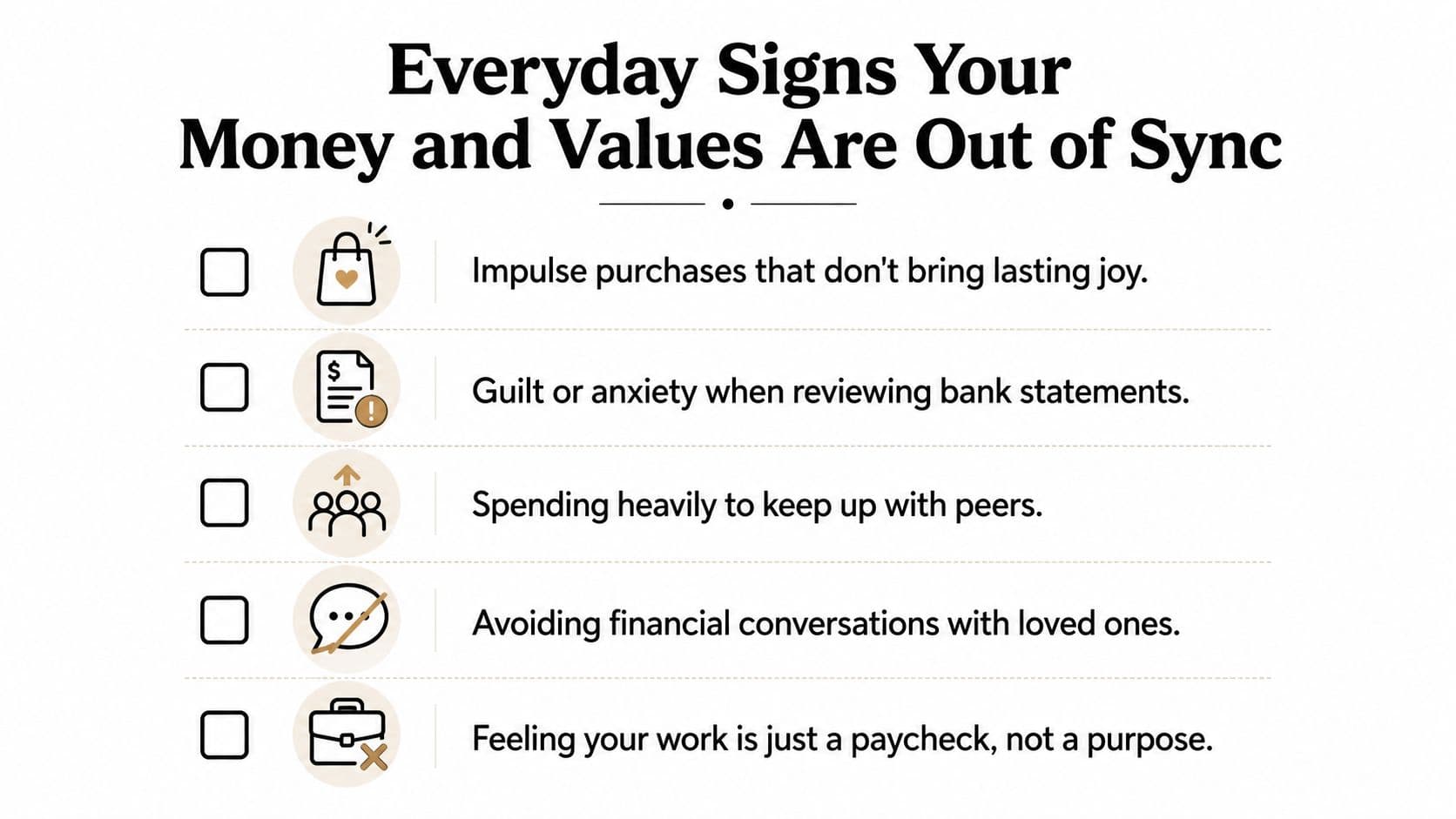
A guided checklist
- Subscriptions that drain a priority: You say learning or travel matters, but unused services keep taking money that could fund a class, trip, or meaningful experience.
- Status spending: You upgrade a car, wardrobe, or phone mainly to impress peers while telling yourself that freedom and adventure come first. The purchase may be enjoyable, but its purpose deserves an honest look.
- Security without preparation: You describe security as essential but keep underfunding emergency savings or avoiding an overview of recurring obligations. Your stated value is protection, but your routine leaves you exposed.
- Generosity that exists only in principle: You describe a cause as central to your identity, yet giving never receives a deliberate place in your spending plan. The gap may call for a smaller, consistent commitment rather than self-criticism.
- Work treated only as a paycheck: You value craft, contribution, or purpose, but your financial decisions lock you into work that leaves no room for those priorities.
The same pattern can appear in relationships. You may say connection matters while avoiding money conversations because they feel awkward. You may value family time while accepting every extra shift to support a lifestyle nobody has discussed.
One mismatch is human. People get tired, misjudge purchases, and respond to pressure. A repeated pattern is different. It's an invitation to ask which value is being crowded out, what the current choice is protecting, and whether that protection still makes sense.
A Simple Framework to Clarify What You Value Most
Abstract values become easier to use when you translate them into four money-related dimensions: security, freedom, power, and love. A 16-item money-attitudes scale uses these four dimensions and asks people to rate statements on a 5-point Likert scale, from strongly disagree to strongly agree. The framework is described in research on money attitudes as security, freedom, power, and love.
This isn't a test that can tell you who you are. It's a structured prompt for noticing what your financial behavior already emphasizes.
Four questions for your financial life
Security asks, “What would help me feel stable and protected?” Your answer may involve predictable expenses, a reserve, manageable obligations, or a home that feels dependable.
Freedom asks, “What would give me more choice over my time and direction?” You might value flexible work, a shorter commute, fewer fixed commitments, or the ability to leave an unhealthy situation.
Power asks, “How do I want money to extend my influence?” This can involve leadership, business ownership, professional status, public impact, or the ability to fund projects. Power isn't automatically shallow. It becomes problematic when you pursue external approval while neglecting deeper priorities.
Love asks, “How should money express connection and care?” The answer may involve supporting family, sharing experiences, giving, hospitality, or creating time for people who matter.
Score the pattern, then write the compass
Rate how strongly each dimension appears in your current financial life on a 1-to-10 scale. Base the score on your actual income, spending, savings, work choices, and giving, not on the person you hope to become. Then rate how important each dimension feels to you now.
The gap between those two ratings is often more useful than the absolute score. A person may care about freedom while organizing every financial decision around security. Another may value love but spend almost nothing on shared time because status purchases absorb the available margin.
For a guided writing exercise, use a values clarification exercise. Finish with one sentence:
“When my money reflects my highest priority, it should feel like ______.”
Keep that sentence where you make financial decisions. It can become a compass when a purchase looks attractive but doesn't support the life you want.
Putting Values to Work in Real Financial Decisions
Clarity matters only when it changes behavior. Start with choices you repeat, because repeated decisions reveal your real priorities more clearly than occasional declarations.
Consider a freelancer whose highest dimension is freedom. This person may accept a lower guaranteed income in exchange for flexible work, keep fixed costs manageable, and direct available money toward a reserve that protects choice. A parent whose highest dimension is security may prefer stable employment, predictable housing costs, and regular saving before increasing discretionary spending. Neither approach is universally correct. Each makes sense when it serves the person's chosen priority.
Three practical exercises
- Pause before buying. Ask, “Which value does this purchase serve?” If the answer is status, convenience, connection, health, or learning, name it plainly. If you can't identify a meaningful purpose, wait before proceeding.
- Audit your statements monthly. Review transactions and mark those that supported your top values. Don't search for moral perfection. Look for recurring categories that consistently take money away from what matters.
- Allocate values first. Choose a fixed portion of income for the dimension you rated highest. Direct it automatically where possible, whether that means savings for security, a flexible-work reserve for freedom, impact projects for power, or family support for love.
| Spending Category | Misaligned Choice | Values-Aligned Choice |
|---|---|---|
| Housing | Choosing a larger home that creates a punishing commute | Choosing a smaller home that protects time and flexibility |
| Learning | Buying status goods while postponing a course | Funding training that supports craft or career direction |
| Transport | Upgrading to impress peers | Selecting reliable transport that supports freedom and useful time |
| Giving | Donating only when guilt appears | Creating a deliberate giving plan connected to love or contribution |
| Investing | Selecting an investment solely because it sounds fashionable | Reviewing whether the approach reflects your principles, including avoiding greenwashing in your portfolio |
Small choices can create a coherent financial story. A shorter commute may protect more daily life than a larger house. A course may strengthen your future options more than a luxury item. The purpose isn't to eliminate pleasure. It's to make pleasure, protection, and progress intentional.
You can also explore practical reflections on money patterns and meaning through the spiritual laws of money, then test any idea against your actual circumstances rather than adopting it automatically.
Life Path Insight and Long-Term Money Choices
Long-term financial choices become clearer when you connect them with the kind of life you are trying to build. In Dan Millman's The Life You Were Born to Live, a life path number points to recurring patterns and lessons. The Life Purpose App provides a digital way to explore that framework through a birth date, life-path analysis, spiritual laws, and areas such as money, career, health, and relationships.
Treat this framework as a reflective lens, not as a budget, financial plan, or substitute for evidence-based advice. If your recurring themes involve building, teaching, healing, creativity, or service, examine whether major financial commitments support those qualities or restrict them. Your values become more useful when they guide a decision you can see, such as the work you accept, the risks you take, or the time your expenses leave available.
Two ways a life path can inform money
A person drawn toward creativity might choose flexible, expressive work instead of a conventional role with steadier income. That decision can be responsible when the person understands the tradeoff, keeps fixed costs manageable, and builds financial arrangements that preserve creative time.
A service-oriented person may favor stable assets and consistent saving because those choices support charitable goals, family responsibilities, or a reliable ability to help others. Stability then serves a purpose beyond accumulation. It becomes a practical expression of contribution.
The same purchase can carry different meanings. A home might provide security, a base for creative work, space for relatives, or social status. The useful question is not whether another person's financial path looks admirable. Ask whether your own commitment reflects the direction you want your life to take.
Use the framework at crossroads
Return to The Life You Were Born to Live and the Life Purpose App before a significant choice involving work, education, housing, business, or long-term saving. Write three answers:
- What lesson or quality does this decision strengthen?
- What value does it protect?
- What part of my life could it make harder?
For a closer look at repeated financial behavior, explore this guide to recognizing money patterns. Life-path insight earns its place when it produces practical questions, makes tradeoffs visible, and keeps your choices connected to real responsibilities.
Keeping Money and Values Aligned Over Time
Values change as life changes. A priority that feels central during early career may shift when you become a parent, care for a relative, change your health routine, or reconsider the kind of work you want to do. Alignment requires review, not a one-time declaration.
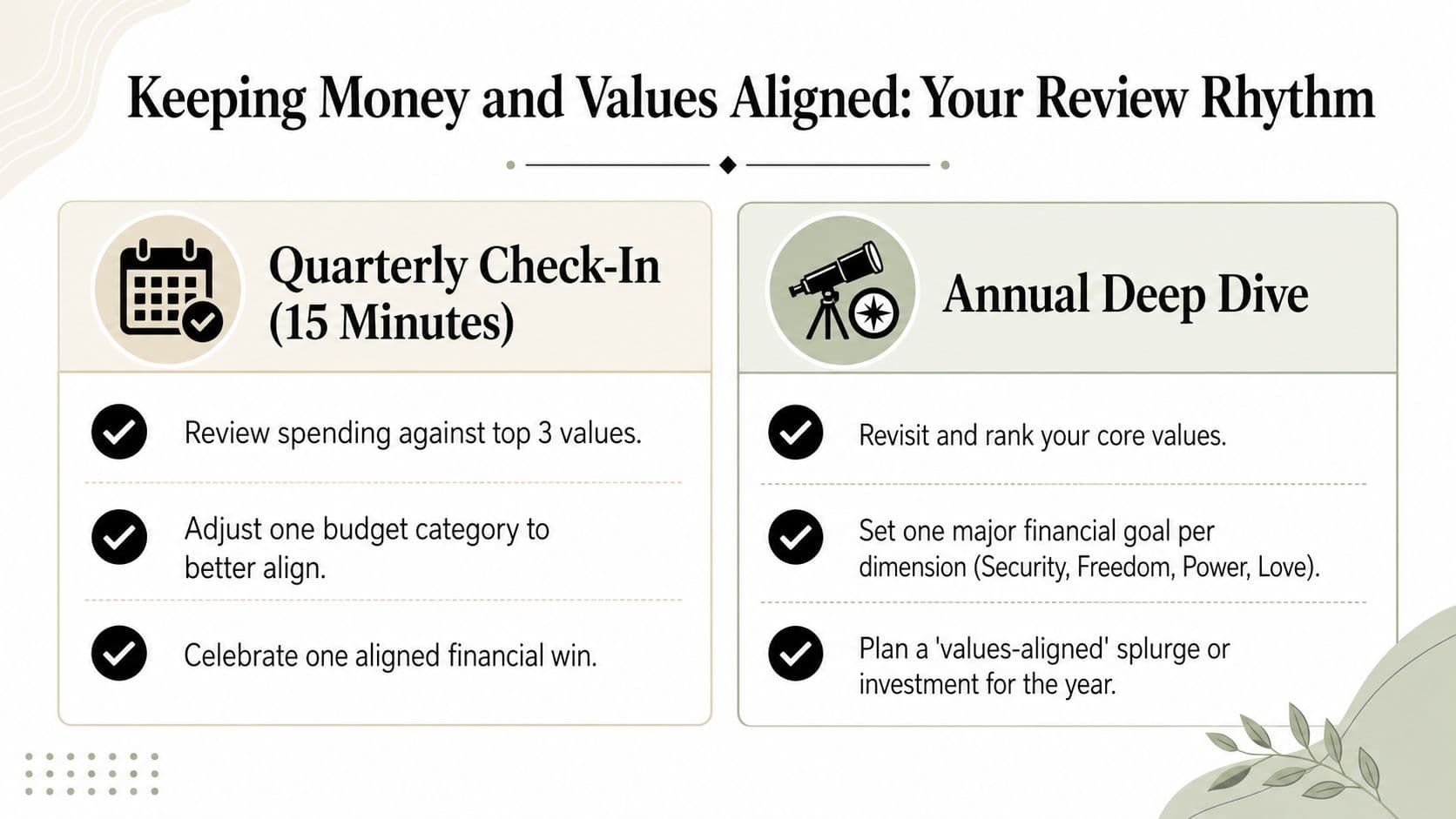
A repeatable review rhythm
Set aside a short monthly check-in and answer three questions:
- What did I spend on that reflected my values?
- What did I spend on that didn't?
- What small adjustment will I try next month?
Every quarter, review spending against your top three values. Adjust one category rather than redesigning your entire life, and celebrate one decision that expressed your priorities well. Small corrections are easier to sustain than dramatic restrictions.
Once a year, revisit your values list and life-path theme from Dan Millman's framework. Ask whether your savings, debt, career direction, and giving still support the life you want to build. You can also set one meaningful goal for each dimension, security, freedom, power, and love, as long as the goals fit your resources and responsibilities.
Accountability helps. Share the review with a partner, keep a journal, or work with a coach who can help you notice rationalizations without judging your choices. Warning signs include avoiding statements, feeling repeated guilt after spending, hiding purchases, or making major commitments without connecting them to a value.
Money and values alignment isn't a single decision. It's a steady practice of noticing, adjusting, and choosing again.
The Life Purpose App offers a digital companion to Dan Millman's The Life You Were Born to Live, helping you explore your life path, spiritual laws, money patterns, and related life areas through a birth-date-based system. Visit Life Purpose App to reflect on how your financial choices can support your values and the life you're working to create.
Discover Your Life Purpose Today!
Unlock your true potential and find your life’s purpose.
