Discover how money patterns connect to your life path and nine-year cycles. Learn to recognize limiting financial beliefs and shift them using Dan Millman's
August 23, 2026 (1mo ago) — last updated August 24, 2026 (1mo ago)
Money Patterns and Your Life Path
Discover how money patterns connect to your life path and nine-year cycles. Learn to recognize limiting financial beliefs and shift them using Dan Millman's
← Back to blog
You check your bank balance after payday and feel a familiar disappointment. The income looked adequate, yet bills, subscriptions, family requests, and small comforts have absorbed it. Perhaps you've built savings before, only to spend them during an emergency or an emotional low. The numbers change, but the story keeps returning.
That repeating story is a money pattern. It includes your habits, but it also reaches into your beliefs about safety, worth, generosity, control, and purpose. Spiritual reflection can help you notice the deeper loop, while practical action gives that insight somewhere useful to go.
Why Your Financial Struggles Keep Repeating
Maya earned well enough to feel secure on paper. She paid her bills, helped relatives, and occasionally moved money into savings. Then an unexpected expense appeared, or a difficult week led to online shopping, and the balance disappeared. She didn't lack intelligence. She lacked a clear understanding of the emotional sequence that came before each financial decision.
Her pattern looked something like this:
- Pressure: She felt responsible for everyone.
- Relief: Spending or giving made the pressure briefly quieter.
- Regret: She promised to be more disciplined.
- Reset: Payday created a temporary sense of possibility.
- Repetition: The same trigger returned.

A budget might show Maya where the money went, but it wouldn't automatically explain why giving felt safer than keeping, or why saving triggered anxiety. Money patterns often operate before conscious reasoning begins. A person may spend to prove love, refuse to charge fairly, avoid statements because they fear bad news, or cling to every coin because security once felt fragile.
The modern financial environment makes those loops easier to repeat. The Bank for International Settlements reported that in 2024 annual cashless payments per capita in emerging market and developing economies rose 21% to 242, while credit transfers represented 94% of cashless payment value in those economies and 86% in advanced economies. The same update said the average value per cashless payment stabilized at about USD 529 in emerging markets, showing how digital money now moves through everyday life at varied transaction sizes. The BIS payment statistics commentary gives useful context for why money can feel less tangible and easier to move impulsively.
You don't need spiritual language to begin observing yourself. You only need curiosity. If your current finances leave no space to pause, practical guidance on creating actionable financial breathing room can support the outer part of the work.
A useful starting point: Don't ask only, “Where did my money go?” Ask, “What was I feeling, believing, or trying to avoid just before I used it?”
Recognition doesn't blame you. It gives you a choice point. Once you can see the loop, you can interrupt it with a different response.
What Money Patterns Really Mean
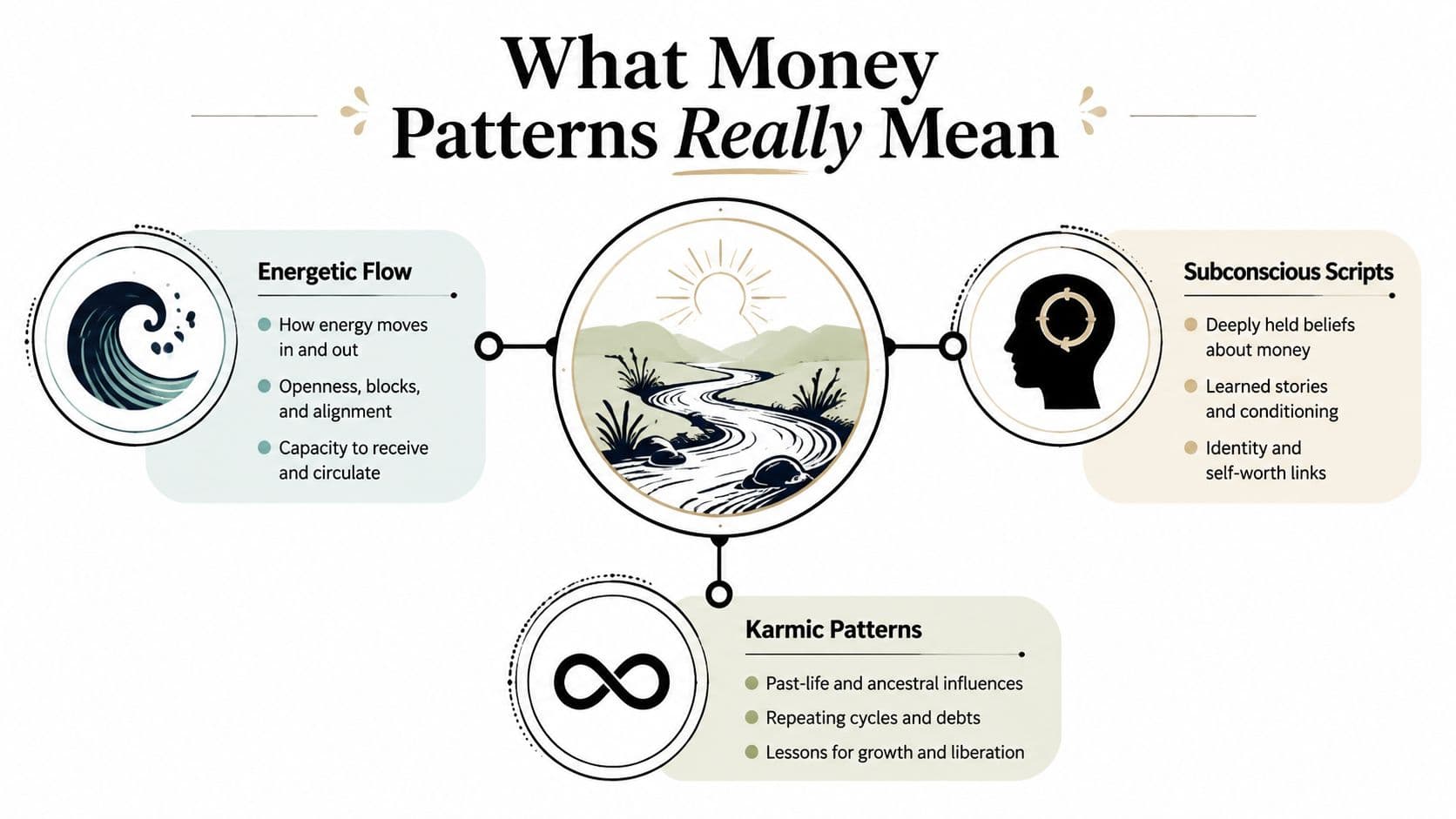
A money pattern is the route your financial energy tends to follow. Think of a river carving a channel through rock. After years of flowing in the same direction, water returns to that channel with little effort. Your money can behave similarly, following paths shaped by childhood experiences, family attitudes, cultural expectations, and personal wounds.
That spiritual definition differs from a conventional budget. A budget records income and expenses. A financial plan organizes goals, risks, and resources. Money-pattern work asks what meaning you attach to those numbers. Does saving mean freedom, or does it mean deprivation? Does receiving feel nourishing, or does it create an obligation? Does wealth feel compatible with your identity?
Three layers make the idea easier to understand:
- Energetic flow: This describes your felt relationship with giving, receiving, spending, and keeping. Someone may allow money to arrive but feel compelled to send it away.
- Subconscious scripts: These are inherited or learned sentences such as “People like me never get ahead” or “If I have more, others will resent me.”
- Karmic patterns: In a spiritual framework, repeated financial challenges can become invitations to develop qualities such as discernment, trust, boundaries, humility, or responsible power.
Dan Millman's revised 25th Anniversary Edition of The Life You Were Born to Live covers all forty-five life paths for people born between 1750 and the present, linking each path to core issues in health, money, sexuality, career, relationships, and life cycles. The book's description places money inside a wider life-purpose map rather than treating it as an isolated skill.
This doesn't mean a life path mechanically causes a bank balance. It means the system can offer a reflective lens. You might notice that your financial conflict mirrors a broader lesson you face elsewhere, such as learning to set limits, speak truthfully, trust your abilities, or use influence with care.
You can support reflection with simple rituals, too. Some people use journaling, prayer, breathwork, or a quiet scent such as Satya Money Matrix at Aroma Warehouse to mark a moment of attention. The object isn't magical proof of financial change. Its value is symbolic, helping you pause before acting from an old script.
Common Money Archetypes and Limiting Beliefs
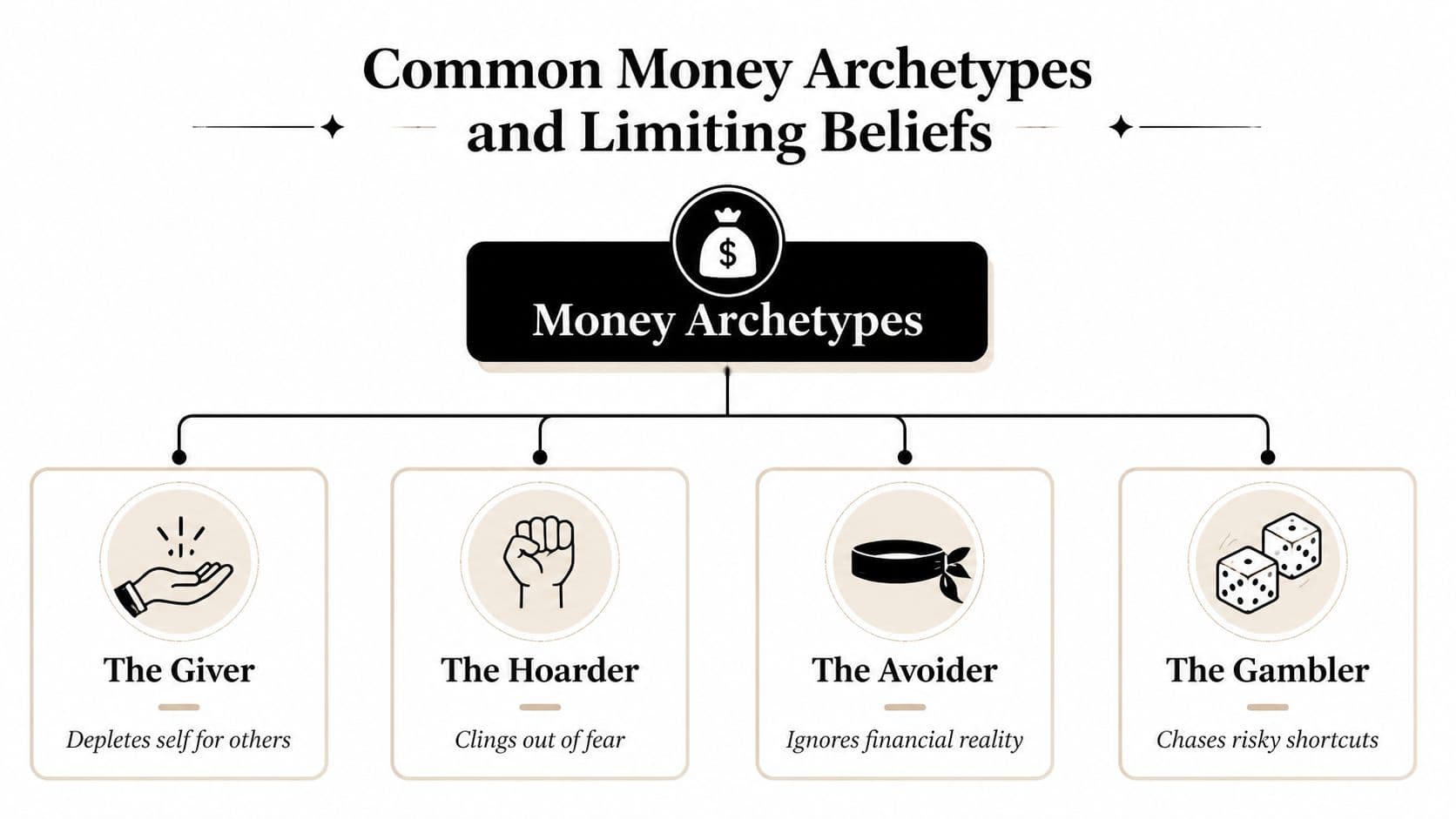
Archetypes are mirrors, not diagnoses. Individuals move between several, depending on stress, relationships, and the amount of financial uncertainty they're carrying.
The Giver
The Giver pays for meals, rescues relatives, accepts underpayment, and says yes before checking available funds. The limiting belief is often, “My value comes from what I provide.” Beneath the generosity may be a life-purpose wound around belonging. If you learned that love had to be earned, keeping money can feel selfish.
The corrective lesson isn't becoming cold. It's learning that a boundary can protect generosity from turning into resentment. Before helping, pause and ask whether the gift is affordable, freely chosen, and consistent with your own responsibilities.
The Hoarder
The Hoarder keeps money untouched, rejects reasonable enjoyment, and treats every expense as a threat. The hidden sentence may be, “Nothing is safe unless I control everything.” This pattern can arise from scarcity, family instability, or a spiritual lesson involving trust and flexibility.
Security matters. The work is to separate wise preparation from fear-based contraction. A written plan for essential expenses can create more genuine safety than repeatedly checking a balance.
The Avoider
The Avoider leaves unopened statements, forgets renewal dates, and hands financial decisions to a partner without understanding them. Their belief may be, “If I don't look, the problem can't hurt me.” Often, shame has become stronger than curiosity.
Avoidance usually shrinks choice. A gentle first step is to open one account summary with another trusted person present, without trying to solve everything that day.
The Gambler
The Gambler seeks a dramatic rescue. Risky trades, impulsive purchases, or borrowing for a quick emotional lift can create alternating periods of excitement and fear. The underlying belief is often, “A sudden breakthrough will save me from ordinary limits.”
The deeper lesson may involve patience, accountability, and respect for reality. If gambling is causing harm, spiritual interpretation should never replace professional support, financial safeguards, or addiction treatment.
Use these prompts privately:
- Which archetype appears when you're calm?
- Which one appears after conflict, fatigue, or shame?
- What sentence about money seems to justify the behavior?
- What would a caring, grounded response look like instead?
Naming the pattern reduces its mystery. You can then work with the wound without making the wound your identity.
How Your Life Path Number Shapes Financial Themes
Dan Millman's system connects a birth date with a life path, then explores the gifts, challenges, and lessons associated with that path. In this approach, a financial difficulty isn't automatically evidence of failure. It may reflect a recurring theme that also appears in your work, relationships, or decisions about responsibility.
One person may repeatedly undercharge because self-worth remains unsettled. Another may earn well but hoard because control feels safer than trust. Someone else may give beyond their means because generosity has become a substitute for honest intimacy. These examples aren't predictions. They're ways to ask better questions about behavior.
The value of a life-path framework rests in its specificity. Instead of saying “I'm bad with money,” you might investigate a more useful question: What quality am I being asked to develop through money? The answer could involve discernment, courage, moderation, receptivity, independence, or stewardship.
The book The Life You Were Born to Live presents forty-five distinct life paths, and its money themes sit alongside health, sexuality, career, relationships, and life cycles. That broader context matters because financial habits rarely stay in one compartment. A person who struggles to state a price may also struggle to ask for help. A person who controls every household decision may find the same tension in professional teams.
The financial-numerology guide from the Life Purpose App can help you reflect on money themes through this system. Keep the interpretation grounded: a life path can offer language for reflection, but it cannot replace checking balances, understanding contracts, seeking qualified advice, or addressing harmful behavior.
The Life Purpose App gives access to the complete text of all 45 Life Paths and can determine the life path of anyone born between 1800 and the present. Its own description explains that function directly.
Use your life path as a compassionate lens, not a verdict. The question isn't “What number am I?” It's “What am I practicing through the way I earn, spend, save, receive, and share?”
Navigating Your Nine-Year Financial Cycles
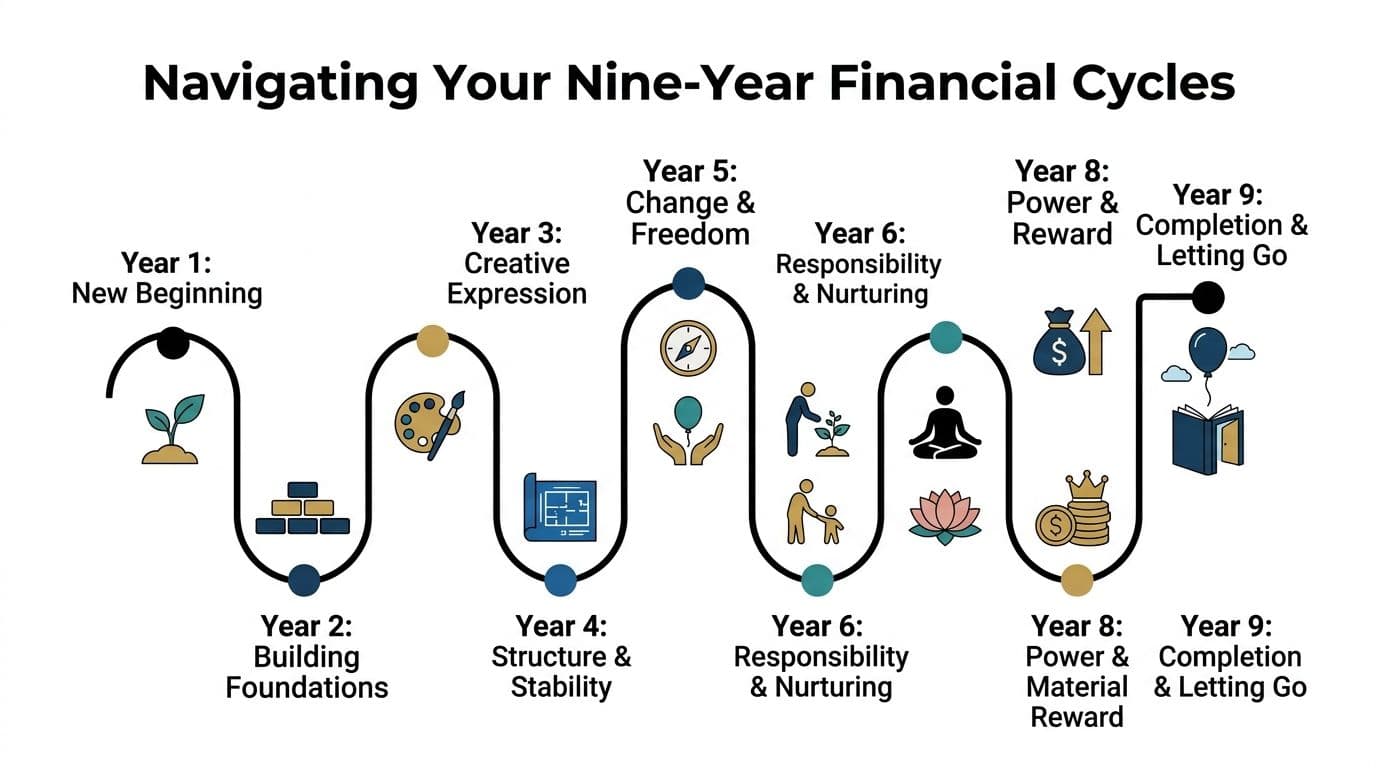
Nine-year cycles offer a timing lens. Rather than treating every year as suitable for the same financial behavior, the framework assigns each phase a different quality. That can help you distinguish between a season for starting, consolidating, changing direction, deepening, or releasing.
Read the cycle as a sequence
- Year 1, New Beginning: Choose a direction, start a financial practice, or create a fresh income intention. Keep commitments clear rather than scattering your energy.
- Year 2, Building Foundations: Strengthen routines, partnerships, and patience. This phase suits steady preparation more than dramatic moves.
- Year 3, Creative Expression: Explore communication, learning, and visible ideas. Financially, it can invite you to articulate an offer or develop a creative skill.
- Year 4, Structure and Stability: Organize records, clarify obligations, and build dependable systems. Structure becomes a form of care.
- Year 5, Change and Freedom: Review what has become restrictive. Change can be useful, but freedom without discernment can become financial volatility.
- Year 6, Responsibility and Nurturing: Balance household, family, and community commitments with personal sustainability. Caring doesn't require self-erasure.
- Year 7, Spiritual Growth: Slow down, study, and examine motives. This phase may favor reflection before expansion.
- Year 8, Power and Material Reward: Consider leadership, stewardship, and the responsible use of resources. Ambition needs ethics and clear boundaries.
- Year 9, Completion and Letting Go: Finish, simplify, release outdated commitments, and make room for a new direction.
These labels aren't guarantees of income or investment outcomes. They're prompts for timing and self-awareness. A Year 4 mindset can make a disorganized financial life more manageable, while a Year 9 may encourage you to stop funding an identity or project that no longer fits.
To work with the cycle, calculate your position using a consistent method from Dan Millman's system, then compare the theme with your actual circumstances. The nine-year cycle guide from the Life Purpose App can provide a framework for that reflection.
Timing principle: Let the cycle shape your questions, not dictate your decisions.
Practical financial judgment remains essential. No numerological phase can make an unaffordable purchase wise, and no difficult phase means you must reject every opportunity.
Practical Steps to Shift Limiting Money Patterns
Insight becomes useful when it changes what you do at the moment an old trigger appears. Use this practice over several check-ins rather than demanding one perfect breakthrough.
Find the origin story
Write down an early memory involving money. It might involve a parent arguing over bills, a caregiver giving beyond their means, or a moment when you felt excluded because of cost. Record what happened and the conclusion you drew.
Then separate the event from the belief. “Money disappeared during conflict” is an observation. “Money always disappears” is a script.
Observe without punishment
For a week, note each significant money decision with four short details:
- Trigger: What happened immediately beforehand?
- Feeling: What emotion was present?
- Action: What did you buy, avoid, give, or hold?
- Need: What were you hoping the action would meet?
Don't call yourself irresponsible. Shame often strengthens avoidance. Curiosity gives you information.
Connect the loop with a life lesson
Read the money themes associated with your path in The Life You Were Born to Live and consider whether a recurring quality appears. You might be practicing boundaries, receiving, patience, honest self-valuation, or responsible authority.
Hold the interpretation lightly. The purpose is not to explain away a debt or predict a result. The purpose is to identify a quality you can practice in observable ways.
Design a replacement response
Choose one response for one trigger. If you usually spend after a stressful conversation, wait before purchasing and write the feeling down. If you usually undercharge, use a prepared pricing statement. If you avoid statements, schedule a short weekly review.
Meditation can calm the nervous system, but it won't pay a bill by itself. A budget can organize your money, but it won't heal shame by itself. Inner awareness and outer action need each other.
For further reflection on the relationship between spiritual practice and financial behavior, explore spiritual laws of money. Keep the practice concrete: one pause, one honest review, one changed response.
Using the Life Purpose App to Uncover Your Money Story
A digital tool can make self-inquiry easier to begin. The Life Purpose App lets you enter a date of birth to identify a life path within Dan Millman's framework, then provides access to life-path material connected with money, career, relationships, health, and other themes.
Its role is best understood as a companion to The Life You Were Born to Live, not as a replacement for practical financial care. The app's support material identifies Millman's book as the reference work behind the app, confirming its connection to his 45-path system rather than to a generic numerology framework. The Dan Millman reference page explains that relationship.
You can use the material as a journaling prompt: Which money challenge feels familiar? Where do you confuse generosity with obligation? What financial decision would express the healthier side of your life-path lesson? Then bring those questions into ordinary actions such as reviewing expenses, setting a boundary, asking for fair compensation, or seeking qualified help.
The app offers a summary experience, while paid options provide access to complete text and fuller material on life paths, primary numbers, and cycles. Treat those options as access choices, not promises of financial outcomes.
The Life Purpose App offers date-of-birth life-path insight, access to Dan Millman's system, and guidance for reflecting on life themes and cycles. Visit it to explore your money story with greater compassion, then pair that reflection with one practical financial action you can take today.
Discover Your Life Purpose Today!
Unlock your true potential and find your life’s purpose.
