February 20, 2026 (26d ago) — last updated March 10, 2026 (8d ago)

Create a Powerful New Year's Ritual for a Meaningful Year

Move beyond resolutions with a personal New Year's ritual. Learn how to design a meaningful ceremony to set intentions and manifest a purposeful year ahead.

← Back to blog
Cover Image for Create a Powerful New Year's Ritual for a Meaningful Year

Move beyond resolutions with a personal New Year's ritual. Learn how to design a meaningful ceremony to set intentions and manifest a purposeful year ahead.

A New Year's ritual is more than just a list of goals; it's an intentional ceremony you craft for yourself. It’s a quiet moment to look back on the year that's passed and consciously set the tone for the one unfolding. This isn't about simply "doing" something different—it's about "being" someone new.

Why a New Year's Ritual Beats a Resolution Every Time

Let’s be honest. How many times have you made a New Year's resolution, full of conviction, only to have it fizzle out by February? We've all been there. Resolutions tend to fixate on a single outcome, like "get fit" or "stop procrastinating," without ever touching the mindset that created the habit in the first place.

A New Year's ritual, though, is a whole different game. It’s about carving out sacred time for real reflection and setting intentions that come from a deeper place. Instead of a rigid goal, you’re creating an energetic shift—a feeling you want to carry with you all year long.

That’s what gives a ritual its staying power. It's not a fleeting promise; it's a deeply felt experience.

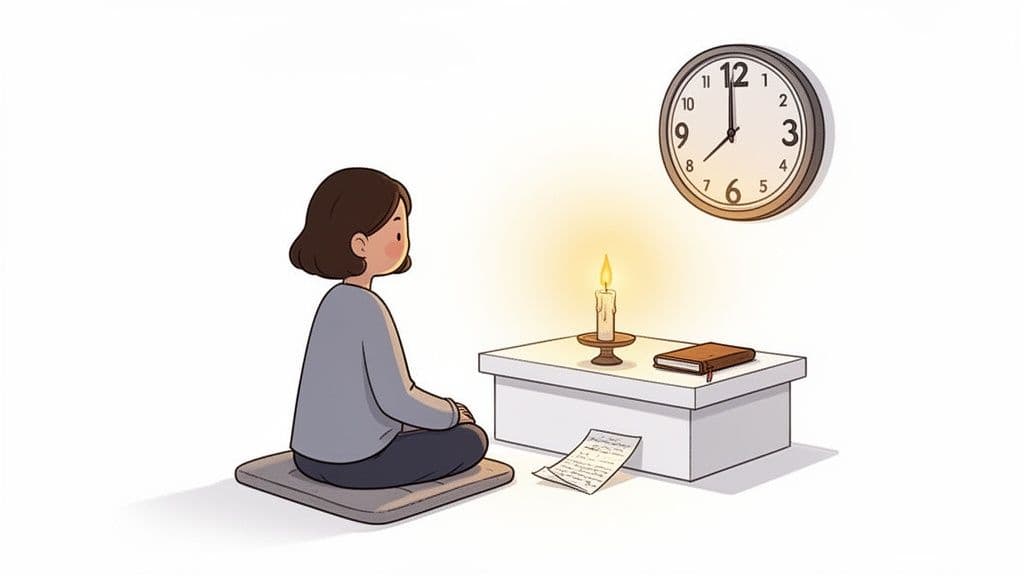
A person meditates, reflecting by candlelight, with a clock showing midnight, a book, and a note.

From Doing to Being

When you perform a ritual, you’re not just making a verbal promise to yourself. You’re engaging in a symbolic act that makes your desires feel tangible and real. This physical practice creates a powerful psychological anchor for your hopes.

Think about how deeply ingrained practices become cultural cornerstones, like the tradition of Chai tea from India as a daily ritual. It’s never just about the drink; it’s about the meaning, the pause, and the connection behind the action. Your New Year's ritual can have that same depth.

Connecting with Ancient Wisdom

While over 1 billion people worldwide participate in New Year's traditions, an estimated 80% of resolutions are abandoned by the second month of the year. That’s a huge disconnect. It tells us we need something more than just wishful thinking.

This is where you can draw on ancient wisdom to add structure and insight. For instance, in his book, “The Life You Were Born to Live,“ Dan Millman maps out dozens of distinct life paths based on birth dates. Understanding your specific path helps you see your core strengths and challenges, allowing you to create a ritual that’s perfectly aligned with who you are.

The Life Purpose App brings these kinds of insights right to your fingertips, helping you set intentions that genuinely resonate. For more on structuring this, take a look at our guide on how to use goal-planning templates for your intentions.

A ritual transforms a moment in time into a meaningful experience. It’s the difference between watching the clock strike midnight and consciously stepping through a doorway into your future.

By creating your own personal ceremony, you shift from passively hoping for a better year to actively co-creating it.

Preparing Your Space and Mind for Your Ceremony

A truly meaningful New Year’s ritual doesn't just spontaneously happen. It starts with setting the stage, both in your physical environment and in your own mind. Think of this preparation as the first, crucial part of the ceremony itself.

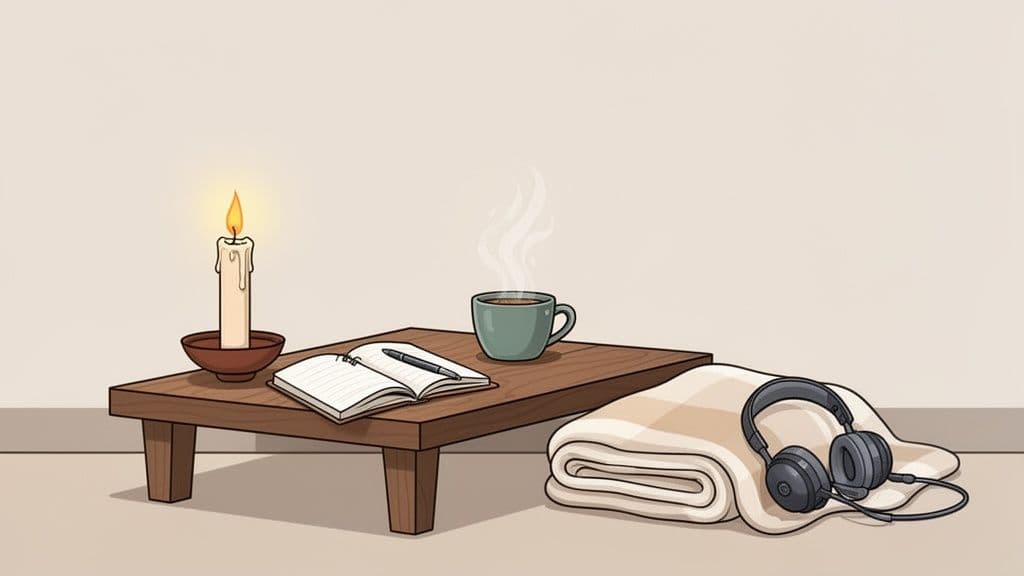
A cozy setup with a lit candle, steaming coffee, notebook, and headphones for quiet reflection.

First things first, find a time and a place where you can be completely undisturbed. This might mean waking up an hour before anyone else or waiting until the house is quiet late at night. Your spot can be as simple as a comfy chair in a quiet corner.

The real magic is in making that space feel special. The physical act of tidying up your chosen area can do wonders for clearing away mental clutter. If you want to go deeper, you can also learn how to remove negative energy from your home to create a truly supportive atmosphere for your reflections.

Setting an Intentional Atmosphere

Turning your corner into a sacred space is all about engaging your senses. You don't need elaborate tools—just a few items that hold meaning for you. Below are some ideas for gathering your ritual toolkit.

Your New Year's Ritual Toolkit

CategoryItem ExamplesPurpose
SightCandle, soft lamp, string lightsCreates a warm, focused, and serene visual environment.
SoundInstrumental music, nature sounds, singing bowlCalms the mind and helps block out distracting household noises.
ScentIncense, essential oil diffuser, palo santoScent is tied to memory and emotion; use it to signal a special moment.
TouchCozy blanket, favorite mug, smooth stone, crystalA physical anchor to hold can help keep you grounded and present.
ReflectionJournal and pen, notebookThe essential tools for capturing your thoughts, lessons, and intentions.

These are just suggestions, of course. The key is to choose things that make you feel centered and ready to connect with yourself.

Clearing Your Mental Space

With your physical space set, it's time to quiet your mind. This is where your journal becomes your most trusted confidant. There's something about writing by hand that slows us down and connects us to our inner voice in a way that typing just can't match.

The point of looking back isn't to judge yourself for what you did or didn't accomplish. It's about honoring the journey, gathering the wisdom, and acknowledging your growth before you move forward.

Before you can genuinely look ahead, you have to lovingly close the door on the year that's passed. Here are a few prompts to get you started on that reflection:

  • What’s one word that captures the essence of this past year for you?
  • What were your biggest challenges, and what new strengths did you find in yourself while facing them?
  • Who were the people who mattered most this year, and what did they teach you?
  • What is one lesson you learned that you’ll absolutely carry with you?
  • What are you finally ready to release and leave behind in this chapter?

Working through these questions creates the clarity you need for the rest of your ritual. You're consciously and gratefully closing one door before you turn to open the next one.

Designing Your Personal Ritual: A Three-Act Ceremony

Now that you've prepared your space and cleared your mind, we get to the heart of it all: bringing your ceremony to life. A New Year's ritual doesn't need to be some grand, complicated affair. Its real power comes from your intention, not from a bunch of rigid rules.

I find it helpful to think of the ceremony flowing through three natural acts. This simple structure—releasing, intending, and welcoming—isn't a strict script. Think of it more as a gentle guide to help you move from the past into the future with real awareness. It’s your ritual, after all. Make it feel like you.

Act One: Releasing the Past

The first step in any true renewal is letting go. You’ve already spent some time reflecting on the past year, so now is the moment to consciously release whatever is no longer serving you. This symbolic act is what creates the open space needed for new energy and experiences to find their way in.

Fire is a classic and incredibly powerful way to do this. Grab a piece of paper and write down everything you’re ready to leave behind—habits, fears, old beliefs, lingering resentments. Don't be vague; get specific.

Next, find a safe way to burn it. A fireproof bowl, your fireplace, or an outdoor fire pit works perfectly. As you watch the paper catch flame, really visualize the smoke carrying away the weight of those burdens. See them turn to ash and feel yourself becoming lighter. If fire isn't an option, no problem. Shredding the paper into tiny pieces or even burying it in the earth can be just as potent.

The point of releasing isn't to forget what happened or pretend it didn't exist. It's about making a conscious choice not to carry its weight forward. You honor the lessons, and then you set down the baggage.

This part of your ritual is a powerful declaration that you refuse to be defined by old stories. It's you, creating a clean slate for yourself.

Act Two: Setting Your Core Intention

With all that new space you've created, it's time to plant a seed. Instead of a long to-do list of resolutions, this is about focusing on one single, powerful intention for the year. A resolution often feels like a chore, saying, "I will do this." An intention is a statement of being: "I am becoming this."

Start by thinking about the feeling you want to invite into your life this year. Is it more peace? More vibrant creativity? A deeper sense of connection?

Once you have that feeling, craft a short, positive statement in the present tense, as if it's already true. For example:

  • Instead of "I will stop worrying so much," try: "I am grounded and trust the flow of my life."
  • Rather than "I want to get a new job," shift it to: "I am open and receptive to fulfilling opportunities."
  • Instead of "I will lose 20 pounds," an intention might sound like: "I lovingly care for my body and make choices that honor my health."

Write this down on a fresh piece of paper. Say it out loud. Feel the truth of it resonate in your body. This one sentence becomes your North Star for the year—a touchstone you can return to whenever you need to find your way.

Act Three: Welcoming the Future

The final phase is all about sealing that intention and formally welcoming the energy of the New Year. It's a moment of quiet celebration and embodiment, turning your focus from what has been to all that can be.

And you're not alone in this. Every New Year's Eve, over 1 billion people join in celebrations that mix festive fun with a deep, collective hope for renewal. These modern ceremonies are a direct descendant of ancient practices, like the Babylonians' 4,000-year-old Akitu festival where they made promises to their gods. Today, those have evolved into our personal commitments to growth and well-being. If you're curious, you can learn more about these fascinating global traditions on Oddee.com.

Here are a few simple ways you can close your ritual and welcome what's to come:

  • Light a New Candle: Designate a special candle just for your intention. As you light it for the first time, state your intention one last time. You can relight this candle anytime during the year when you need a reminder of your path.
  • A Moment of Visualization: Close your eyes and just imagine your year ahead, completely infused with the feeling of your intention. Don't get hung up on specific outcomes, just sit with the positive energy you're calling in.
  • A Symbolic Sip: Raise a glass—of water, herbal tea, champagne, whatever feels right. Make a toast to yourself, to your journey, and to the beautiful year you are now stepping into.

This final step brings everything full circle. You've cleared out the old, planted a seed for the new, and now you're opening your arms to receive whatever comes next.

Aligning Your Ritual With Your Life Path

If you want to add a powerful layer of personal meaning to your New Year's ritual, you can sync it up with your own unique spiritual blueprint. This isn't about grabbing a generic script off the internet; it's about customizing your ceremony so it truly resonates with the specific energy flowing through your life right now.

A fantastic way to do this is by getting to know your life path number. Dan Millman’s book, "The Life You Were Born to Live," lays out a fascinating system that helps you uncover your core purpose using just your birth date. The Life Purpose App brings this wisdom to your fingertips, showing you the exact themes you’re meant to be exploring.

Understanding Your Personal Year

One of the most valuable insights you can get is figuring out which year you're in within your personal nine-year cycle. Each year carries its own distinct vibe, and when you tailor your ritual to that theme, it becomes incredibly potent.

Here's how it works:

  • A `1` year is all about fresh starts and planting new seeds. This is the perfect time for a ritual focused on launching a new venture or embracing a completely new mindset.
  • A `5` year brings themes of freedom, big changes, and adventure. Your ceremony could be all about finally breaking free from old patterns that have held you back.
  • A `9` year signals completion, endings, and release. This is the ideal moment for a ritual that's heavily centered on letting go of what no longer serves you.

Knowing this lets you work with the natural current of your life instead of fighting against it. It’s like adding a little cosmic timing to your personal goals. You can discover your personal year and calculate your life path number using these very principles.

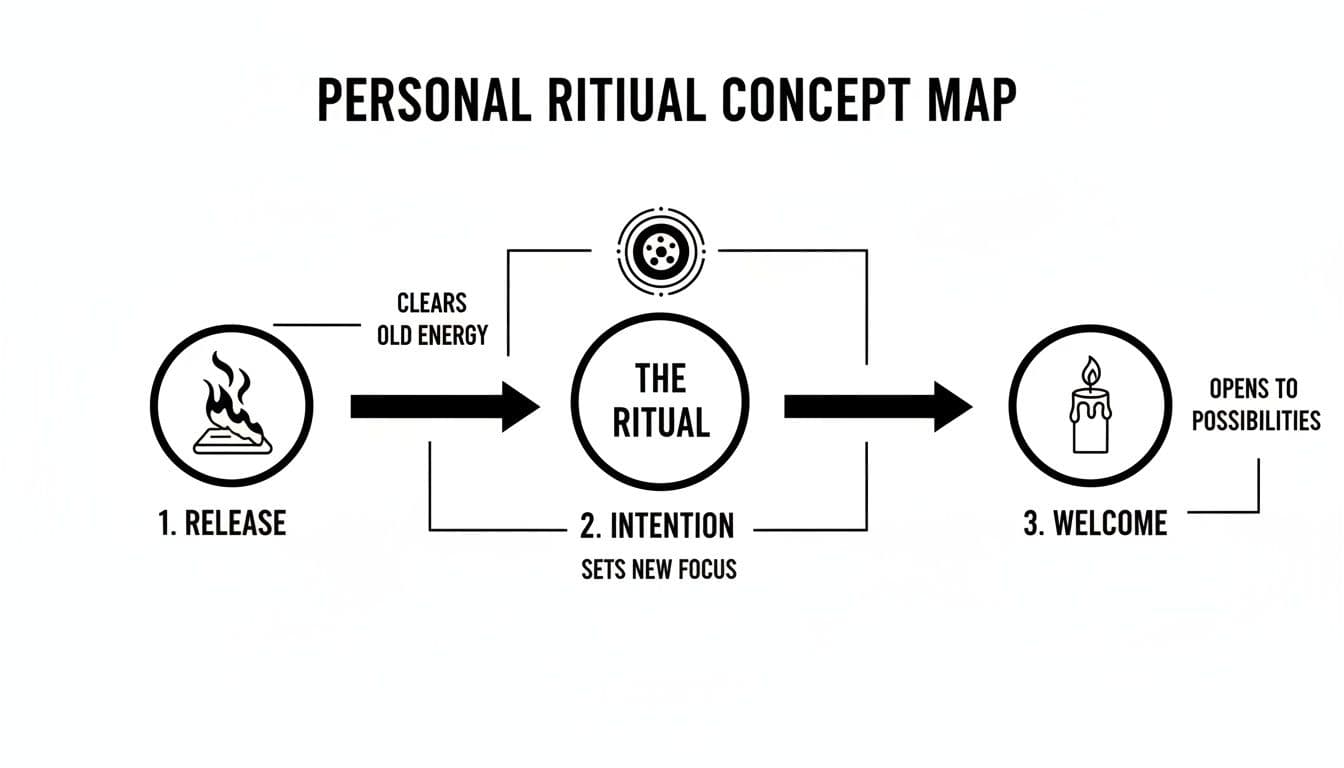
This simple map shows you that profound flow—from releasing the old to setting your intention and welcoming what's next.

A personal ritual concept map with three steps: Release old energy, set new intention, and welcome new possibilities.

Each part of the ritual builds on the last, creating a clear pathway from the past you're leaving behind to the future you are consciously stepping into.

Your Ritual as a Personal Development Framework

Think of your New Year's ritual as a bespoke personal development plan, one you've designed to guide your growth for the entire year ahead. When you infuse it with insights from your life path, you're not just hoping for the best; you're creating a roadmap that is uniquely yours, one that honors both your innate gifts and your current challenges.

This kind of personalized insight is exactly what makes the ritual feel so anchored and real. It turns a symbolic act into a practical guidepost for your life.

By aligning your ritual with your life path, you're essentially saying to the universe: "I see the lessons I'm here to learn, and I'm ready to consciously participate in my own growth."

This adds a profound sense of purpose that you can feel. As outlined in Dan Millman's "The Life You Were Born to Live" and available in the Life Purpose App, these cycles aren't a modern invention; they mirror ancient wisdom where birth dates can reveal one of several unique paths. A New Year's ritual becomes the perfect container to reflect on your personal gifts and challenges, especially around big themes like money, sexuality, and relationships.

Ultimately, personalizing your ritual this way makes it exponentially more powerful. You’re no longer just setting a vague intention; you're creating a sacred act that honors your specific journey, right here and now.

Keeping the Magic Alive All Year Long

So you’ve had this powerful, moving experience with your New Year's ritual. Now what? The energy you stirred up doesn't just vanish when you blow out the candles. The real magic happens when you carry that feeling with you, letting it shape the days and months to come.

This isn't about some superhuman effort. It’s about creating gentle, consistent reminders that keep your intention alive and well. Think of it as turning a potent, one-night ceremony into a trusted compass for your entire year, helping you stay true to the path you’ve set for yourself.

Weaving Your Intention into the Everyday

The trick to making your intention stick is to sprinkle little reminders throughout your daily life. You don’t need a huge production. Just small, simple nudges that reconnect you to the clarity and purpose you felt during your ritual.

Here are a few ideas I've seen work wonders:

  • Build a small altar or vision board. Find a little corner—a bookshelf, a windowsill, even a spot on your desk—and fill it with things that represent your intention. It could be photos, quotes, crystals, or colors. Seeing it every day is a quiet, powerful reinforcement.
  • Set monthly check-in dates with yourself. Seriously, put it in your calendar! Take just 15 minutes on the first of every month to grab a cup of tea, sit with your journal, and ask: How am I doing with this? Where do I feel aligned? What needs a little tweak?
  • Turn your intention into a mantra. Write it on a sticky note and stick it on your bathroom mirror or your laptop. Saying it out loud each morning is an incredibly simple but effective way to set the tone for your day before the world rushes in.

Each of these small acts is a way of telling yourself, "I am committed to this." You're actively tending to the seeds you planted, ensuring they have the support they need to grow.

Going Deeper with Post-Ritual Journaling

Your journal is your best friend for this part of the journey. It's a private space to track how your intention is actually showing up in your life—to notice the subtle shifts, celebrate the small wins, and get curious about the challenges.

A week or so after your ritual, once the dust has settled, sit down and reflect on what’s starting to bubble up.

Try these prompts to get the words flowing:

  • Where have I already noticed my intention appearing, even in tiny ways?
  • What new ideas or opportunities have surfaced since I declared this for myself?
  • Have I noticed a shift in how I react or what I prioritize?
  • When did I feel most like the person I want to be this year?
  • What’s one small thing I can do this week to honor what I’ve set in motion?

This ongoing dialogue with yourself is what makes the difference. It turns a single, beautiful moment on New Year's Eve into a living, breathing practice that guides you, supports you, and helps you build the year you truly want.

Still Have a Few Questions?

It's completely normal to have a few lingering questions as you start to plan your own New Year's ritual. Let’s tackle some of the most common ones I hear, so you can move forward with total confidence.

What If I Don’t Feel "Spiritual" Enough?

This is a big one, but let me put your mind at ease: you don't need any particular spiritual or religious beliefs to make this work. At its heart, a New Year's ritual is simply an act of intentional reflection.

Think of it less as a mystical ceremony and more as a focused session of personal planning, but with more soul than a spreadsheet of goals. The real magic comes from carving out time to pause, reflect, and consciously decide where you want to put your energy. Call it mindful, call it intentional—the label doesn't matter.

How Much Time Do I Really Need to Set Aside?

There's no golden rule here. Your ritual could be a quick 15-minute moment of quiet focus or a full-on hour-long ceremony. The important thing isn't the clock; it's the quality of your attention.

Honestly, a short, heartfelt ritual where you're fully present is a hundred times more potent than a long, drawn-out one where your mind is on your to-do list. Don't let a busy schedule stop you. Pick a window of time that feels like a gift, not a chore.

A New Year’s ritual isn’t another task to check off your list. It's a gift you give yourself—a moment of quiet clarity to set the tone for the year.

Is It Too Late If I Missed New Year’s Day?

Absolutely not! While the energy of turning the calendar page is powerful, your personal "new year" can start whenever you declare it.

You can do this ritual on the first weekend of January, on your birthday, or on any day that feels like a clean slate for you. The power is in your intention, not the date on the calendar.

This is all about tuning into your own rhythm. If you want to get even more specific, you can explore tools that connect with your personal timing. Dan Millman’s book, "The Life You Were Born to Live," or the Life Purpose App can offer fascinating insights into your life path, helping you tailor your ritual to your unique journey.


The Life Purpose App offers a gateway to understanding your unique spiritual blueprint, helping you create a New Year’s ritual that aligns perfectly with your journey. Discover your life path and unlock deeper self-knowledge today at https://lifepurposeapp.com.

← Back to blog

Discover Your Life Purpose Today!

Unlock your true potential and find your life’s purpose.