Explore how numerology and career guidance come together through Dan Millman's Life Purpose system. Learn to interpret life paths, gifts, cycles, and workplace

October 18, 2026 (1mo ago)
Numerology and Career Guidance Using Dan Millman's System
Explore how numerology and career guidance come together through Dan Millman's Life Purpose system. Learn to interpret life paths, gifts, cycles, and workplace
← Back to blog
Explore how numerology and career guidance come together through Dan Millman's Life Purpose system. Learn to interpret life paths, gifts, cycles, and workplace
You close your laptop after another working day and realize you're not just tired. You're wondering whether the work still fits. The paycheck matters, but so does the feeling that your abilities are being used for something you care about.
Exploring numerology and career through Dan Millman's The Life You Were Born to Live and the Life Purpose App can give that uncertainty a language. The useful question isn't whether your birth date can choose your profession. It's whether a symbolic description helps you notice something worth investigating.
When Work Stops Feeling Like Work
Perhaps you're good at your job. Colleagues trust you, deadlines get met, and there's no obvious reason to leave. Yet the parts you enjoy, explaining a difficult idea, solving an unfamiliar problem, helping someone grow, occupy less and less of your day.
That distinction matters. Disliking your current arrangement doesn't necessarily mean you've chosen the wrong profession. You might need different responsibilities, clearer boundaries, or an employer who makes better use of your skills.

A mirror rather than a manual
Dan Millman's The Life You Were Born to Live, the foundation of the Life Purpose App, places life-path interpretation within a broader discussion of livelihood, health, money, sexuality, and relationships. Its career guidance emphasizes work consistent with a person's innate drives and abilities, rather than a guaranteed occupational destination, as described in the book's published overview.
Read that way, the framework becomes a mirror. You look at a description, compare it with your experience, and ask where the resemblance holds or breaks down.
For example, suppose you enjoy translating complex material into clear explanations. That doesn't automatically make teaching your next career. You could explore training colleagues, writing documentation, advising clients, or improving communication within your existing role.
A useful starting question: What conditions help me do work I can respect, using abilities I can actually demonstrate?
This question leaves room for discovery. It also separates the work itself from the setting in which you do it.
Before deciding you need a new professional identity, examine your ordinary week. Note which tasks engage you, which drain you, and which you'd willingly practice. Those observations give you something concrete to bring to the book, instead of asking it to make the decision for you.
The Life Purpose Framework at a Glance
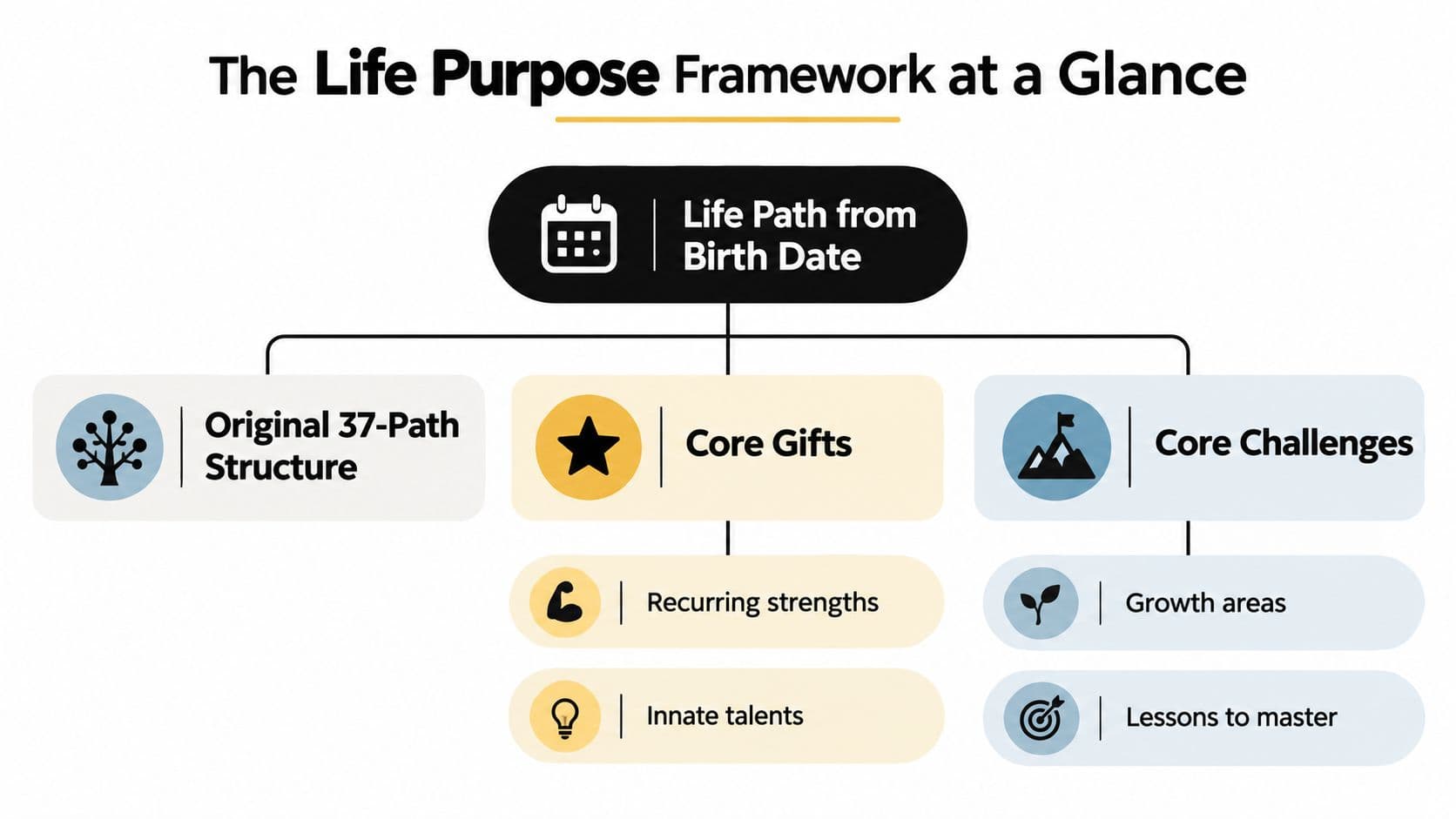
Dan Millman's The Life You Were Born to Live and the Life Purpose App organize life paths through a birth-date-based interpretive system. The birth date supplies the starting point; the accompanying descriptions supply themes to consider. Neither should be mistaken for a skills assessment.
Begin with the calculation instructions in the book or enter your birth date into the app. Follow this particular system rather than borrowing a calculation from an unrelated website. Then read the surrounding material, not just the resulting label.
Original vs Expanded Life Purpose System
The original book described 37 paths, while later material associated with the revised edition describes 45 paths, extending the framework to people born after 2000, according to the edition information for Millman's book.
| Feature | Original Book Framework | Extended Material in the App |
|---|---|---|
| Scope | Original set of paths described above | Expanded set described above |
| Birth-date coverage | Earlier framework | Extension includes later birth dates |
| Career emphasis | Drives, abilities, and purposeful livelihood | Digital exploration of the book-based material |
| Responsible use | Interpret themes alongside experience | Use accessible descriptions without treating them as assessment scores |
The difference is coverage, not proof that the expanded material predicts career outcomes more accurately. A larger interpretive map is still an interpretive map.
Read the layers together
A path label in Dan Millman's The Life You Were Born to Live and the Life Purpose App is an entry point, not the entire reading. For career reflection, distinguish these working terms:
- Innate drives: Motivations the description invites you to examine.
- Core gifts: Suggested strengths to compare with your actual work.
- Recurring challenges: Possible difficulties to investigate without turning them into permanent defects.
- Wider context: Connections with other areas of life that may affect your choices.
Keep a notebook beside the reading. Record what resonates, what doesn't, and what remains uncertain. Don't force yourself to fit every sentence. A useful interpretation should leave you with sharper questions, not pressure to become the person described.
Reading Core Gifts and Challenges at Work
Suppose a description makes you think you're good at bringing scattered information together. That's a promising observation, but feeling recognized isn't the same as demonstrating a skill. Look for a report, presentation, or project where your synthesis helped someone understand a problem.
When reading gifts and challenges in Dan Millman's The Life You Were Born to Live through the Life Purpose App, translate symbolic language into something a colleague could observe. This protects you from accepting an appealing description without checking it.
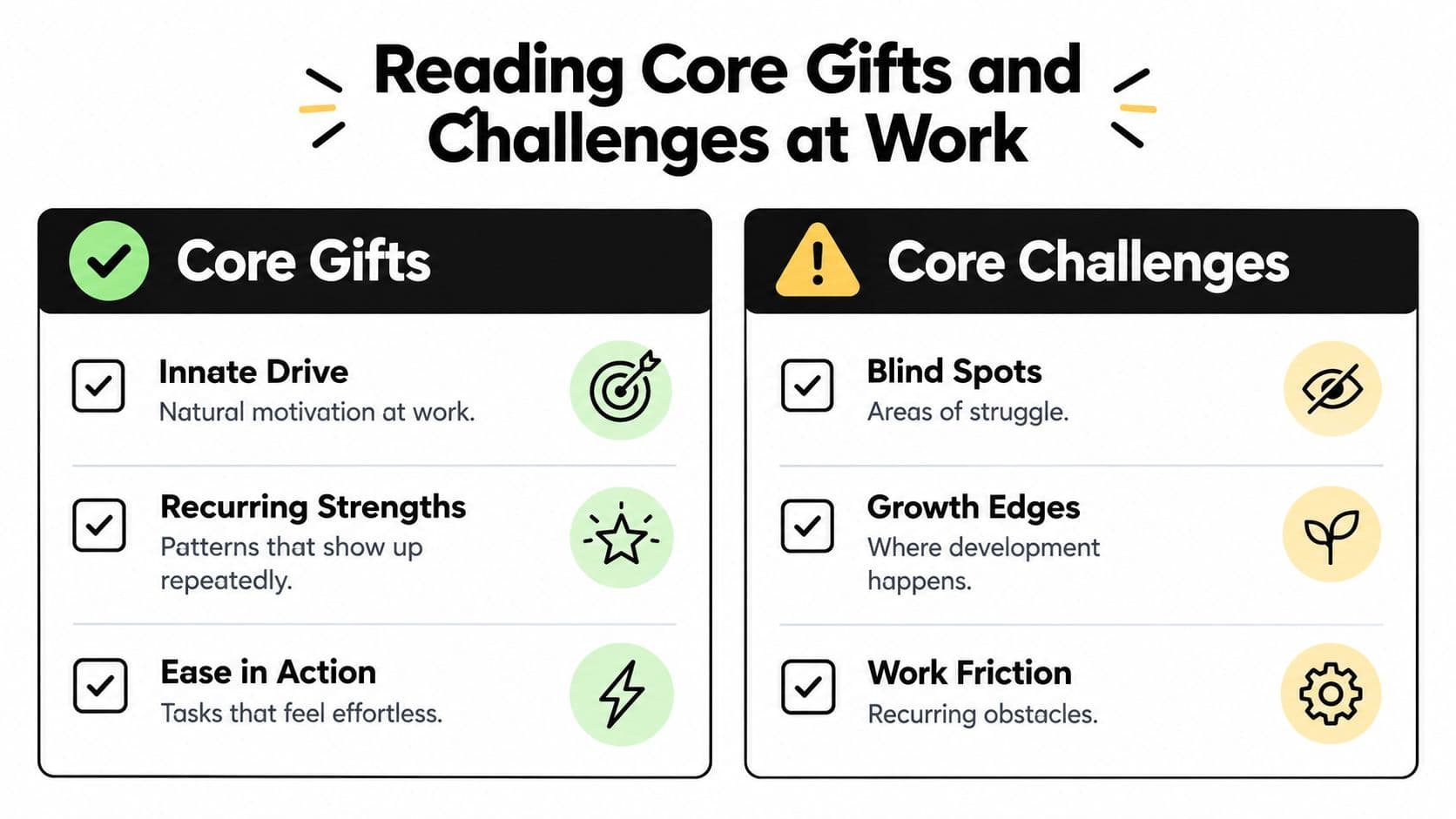
Translate the theme into behavior
A review of career-decision tools emphasizes the importance of reliability, validity, and practical usefulness in empirically tested instruments. A responsible application of symbolic reflection is therefore hypothesis generation: name a possible pattern, define what would count as evidence, and investigate it.
| Reflective theme | Observable behavior to examine | A question worth testing |
|---|---|---|
| Synthesis | Turning varied information into a clear recommendation | Can someone use my summary to make a decision? |
| Autonomy | Completing work with limited supervision | Do I deliver reliably when I set my own schedule? |
| Difficulty with detail | Missing requirements or unclear handoffs | Would a checklist improve the quality of my work? |
These are illustrative translations, not assigned traits for particular birth dates. They show how to move from an interpretation to an investigation.
Separate motivation from capability
Wanting independence doesn't establish readiness for freelance work. You might enjoy choosing your methods but dislike finding clients, negotiating scope, or managing uncertain income. Likewise, enjoying research doesn't mean you've developed the methods a research role requires.
To distinguish what matters to you from what you can already do, HiredBySkill's resource can help you find your core career values.
Ask yourself:
- Evidence: Which completed projects support this supposed strength?
- Feedback: What would someone who has worked with me confirm or challenge?
- Development: Is this difficulty a skill gap, a workload problem, or an unclear expectation?
You're not trying to prove the reading right. You're trying to understand your work more accurately.
Nine-Year Cycles and Career Timing
You may know what interests you and still feel unsure about timing. Should you take the course now, pursue a leadership role, or give yourself space to recover? Those are different decisions, even when they concern the same occupation.
Dan Millman's The Life You Were Born to Live connects career exploration with nine-year life cycles, and the Life Purpose App makes the book-based cycle material available for reflection. The book's livelihood framework places work within a wider changing life context, rather than treating vocation as a fixed decision.
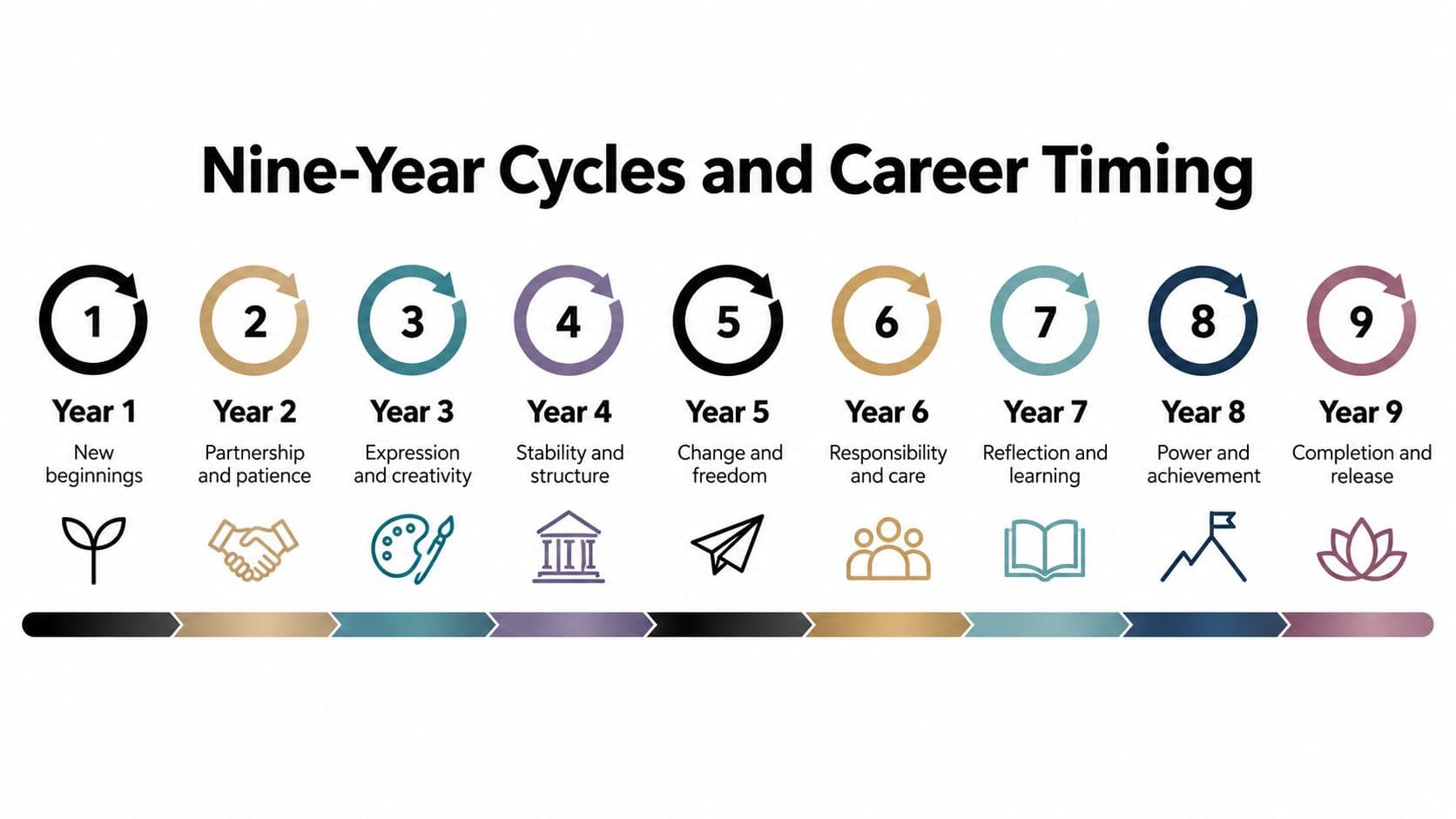
Questions for different seasons
You can use the themes as prompts for exploration, consolidation, and legacy across different decades. That doesn't mean younger people must explore while older people must mentor. Someone can begin again after an established career, and someone early in working life can value stability.
Consider the distinction:
- Exploration: What unfamiliar work could I try without abandoning my current responsibilities?
- Consolidation: Which existing ability deserves deeper training or a more sustained commitment?
- Legacy: What knowledge could I document, teach, or pass to colleagues?
For a closer explanation of the symbolic timing framework in Dan Millman's The Life You Were Born to Live and the Life Purpose App, consult the guide on nine-year cycles.
Use timing without surrendering judgment
Suppose you're considering further study. A reflective theme might help you articulate why learning feels important now. The practical decision still depends on the course content, entry requirements, schedule, cost, and relevance to the work you want.
A calendar theme can prompt a question. It can't establish that an opportunity is safe, affordable, or suitable.
Try sampling the subject before making a substantial commitment. Attend an introductory session, complete a small assignment, or talk with someone who uses the skill professionally.
Treat timing as a planning lens, not a deadline imposed by your birth date. You don't need to delay a sound opportunity because a symbolic description seems mismatched, and you shouldn't rush into an unsuitable one because it seems aligned.
Compatibility Insights for Colleagues and Teams
A colleague sketches possibilities quickly; another wants requirements clarified before anything begins. They might complement each other, or they might spend meetings feeling that the other person is obstructing progress. The useful question is how they can coordinate, not which personality is preferable.
For life-path compatibility in Dan Millman's The Life You Were Born to Live, the Life Purpose App offers relationship exploration involving saved contacts and public figures through in-app Wikipedia look-ups. In a workplace setting, treat the resulting interpretations as conversation prompts, not measurements of team effectiveness.
Shared rhythm or complementary roles
Similar preferences can make cooperation feel straightforward. Colleagues may agree about how much preparation a meeting needs or how quickly to move from discussion to action. But shared preferences can also leave work unattended if everyone avoids the same tasks.
Contrasting preferences offer a different possibility:
| Working pattern | Potential contribution | Agreement to discuss |
|---|---|---|
| Broad strategic thinking | Identifying direction and alternatives | When must ideas become a defined proposal? |
| Detail-focused execution | Checking requirements and completing handoffs | Which details are essential before work begins? |
| Shared enthusiasm for experimentation | Generating and testing possibilities | Who will document results and close unfinished work? |
These are hypothetical work patterns, not outcomes predicted by particular numbers. Ask colleagues how they prefer to work before interpreting their behavior.
Keep the conversation voluntary
Don't use a symbolic description to assign someone a role, explain away conflict, or make hiring and promotion decisions. A person who enjoys detail may still want strategic experience. Someone who speaks confidently may prefer contributing expertise rather than managing others.
Useful questions include:
- Communication: Do you want feedback in writing, in conversation, or both?
- Ownership: Which decisions can each person make independently?
- Repair: How should we raise concerns before frustration builds?
The interpersonal intelligence example offers a related starting point for thinking about everyday interactions.
Keep birth-date sharing optional, especially where managers are involved. Nobody should have to accept a spiritual framework to participate fully at work. Clear agreements, respectful feedback, and observed performance remain the practical basis for cooperation.
What Birth-Date Numerology Cannot Promise
Birth-date numerology cannot responsibly promise a suitable occupation, higher earnings, promotion, or career success. Dan Millman's The Life You Were Born to Live and the Life Purpose App can support meaning-making, but their interpretations shouldn't be presented as psychometrically validated career diagnostics.
The distinction is between subjective recognition and predictive evidence. A description can feel personally meaningful without demonstrating that it forecasts how you'll perform in a job.
What stronger evidence looks like
An occupational-psychology review of interests and online self-assessments reports moderate criterion-related validity for vocational interests across outcomes including job performance, training performance, job knowledge, and tenure. It also reports that using multiple interest dimensions works better than simple one-dimensional matching.
Personality research provides another contrast. A 2024 study of software engineering and data-science professionals examined the Big Five traits and reported that extraversion, conscientiousness, and openness influenced preferences for different career roles (personality and career-role research). That doesn't make personality a verdict either, but it provides an empirical basis that symbolic birth-date interpretation lacks.
Check meaning and sustainability separately
Career satisfaction isn't only an inner alignment problem. You also need to examine compensation, workload, management, safety, and opportunities to develop.
| Decision axis | Questions to ask |
|---|---|
| Meaning | Do I respect the work? Does it use or develop abilities I value? |
| Sustainability | Can I meet my obligations? Are the workload, boundaries, and employment conditions acceptable? |
Research on workplace spirituality, satisfaction, and performance found associations within an education-sector sample. It doesn't establish that numerology causes better performance, and it shouldn't be used to excuse poor employment conditions.
Decision boundary: Meaningful work doesn't cancel an employer's responsibility to provide fair and workable conditions.
Should you change careers because of a reading? Not on that basis alone. Investigate the attraction, compare it with occupational requirements, and try a reversible experiment before making a consequential move.
A Practical Toolkit for Career Exploration
Suppose a life-path reading points toward teaching, but you have never taught anyone. Treat that theme as a hypothesis, not a job recommendation. A small experiment can show whether the work interests you and whether your skills fit its everyday demands.
Dan Millman's The Life You Were Born to Live and the Life Purpose App offer a life-path theme to investigate. Set it beside an interest assessment, a skills inventory, and information about actual job duties. Validated interest and personality research can help you test whether the theme matches your preferences, rather than treating numerology as proof.
Build a compact evidence record
Use one page to keep interpretation and real-world evidence separate:
- Working hypothesis: Describe a possible preference or strength in everyday language.
- Existing evidence: Note relevant projects, feedback, qualifications, and work you have enjoyed.
- Unknowns: List what you have not tested, including routine tasks and less appealing responsibilities.
- Next experiment: Choose a work sample, informational interview, or introductory course.
- Decision criterion: Decide what result would support continuing and what might lead you to reconsider.
If a blank page feels intimidating, StoryCV's 10-minute career clarity plan offers a way to narrow the question. Focus on one uncertainty, such as whether you enjoy training colleagues, rather than trying to settle your future at once.
Choose the reading depth you need
The Life Purpose App is built around Millman's book. Its free tier includes a life-path summary and system overview. Paid options provide access to the complete text from the 25th Anniversary Edition and detailed analyses. More reading can add context to a theme, but it cannot make a career prediction certain.
For planning beyond the reading, use the app's guidance. Then bring your evidence record to an informational interview. Ask what the job involves on an ordinary day, what competent work looks like, and which entry requirements you still need to meet.
The aim is to turn a symbolic theme into a question you can test. Let observed interest, ability, and working conditions shape the decision.
Reading the Book as a Companion, Not a Verdict
The most useful result isn't a new label. It's a better sentence about your working life: “I enjoy explaining difficult material, but I need preparation time,” or “I want independent responsibility with clear expectations.” Those statements help you evaluate projects and vacancies.
Dan Millman's The Life You Were Born to Live and the Life Purpose App are most helpful as companions to that process. You can return to their life-path reflections when your responsibilities change, while allowing your experience to revise your understanding.
Try a small piece of real work
Choose a possible gift or challenge and test it during the coming week. If you suspect that explanation is a strength, create a short guide for a task you know well. Give it to someone unfamiliar with the task and ask them to use it.
Don't ask only whether they liked the guide. Ask where they became confused, whether they completed the task, and what information was missing. Then revise it.
- Observe the work: Did the outcome meet the need?
- Observe yourself: Did you enjoy preparing, delivering, and improving it?
- Observe the setting: Did the available time, support, and expectations help or hinder you?
If the experiment goes poorly, resist turning that result into a permanent judgment. You may need practice, a different audience, or clearer instructions. If it goes well, you have a reason to try a more demanding version.
Let your understanding change
You don't have to choose between spiritual reflection and practical judgment. You can find personal meaning in a framework while refusing to let it overrule evidence, financial responsibilities, or your own agency.
Keep what helps you ask useful questions. Set aside what doesn't match your experience. Career growth can involve a different profession, but it can also mean better boundaries, deeper competence, or a more suitable role within familiar work.
The aim is to build a working life you can understand and sustain, not to prove that a description was right.
The Life Purpose App offers a free summary and system overview based on Dan Millman's The Life You Were Born to Live, with fuller book content available through paid options. Visit Life Purpose App, choose a career-related theme to reflect on, and turn it into a small work experiment you can evaluate for yourself.
Discover your life path today
Enter your date of birth and see your life path, free.
Find your life path