Discover what your numerology personality reveals using Dan Millman's The Life You Were Born to Live — life paths, core gifts, and how to interpret them.

October 8, 2026 (7d ago)
Numerology Personality Explained Through Your Life Path
Discover what your numerology personality reveals using Dan Millman's The Life You Were Born to Live — life paths, core gifts, and how to interpret them.
← Back to blog
Discover what your numerology personality reveals using Dan Millman's The Life You Were Born to Live — life paths, core gifts, and how to interpret them.
You read a description of your personality and pause. It mentions independence, a recurring struggle, or the need for meaningful work, and the wording feels surprisingly personal. Then comes the natural question: can a birth date really reveal that much about you?
Dan Millman's The Life You Were Born to Live offers a clear system for exploring that question through life paths. The Life Purpose App turns the same framework into a digital tool. Together, they provide a way to examine numerology personality through a specific calculation, a structure of 45 life paths, and changing nine-year cycles.
This approach is more useful when you know exactly what the number represents, how it was calculated, and where interpretation ends. You can also compare a symbolic reading with a more conventional way to identify your strengths with this test, then notice where the two approaches agree or differ.
The aim here is precision. You'll learn how Millman's method works, what a life path is intended to describe, and how to use the result as a prompt for honest self-reflection rather than as a fixed verdict.
Why Your Numerology Personality Feels So Accurate
A reader named Maya opens a personality profile during a quiet evening. The description says she values independence, ponders before acting, and sometimes holds herself to demanding standards. She recognizes herself immediately. The profile seems to understand the private tension between wanting freedom and wanting reassurance.
That feeling is common with personality readings. Broad statements can connect with real experiences, especially when they describe qualities many people see in themselves. The emotional response may be genuine even when the reading doesn't prove that a birth date caused those qualities.
Dan Millman's The Life You Were Born to Live gives numerology personality a defined structure rather than a loose collection of number meanings. Its method begins with the complete birth date, maps the result to one of 45 life paths, and connects that path with themes such as talents, challenges, health, money, sexuality, career, and relationships. The Life Purpose App presents this framework digitally, so readers can calculate and explore their profile without manually searching through the book.
A useful starting point: Let the reading raise questions about your life. Don't let it settle those questions for you.
The distinction matters. A description of independence could refer to entrepreneurship, a strong need for personal space, or the ability to make decisions without approval. Those expressions may look different depending on culture, age, work, family responsibilities, and current circumstances.
This article follows Millman's system step by step. You'll see how the birth-date calculation differs from many simplified online methods, why the revised book contains 45 paths, and how the nine-year cycles add movement to a profile. You'll also learn why a reading can feel accurate and how to test its usefulness against observable behavior.
Where Numerology Personality Comes From
Numerology treats numbers as symbols of human and cosmic qualities, not only as tools for counting. Its historical foundation is closely associated with Pythagorean number symbolism in ancient Greece. Pythagoras flourished in the 6th century BCE, and the Pythagorean tradition assigned symbolic and mystical properties to numbers, as described in the historical account of Pythagoras.
In that tradition, 1 represented unity and the origin of all things, because other numbers could be produced by adding units. 2 symbolized the feminine principle, while 3 symbolized the masculine principle. Their union appeared in 5, expressed as 2 + 3. The number 10 also held importance through the tetractys, a triangular arrangement of the first four integers, 1 + 2 + 3 + 4 = 10.
The important historical shift was the move from seeing numbers only as quantities to interpreting numerical relationships as meaningful patterns in nature, human life, and character. That shift occurred during the 6th century BCE, although the historical record is limited. Britannica notes that little is known with certainty about Pythagoras himself, and some discoveries attributed to him may have come from followers or later thinkers.
From ancient symbols to a modern life-path system
Dan Millman's The Life You Were Born to Live is best understood as a modern descendant of this symbolic tradition. It isn't a method directly documented by Pythagoras. Millman organized number symbolism into a practical framework for examining recurring themes in a person's life.
The Life Purpose App follows that same Millman framework. It doesn't require you to accept every interpretation as literal. Instead, the number serves as a starting point for considering patterns, tensions, and possible areas of growth.
Numbers can act as mirrors, not verdicts.
That idea keeps the system grounded. A symbolic profile may help you name an experience that was difficult to describe, but it can't replace direct observation of your choices, relationships, habits, and values.
How to Calculate Your Life Path From Your Birth Date
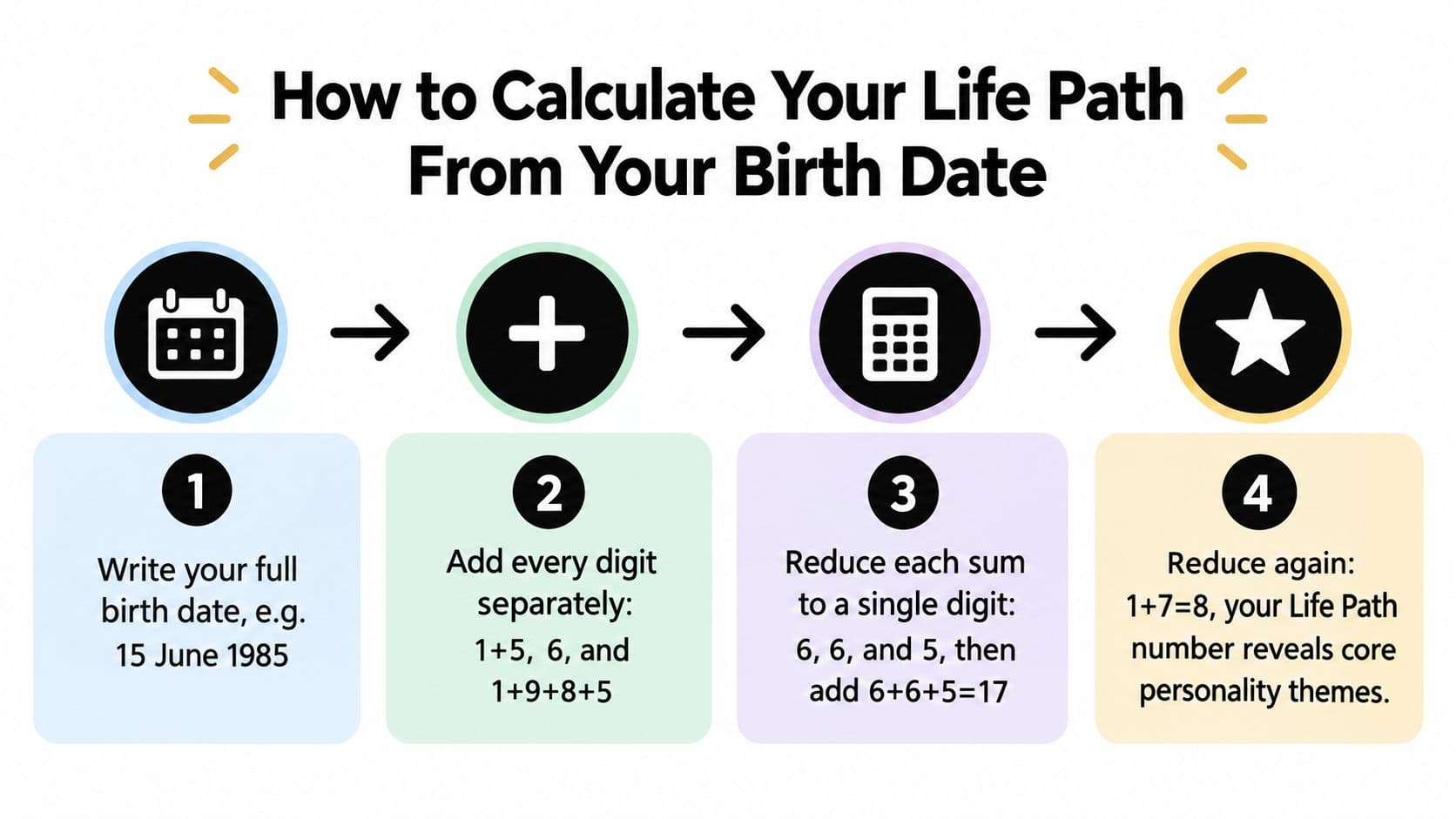
The calculation associated with Dan Millman's The Life You Were Born to Live is straightforward, but one detail often causes confusion. You add every digit in the complete birth date in one continuous sum. You don't first reduce the month, day, and year separately.
Take the example August 25, 1987. Write the date numerically and add each digit:
8 + 2 + 5 + 1 + 9 + 8 + 7 = 40
The resulting total, 40, identifies the relevant profile in Millman's system. It isn't treated only as a conventional single-digit number. The profile associated with the total provides the framework for interpreting the person's life path.
The calculation in practical steps
- Write the full birth date. Include the month, day, and year.
- Separate every digit. For August 25, 1987, the digits are 8, 2, 5, 1, 9, 8, and 7.
- Add the digits continuously. The total is 40.
- Use the resulting total to identify the profile. Millman's system connects that total with one of its life paths.
The most common mistake is to calculate the parts independently. Someone might reduce August, the day, and the year separately, then combine those reduced values. That isn't the calculation method used in The Life You Were Born to Live.
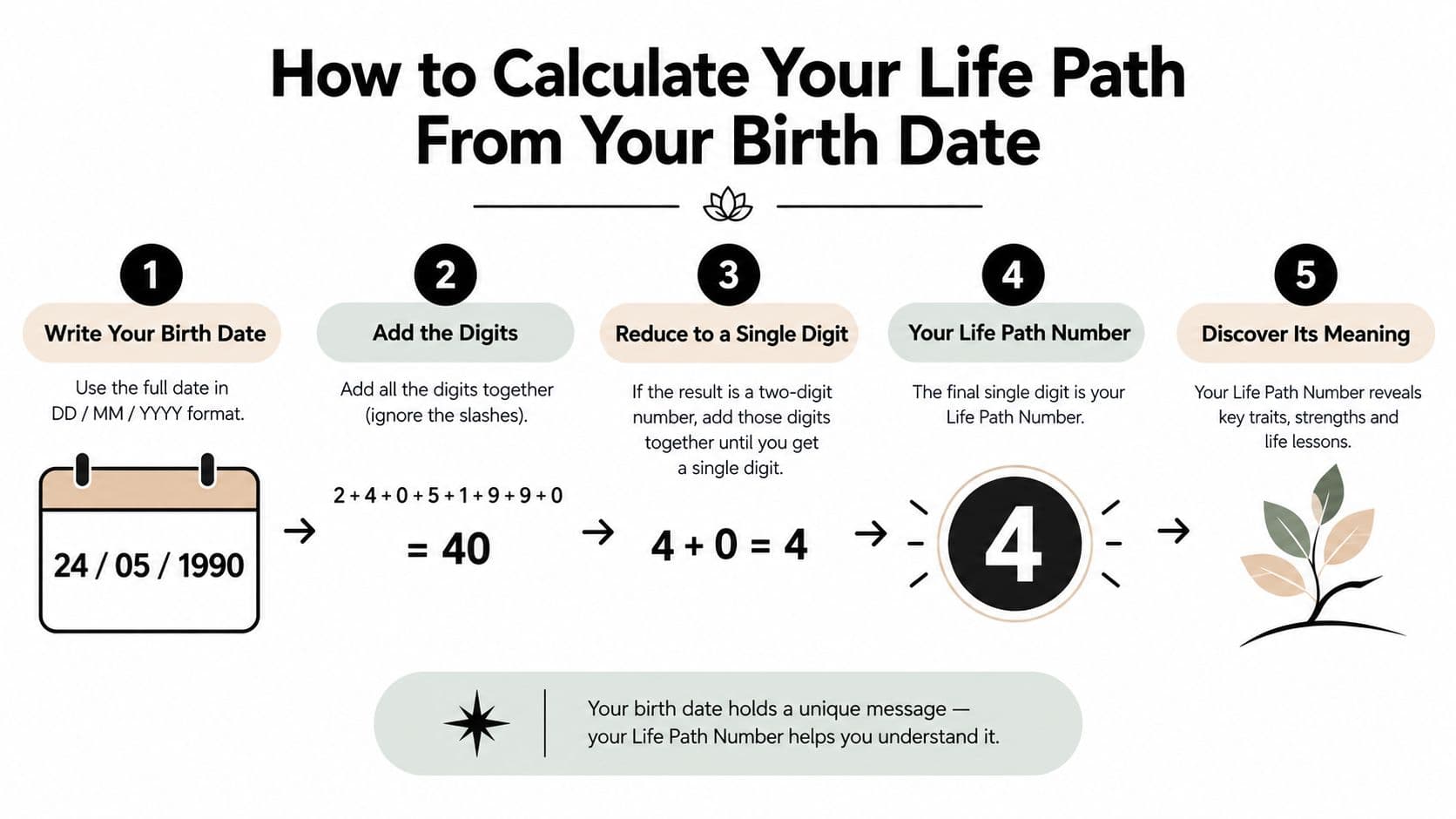
The guide can help you check the process before interpreting the result. The Life Purpose App applies the same birth-date method automatically, which is useful if you want to avoid arithmetic errors or move directly to the associated profile.
Calculation and interpretation are separate steps. First, establish the total accurately. Then read the themes connected with that life path and compare them with your actual experience.
What the 45 Life Paths Reveal About You
The revised 25th Anniversary Edition of Dan Millman's The Life You Were Born to Live expands the original system from 37 life paths to 45, as explained in Millman's discussion of the revised framework. The expanded structure covers people born from 1750 through the present and was intended to represent people born after the year 2000 more completely, since their birth dates weren't fully represented in the earlier edition.
A life path isn't a one-word label such as “creative” or “ambitious.” Each path connects several areas of life, allowing the reader to examine how a core theme might appear in different settings. The book also explains how the system can be used to examine the paths of other people, not only your own.
The profile areas at a glance
| Theme Area | What the Profile Describes |
|---|---|
| Innate talents | Abilities and qualities that may come naturally or develop with practice |
| Core issues | Recurring tensions, lessons, or challenges connected with the path |
| Health | Themes related to wellbeing and personal balance |
| Money | Patterns involving resources, security, earning, or material concerns |
| Sexuality | Intimacy, desire, and the way personal connection may be explored |
| Career | Work-related strengths, difficulties, and possible areas of expression |
| Relationships | Patterns of connection, cooperation, boundaries, and emotional learning |
The value of this structure is its breadth. A person may show independence at work, caution with money, and a strong need for personal space in relationships. Those aren't separate personality fragments. They can be different expressions of a theme that the reader recognizes across contexts.
Read a path as a lens
Millman's framework becomes less useful when readers treat a path as destiny. A life path can suggest questions such as, “Where do I repeatedly take responsibility?” or “What kind of challenge keeps returning in my work and relationships?” It can't make a decision on your behalf.
The Life Purpose App connects the birth-date result with Millman's path material, making it possible to explore the same theme across several life domains. That wider view helps prevent a narrow interpretation based on a single flattering trait.
Riding the Nine-Year Cycles of Your Life
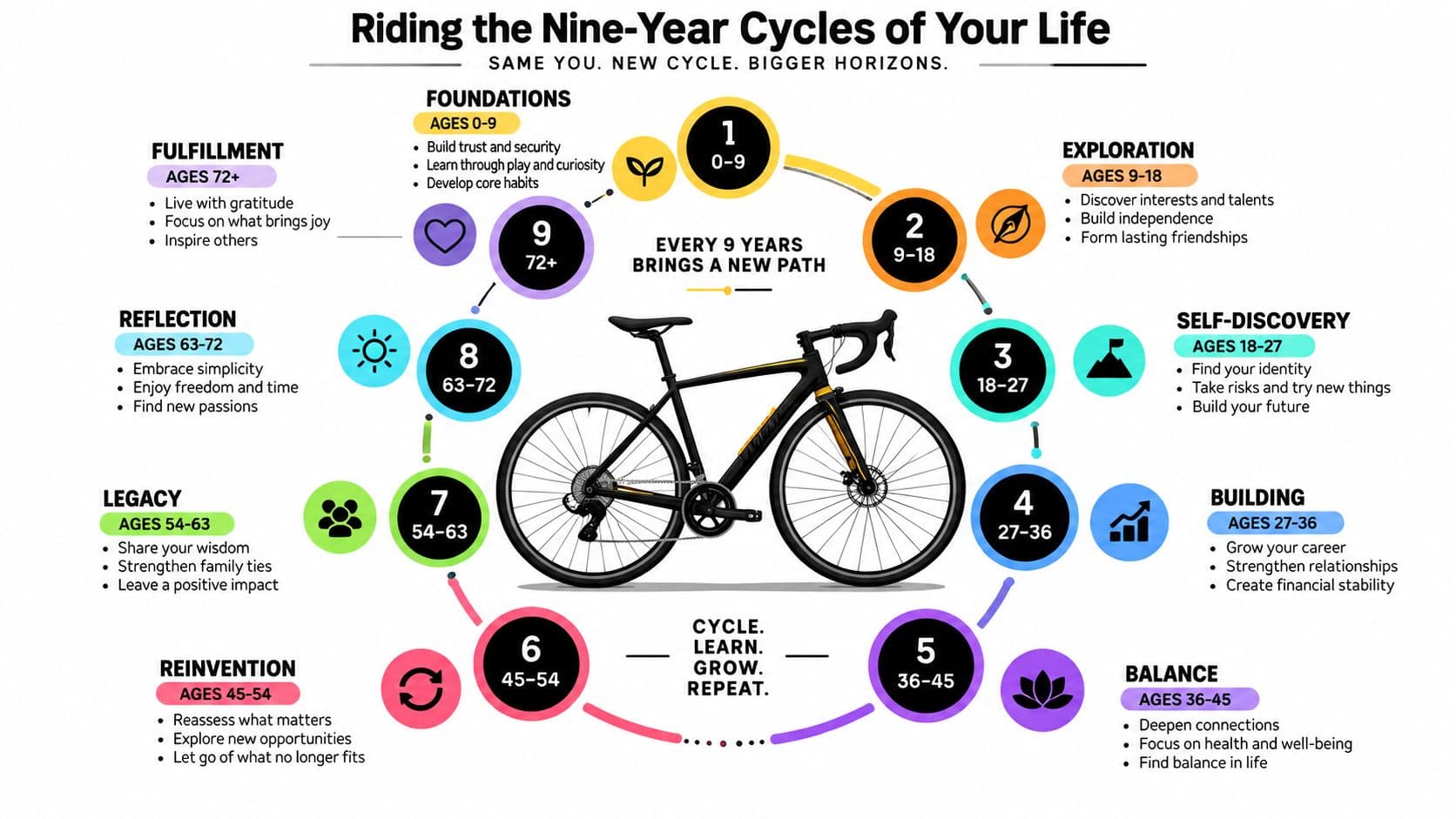
A life path describes a broad pattern, while Millman's nine-year cycles add a sense of timing. Each year carries a distinct emphasis, so the same person may experience their underlying themes differently as the cycle moves forward.
The sequence begins with Year 1, associated with new beginnings and initiative. Year 2 emphasizes cooperation and patience, followed by Year 3 with expression and creativity. Year 4 turns toward structure and effort. Year 5 brings change and freedom, while Year 6 focuses on responsibility and service. Year 7 invites reflection and study. Year 8 concerns leadership and material matters, and Year 9 centers on completion and release, as described in the overview of Millman's nine-year cycle.
One person, different stages
Consider Elena, who has spent years developing a small design practice. During a Year 1 emphasis, she might feel ready to begin a new service or take greater initiative. In Year 2, the practical challenge could involve listening, collaboration, and allowing a partnership to develop rather than forcing quick decisions.
A Year 3 might bring more public expression, such as publishing ideas or presenting creative work. Year 4 could require systems, schedules, and sustained effort. Later, a Year 5 may encourage a change in direction, while Year 6 could place greater attention on clients, family, or community responsibilities.
This doesn't mean Elena must behave according to a timetable. The cycle offers a vocabulary for noticing the kind of work a period seems to invite. The Life Purpose App presents these nine-year themes alongside the life-path material, so the profile has both a stable framework and a changing texture.
A reflective reader might ask, “What am I being asked to begin, strengthen, release, or understand at this stage?” That question is more constructive than using a cycle to predict a guaranteed event.
Seeing Yourself in Typical Life Path Profiles
A Millman-style profile becomes easier to understand when you watch its themes move through ordinary life. The following sketches are composite examples, not predictions about any particular person.

Independence in different surroundings
One person may express independence by building a business and choosing flexible work. Another may show the same theme by becoming financially self-reliant, setting careful boundaries with family, or managing caregiving responsibilities without surrendering personal agency.
The theme doesn't dictate one career. It raises a question about how autonomy really appears in the person's life. Does independence help them make clear decisions, or does it sometimes prevent them from asking for support?
Creativity beyond artistic work
A creative profile doesn't have to mean a career in music, painting, or writing. A teacher may express creativity through lesson design. A product manager may find it in problem-solving. A parent may use it to create rituals that make family life feel meaningful.
The useful test is behavioral. Look for repeated choices, not a single moment of recognition. If someone says, “I'm creative,” ask where that quality shows up, how often it appears, and whether other people can point to concrete examples.
Service with boundaries
A service-oriented theme may appear as mentoring, healthcare work, community involvement, or quiet support for friends. It can also create a challenge if the person consistently gives more than they can sustain.
Culture and life stage change the expression. A young adult may serve through work and friendships, while a parent or older caregiver may experience service through family responsibilities. The same symbolic theme can look generous in one setting and exhausting in another.
Ask whether the profile describes what you consistently do, what happens only under pressure, or what you hope to become.
That distinction protects readers from turning a desirable description into an identity. The profile can open a conversation with yourself, but your repeated behavior supplies the evidence.
Using Your Numerology Personality Wisely
Psychological research offers an important explanation for why generalized readings can feel personal. The Barnum effect, associated with Bertram Forer's 1949 demonstration, describes how people may accept broad and favorable statements as individualized descriptions. A later dissertation examined 441 personality statements with 386 participants and found 150 statements that exceeded a 72.5% endorsement rate, with acceptance strongly associated with social desirability, as reported in the dissertation on generalized personality descriptions.
That research doesn't test Dan Millman's specific framework. It does establish a necessary boundary: perceived relevance isn't the same as predictive validity. There's no credible evidence in the available sources that reducing a birth date to a numerological value causally determines personality, compatibility, or future events.
Use the profile as a reflective hypothesis. Write down which qualities are consistently observable, which appear only during stress, and which you'd like to develop. Then revisit those notes across different nine-year phases and compare them with actual decisions, relationships, and habits.
Avoid using a numerological interpretation as a diagnosis or as professional advice about health, relationships, sexuality, or career. The Life Purpose App and The Life You Were Born to Live can support self-inquiry, but qualified professionals should guide sensitive personal decisions.
Going Deeper With the Life Purpose App
The Life Purpose App works as a digital companion to Dan Millman's The Life You Were Born to Live. You enter a date of birth, find the associated path within the 45-path framework, and explore themes involving gifts, challenges, health, money, career, sexuality, and relationships. It also presents the nine-year cycles and supports relationship exploration through in-app Wikipedia look-ups.
Its free tier provides a life-path summary and system overview. Paid options give you access to the complete 25th Anniversary Edition text, detailed analyses, primary numbers, and cycles. You can also read about the app's broader approach.
Your number is an invitation to know yourself, not a verdict about who you must become. The book provides the framework, and the app provides a practical way to explore it.
Life Purpose App lets you calculate your life path, explore its themes across work and relationships, and follow the nine-year cycles associated with Dan Millman's system. Visit Life Purpose App, enter your birth date, and use the result as a starting point for concrete reflection rather than a fixed label.
Discover your life path today
Enter your date of birth and see your life path, free.
Find your life path