Curious about a numerology reading online? Learn what it is, how it works, and how Dan Millman's Life Purpose App brings clarity to your path.

October 10, 2026 (5d ago)
Numerology Reading Online: What to Expect and How to Begin
Curious about a numerology reading online? Learn what it is, how it works, and how Dan Millman's Life Purpose App brings clarity to your path.
← Back to blog
Curious about a numerology reading online? Learn what it is, how it works, and how Dan Millman's Life Purpose App brings clarity to your path.
An online numerology reading is a structured reflection tool, not a forecast. The most grounded version of this practice is Dan Millman's The Life You Were Born to Live, made digital through the Life Purpose App and its 45-path system.
What would change if you stopped asking whether a number can predict your future and started asking whether a symbolic framework can help you examine the life you're already living? That question separates a thoughtful numerology reading online from a generic personality paragraph.
A birth date can produce a clear calculation. The meaning you draw from that calculation belongs to a spiritual and philosophical system, not to an established science. Dan Millman's book provides the specific framework considered here, while the Life Purpose App turns that framework into an accessible digital reading.
What an Online Numerology Reading Actually Is
An online numerology reading takes information such as your date of birth, applies a defined calculation, and presents an interpretation of the resulting number. In Dan Millman's The Life You Were Born to Live, that interpretation is organized around 45 life paths, each associated with themes such as gifts, challenges, relationships, career, health, money, and sexuality. The Life Purpose App presents this book-based system in digital form.
That distinction matters. A calculator that reduces a date to a single digit and attaches a generic paragraph may be using a different numerology tradition. This article focuses on Dan Millman's specific method, not on a blended collection of unrelated number meanings.
Calculation is not interpretation
The calculation layer answers a narrow question: which birth number does the method assign to this date? The interpretive layer asks what the associated life path might invite you to examine. Those are different tasks, and a responsible reading keeps them separate.
The calculation follows a rule. The interpretation offers a lens. Your experience supplies the evidence.
That structure is why the Life Purpose App can feel more substantial than a free calculator without pretending to offer scientific certainty. Its reading is connected to a named book and a defined framework rather than a one-size-fits-all script assembled from disconnected traditions. The Life You Were Born to Live was first published by HJ Kramer in 1993 and is listed at 447 pages in the Google Books bibliographic record. The revised 25th Anniversary Edition, published in 2018, expanded to 504 pages, according to the same record.
Those details don't prove that the system predicts anything. They do show that Millman's framework is a developed body of material rather than a few interchangeable descriptions.
A useful boundary: The date produces the assigned path. It doesn't force you to accept every sentence written about that path.
What a reading can offer
A reading can give you language for recurring questions:
- Patterns: Do you repeatedly encounter the same type of challenge?
- Strengths: Which abilities do you rely on, and which ones you neglect?
- Tensions: Where do your ambitions conflict with your habits?
- Reflection prompts: What choice, relationship, or responsibility deserves closer attention?
The value is interpretive. If a passage helps you describe something you've struggled to articulate, it may become a useful prompt for journaling or conversation. If it doesn't fit, you're allowed to set it aside.
That approach also prevents a common misunderstanding. A life-path reading isn't a diagnosis, a guarantee of compatibility, or an instruction to make a major decision. It's a structured invitation to look at your choices through Dan Millman's symbolic language.
Why Numerology Carries Meaning at All
Numbers feel objective because mathematics gives them stable quantities. Numerology adds another layer by treating numbers as symbols. That symbolic use has a long history, but history shouldn't be confused with proof of prediction.
The Encyclopaedia Britannica account of Pythagoreanism places numerology's historical foundation in ancient Greek Pythagoreanism. Pythagoras flourished in the sixth century BCE, and the Pythagoreans are identified as the earliest known systematic group to treat numbers as possessing mystical properties. This tradition reaches back more than 2,500 years.
For the Pythagoreans, numbers weren't merely tools for counting. They expressed unity, order, and the structure of the cosmos. In that symbolic system, 1 represented unity and the origin of all things, while 10 was regarded as the most perfect number because it equals the sum of 1, 2, 3, and 4.
Symbolic meaning is not causal power
That history explains why contemporary numerology readings treat numbers as carriers of meaning. It doesn't establish that a birth date causes a personality, determines a relationship, or forecasts a future event.
Dan Millman's The Life You Were Born to Live and the Life Purpose App work best when you hold both ideas at once. You can take the symbolic language seriously as a tool for self-examination while remaining honest that it isn't an empirically validated prediction method.
A birth date is useful in this context because it provides a stable starting point. You don't have to choose which number describes you on a particular day. The system gives you a repeatable entry point, and the interpretation gives you themes to consider.
That repeatability can support reflection. Someone might read a passage about responsibility and ask where they take on too much. Another person might consider a theme about independence and notice how often they avoid asking for help. The insight comes from the examination, not from evidence that the number caused the behavior.
For readers who enjoy symbolic environments, surrounding that reflection with intentional objects can make the experience feel more personal. A resource such as scented candles for star signs may suit someone who already connects spiritual practice with atmosphere. It doesn't add proof to a numerology reading, but it can support a quiet setting for journaling.
A middle ground is more useful
You don't have to choose between unquestioning belief and total dismissal. A grounded approach says:
- The historical tradition is real. Pythagoreanism treated numbers symbolically.
- The calculation can be consistent. Dan Millman's method follows defined steps.
- The interpretation is spiritual and reflective. It isn't established prediction.
- Your judgment remains primary. A reading shouldn't replace professional advice or lived evidence.
The Life Purpose App's role makes the most sense within that middle ground. It digitizes Millman's book-based system so that a reader can access a structured interpretation without turning the result into destiny.
Automated Calculations Versus Personalized Readings
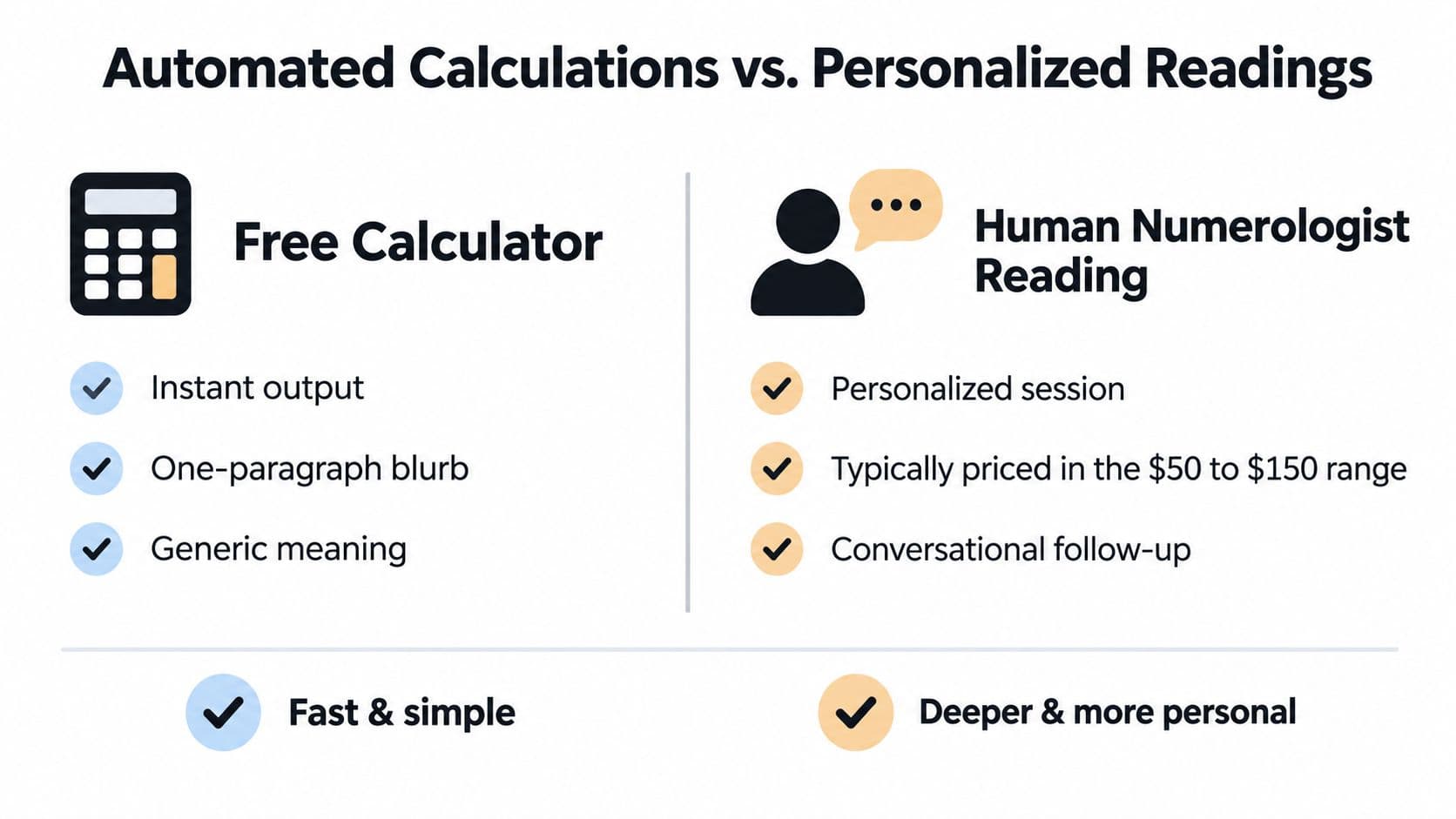
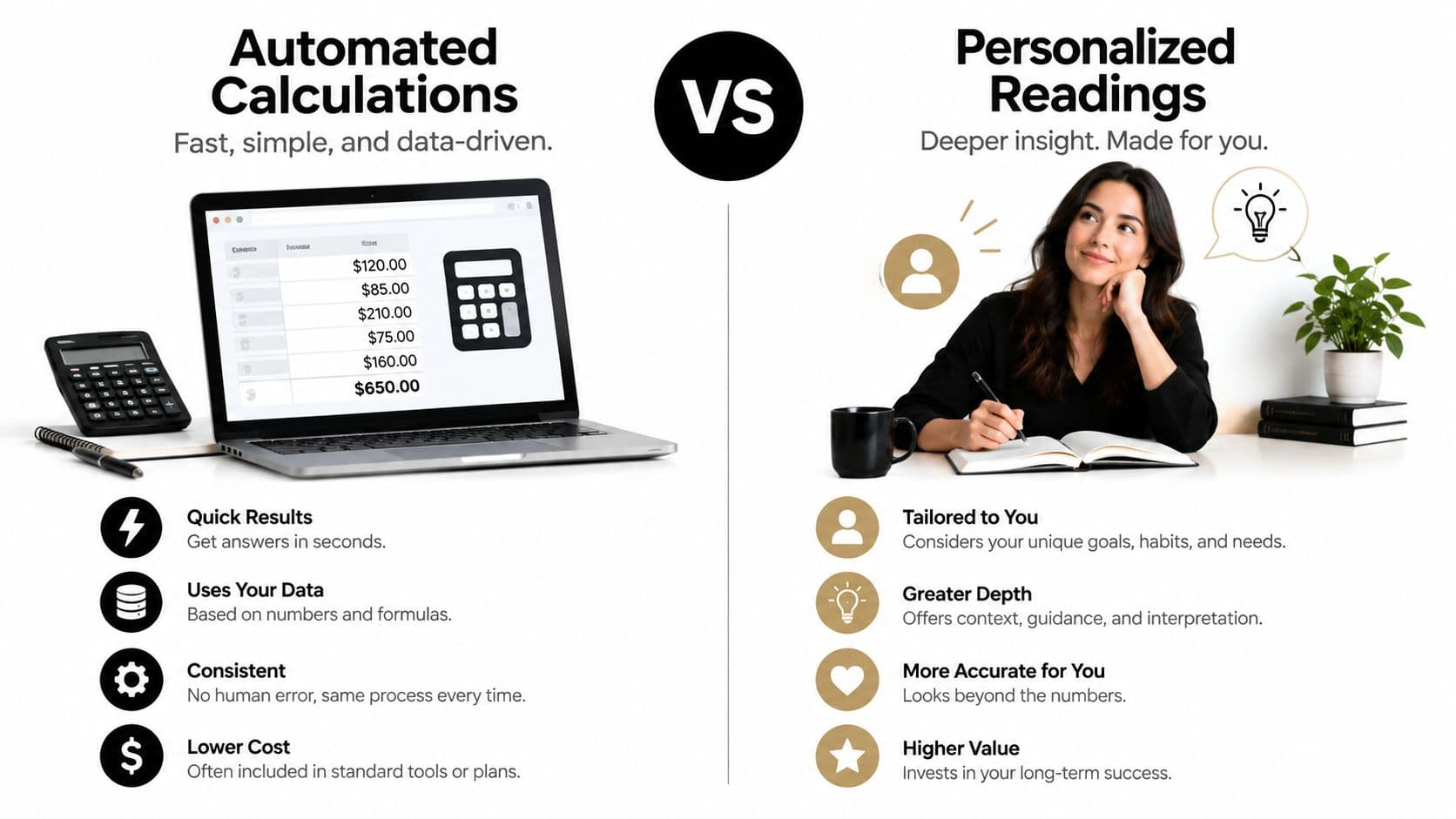
A typical search for numerology reading online produces two familiar options. One is a free calculator that returns an immediate paragraph. The other is a personalized session with a human numerologist who asks questions, follows your responses, and adapts the conversation.
Neither format is automatically meaningful. The better choice depends on what you want from the experience and how clearly the provider explains its method.
Three formats, three different experiences
| Format | Interpretive Depth | Method Transparency | Personalization | Best For |
|---|---|---|---|---|
| Free calculator | Usually brief | Varies | Low | A quick introduction |
| Human numerologist | Conversational and variable | Depends on the practitioner | High during the session | Exploring personal questions |
| Life Purpose App | Book-based and structured | Tied to Dan Millman's method | Based on your birth date and selected contacts | A repeatable reading grounded in The Life You Were Born to Live |
A free calculator is convenient. It can show you how a date-based calculation feels, but a short output may not explain which tradition it follows or why its interpretation applies. If you can't find the method, you're being asked to trust the result without understanding its rules.
A human reading offers responsiveness. You can describe a concern, a challenge an interpretation, or ask for clarification. The weakness is inconsistency. Two practitioners may use different traditions, emphasize different themes, or make claims that go beyond what their method can support.
The Life Purpose App occupies a distinct middle position. It uses an algorithmic calculation to assign one of Dan Millman's life paths, then presents material connected to The Life You Were Born to Live. You don't receive the spontaneous exchange of a live session, but you do receive a repeatable book-anchored framework.
Watch for the Barnum effect
Broad statements often feel personal because people recognize themselves in language that could apply to many lives. This is known as the Barnum effect, and it helps explain why a reading can seem accurate even when its wording is general. The discussion of numerology and the Barnum effect supports separating the rule-based calculation from the interpretive text and avoiding predictive certainty.
Use that insight as a quality test. A provider should make it clear what was calculated, what was interpreted, and what remains your own judgment.
Ask before accepting: “What part of this result follows from the method, and what part is an invitation for me to reflect?”
A useful reading doesn't need to sound mysterious. It needs to be clear enough for you to question it.
Walking Through a Reading on the Life Purpose App
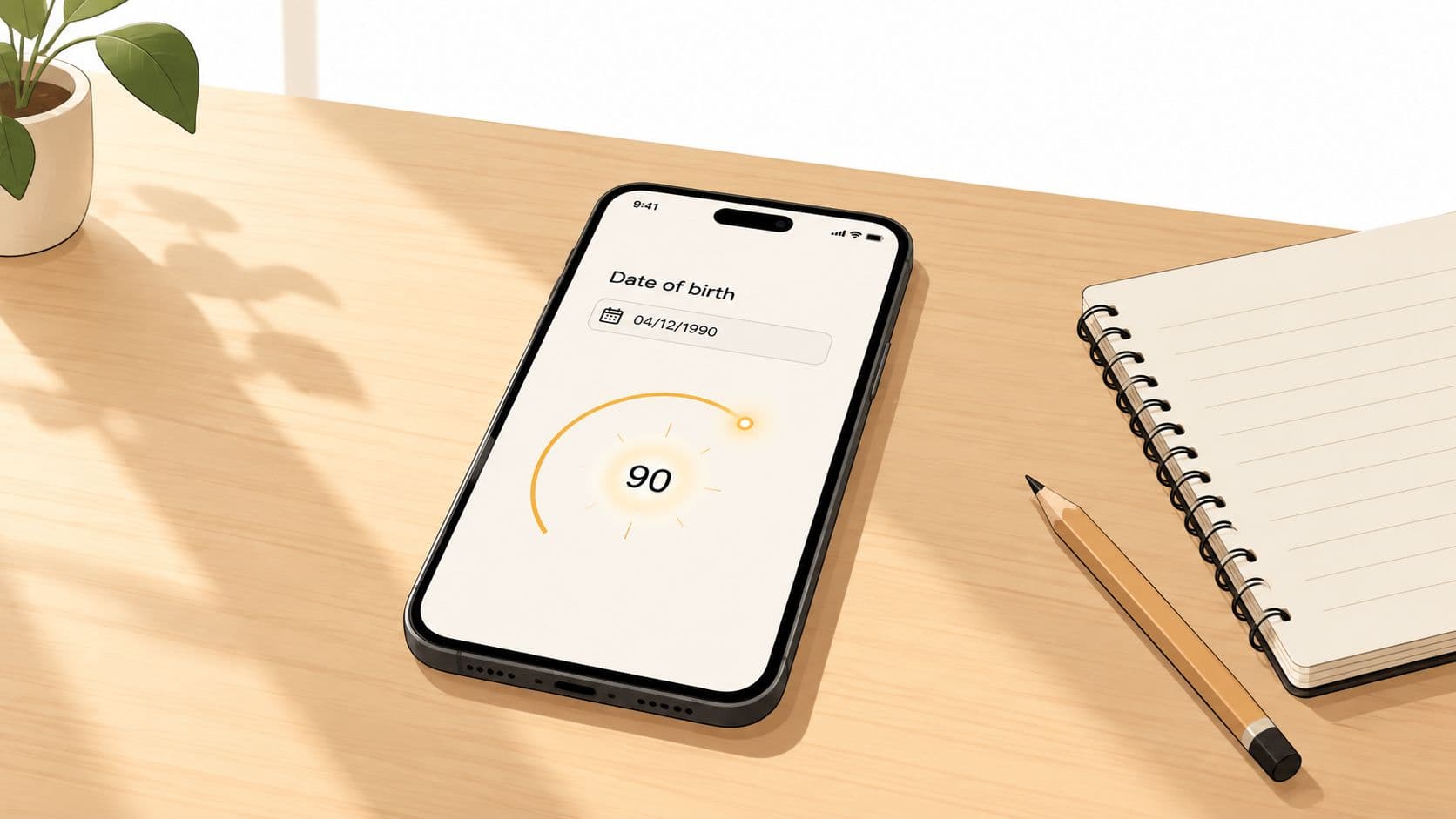
The simplest way to understand a Life Purpose App reading is to follow the sequence a user encounters. You begin with a date of birth, not with a long personal narrative. That keeps the first stage focused on the system's stated calculation.
Step one is entering the complete date
Dan Millman's method begins by writing the complete date of birth numerically and adding every digit, including zeros. The resulting sum is reduced by adding its digits to produce a final sum. The birth number records both results in a format such as original sum/final sum. For twentieth-century birth dates, the final sum falls between 2 and 12, as described in the documented calculation method.
This two-part format is important because it differs from the common habit of reducing every result immediately to a single digit. If the method gives you an original sum and a final sum, don't discard the first part just because another calculator would.
The app handles the arithmetic so you don't have to worry about adding the digits incorrectly. What matters is that you understand the rule and can distinguish the mechanical result from the meaning attached to it.
Step two is receiving the life-path material
Once the calculation is complete, the reading connects your birth number to one of Dan Millman's 45 life paths. The revised edition expanded the framework from 37 paths to 45, adding paths for people born after 2000, as explained in the author interview about the expanded system.
The material may address core gifts, recurring challenges, spiritual laws, and practical areas such as health, money, sexuality, career, and relationships. Read those themes as areas for attention, not as fixed traits stamped onto your identity.
A free tier provides a summary of the life path and an overview of the system. Paid options provide access to the complete text associated with the 25th Anniversary Edition, more detailed life-path analyses, unlimited contacts, and primary numbers and cycles. You can begin with the summary and decide whether the fuller material supports the kind of reflection you want.
For a related perspective on using a symbolic system to ask purposeful questions, a Life Purpose Oracle guide offers another way to approach personal inquiry.
Step three is making the reading yours
Don't rush from the result to a conclusion. Read one theme at a time and write down what it brings to mind. You might note a repeated work pattern, a relationship habit, or an area where you've been avoiding responsibility.
Then write a counterexample. If the reading describes you as independent, where have you relied successfully on other people? If it emphasizes sensitivity, when have you responded calmly under pressure? Counterexamples stop the reading from becoming a flattering story that explains everything.
The most useful output is a question you can carry into ordinary life. “Where am I using this strength well?” is more practical than “What will happen to me?” That shift preserves curiosity without handing the reading authority it hasn't earned.
Nine-Year Cycles and Relationship Dynamics
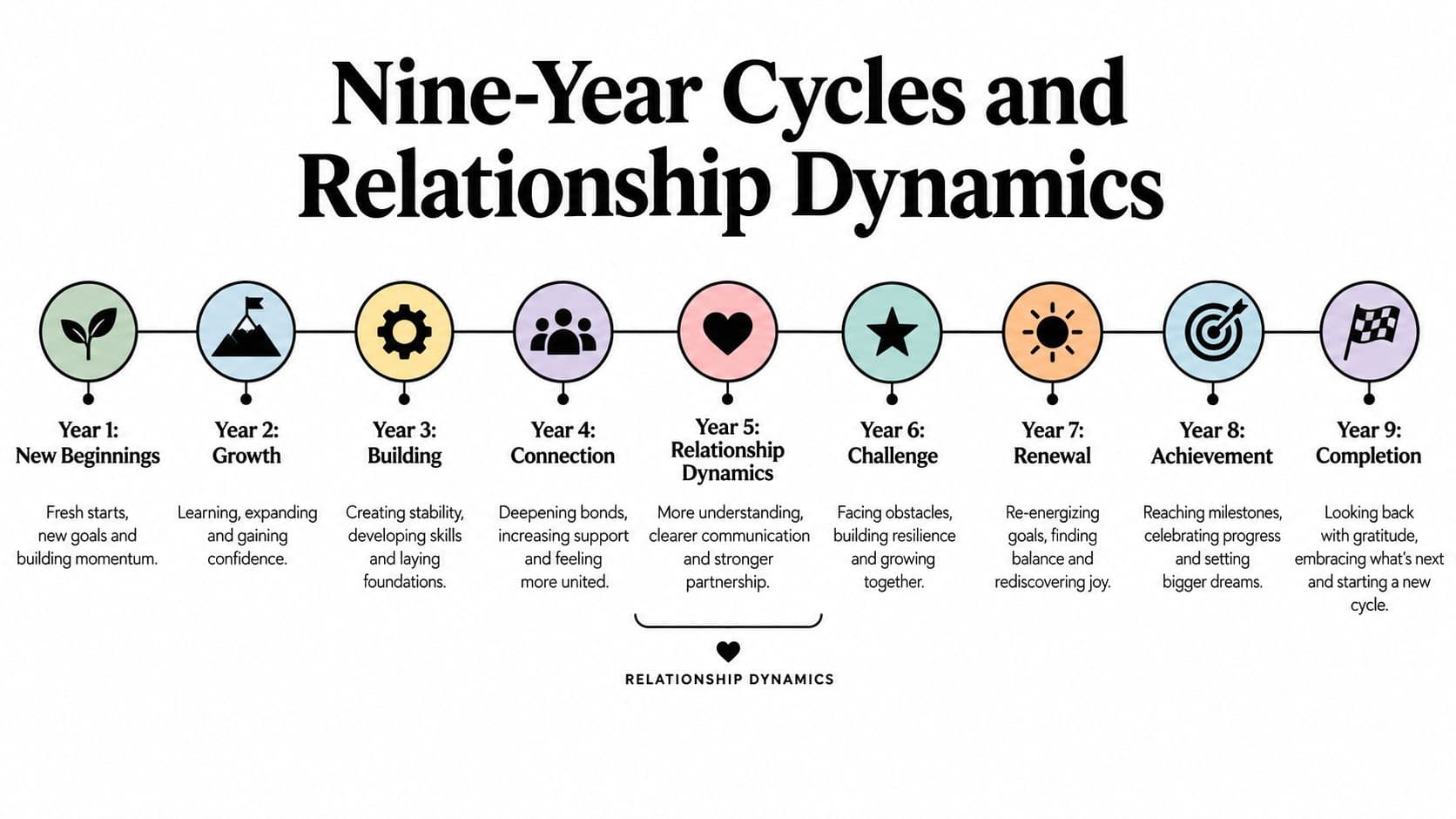
A life-path assignment is only one part of Dan Millman's system. The Life You Were Born to Live also describes nine-year cycles of life, giving readers a timing framework alongside the birth-date-based path. The Life Purpose App brings those cycles into a digital format so users can revisit them as their circumstances change.
A cycle can be used as a prompt for noticing development. You might ask whether the current period feels like an opening, a consolidation, a challenge, or a completion. The system supplies a language for the question. It doesn't prove that an event must occur at a particular time.
Timing adds context, not certainty
The revised 25th Anniversary Edition combines the life-path method with recurring nine-year cycles, as described in the Google Books edition information. That combination lets a reader consider both enduring themes and the season of life in which those themes are being examined.
For example, someone reflecting on career direction might use the life path to explore habitual strengths and the cycle material to ask whether the present period calls for experimentation, patience, or completion. The result should inform a journal entry or conversation, not dictate a resignation letter.
The guide to Dan Millman's nine-year cycle provides a focused entry point for readers who want to explore the timing side of the system.
Relationships need a higher standard of care
The Life Purpose App also lets users explore relationship dynamics involving friends, family members, co-workers, and public figures through in-app Wikipedia look-ups. That feature can make the framework feel more relational, but it also creates a responsibility: a symbolic profile isn't evidence about another person's character.
Use compatibility material to examine your expectations and communication patterns. Don't use it to label a partner, decide that a colleague is untrustworthy, or justify avoiding a conversation. The other person may not share the framework, and they may not have consented to having their birth information analyzed.
The same principle applies to public figures. A lookup can be an interesting way to explore how the system organizes information, but it can't give you reliable access to someone's private motives.
The app offers customer support and is available in English, French, and German, which makes the book-based material accessible to readers in different language settings. That convenience matters, but clear interpretation still depends on the user's willingness to hold the results lightly.
Choosing an Online Provider With Discernment
A numerology provider earns trust through clarity, not through dramatic promises. Before entering your date of birth, look for a named method, an explanation of the calculation, and language that distinguishes symbolic reflection from empirical prediction.
Dan Millman's The Life You Were Born to Live gives the Life Purpose App a traceable source. The app presents the 45-path framework, the two-part birth-number method, and the nine-year-cycle material as parts of a defined book-based system. That doesn't make every interpretation true, but it lets you understand what you're reading.
A practical evaluation checklist
Method: Can you identify the tradition and the rules used to calculate the result?
Source: Does the provider identify a real book or established system, rather than presenting anonymous wisdom as universal truth?
Boundaries: Does the service avoid telling you that a number can determine medical, psychological, legal, financial, or relationship outcomes?
Data handling: Does it explain what happens to your birth date, contact information, and relationship inputs?
Access: Can you use the service in a language you understand, and can you reach customer support if something goes wrong?
A provider that fails the first three checks may give you an entertaining paragraph, but you won't know what it means or how much authority to give it. For broader guidance on evaluating support services and asking practical questions before sharing personal information, the revibementalhealth.com/what-to-look-for-in-a-therapist/ offers a useful comparison point, even though therapy and numerology are different kinds of services.
Privacy is part of the reading experience
A birth date is persistent personal data. Users may also add details about relationships, health, work, or emotional concerns while interpreting a result. Research on digital divination highlights the need for platforms to minimize collection, explain retention and deletion, encrypt information in transit and at rest, separate account identifiers from reading records, and avoid exposing contact or compatibility data in shared links or analytics logs. These safeguards are discussed in research on privacy and digital divination.
You should also avoid entering someone else's details without permission. A compatibility reading is not evidence about that person, and it shouldn't be used for employment, safeguarding, medical, financial, or legal decisions.
The Life Purpose App can be evaluated against this checklist by examining its book-anchored framework, its available reading tiers, its customer support, and its language options. Before using any provider, read its current privacy information directly. For a wider comparison of services and features, the guide to the best numerology apps can help you form your own questions.
How to Read Your Results Without Overreaching
A reading becomes useful when you test it instead of accepting it. This is especially important because numerology lacks the peer review, replicability, reliability, validity, and evidential support expected of a validated scientific method. Independent science-communication reporting also identifies confirmation bias and the Barnum effect as reasons broad statements can feel personally precise, as explained in this fact-check on numerology and prediction.
Try this four-part practice with a Life Purpose App result or any other online reading.
Start with the sentence that catches your attention
Read the passage once without trying to prove it. Mark the line that creates a clear emotional response, whether that response is recognition, resistance, relief, or irritation.
Then ask what, specifically, it brings to mind. “This sounds like me” is too vague. A stronger note might say, “I often volunteer for difficult tasks, then resent the lack of help.”
Look for evidence in both directions
Write one lived example that supports the interpretation and one that complicates it. If the reading describes a tendency toward leadership, record a situation where you led effectively and another where you preferred collaboration.
This doesn't turn numerology into a scientific test. It makes your reflection more honest by preventing selective attention from doing all the work.
Reflection rule: A passage that fits only after you reinterpret every exception isn't strong evidence about your life.
Turn a theme into an optional question
A symbolic statement becomes more useful when you translate it into a choice. Instead of “I am destined to struggle with relationships,” ask, “What communication pattern do I keep repeating, and what would I like to try differently?”
Instead of “My path guarantees career success,” ask, “Which ability could I develop more deliberately?” The second version gives you agency and leaves room for facts that the reading doesn't address.
Keep consequences in proportion
Don't use a numerology result as a substitute for medical, psychological, legal, or financial advice. Don't end a relationship, reject treatment, invest money, or make a professional decision because an online reading told you the outcome was fixed.
A reading can sit beside your judgment, conversations, and professional guidance. It shouldn't replace them. The most respectful way to use Dan Millman's framework is to treat it as a mirror, then decide what you see through careful attention to your actual life.
Starting Your Reading With Confidence
What would make you trust an online numerology reading enough to try it, without handing it more authority than it deserves?
A careful start helps. Dan Millman's system is not a free-form personality quiz or a generic spiritual reading. It begins with your full date of birth, then places you within one of 45 life paths from The Life You Were Born to Live. The Life Purpose App turns that structure into a digital reading that covers gifts, challenges, relationships, career, health, money, sexuality, nine-year cycles, and relationship dynamics. The calculation gives you a fixed map. Your job is to see whether the map matches the terrain of your actual life.
That distinction matters. A map can orient you, but it does not walk the road for you.
Before you enter your date, pause long enough to set a few boundaries. Ask yourself what you want from the reading. Curiosity, journaling, relationship reflection, or a broader sense of direction all lead to different kinds of attention. Ask what you will not use it for. That one question can keep a symbolic system from drifting into decisions it cannot make for you. Ask what data you are sharing, including storage, deletion, account, and sharing practices. Ask how you will test the result. Write down what fits, what does not, and what stays unclear. Ask who else is involved. Another person's information is not yours to analyze without permission.
People often turn to numerology during periods of uncertainty because they want language for what they are feeling. That impulse is understandable. It also helps to keep categories clear. If the issue in front of you is ongoing conflict, grief, or strain in a partnership, support grounded in lived communication may serve you better than symbolic compatibility alone. A practical resource such as the Vancouver Counselling Clinic guide belongs to that different category of help.
The app is available in English, French, and German, with customer support for people who need help using the reading. That makes it easier to approach Millman's method in a digital format, but accessibility is not the same as truth. The value still comes from honest interpretation.
A strong first reading usually leaves you with clearer questions, not fixed answers. Write down one passage that feels accurate, one counterexample, and one action you choose freely. If you want to explore Dan Millman's method in that spirit, visit Life Purpose App.
Discover your life path today
Enter your date of birth and see your life path, free.
Find your life path