Discover how Debra Frasier’s On the Day You Were Born plants a lasting sense of belonging and how Dan Millman’s life-path numerology uses your birth date to reveal strengths, challenges, and purpose. Learn a simple three-step calculation to find your life path and practical ways to apply it.

November 24, 2025 (11mo ago) — last updated July 23, 2026 (3mo ago)
Life Path Numerology and On the Day You Were Born
How Debra Frasier’s On the Day You Were Born pairs with Dan Millman’s life-path numerology, plus a simple three-step life path calculation.
← Back to blog
Discover how Debra Frasier’s On the Day You Were Born plants a lasting sense of belonging and how Dan Millman’s life-path numerology uses your birth date to reveal strengths, challenges, and purpose. Learn a simple three-step calculation to find your life path and practical ways to apply it.
Life Path Numerology and On the Day You Were Born

Discover how Debra Frasier’s beloved picture book can plant a seed of belonging that grows into adult self-discovery, and learn a simple three-step method to calculate your life path using Dan Millman’s numerology system.
Why On the Day You Were Born still matters
First published in 1991, On the Day You Were Born celebrates each child’s arrival and affirms their place in the world. The book’s lyrical prose and vivid illustrations connect birth to the rhythms of nature—moon tides, migrating animals, and the steady pull of the earth—to create a sense of wonder and worth that readers return to again and again. The book has sold over 1,089,165 copies worldwide1.
Debra Frasier blends imagery and gentle affirmation to make readers, parents, and caregivers feel that a child’s arrival was noticed and meaningful. That message supports emotional development and a lasting foundation of belonging. For adults, revisiting that feeling can be part of inner-child work aimed at reclaiming a sense of being cherished.
Reading aloud also supports language development and emotional connection, strengthening the book’s lasting impact on early childhood development2.
From childhood belonging to adult life purpose
The simple idea that your birth date mattered as a child can become a practical starting point for adult meaning-making. Dan Millman’s The Life You Were Born to Live maps themes, gifts, and challenges from the numbers in your birth date. Millman’s approach is used as a reflective tool to reveal recurring patterns in work, relationships, and personal growth. The official Life Purpose App offers an easy way to get an instant life-path summary3.
How Millman’s life-path numerology works
Millman treats your birth date as a blueprint. By reducing the month, day, and year into core numbers, his system highlights likely strengths, blind spots, and life lessons. The aim is clarity, not fate: understanding your number helps you recognize patterns so you can act with more awareness and less resistance.
This numerology is symbolic and cultural rather than scientific, and many people use it as a reflective practice to gain insight rather than prediction4.
How to calculate your life path number (three simple steps)
The method is straightforward: reduce each part of your birth date to single digits or recognized master numbers, then add and reduce the total to your final life-path number.
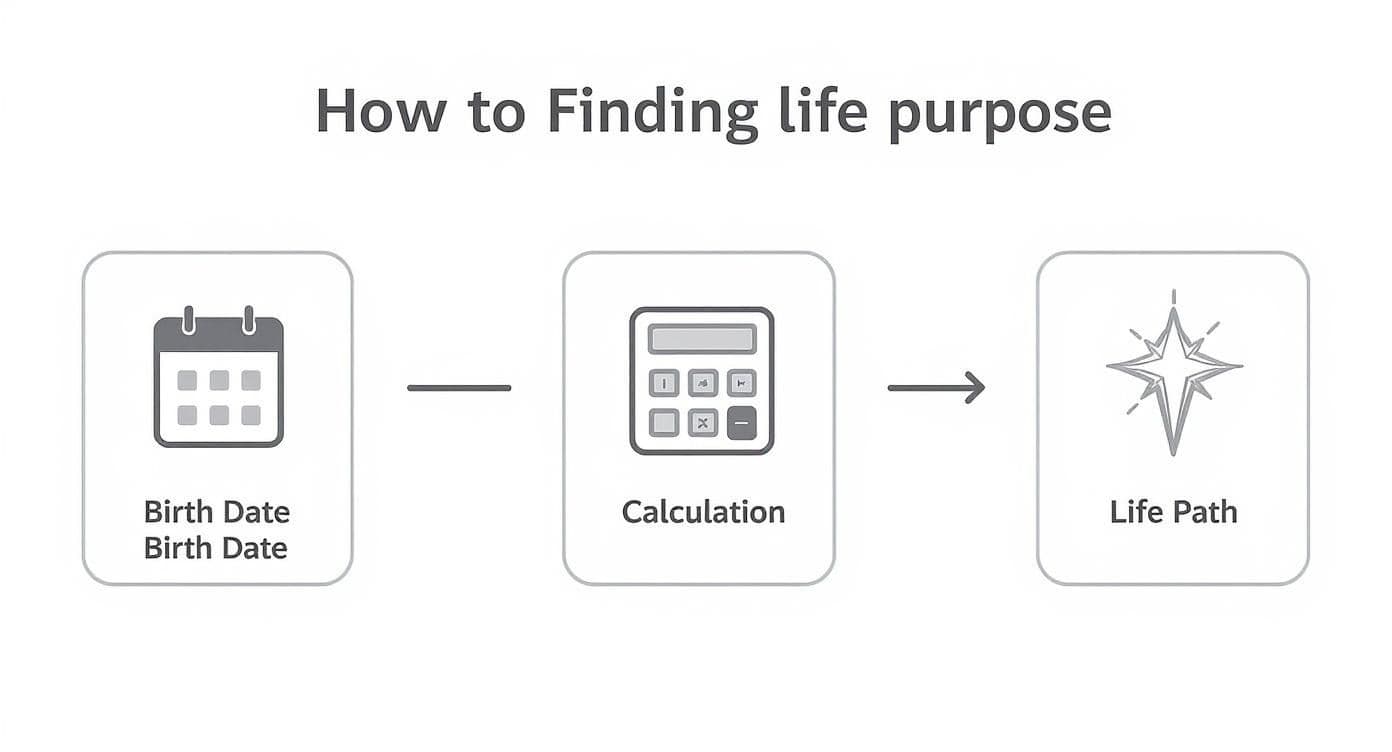
Step-by-step example
| Birth Date Component | Example (October 26, 1985) | Calculation |
|---|---|---|
| Month | October (10) | 1 + 0 = 1 |
| Day | 26 | 2 + 6 = 8 |
| Year | 1985 | 1 + 9 + 8 + 5 = 23 |
| Total | — | 1 + 8 + 23 = 32 → 3 + 2 = 5 |
In Millman’s system this may be written as a 32/5 life path. The reduced final number (5) describes core themes—here, freedom, experiential learning, and building discipline.
For a complete walkthrough and examples, see our guide on how to calculate your life path at /guides/how-to-calculate-life-path.
What each number reveals
Each life-path number groups themes, talents, and challenges that tend to recur throughout life. Millman’s descriptions cast these patterns as invitations for growth: they’re not fixed destiny but practical language for recognizing where you may thrive or struggle.
Applying your life path: practical uses
- Self-awareness: Clarify recurring patterns so you can make different choices.
- Relationships: Use life-path insights to understand communication styles and friction points.
- Career and growth: Match tasks and environments to your natural tendencies and gifts.
If you prefer an instant reading, try the Life Purpose App for a compact summary of core lessons, strengths, and likely challenges tied to your birth date3.
Connecting Frasier’s message to Millman’s framework
Both the children’s book and Millman’s numerology center on the idea that your birth matters. Frasier offers an emotional foundation of belonging; Millman translates your birth date into themes you can use to shape an adult life.
When combined, the two perspectives create a continuous path: the sense that you were celebrated at birth becomes practical insight for living purposefully as an adult.
Common questions about life-path numerology
How accurate is this system?
This isn’t fortune-telling. Think of numerology as a reflective personality framework similar to other self-awareness tools. Many people report recognition when they read their life-path description; treat it as an aid for reflection, not a literal prediction4.
Can my life path number change?
No—the number is a mathematical result of your birth date, so it does not change. How you express that path shifts over time through growth and choice.
What if I don’t like my life path?
Pushback is normal. Discomfort often points to a growth edge. Use the description as a starting place for experimentation and self-work rather than a label that limits you.
Reader Q&A — Practical answers
Q: Can life-path numerology help my relationships?
A: Yes. Knowing patterns linked to birth numbers can clarify communication styles and recurring conflicts, making empathy and compromise easier.
Q: Is this a substitute for therapy or career counseling?
A: No. Use life-path insights as one tool alongside professional guidance when appropriate.
Q: How do I check my calculation if I suspect an error?
A: Recheck month, day, and year reductions, then add the components and reduce to a single digit or recognized master number. For convenience, use the Life Purpose App or our step-by-step guide at /guides/how-to-calculate-life-path.
Three concise Q&A sections
Q1: What links Frasier’s book and Millman’s numerology?
A1: Frasier builds belonging; Millman turns that belonging into a practical map of strengths and challenges.
Q2: How can skeptics test this system?
A2: Calculate your life path, read the life-path description, and try one suggested practice for 30 days to see whether it offers useful insight.
Q3: Where can I learn more on this site?
A3: Visit our guides at /guides for detailed walkthroughs on calculating your life path and applying life-path themes to relationships and career.
1.
Publishers Weekly, “All-Time Bestselling Children’s Books,” Publishers Weekly. https://www.publishersweekly.com/pw/by-topic/childrens/childrens-industry-news/article/28595-all-time-bestselling-children-s-books.html
2.
American Academy of Pediatrics / HealthyChildren.org, “Reading Aloud to Your Child.” https://www.healthychildren.org/English/family-life/Media/Pages/Tips-for-Reading-Aloud-to-Your-Child.aspx
3.
Life Purpose App, official companion to Dan Millman’s The Life You Were Born to Live. https://lifepurposeapp.com
4.
Encyclopaedia Britannica, “Numerology.” https://www.britannica.com/topic/numerology
Discover your life path today
Enter your date of birth and see your life path, free.
Find your life path