Ever feel a pit in your stomach when you’re anxious or a tightness in your chest when grief hits? The organ emotion chart—rooted in Traditional Chinese Medicine—maps how emotions like anger, grief, worry, joy, and fear can show up physically, giving you a practical tool for greater self-awareness and balance.
February 25, 2026 (6mo ago) — last updated May 4, 2026 (3mo ago)
Organ-Emotion Chart: Mind-Body Health Guide
Discover how the organ emotion chart links emotions to physical symptoms and practical steps to restore balance in mind and body.
← Back to blog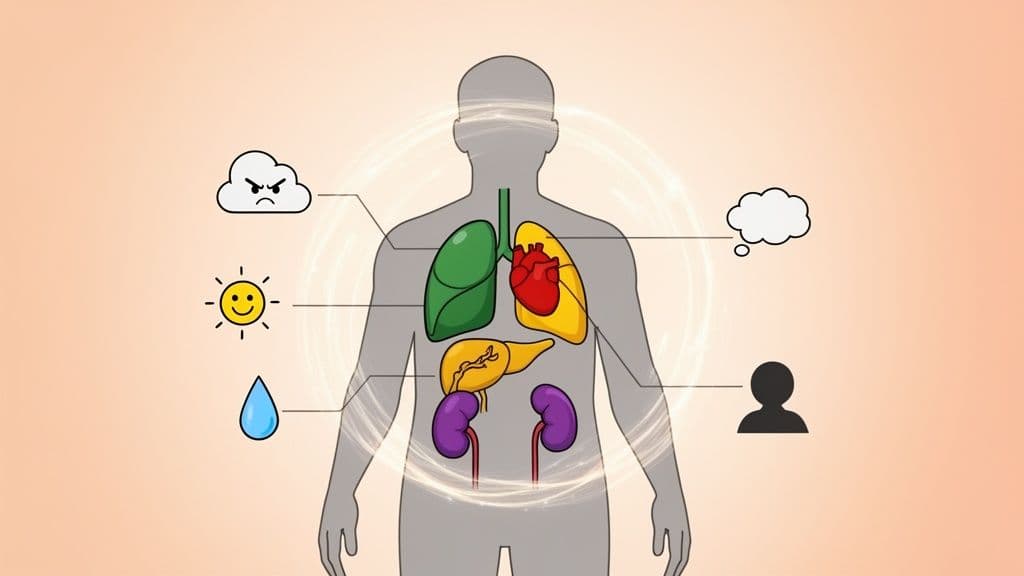
Your Guide to the Organ Emotion Chart and Mind-Body Health
Discover the organ emotion chart, a practical map for understanding how feelings like anger and grief connect to your physical health and overall well-being.
Introduction
Ever feel a pit in your stomach when you’re anxious or a tightness in your chest when grief washes over you? The organ emotion chart is an ancient framework from Traditional Chinese Medicine that helps explain these physical sensations. It shows how emotions and organs are deeply linked, offering a way to listen to your body and respond with practical care.
Decoding the Wisdom of Your Body
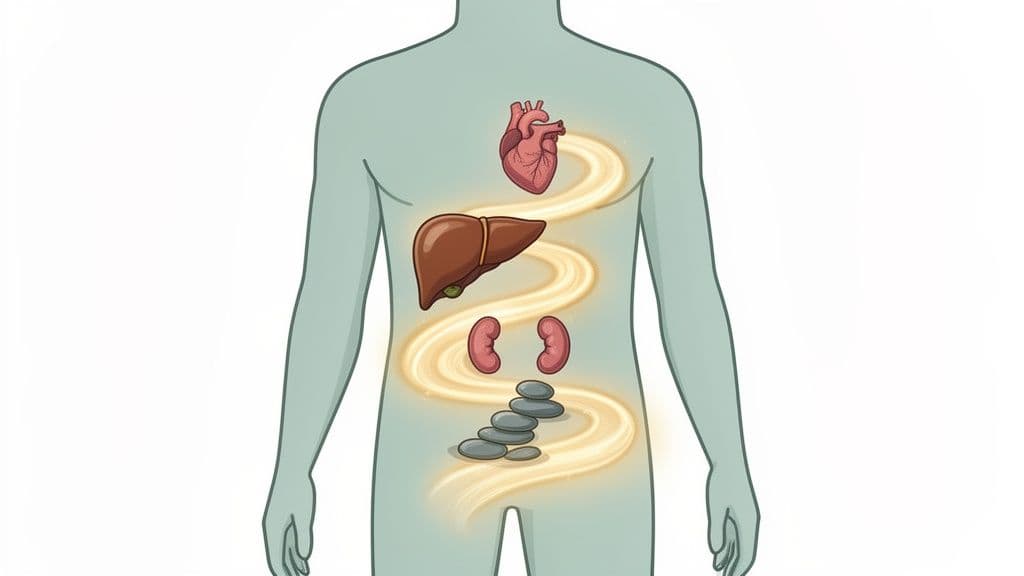
A wave of fear can make your knees weak. A flash of anger might send a hot pulse through your body. These sensations aren’t just metaphors; they’re real signals. The organ emotion chart translates that language, treating emotions as energetic forces that can influence organ function when they persist or become imbalanced.
The Flow of Qi
Central to this system is Qi (pronounced “chee”), the life force that moves through the body. Picture your body as a river system and Qi as the water.
- When emotions are balanced, Qi flows freely and nourishes the organs.
- When emotions get stuck, a dam of unexpressed anger or prolonged sorrow can block that flow, creating imbalances that show up as specific physical symptoms.
This holistic view links emotional patterns with possible physical consequences—for example, chronic grief may tax the lungs, while ongoing worry may affect digestion and the spleen’s function.
A New Perspective on Wellness
Reading an organ emotion chart gives you a practical way to pay attention to bodily signals. It’s a tool for self-awareness, not a medical diagnosis. It complements other energy-mapping systems, such as chakra charts, and can deepen how you interpret recurring symptoms and emotional habits.
The chart is often discussed alongside Traditional Chinese Medicine principles, which have paired emotions with organ systems for centuries4.
The Core Organ and Emotion Connections
At the heart of the organ-emotion chart are specific, time-tested pairings. Think of your body like a guitar: when each string has the right tension, the music is harmonious. When one string is too tight, it produces a jarring note. Likewise, when one emotion is chronically elevated, the corresponding organ system can feel out of balance.
The Five Foundational Pairs
These five pairs are the most commonly referenced:
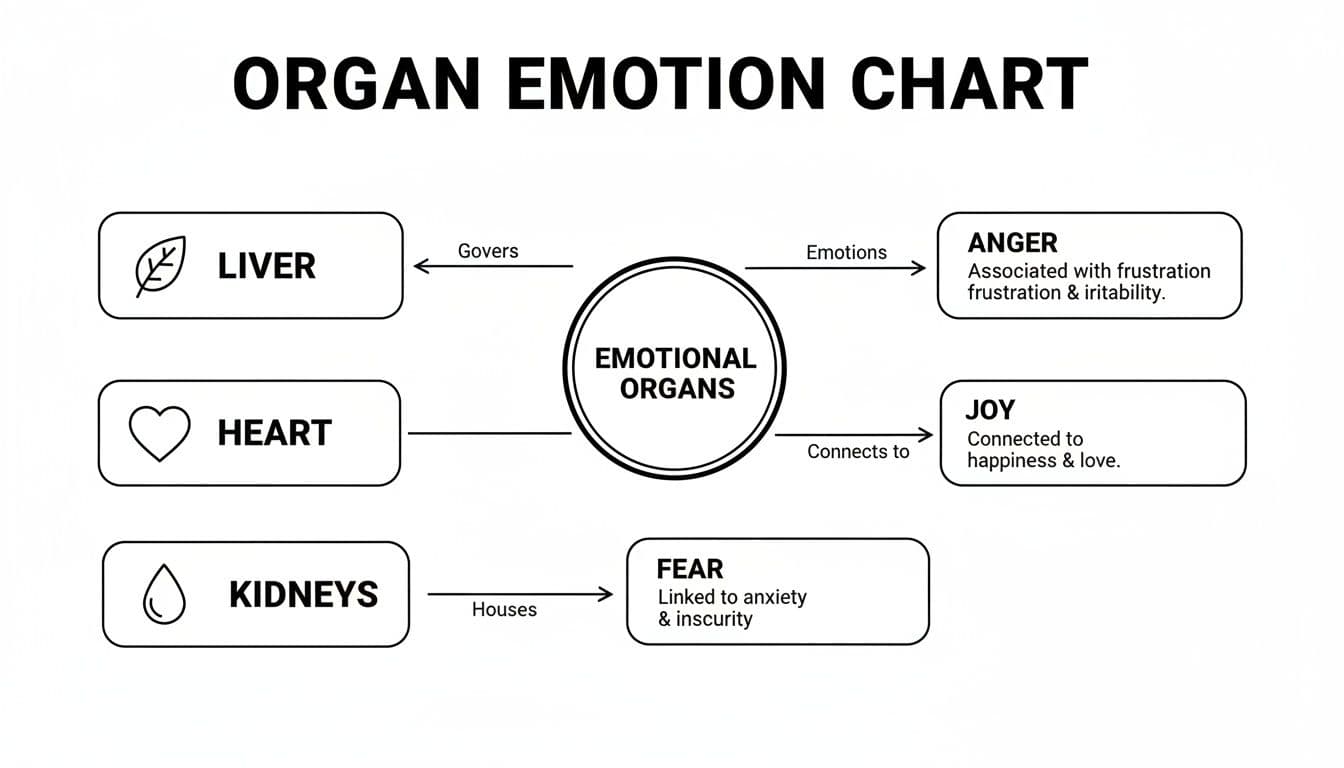
- Liver → Anger: Frustration or resentment can obstruct the liver’s role in moving Qi, often showing as headaches, neck and shoulder tension, or eye issues.
- Heart → Joy: Excessive or agitated joy can disturb the heart’s rhythm, sometimes showing as restlessness, palpitations, or insomnia.
- Spleen → Worry: Chronic overthinking can affect digestion, leading to bloating, fatigue, poor appetite, or brain fog.
- Lungs → Grief: Unprocessed sadness can deplete lung energy, potentially weakening immunity or showing as shortness of breath and skin conditions.
- Kidneys → Fear: Persistent fear or insecurity can drain core energy, showing as lower back pain, deep fatigue, or low libido.
These pairings are not diagnostic rules but guides developed through long observation and supported by modern research into how emotions map onto bodily sensations1.
From Worry to Fear
Each organ–emotion link points to how emotional patterns may express physically. For instance, long-term worry may show up as digestive complaints tied to the spleen, while deep-seated fear can feel like a draining heaviness linked to the kidneys.
Research that maps bodily sensations across cultures supports the idea that emotions produce consistent physical patterns, reinforcing the practical value of these ancient pairings1.
Quick Reference Table
| Organ | Associated Emotion | Element | Signs of Imbalance |
|---|---|---|---|
| Liver | Anger, Frustration, Resentment | Wood | Headaches, irritability, tight neck & shoulders, eye issues |
| Heart | Joy (or Lack of Joy, Mania) | Fire | Anxiety, palpitations, insomnia, restlessness |
| Spleen | Worry, Overthinking, Obsession | Earth | Digestive issues, bloating, fatigue, poor appetite, brain fog |
| Lungs | Grief, Sadness, Loss | Metal | Shortness of breath, weak immune system, skin problems |
| Kidneys | Fear, Insecurity, Shock | Water | Lower back pain, exhaustion, low libido, feeling cold |
Use this table as a starting point when you notice recurring symptoms that might have an emotional component.
How to Use an Organ-Emotion Chart for Self-Discovery
Treat the chart as a set of prompts for a conversation with yourself. Start by noticing: what physical sensations and emotional patterns repeat? Once you spot a pattern, consult the chart to explore possible links and reflect with curiosity rather than judgment.
Starting a Dialogue with Your Body
Example: if you often feel bloated when stressed, check the spleen/worry connection. Ask nonjudgmental questions like, “What am I mentally chewing on that I can’t let go of?” Recording insights in a simple journal helps reveal patterns over time.
This approach pairs well with other frameworks for self-understanding, such as life-path systems and mindful practices like those described in our guide to the chakras color chart and how to practice mindfulness.
A Simple Four-Step Practice
- Identify a recurring pattern: physical symptom or dominant emotion.
- Consult the chart: find the likely organ–emotion pair.
- Reflect with curiosity: ask gentle questions about where that feeling appears in your life.
- Track your insights: keep a journal to spot trends over weeks or months.
What Modern Science Says About This Connection
Ancient observations and modern science are increasingly in dialogue. Psychoneuroimmunology, the study of how emotions influence the nervous and immune systems, shows clear links between psychological states and physical health2.
The Body Maps of Emotion
A landmark 2014 study created bodily “maps” showing where people feel different emotions. Across 701 participants and several cultures, researchers found consistent patterns—anger lights up the upper chest and arms, while sadness reduces sensation in the limbs—mirroring many organ–emotion ideas1.
These findings suggest emotions are full-body events, not just mental states, and they give modern support to the practical insights of the organ emotion chart.
Integrating Ancient Wisdom with Modern Tools
Rather than replacing one with the other, ancient charts and modern research complement each other. Understanding emotional-physical patterns helps you take richer, more targeted steps to support well-being. Practices that calm the nervous system and help process emotions—like mindfulness, breathwork, and gentle movement—are especially useful for restoring balance.
Practical Steps for Emotional and Physical Balance
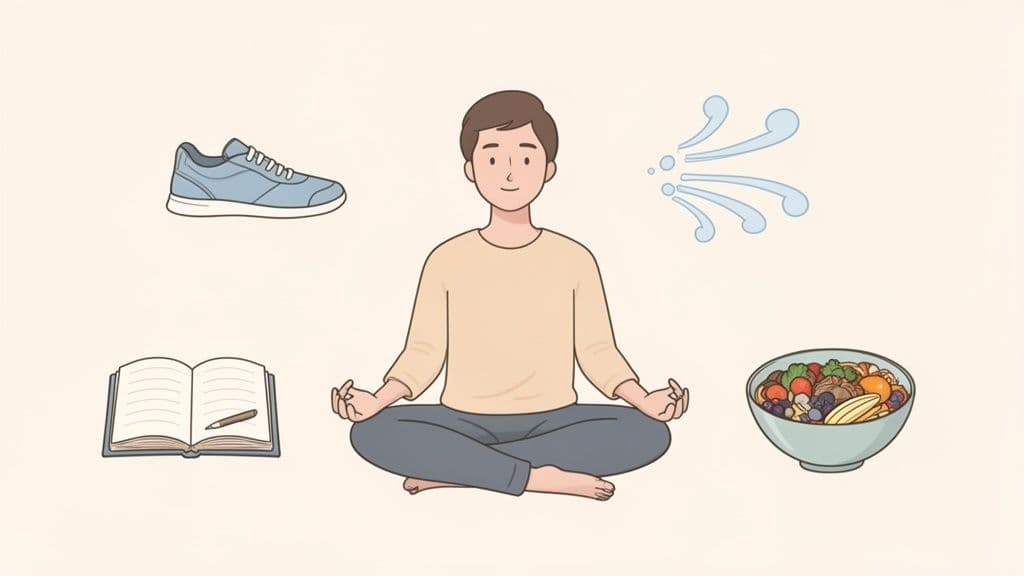
Use the chart to identify which emotions may be contributing to physical strain, then try small supportive practices that encourage emotional flow and physical ease.
Gentle Practices for Core Emotions
- Liver (Anger): Move stagnant energy—brisk walks, rhythmic movement, vigorous stretching, and setting healthy boundaries.
- Spleen (Worry): Grounding activities—cooking, gardening, walking barefoot, journaling, and meditation to quiet mental loops.
- Lungs (Grief): Breathe with intention—try slow inhalation for four counts and longer exhalation for six counts to create space for sadness.
- Kidneys (Fear): Restore with gentle care—warm baths, herbal tea, calming music, and prioritizing sleep.
A 2021 study of 281 elderly residents found links between emotional states and organ-related health, suggesting emotional balance can relate to chronic disease outcomes3.
Common Questions About the Organ Emotion Chart
Can an emotion really make me sick?
Not in a one-to-one way. Short-term feelings don’t cause illness. But chronic, unprocessed emotions can create stress that weakens organ systems over time. Think of it like prolonged heavy rain versus a single storm: persistent strain can erode resilience.
What if I have no physical symptoms?
Feeling emotions without physical symptoms often means you’re processing them well. The chart is most useful when patterns feel stuck—recurring physical complaints or emotions that won’t shift.
Is this a replacement for seeing a doctor?
No. The chart is a complementary tool for self-awareness, not a diagnostic substitute. See a qualified healthcare provider for medical concerns. You can use the chart to bring clearer observations to your medical appointments.
Three Short Q&A Sections
Q: What is the organ emotion chart?
A: It’s a Traditional Chinese Medicine map linking core emotions to organs, used to notice patterns between feelings and recurring physical symptoms.
Q: How do I start using it?
A: Notice recurring symptoms, consult the chart to find the likely organ–emotion pair, reflect with curiosity, and track insights in a journal.
Q: Does science support this?
A: Modern studies show emotions create consistent bodily sensations, and research in psychoneuroimmunology links emotional states with nervous and immune responses12.
Ready to explore more ways to connect mind and body? Check our guides on the chakras color chart and how to practice mindfulness for practical next steps.
1.
Nummenmaa, Lauri, et al. “Bodily maps of emotions.” Proceedings of the National Academy of Sciences 111, no. 2 (2014): 646–651. https://www.pnas.org/doi/10.1073/pnas.1321664111
2.
For an overview of how psychological states affect the nervous and immune systems, see research on psychoneuroimmunology. https://www.ncbi.nlm.nih.gov/pmc/articles/PMC3150158/
3.
Study linking emotional responses and chronic diseases: “The relationship between chronic diseases and emotional responses in elderly residents of the community.” Herald Open Access (2021). https://www.heraldopenaccess.us/openaccess/the-relationship-between-chronic-diseases-and-emotional-responses-in-elderly-residents-of-the-community-focusing-on-the-evaluation-method-of-the-chinese-medicine-five-emotions-measurement-scale-and-prediction-of-five-organ-diseases
4.
Background on Traditional Chinese Medicine and its approaches: National Center for Complementary and Integrative Health. https://www.nccih.nih.gov/health/traditional-chinese-medicine-what-you-need-to-know
Discover Your Life Purpose Today!
Unlock your true potential and find your life’s purpose.
