A practical, step-by-step guide to overcoming life challenges with resilience, spiritual insight, and actionable tools rooted in Dan Millman's wisdom.

September 5, 2026 (1mo ago)
Overcoming Life Challenges with Purpose and Resilience
A practical, step-by-step guide to overcoming life challenges with resilience, spiritual insight, and actionable tools rooted in Dan Millman's wisdom.
← Back to blog
A practical, step-by-step guide to overcoming life challenges with resilience, spiritual insight, and actionable tools rooted in Dan Millman's wisdom.
Maya sat at her kitchen table with a mug gone cold, a termination letter beside unopened mail. In one autumn, she lost her job, watched her engagement dissolve, and received a frightening health diagnosis, leaving her unsure which question to answer first.
When Life Stops Making Sense
The call about Maya's job ended with a polite goodbye and a silence that seemed to fill the room. She kept looking at the phone, as if the screen might explain what happened next. Outside, rain tapped against the window. Inside, the kitchen table collected bills, medical papers, and messages she couldn't bring herself to answer.
A few weeks later, her fiancé said he no longer knew whether they wanted the same future. The relationship that had once felt like shelter became another source of uncertainty. Then a routine appointment produced a health scare diagnosis, and Maya found herself carrying a new vocabulary of tests, referrals, and waiting.

She didn't need a motivational speech. She needed a place to put the fear. She needed someone to admit that three major disruptions can make ordinary tasks feel strangely difficult. Even deciding whether to make dinner became tangled with larger questions: Who am I now? What can I trust? How do I plan when every plan seems temporary?
For a while, Maya interpreted her confusion as evidence that she was failing. That interpretation made the experience heavier. Disorientation after a major setback isn't a character flaw. It's a natural response when familiar roles, expectations, and sources of security change at the same time.
The work of overcoming life challenges doesn't begin with pretending everything happens for a reason. It begins with acknowledging what happened, allowing the nervous system to settle enough for thought to return, and creating a little space between the event and the story formed around it.
Dan Millman's wisdom is useful here when it's held lightly. His approach, presented in The Life You Were Born to Live, treats difficulty as part of a life path and its curriculum, not as proof that a person has been abandoned by life. That perspective doesn't erase pain. It can help a person ask a more workable question: What might I learn, practice, or become through this season?
Maya was still at the threshold. She didn't yet have a plan, and she didn't need one in that first moment. Before action comes understanding, especially an understanding of why one event can feel much larger than its visible facts.
Why Challenges Feel Bigger Than They Should
A job loss may look like one event on paper. In daily life, it can remove income, routine, identity, and a sense of belonging at the same time. Shame, uncertainty, isolation, and fear about what comes next gather around the facts. The nervous system reacts to that combined threat, so the experience can feel larger than the event's visible details.
A global resilience survey reported that 43% of people worldwide said they could do nothing to protect themselves and their families in a disaster, compared with 36% in 2021, a 7-point increase in perceived lack of agency. It also found that 30% of people globally who experienced a disaster in the previous five years received no warning, while the share who experienced a natural-hazard disaster in that period rose from 27% to 30% between 2021 and 2023. Resilience scores fell in 42 of 120 countries measured in both years (Lloyd's Register Foundation resilience survey).
These findings point to conditions that shape resilience, including preparation, warning, and the perceived ability to act. They do not measure a person's character. Pressure can be widespread, even when it feels like a private failure.
The threat response behind the story
The SCARF model explains why a setback can feel existential. It describes five social needs that affect threat and reward responses:
- Status: Losing a job may feel like a verdict on your worth.
- Certainty: An unclear diagnosis or unstable future sends the mind searching for answers.
- Autonomy: Illness or financial pressure can shrink your sense of choice.
- Relatedness: A breakup can make familiar connection feel suddenly absent.
- Fairness: An unexpected loss may create the painful impression that life has treated you unjustly.
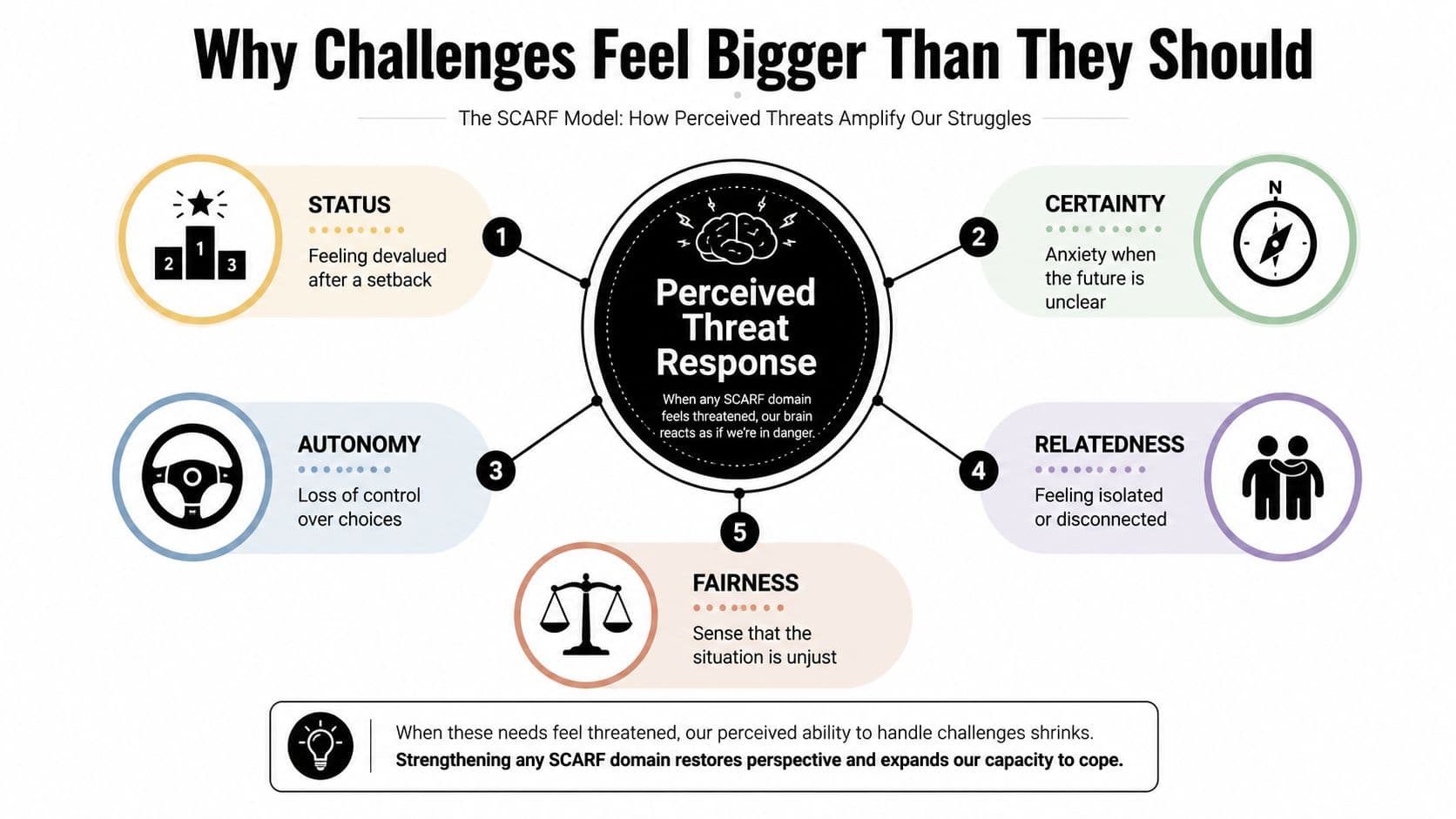
The central event rarely stands alone. Poor sleep can weaken concentration. Unanswered messages can increase social tension. A difficult conversation at work may awaken an older fear about competence. Each pressure might be manageable by itself, yet together they narrow attention until danger becomes the only visible feature.
Practical distinction: The size of an event matters, and so does the meaning your body and mind attach to it.
Earlier experiences can also influence the intensity of a present crisis. A large U.S. review found that 45% of children ages 0 to 17 had at least one adverse childhood experience, while another national analysis found that one in ten children had experienced three or more ACEs. A systematic review reported higher odds of learning or behavior problems and high school absenteeism among children with four ACEs than among children with none, with odds ratios of 32.6 and 7.2, respectively (Childhood adversity review). These findings call for care rather than blame. A strong reaction may reflect accumulated experience, not a lack of willpower.
Dan Millman's life-path framework, presented in The Life You Were Born to Live, offers another way to place difficulty in context. Recurring tensions can become areas for practice within a life path, rather than proof of permanent defeat. His nine-year cycles also suggest that a difficult season can be part of a larger rhythm, a period of learning and adjustment rather than the final definition of a life.
That perspective should sit beside practical help, not replace it. For spiritual grounding during a crisis, the PrayerPetals career resilience resource can accompany professional, medical, and community support.
When agency feels small, clear understanding restores the first piece of choice. A person does not need to solve the whole challenge at once. Recognizing the layers makes the next response more deliberate.
Seeing the Challenge Clearly and Reframing Its Meaning
Reframing works only after honest assessment. If you rush to find a positive lesson, you may bypass grief, minimize a genuine risk, or blame yourself for circumstances outside your control. Start with the facts, then decide what meaning you're willing to make from them.
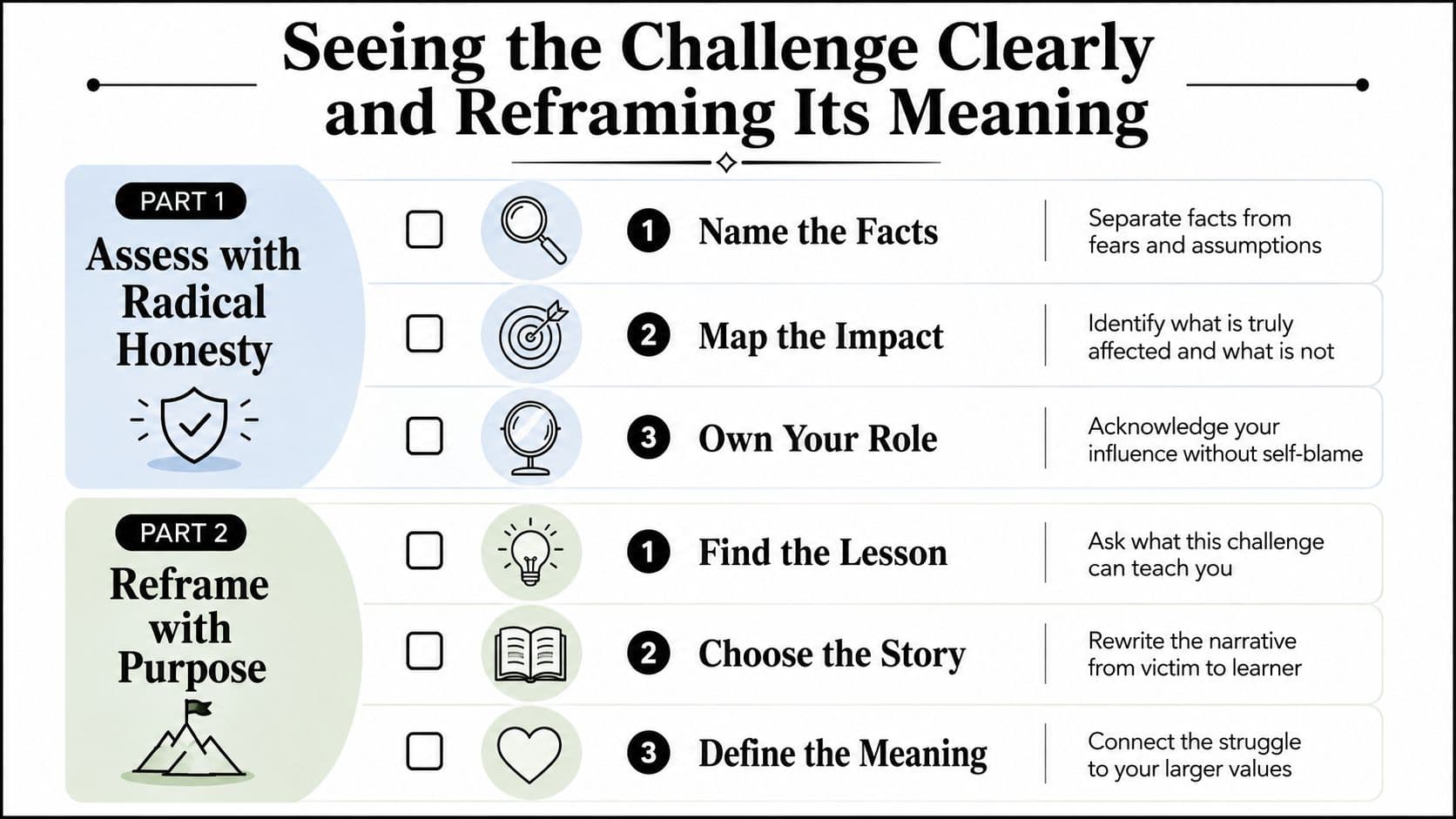
Assess with radical honesty
Use a notebook and write without trying to sound wise.
-
Name the facts. Record what happened in observable language. “My position ended on Monday” is a fact. “Nobody will hire me” is a prediction.
Journal prompt: What do I know, and what am I assuming? -
Map the impact. Look at the effect on your body, relationships, work, finances, and identity. Don't turn every affected area into one giant problem. Separate the medical appointment from the fear about the future, and separate the relationship conversation from the belief that you'll always be alone.
Journal prompt: Which part needs attention first? -
Map the people involved. List the people who can provide information, practical help, emotional support, or professional guidance. This step turns a private fog into a visible network.
Journal prompt: Who needs to know, who can help, and who needs a boundary? -
Own your role without self-blame. Ask where your decisions matter and where they don't. Responsibility gives you a place to act. Shame only tells you that you are the problem.
Journal prompt: What is mine to repair, request, decide, or release?
Reframe with purpose
Once the facts are clear, ask what interpretation will help you respond well. Dan Millman's framework in The Life You Were Born to Live and the Life Purpose App can offer a vocabulary for recurring themes in areas such as work, relationships, health, and personal growth. Treat a life-path insight as a reflective lens, not a diagnosis or a fixed prediction.
Consider two interpretations of the same event. Under a punishment lens, Maya might write, “I lost everything because I'm incapable of building a stable life.” Under a lesson lens, she might write, “This season is showing me that my identity cannot rest entirely on a job and relationship, and I need to make decisions that respect my health.”
The second statement isn't automatically true. It's more useful because it identifies practices Maya can test: asking better medical questions, reviewing her financial options, and reconsidering what kind of work fits her energy.
That perspective should sit beside practical help, not replace it. For spiritual grounding during a crisis, the PrayerPetals career resilience resource can accompany professional, medical, and community support.
When agency feels small, clear understanding restores the first piece of choice. A person does not need to solve the whole challenge at once. Recognizing the layers makes the next response more deliberate.
Run the loop inside the season
Suppose someone has spent months applying for roles that look impressive but leave no energy for recovery. A cycle-oriented question might be, “Am I trying to harvest an old identity when this season is asking me to release it?” The practical response remains testable: review the role criteria, speak with trusted people, and try a different type of application.
Journal on three lines:
- What season does my current life seem to resemble?
- What response would fit that season?
- What am I resisting because I want a different season?
Feedback then becomes data, not a verdict. The application response, the conversation, or the body's reaction to a new routine tells you what to adjust. Purpose gives the experiment direction, while the review loop keeps the interpretation grounded.
Using Life Cycles and Feedback Loops to Iterate
A plan can fail because the action was poor. It can also fail because the timing, energy, or season of life calls for something different. Dan Millman's nine-year cycle framework, presented through The Life You Were Born to Live, is most useful when treated as a map of thematic seasons rather than a rigid prediction.
The cycle language gives you a way to ask whether you're being invited to begin, build, harvest, or release. An initiating season may reward experimentation and first steps. A building season may ask for patience, systems, and repetition. A harvesting season can focus attention on results and contribution. A releasing season may require clearing commitments that no longer fit.
The Life Purpose App life-cycle chart can help readers explore this framework and relate it to personal timing. Keep the interpretation tentative. A cycle doesn't decide whether you call the doctor, revise your résumé, or set a boundary. It can help you consider why a particular response may be more aligned than another.
Run the loop inside the season
Suppose someone has spent months applying for roles that look impressive but leave no energy for recovery. A cycle-oriented question might be, “Am I trying to harvest an old identity when this season is asking me to release it?” The practical response remains testable: review the role criteria, speak with trusted people, and try a different type of application.
Journal on three lines:
- What season does my current life seem to resemble?
- What response would fit that season?
- What am I resisting because I want a different season?
Feedback then becomes data, not a verdict. The application response, the conversation, or the body's reaction to a new routine tells you what to adjust. Purpose gives the experiment direction, while the review loop keeps the interpretation grounded.
Redefining Success After a Major Setback
“Bouncing back” sounds admirable, but it can hide an unhelpful assumption: that the goal is to restore the exact life that existed before the crisis. Sometimes that life contained the strain, values conflict, or overextension that made the setback especially damaging. Returning to the old baseline may return you to the old problem.
The APA Stress in America 2025 report found that 85% of adults cited obstacles standing in the way of their goals, while 26% were unsure or didn't think they would achieve their dreams. At the same time, 84% believed they could build a good life that looks different from past generations (APA Stress in America 2025). These findings support a more flexible definition of resilience. People can acknowledge obstruction while still imagining a worthwhile future that isn't a replica of the past.
Three questions for a new definition
Ask yourself:
-
What matters even when the old status markers disappear?
A title, income level, relationship status, or public image may have mattered, but they may not be the deepest measure of a good life. -
What does my energy make possible?
A health scare, caregiving responsibility, or prolonged stress may change the pace and shape of work. Designing around actual capacity is wiser than proving yourself through exhaustion. -
Who benefits from the life I build?
Contribution can take many forms. It may involve paid work, family care, creative practice, community service, or quiet reliability.
Consider a person who receives a health scare after years in a demanding profession. Instead of returning to the same schedule as soon as possible, they might explore training, advisory work, or a role with more control over time. That pivot isn't automatically a success. It becomes meaningful if it reflects health needs, values, and a sustainable way to contribute.
A useful reflection appears in this guide on moving beyond the feeling of failure. The aim isn't to force optimism. It's to separate grief for the old plan from loyalty to a future that may no longer fit.
Write this sentence and complete it slowly: “The life this setback may be pointing me toward is one where…” Include ordinary details. Describe a Tuesday morning, the people around you, the work you do, and how your body feels when you finally rest. A new definition becomes credible when it can guide daily choices.
A Sustainable Practice for Long-Term Resilience
Resilience becomes more dependable when you give it a structure that doesn't require constant inspiration. The CDC describes occasional stress as a normal part of life and recommends practical coping actions including taking breaks from news and social media, making time to unwind, practicing gratitude daily, connecting with others, and getting at least 7 hours of sleep per night (CDC guidance on living with stress).
Use the following weekly anchors. Keep them small enough to repeat.
- Morning intention-setting: Write the one response that deserves your attention today.
- One reframe exercise: Separate a fact from the fearful story attached to it.
- One concrete action: Complete a small step within a defined time window.
- Feedback review: Record what happened and what you'll change.
- Cycle check-in: Use The Life You Were Born to Live and the Life Purpose App as reflective tools for considering your current life-path themes and nine-year cycle.
- Gratitude or reflection ritual: Name one person, capacity, opportunity, or moment you don't want to overlook.
A meta-analysis of resilience interventions found a moderate overall improvement, with a pooled standardized mean difference of 0.44, and reported that approaches combining CBT and mindfulness were among the strongest formats. However, only 4 of 11 studies were individually significant, and the review found meaningful variation between studies, so intervention design, fit, and implementation matter (resilience intervention meta-analysis).
That finding argues against chasing a perfect technique. Build a practice you can evaluate. If a morning intention feels forced, make it shorter. If a cycle reflection increases anxiety, return to observable facts. If isolation keeps returning, ask a real person to join the process. Community support can also become part of recovery, and the Kindness Community Foundation guide to community service benefits offers ideas for connecting contribution with wellbeing.
Maya's first victory wasn't solving her job, relationship, or diagnosis. It was clearing one corner of the table, writing down the next medical question, and telling a trusted friend the truth. Agency returned through modest acts that matched reality.
Start with one honest, aligned week. You don't need to leap over the whole challenge. You need a repeatable way to meet the next part of it.
The Life Purpose App offers life-path insights based on Dan Millman's The Life You Were Born to Live, along with guidance on spiritual laws and nine-year life cycles. Visit Life Purpose App to explore a reflective framework for meeting current challenges with clearer purpose, practical self-observation, and renewed direction.
Discover your life path today
Enter your date of birth and see your life path, free.
Find your life path