Ready to stop drifting? Learn how to create a personal development path that blends practical goals with deep self-knowledge for a more purposeful life.
June 30, 2026 (27d ago) — last updated July 10, 2026 (18d ago)
Your Personal Development Path: A Practical Blueprint
Ready to stop drifting? Learn how to create a personal development path that blends practical goals with deep self-knowledge for a more purposeful life.
← Back to blog
You might be in a season where nothing is exactly wrong, but something feels off. You're doing what needs to be done. You answer messages, meet deadlines, pay bills, maybe even read good books and listen to thoughtful podcasts. Still, a quiet question follows you around: Is this really my path, or am I just staying busy?
That question matters.
A personal development path isn't only for people in crisis. It's for ordinary moments when you realize that drifting and growing are not the same thing. I've learned that the turning point usually isn't dramatic. It often begins when someone gets honest enough to say, “I want my outer life and inner life to stop pulling in different directions.”
Beyond the Crossroads What Is a Personal Development Path
When people hear the phrase personal development path, they often picture a rigid plan. A checklist. A color-coded spreadsheet. A new set of standards to fail at by next month.
That's not how I see it.
A personal development path is more like a living map you draw as you walk. It helps you notice where you are, where you want to go, and what kind of person you need to become along the way. It isn't borrowed from someone else's timeline. It's built from your values, your strengths, your blind spots, and the kind of life that would feel honest to live.

Why most people feel stuck
People usually don't feel stuck because they lack ambition. They feel stuck because they're trying to improve without a framework. They collect advice, start habits, set goals, then lose clarity when life gets noisy.
That's why a path matters. It gives shape to growth.
A useful way to think about it is this:
- Direction matters more than intensity. Pushing harder doesn't help if you're pushing toward the wrong thing.
- Self-knowledge comes before strategy. If you don't know what you're building toward, every method feels random.
- Flexibility beats perfection. A real path changes as you do.
If you want a grounded example of how planning can work in real life, Learniverse's framework for professional growth lays out how development plans connect reflection, goals, and action in a practical way.
What belongs on your map
Your map doesn't need to include every area of life at once. In fact, trying to overhaul everything usually creates stress, not change. Start with a few honest questions:
- Where do I feel most out of alignment right now?
- What am I craving more of. Confidence, peace, direction, skill, health, meaning?
- Which part of my life keeps asking for attention?
Practical rule: Your path should reduce confusion, not add more pressure.
Sometimes your next step is professional. Sometimes it's emotional healing. Sometimes it's learning to trust your own voice again. A good personal development path makes room for all of that.
The point isn't to become a polished version of yourself. The point is to become a more integrated one.
Moving From Managing to Transforming Yourself
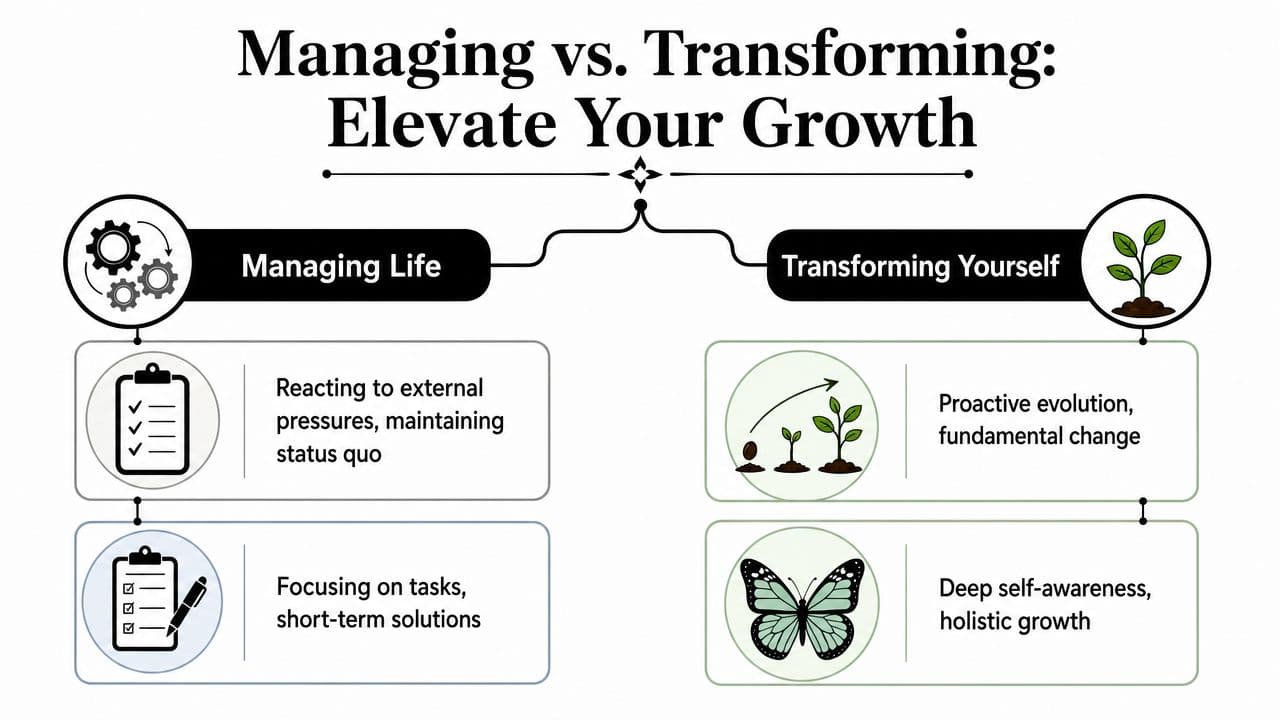
Many people work hard on themselves and still feel unchanged. They manage their schedule better, react less impulsively, read more, maybe even build stronger habits. Those things help. But they don't always create the deeper shift people are longing for.
That's because managing your life and transforming yourself are not the same task.
The Wheel of Self
One of the clearest ways to understand this is through five core aspects of self:
- Mind
- Body
- Motivation
- Behavior
- Emotion
Existing personal development models often focus on behavior while neglecting the deeper work of transforming these five aspects, which leaves many people managing life without reaching more fulfilling growth, as discussed in AACSB's exploration of transformative personal growth.
If your behavior changes but your inner drivers stay the same, the change rarely lasts. You can force yourself to speak up in meetings, but if your emotional world is still shaped by fear of rejection, that new behavior will feel exhausting. You can follow a meal plan, but if your relationship with your body is still rooted in shame, health becomes punishment instead of care.
Managing life
Managing has value. It helps you stabilize. It helps you cope. It keeps your days from unraveling.
You're managing when you:
- Use systems to stay functional. Calendars, reminders, routines, and to-do lists keep things moving.
- Solve surface problems first. You improve punctuality, reduce clutter, or organize your work.
- Respond to pressure. Your changes happen because something feels urgent.
This stage isn't failure. It's often necessary. But it has limits.
Transforming yourself
Transformation asks a different question. Not “How do I perform better?” but “What in me is ready to change at the root?”
That kind of work looks like this:
- Mind shifts first. You stop repeating inherited beliefs that no longer fit your life.
- Emotion becomes information. Instead of suppressing anger, grief, or anxiety, you learn what they're trying to show you.
- Motivation gets purified. You notice where you're chasing approval instead of alignment.
Managing helps you survive the week. Transformation changes the person who enters the week.
Habits still matter here. They just need to serve something deeper than productivity. If behavior is your starting point, practical tools can help. For example, if you want to make your routines more consistent, you can automate your habits with Recurrr and remove some of the friction that causes good intentions to fade.
But the soulful part can't be outsourced. Sooner or later, every personal development path asks the same thing: Are you trying to become more efficient at being who you've always been, or are you willing to become someone new?
The Four Key Terrains of Your Growth Map
Once you stop seeing growth as a single project, life gets easier to understand. Your personal development path usually unfolds across four connected terrains. They overlap constantly. Progress in one often supports another, and neglect in one can gradually weaken the rest.
The four terrains are professional and skills growth, emotional intelligence, physical well-being, and spiritual alignment.
A simple view of the four terrains
| Development Area | Primary Focus | Example Goals |
|---|---|---|
| Professional and skills | Capability, contribution, learning | Improve communication, build leadership skills, change careers |
| Emotional intelligence | Self-awareness and relationships | Handle conflict better, set boundaries, listen without defensiveness |
| Physical well-being | Energy, recovery, embodied health | Sleep consistently, move regularly, eat with more care |
| Spiritual alignment | Meaning, purpose, inner guidance | Clarify values, reconnect with purpose, explore life direction |
Professional and skills growth
This is the terrain commonly recognized first. It includes learning, performance, confidence at work, and the ability to contribute well. It matters because earning, creating, and serving are real parts of adult life.
But skill alone doesn't carry a person very far. Up to 80% of life success can be attributed to emotional intelligence, even though many development plans still underweight it, according to Grand View Research's personal development market.
That means your technical skill and your inner capacity are not separate. They work together.
If you learn well through audio, curated listening can help you stay engaged. I like recommending Podmuse's career podcast recommendations to people who want steady input without turning growth into homework.
Emotional intelligence
This terrain is often neglected because it's harder to measure. Yet it shapes almost everything. Emotional intelligence affects how you respond to stress, how you repair conflict, how you receive feedback, and whether your ambition isolates you or matures you.
A person can be highly capable and still be ruled by defensiveness, avoidance, or emotional fog. That creates friction at home, at work, and inside the self.
Reflection prompt: Where in your life do your reactions create more problems than the original situation?
Physical well-being
Growth becomes fragile when the body is ignored. People often try to solve exhaustion with motivation, when the underlying issue is sleep, nourishment, tension, or overstimulation.
Physical well-being doesn't have to mean extreme discipline. It can mean walking more, resting before burnout, eating in a way that steadies your energy, or noticing what your body has been trying to say for months.
Spiritual alignment
This terrain asks quieter questions. What feels meaningful to you? Which pursuits feel empty even when they look successful? What kind of life fits your nature?
For some people, this looks religious. For others, it looks contemplative, philosophical, or purpose-driven. If you want a broader lens on how life areas connect, you can think through how different domains influence each other.
When these four terrains support one another, your path feels less scattered. You're not just improving isolated parts. You're building a life that can hold both achievement and depth.
How to Chart Your Course in 3 Actionable Steps
A personal development path becomes real when it moves from insight into structure. You don't need a perfect plan. You need a plan that tells the truth.
A structured Personal Development Plan includes self-assessment, SMART goals, action strategies, required resources, and a timeline, and regular tracking helps connect those pieces to actual progress, as outlined in AIHR's professional development plan template guide.
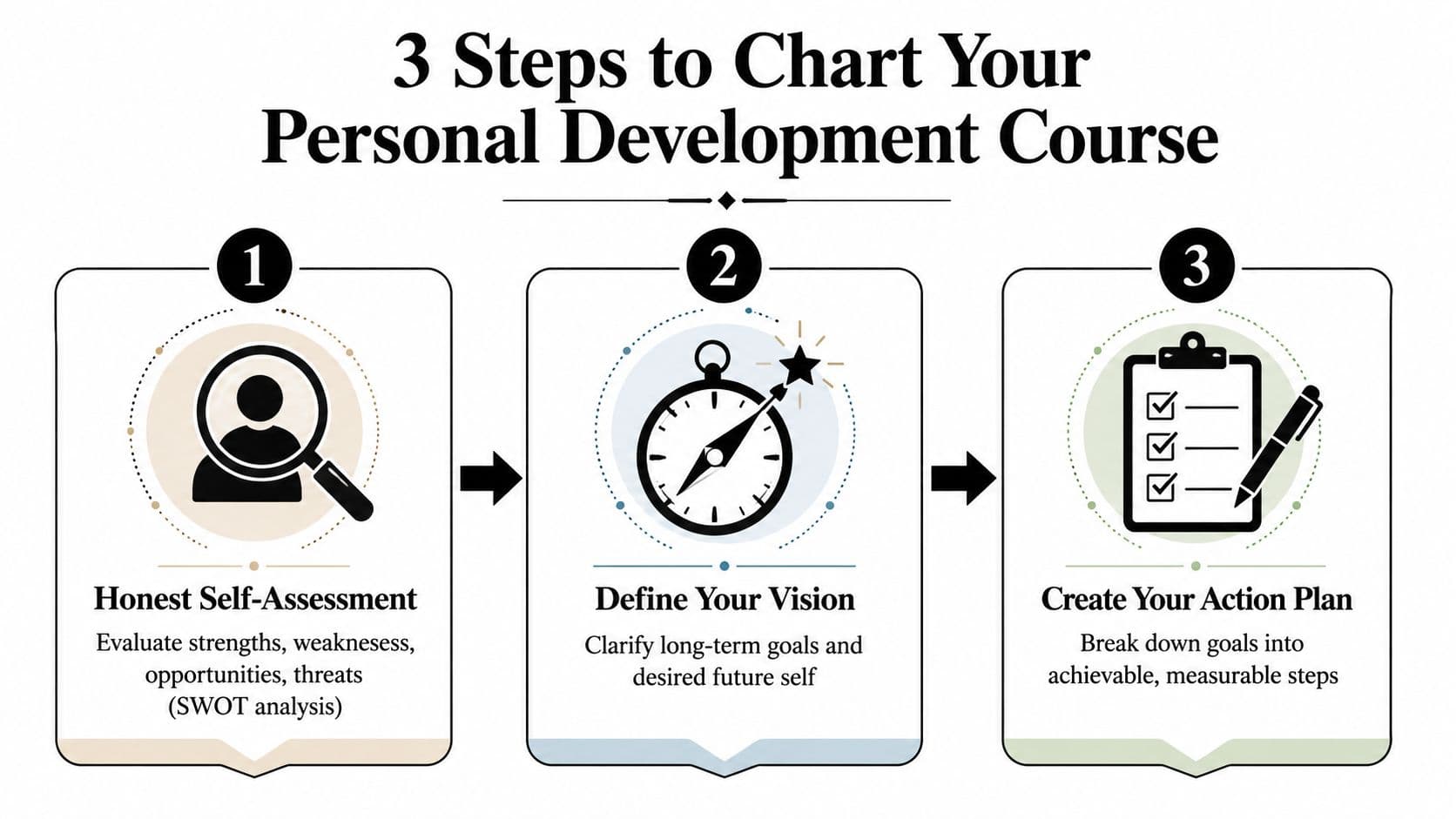
Step 1 Honest self-assessment
Skipping this is common because there's a desire for momentum. But speed without self-assessment usually sends you toward the wrong goal.
Start with what's true now. A simple SWOT analysis can help:
-
Strengths
What comes naturally to you? Where do people already trust you? -
Weaknesses
What pattern keeps repeating? Where do you avoid discomfort? -
Opportunities
What resources, relationships, or openings are available right now? -
Threats
What distractions, fears, or environments keep pulling you off course?
You can also ask a few trusted people for feedback. Not everyone needs a vote, but wise mirrors matter.
Try these questions in a journal:
- What part of my life feels underdeveloped?
- Where am I pretending I'm fine?
- What ability or quality would make the biggest difference if I strengthened it?
Step 2 Define meaningful goals
A vague desire won't guide you. “Be better” has no direction. “Become calmer in conflict” does.
Use the SMART framework to give your goal shape. Make it Specific, Measurable, Attainable, Relevant, and Time-bound. Then narrow your focus. One strong goal is usually more powerful than several scattered ones.
Examples help:
- “Read more” becomes “Finish one book on communication this month and write notes after each chapter.”
- “Get healthier” becomes “Walk after dinner four evenings each week and sleep on a consistent schedule.”
- “Find purpose” becomes “Spend weekly time reflecting on values, strengths, and recurring themes in my life.”
A good goal should feel both stretching and kind. It should ask something of you without demanding self-violence.
Write goals in language that your future self can actually follow.
If you want a practical worksheet to shape this into something usable, a personal development plan template on the Life Purpose App blog is a helpful planning companion.
Step 3 Build an action plan you can live with
Many thoughtful people get lost. They have insight, even good goals, but no bridge between intention and Tuesday afternoon.
Your action plan needs a few grounded pieces:
-
First actions
What are the next one to three moves, not the next twenty? -
Resources
Do you need a mentor, book, course, therapist, coach, or community? -
Checkpoints
When will you review what's working and what isn't? -
Support
Who knows what you're trying to build?
A simple action plan might look like this:
- Spend one evening this week doing a full self-review.
- Choose one main focus for the next season.
- Set one SMART goal connected to that focus.
- List the habits or appointments that support it.
- Review your progress at the end of each month.
The best plans don't try to fix your whole life. They create a rhythm of honest attention. That rhythm is what turns self-development from a mood into a practice.
Discovering Your Life Purpose with Dan Millman
At some point, practical planning leads to a deeper question. Not just “What do I want to improve?” but “What am I here to learn, express, and become?”
That's where Dan Millman's work enters the conversation in a meaningful way. His book “The Life You Were Born to Live” offers a framework for understanding life paths through birth-date based insight, and it can add depth to a personal development path that otherwise stays focused only on performance.
Why this adds something different
Most planning tools help you decide what to do. Millman's system helps you reflect on who you are at a deeper pattern level.
For example, someone might set a career goal that looks sensible on paper, yet feel drained every time they pursue it. Another person may keep returning to the same relationship lesson, the same fear around visibility, or the same pull toward service, teaching, creativity, or leadership. A life path framework can help those repeating themes make more sense.
This doesn't replace reflection, therapy, skill-building, or common sense. It gives them context.
The system and its modern update
Dan Millman's Life Purpose System, described in “The Life You Were Born to Live,” expanded from 37 paths to 45 unique life paths so it could accurately include people born in 2000 or later, as noted in this interview discussing the updated edition.
That matters because people often come across older summaries online and don't realize the system was updated. If you're exploring life paths, it makes sense to work from the later version rather than relying on outdated fragments.
Using it in a grounded way
I'd use this kind of insight as a mirror, not a cage.
Ask questions like:
- What strengths keep showing up in my life, even when I doubt them?
- What challenges seem to repeat until I meet them more consciously?
- Which goals feel aligned with my nature, and which ones feel borrowed?
If you want to place Millman's ideas in the wider context of his teaching, this overview offers useful background. And if you want a digital tool that applies the system from “The Life You Were Born to Live,” the Life Purpose App lets users enter a birth date to explore one of the 45 life paths and related themes.
For some people, this kind of spiritual framework doesn't answer every question. It does something quieter and more valuable. It helps them stop forcing a life that was never fully theirs.
Staying the Course An Evolving Journey
A personal development path isn't a contract you sign once. It's a relationship you keep tending.
That matters because growth changes shape. A goal that fit you six months ago may feel too small now. Or too performative. Or disconnected from what life is asking of you at this stage. Adjusting your path isn't inconsistency. It's maturity.
Long-term goals are easier to sustain when you break them into 90-day milestones and review your personal and professional progress every three months, as recommended in the earlier research cited from Grand View Research. That rhythm is long enough for meaningful movement and short enough to catch drift before it becomes a new lifestyle.
A simple review can include:
-
What worked
Which habits, choices, or supports helped? -
What resisted
Where did you keep avoiding action, and why? -
What changed
Did your priorities shift because you grew, not because you failed?
Growth becomes sustainable when you stop treating revision as weakness.
Keep your path honest. Keep it flexible. Keep it close to your real life, not your imagined perfect one. The deepest changes usually happen that way. Subtly, steadily, and with more grace than force.
If you want a practical way to explore your life path through Dan Millman's “The Life You Were Born to Live,” the Life Purpose App offers a simple starting point. You can use it alongside your journal, goals, and review process to bring more clarity to the inner side of your personal development path.
REQUIREMENTS:
- Remove each broken blog link completely (both the markdown link syntax and the descriptive text)
- Rewrite sentences naturally after removing references
- Preserve all other markdown formatting
- Only remove references to the specific broken blog links, don't change other content
- Process all broken URLs in a single pass
Example: After: "...for your small business."
Please return your response in the following JSON format: { "updatedContent": "the full content with all broken links removed", "removals": [ { "brokenUrl": "the broken blog URL", "explanation": "brief explanation of what was removed and how the text was adjusted" } ] }
REQUIREMENTS:
- Remove each broken blog link completely (both the markdown link syntax and the descriptive text)
- Rewrite sentences naturally after removing references
- Preserve all other markdown formatting
- Only remove references to the specific broken blog links, don't change other content
- Process all broken URLs in a single pass
Example: After: "...for your small business."
Discover Your Life Purpose Today!
Unlock your true potential and find your life’s purpose.
