Learn how to design a personal development system that actually works, with proven frameworks and tools to support your growth journey.
August 6, 2026 (1d ago)
Personal Development System: Proven Frameworks That Work
Learn how to design a personal development system that actually works, with proven frameworks and tools to support your growth journey.
← Back to blog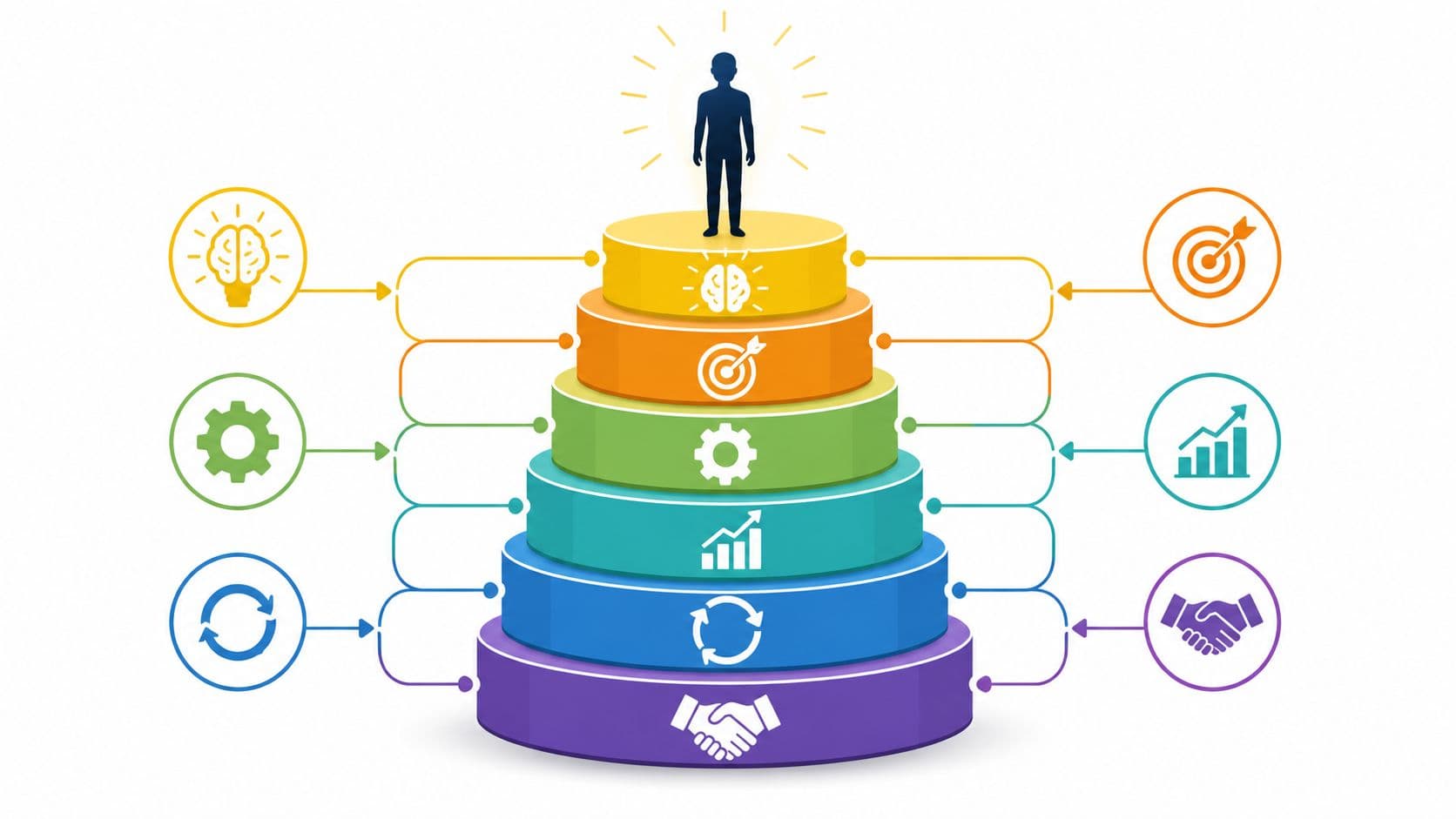
You can feel it when the system isn't working. One week you're journaling in the morning, the next you're listening to a podcast about discipline, then you buy a goal tracker, then you stop opening it after three days. The effort is real, but the pattern keeps circling back to the same place.
That's usually the moment people blame themselves. They say they need more motivation, better willpower, or a different book, but the deeper problem is structural. A personal development system works only when self-knowledge, goals, habits, and feedback are connected like parts of one platform, not scattered like loose tabs in a browser.
Why Your Self-Improvement Efforts Keep Fizzling Out
A lot of people build their growth plan the way they collect apps, one for meditation, one for habits, one for reading, one for planning, then they wonder why nothing sticks. They are trying to solve an integration problem with isolated tools. The result is familiar, a burst of energy, a few good days, then a slide back into old routines.
The bigger issue is that many efforts begin at the surface. Someone sets a goal because it sounds admirable, not because it fits their actual life, then tries to force discipline onto a plan that was never aligned in the first place. That is why the work feels heavy, and why the “failure” is usually a design failure, not a character defect.
A useful place to start is to examine why you keep repeating the same patterns with a question like, “What usually happens right before I stop?” If the answer is unclear, try a simple journal prompt in the evening: “What made today easier to follow through, and what made it harder?” That kind of note is small, but it reveals whether the problem is timing, energy, environment, or a goal that never matched your real context. For a broader starting point, you can find personal growth activities that fit your situation instead of chasing whatever feels inspiring in the moment.
Practical rule: If your growth system depends on mood, it is not a system yet. It is a wish with better packaging.
The difference between tactics and structure matters. A meditation app can be useful, but if the person using it does not know what they are calming down for, the practice becomes maintenance without direction. The same is true for goal spreadsheets, morning routines, and productivity challenges, they all help, but only when they sit inside a bigger architecture.
You can see the same pattern in the way people search for activities without asking whether those activities fit their life. A more grounded way to begin is to explore the context of your daily habits, relationships, and energy, because repeated patterns usually point to a mismatch in the system, not a lack of effort. The point is not to collect more techniques, it is to stop confusing activity with progress.
What a Personal Development System Actually Is
A strong personal development system works like a well-designed software platform. It has layers, boundaries, and clear handoffs. If one module fails, the whole platform doesn't collapse, because each part knows what it's responsible for.
Self-knowledge as the foundation
Every useful system starts with accurate input. In personal growth, that input is self-knowledge, knowing what energizes you, what drains you, what patterns repeat, and what kind of life fits you. Without that layer, people often choose goals that look good on paper but fight their nature in daily life.
Goals as the translation layer
Goals take inner direction and turn it into something measurable. If the foundation is unclear, the goal layer becomes a guessing game. That's why broad intentions like “be better” collapse, while specific aims create something you can test, adjust, and learn from.
Habits, tracking, and feedback
Habits are the execution engine. Tracking is the visibility layer. Feedback is what keeps the system honest.
The architecture matters because each layer depends on the one before it. If self-knowledge is weak, goals drift. If goals are vague, habits lose shape. If tracking is missing, you can't tell whether you're improving or just staying busy.
For readers who want a tool-oriented entry point, Sintera can serve as a journaling layer that helps surface patterns you might miss in day-to-day reflection. The useful question isn't whether a tool sounds inspiring, it's whether it strengthens the architecture instead of adding noise.
A fragile system asks for more motivation. A well-built one makes the next action obvious.
The Six Core Components Every System Needs
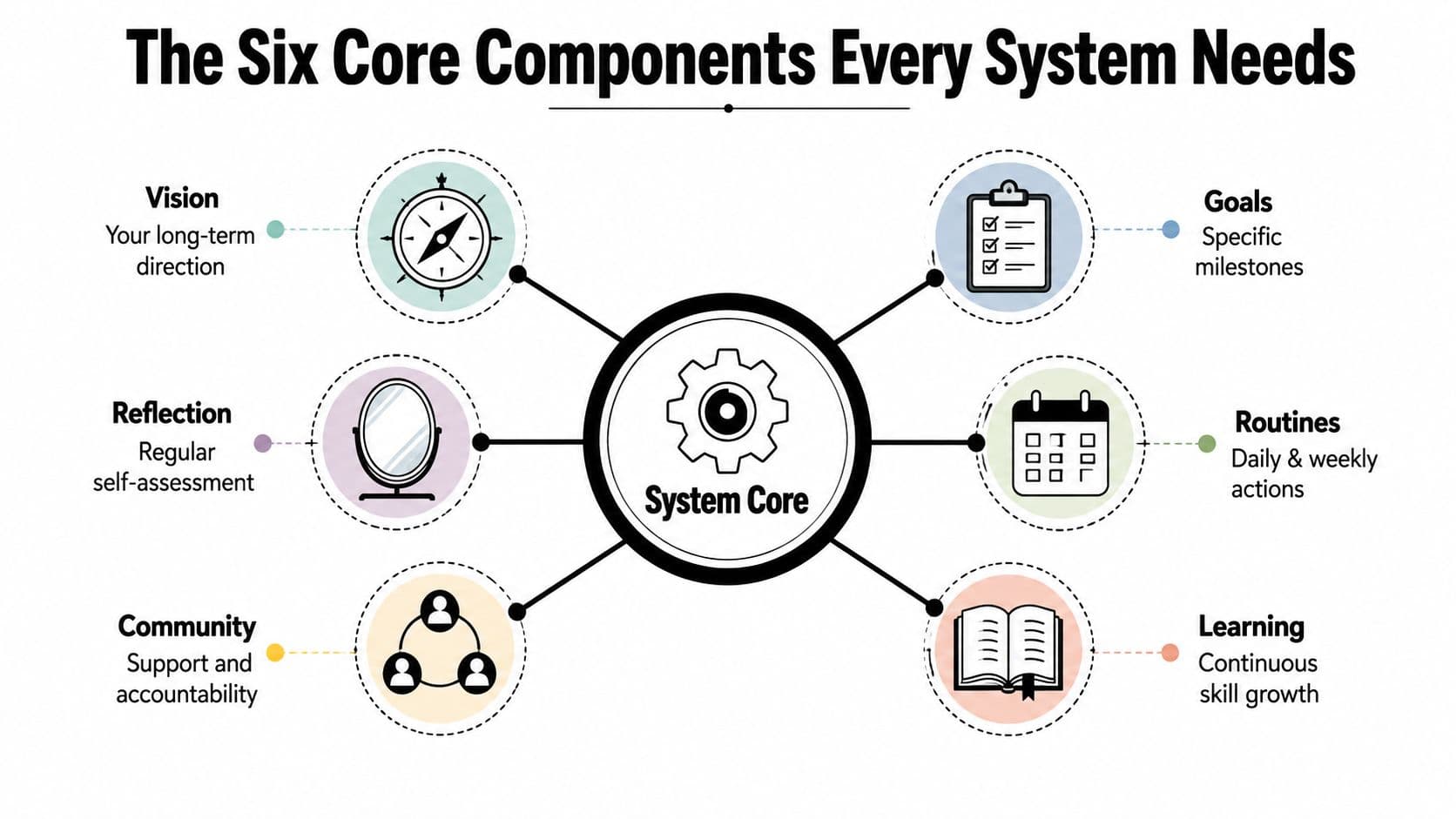
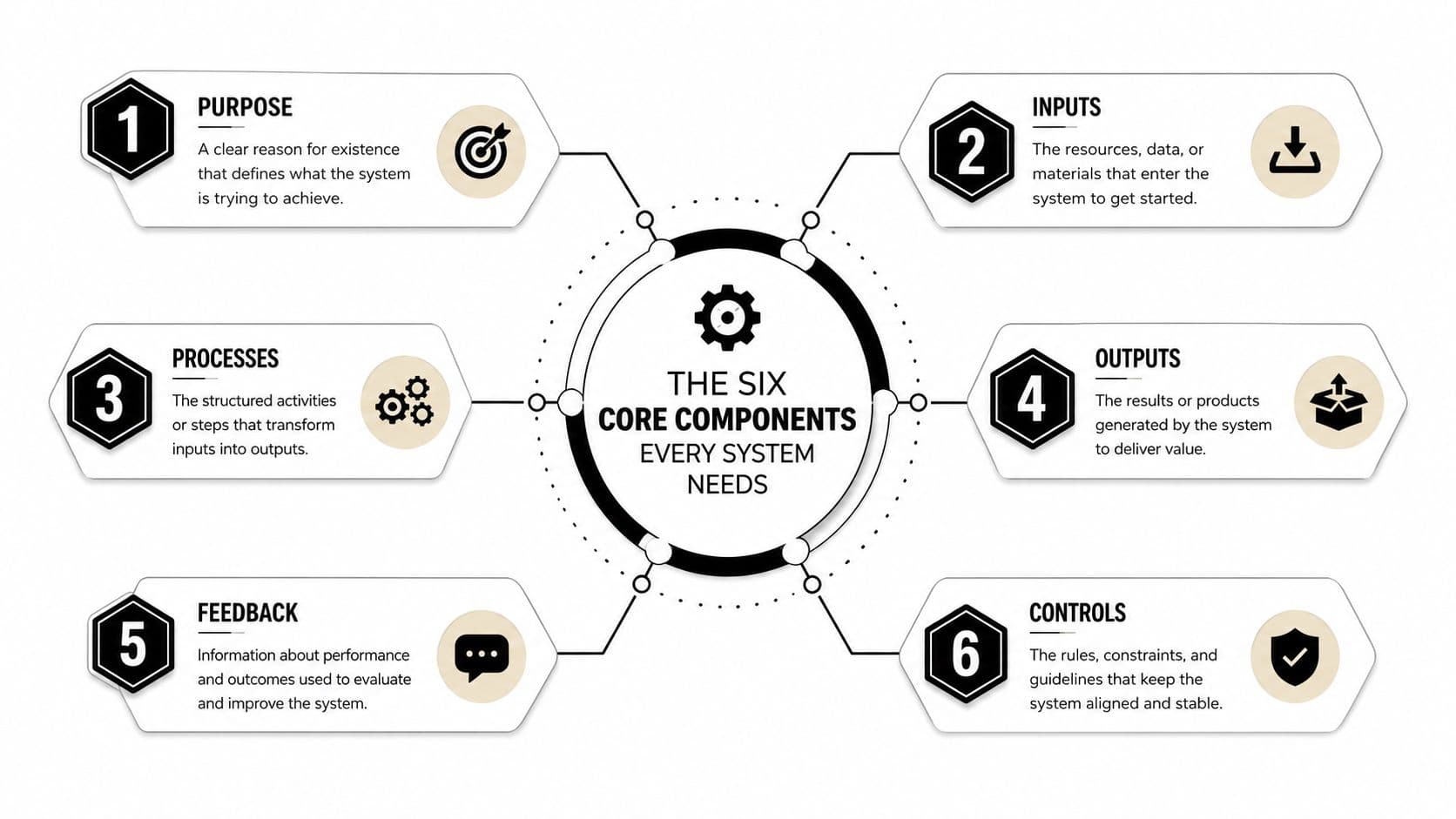
A reliable growth system isn't built from a single breakthrough. It's built from six components that keep each other honest. When one of them is missing, the whole thing starts to wobble.
1. Self-knowledge
This is the layer that tells you who you are working with. It includes your tendencies, blind spots, and the kind of goals you're naturally likely to sustain. If you skip this part, you end up borrowing someone else's blueprint and mistaking it for wisdom.
2. Goal architecture
Goals need shape. That means they should be specific, measurable, achievable, relevant, and time-bound, with metrics tied to the goal itself rather than vague hopes. A goal like “be more confident” stays fuzzy, while a goal tied to visible behavior gives your system something concrete to work with.
3. Habit design
Habits are the part that turns intention into repeated action. The common mistake is trying to rely on inspiration, but routines work better when they're simple enough to survive low-energy days. Daily structure matters more than heroic bursts.
4. Tracking mechanisms
If you don't record what's happening, you're mostly guessing. Good tracking makes progress visible, and visible progress keeps people engaged longer than abstract intention does. A notebook, spreadsheet, or app can all work, as long as the data is tied to the goal.
5. Feedback loops
The point of review is correction. Monthly and quarterly check-ins help you see drift early, so you can adjust before the whole plan goes stale. That cadence matters because small course corrections are easier than rebuilding from scratch.
6. Accountability structures
Some people do fine alone, but many people need an external commitment to make quitting more expensive. That can be a coach, a group, a friend, or a public commitment. The role of accountability isn't pressure for its own sake, it's making follow-through harder to avoid.
The easiest way to diagnose your current setup is simple. Ask which of these six is missing, then ask which one is overloaded. If one layer is carrying the weight for all the others, the system is already under strain.
Dan Millman's book The Life You Were Born to Live and the Life Purpose App fit cleanly into the self-knowledge layer because they're built to help users interpret life patterns before they start setting goals. That matters because a system built on weak input tends to produce weak output.
Comparing the Major Framework Families
Different people need different entry points. Some want structure first, some want behavior first, and some need a deeper sense of identity before they can commit to change. That's why a good framework is less about popularity and more about fit.
| Criteria | Goal-Centric | Habit-Centric | Holistic Wisdom |
|---|---|---|---|
| Setup | Fast and familiar | Simple to start | Slower, more reflective |
| Strength | Clear direction | Daily consistency | Deeper alignment |
| Weak point | Can become abstract | Can become mechanical | Can feel less concrete |
| Best use | People who need targets | People who need routines | People who need self-understanding |
| Stress test | Often weak if goals are misaligned | Strong if routines are small | Strong if the person trusts the method |
| Typical risk | Chasing metrics without meaning | Repeating actions without purpose | Overthinking before acting |
Goal-centric systems are useful when someone needs a target and a finish line. SMART goals and personal OKR-style planning help people move from vague intention to action, which is why they're so widely used. Their weakness shows up when the goal is chosen too quickly, because a crisp target can still be the wrong target.
Habit-centric systems are better when the problem is follow-through. Cue, routine, reward, repeat is easy to understand, and it helps people build consistency without constantly negotiating with themselves. The risk is that the person may become very disciplined about a life that doesn't fit.
Wisdom systems begin earlier. They ask who you are, what your tendencies are, and what kind of path makes sense before the action plan begins. That deeper starting point can reduce waste, because the goals are less likely to fight the person's nature.
For many readers, the right answer is a blend. Use self-knowledge to shape the direction, use goals to define the destination, and use habits to make movement automatic. A framework that ignores any one of those layers usually becomes brittle under pressure.
Building Your System in 90 Days
A working system doesn't begin with a perfect plan. It begins with a clear baseline and a manageable cycle. Trying to change every part of life at once is usually a bad move, because the whole setup starts to behave like a risky multi-service deployment that can't absorb integration pressure.
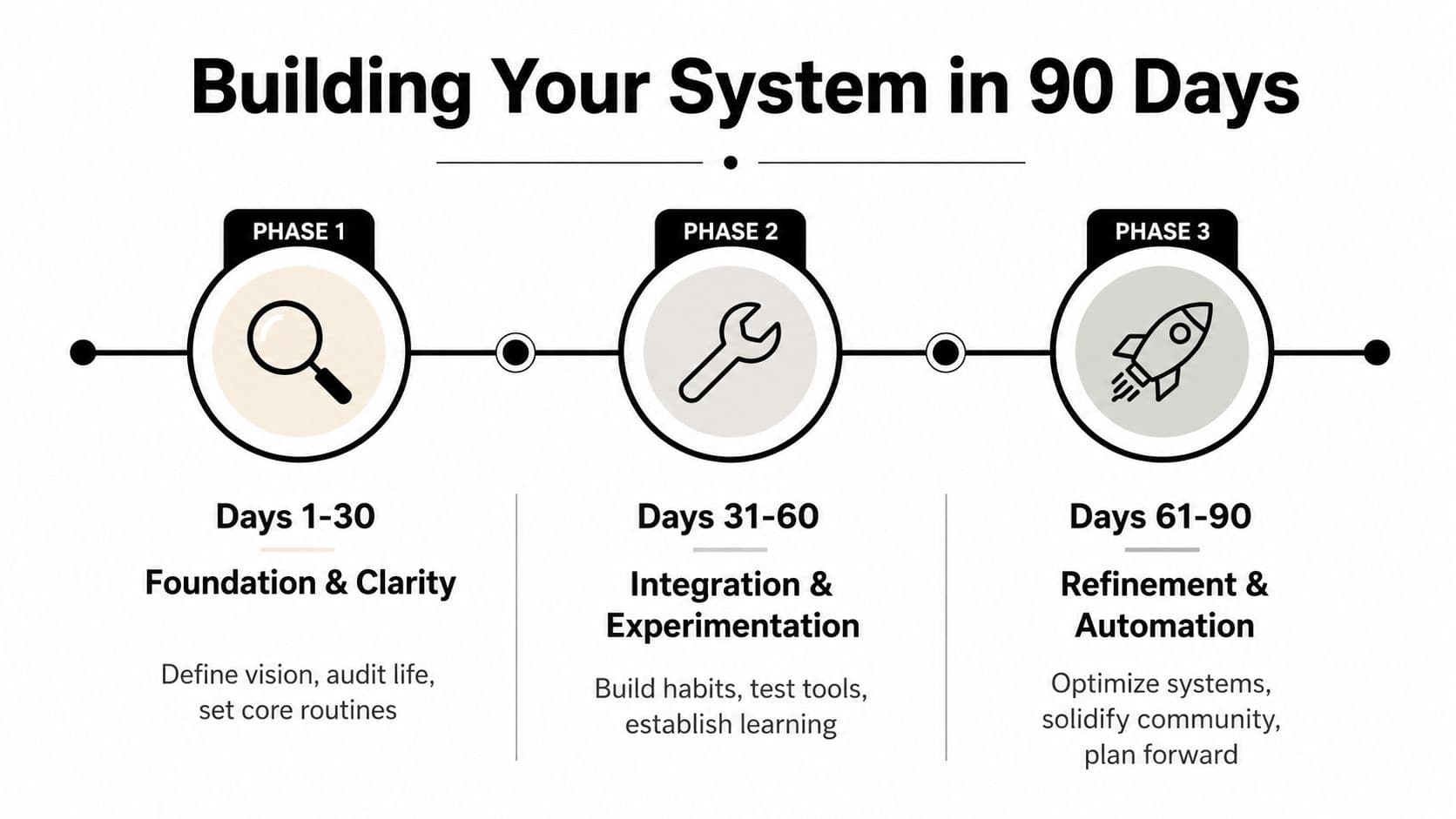
Days 1 to 30
Start with a baseline. Rate the main areas of your life on a 1 to 10 scale, then write one concrete signal for each area so the score isn't just a mood. That signal could be a daily behavior, a frequency, or a visible outcome.
Choose one or two priority domains, not six. The purpose of the first month is clarity, not acceleration. If you can't name the current state, you'll just be improving from a guess.
Days 31 to 60
Now pick one target in the weakest area and build a small experiment around it. Keep weekly tracking tight, because that's the point where people tend to think they're “doing fine” when the data says otherwise. The job here is not to overhaul your identity, it's to test whether the new pattern can survive ordinary life.
Days 61 to 90
Use the original baseline to audit the result. Review what held, what slipped, and what needs a different response next quarter. The system becomes smarter, because the review turns experience into design.
Useful standard: If you can't point to a metric by the end of the cycle, you're not measuring progress, you're narrating it.
A simple structure also helps people stay honest. Set a weekly check-in, a monthly review, and a quarterly reset. That rhythm gives the system enough repetition to learn without turning the process into a second full-time job.
If you want a ready-made planning reference, the internal guide can help you shape the cycle without starting from a blank page.
Integrating Ancient Wisdom as Your Self-Knowledge Layer
A lot of people rush into goals because goals feel practical. The problem is that practical doesn't always mean accurate. If the starting data is wrong, the plan may still look organized while pushing in the wrong direction.
Dan Millman's book The Life You Were Born to Live and the Life Purpose App are useful here because they begin with birth-date-based self-knowledge instead of performance pressure. A user enters a date of birth and gets a life-path framework that highlights core gifts and challenges, including themes connected to health, money, sexuality, career, and relationships. That makes it a foundation layer, not a replacement for action.
Consider someone who keeps setting ambitious career goals but burns out every time they try to force a style of working that doesn't suit them. A life-path read can change the conversation from “Why can't I keep up?” to “What kind of rhythm fits me?” Once that question is clear, the rest of the system gets easier to design.
The app also maps nine-year life cycles and relationship dynamics, which adds a time-based layer most goal systems don't include at all. That matters because people aren't static, and a plan that ignores timing often asks for the same output from a very different season of life.
The practical use isn't mystical performance. It's better alignment. When the self-knowledge layer is stronger, goals stop fighting identity, habits become less performative, and feedback has a more honest reference point.
Self-knowledge guidance becomes much more useful when it's treated as the start of system design, not a side hobby. That's the primary advantage of using an ancient-wisdom framework inside a broader personal development system, it gives the other layers something coherent to build on.
Why Most Systems Fail and How to Prevent It
Most systems don't fail because people are lazy. They fail because the design is incomplete. “Just stay consistent” is weak advice when the structure itself is misaligned.
One common failure mode is trying to build too many modules at once. The fix is to choose one priority domain and test it before adding more complexity. Another failure mode is skipping self-knowledge, which leaves the goals disconnected from the person using them.
A third problem is relying on subjective feelings instead of measurable KPIs. If the data is fuzzy, drift stays invisible until the frustration is already high. A fourth is forgetting the review cadence, which means the system never gets the chance to correct itself early.
A useful antidote is to treat setbacks as diagnostics. If the routine collapsed, ask whether the habit was too large, the goal was misaligned, or the review loop was too loose. That mindset is far more useful than self-blame, because it turns failure into a system update instead of a personality judgment.
If you're looking for a broader reflective lens, find the jungle prescription offers another way to think about inner work as something that unfolds through context, not force. The takeaway is simple. Good systems don't demand perfection, they make refinement possible.
If you want a more grounded way to design your growth, start with the Life Purpose App. It gives you a structured self-knowledge layer that can sit underneath your goals, habits, and reviews, so your personal development system has a clearer foundation. Visit Life Purpose App and use it to build a plan that fits your actual life, not someone else's ideal.
Discover Your Life Purpose Today!
Unlock your true potential and find your life’s purpose.
