Discover a powerful prayer to remove fear and anxiety. This guide offers step-by-step instructions, variations, and daily practices to find lasting peace.
April 11, 2026 (4mo ago) — last updated July 10, 2026 (1mo ago)
A Prayer to Remove Fear That Actually Works
Discover a powerful prayer to remove fear and anxiety. This guide offers step-by-step instructions, variations, and daily practices to find lasting peace.
← Back to blog
Some fears don’t arrive with drama. They show up at 2 a.m. when your body is tired but your mind won’t stop. They sit beside you before a difficult conversation, a medical test, a money decision, or a leap you know you need to make.
In those moments, fear can feel bigger than logic. Bigger than faith, even. Your chest tightens, your thoughts race, and the future starts speaking in worst-case scenarios.
A prayer to remove fear can help because it gives fear somewhere to go. It turns panic into words, and words into surrender. It doesn’t require perfect belief, polished language, or a flawless spiritual life. It asks only for honesty and a willingness to pause.
When Fear Feels Louder Than Faith
You might know this feeling well. You lie in bed, replaying one problem from ten different angles, hoping one of them will finally make you feel safe. Instead, each thought multiplies.

Fear often feels personal, but it’s also profoundly human. In the U.S., anxiety affects many adults annually, and 2 Timothy 1:7 remains one of the best-known biblical anchors for prayer against fear, appearing in over 50 dedicated prayer points and at least 10 structured prayer collections across Christian resources (Jennifer LeClaire).
That verse says, “God has not given us a spirit of fear, but of power and of love and a sound mind.” It matters because it doesn’t shame fear. It challenges fear’s authority.
Why prayer helps in the first place
Prayer interrupts the spiral. It changes your posture from helplessness to relationship.
Instead of asking, “How do I control everything?” prayer asks, “How do I stay grounded while I walk through this?” That’s a very different question.
Fear usually gets louder in isolation. Prayer breaks that isolation.
For many people, prayer also works because it’s immediate. You don’t need a perfect environment. You don’t need to wait until you feel holy, calm, or ready.
If you want a thoughtful Christian perspective on how fear and courage show up together, there are guides that offer a helpful companion read.
What prayer is not
A prayer to remove fear isn’t magic words. It won’t always erase every sensation in a minute.
What it can do is steady your inner life. It can help you breathe again, think more clearly, and remember that fear is present, but it doesn’t have to lead.
Preparing Your Mind and Space for Prayer
Before the words come, your nervous system needs a signal that it’s safe to slow down. Preparation isn’t a fancy ritual. It’s a simple act of intention.

A quiet corner helps. So does the edge of your bed, your parked car, a park bench, or a chair near a window. The point is not perfection. The point is presence.
Start by externalizing the fear
When fear stays vague, it grows. When you name it, it becomes easier to address directly.
Try writing down what is scaring you. Keep it plain.
- Name the core issue. Write, “I’m afraid I’ll fail,” or “I’m scared something will happen to someone I love.”
- Be specific. “Money” is broad. “I’m afraid I won’t be able to cover next month’s bills” is clearer.
- Don’t edit for spirituality. Raw truth is more useful than polished language.
Create a small signal of calm
You don’t need incense, music, or ceremony. But simple cues can help your mind shift from reaction to attention.
A few options work well:
- Turn off notifications so your attention isn’t pulled apart.
- Light a candle or sit near natural light if that helps you feel settled.
- Place both feet on the floor and loosen your jaw and shoulders.
- Take a few slow breaths before you begin.
Practical rule: Make your prayer space easy enough to use on a hard day.
If fear also feels tied to heaviness or spiritual clutter, some people find it helpful to pair prayer with gentle clearing practices.
Keep the setup simple
A useful prayer practice should survive ordinary life. If your routine is too elaborate, you probably won’t return to it when you need it most.
Think in terms of readiness, not performance. One notebook. One chair. One honest moment.
A Simple and Powerful Prayer to Remove Fear
You don’t need a long script. You need a prayer that tells the truth, opens the heart, and gives fear less room to rule.
Here is a simple prayer to remove fear you can return to anytime:
Divine Presence, I bring You my fear exactly as it is. I confess what has been weighing on me and what I’ve been afraid to face. I place this fear into Your hands and release my need to control every outcome. Fill me now with power, love, and a sound mind. Quiet the thoughts that torment me. Strengthen what is weak in me. Guide my next step with peace and clarity. I choose trust over panic, truth over dread, and courage over avoidance. Stay with me as I move forward. Amen.
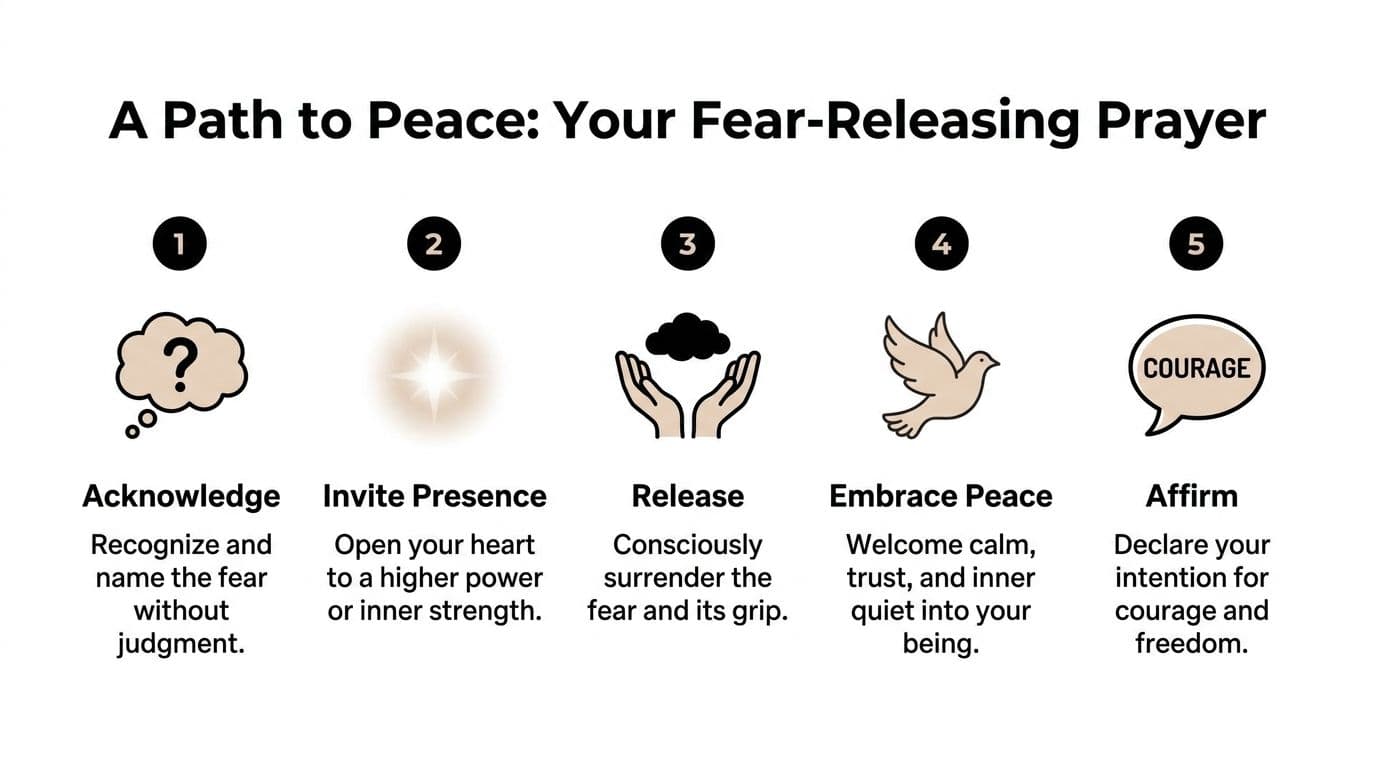
A structured 5-phase process can make prayer more effective in practice. In group interventions, this approach lowered self-reported fear scales by 40 to 50%, and pastoral reports note that acknowledging specific fears verbally and surrendering them in prayer reduces acute anxiety in 65% of sessions (Positively Jane).
The five phases that make the prayer work
The strength of this prayer is its movement. It doesn’t stay in distress. It leads you through it.
| Phase | What you do | Example line |
|---|---|---|
| Acknowledgment | State the fear directly | “I bring You my fear exactly as it is.” |
| Surrender | Release control | “I place this fear into Your hands.” |
| Affirmation | Replace fear’s message | “Fill me with power, love, and a sound mind.” |
| Petition | Ask for what you need now | “Quiet the thoughts that torment me.” |
| Commitment | Choose your next posture | “I choose trust over panic.” |
How to pray it slowly
Some readers rush prayer because they want relief fast. That’s understandable, but fear often loosens when you slow down.
Try this rhythm:
- Read one line at a time and pause after each sentence.
- Notice your body. If your chest tightens at one line, stay there a little longer.
- Repeat the line that lands. Sometimes one sentence becomes the whole prayer for that day.
If your spiritual language leans broader and more universal, you may appreciate prayers that help you find wording that feels natural without losing depth.
If you don’t feel different right away
That doesn’t mean the prayer failed. Often the first change is subtle.
You may feel a little less scattered. A little more able to breathe. A little less fused with the fear. That’s not small. That’s the beginning of freedom.
Adapting Your Prayer for Different Kinds of Fear
Not all fear speaks with the same voice. Fear of failure sounds different from fear of loss. Financial fear has a different texture than fear of rejection.
That’s why a useful prayer to remove fear should be personalized. It should meet the fear you have, not just the fear you wish you had.
Match the prayer to the fear
Here’s a simple way to adjust the core prayer.
| Kind of fear | What it often says | How to shape the prayer |
|---|---|---|
| Fear of failure | “If I try, I’ll fall short.” | Ask for courage to act without demanding a perfect outcome. |
| Financial fear | “I won’t be safe.” | Pray for steadiness, wise decisions, and trust in today’s next step. |
| Fear of rejection | “If people really see me, they’ll leave.” | Ask for inner security and freedom from people-pleasing. |
| Fear of loss | “I can’t bear what might happen.” | Pray for strength to stay present instead of living in imagined grief. |
A few examples:
-
For work or purpose anxiety “Help me do the next honest thing without being ruled by the fear of failure.”
-
For relationship fear “Heal the fear that makes me cling, hide, or expect abandonment.”
-
For uncertainty “Give me enough light for today, even if I can’t see the whole road.”
Use self-knowledge, not just willpower
Most spiritual content on fear stays Christian-centric, but there’s an opening for something more personalized. 28% of U.S. adults practice eclectic spirituality, and that creates space for fear work that includes prayer and self-discovery (King David blog).
Dan Millman’s book, The Life You Were Born to Live, offers a useful lens here. So does the Life Purpose App. Both can help you notice recurring challenges that shape the kind of fear you return to.
For example, someone whose path emphasizes creativity may need prayer around visibility and judgment. Another person may keep facing lessons around trust, boundaries, or self-worth, and their prayer will feel more powerful once it speaks directly to that pattern.
Personalized prayer is often more honest prayer. Honest prayer usually goes deeper.
Weaving Prayer into Your Daily Life
Fear rarely leaves for good because of one powerful moment. More often, peace grows through repetition.
That’s not discouraging. It’s good news. It means you don’t have to force a breakthrough. You can build one.
A short daily rhythm
You can keep this simple:
- Morning. Say one line from your prayer before looking at your phone.
- Midday. Pause for one minute, breathe slowly, and repeat your anchor phrase.
- Evening. Write down what triggered fear and where you felt support.
This kind of rhythm matters because regular practice changes your response over time. In advanced prayer protocols, combining prayer with visualization has been linked to 50% deactivation in the amygdala in fMRI proxies, and 90-day adherence has shown up to 82% sustained relief from chronic anxiety (YouTube prayer research summary).
Add breath and imagery
Prayer lands more effectively when your body isn’t in full alarm.
Try this:
- Inhale gently.
- Exhale longer than you inhaled.
- As you pray, imagine supportive light around you, or picture yourself being upheld by a strong and loving hand.
That image doesn’t need to be dramatic. It just needs to help your body stop acting as if danger is already here.
When fear is physical, prayer works better when you include the body.
Keep it sustainable
Consistency beats intensity. A brief daily practice usually helps more than waiting for a crisis and then trying to pray for half an hour while overwhelmed.
If consistency is hard for you, this guide on how to be consistent in prayer gives practical ideas that are especially useful when you’re just starting or rebuilding the habit.
A journal prompt can also help: What fear showed up today, and what would trust have sounded like instead?
That one question can teach you a lot.
When Fear Lingers What to Do Next
Sometimes you pray sincerely and the fear still comes back. That’s common. It doesn’t mean you lack faith, and it doesn’t mean the prayer was empty.
Many fear practices across Christian history have relied on repetition. Structured collections consistently return to scriptural commands against fear, and the older tradition of repeated prayer, including the Desert Fathers’ repeated use of Psalm 91, points to the same lesson. Consistency is the key to effectiveness ( Julie Giordano).
Common reasons fear keeps returning
A few patterns show up often:
- You only pray in emergencies. That makes prayer feel like rescue, not relationship.
- You stay vague. General prayer can help, but specific fear usually needs specific language.
- You expect instant calm. Sometimes peace comes in layers.
What to try next
If fear keeps circling back, adjust the practice rather than abandoning it.
- Pray aloud. Spoken words can feel more grounding than silent thought.
- Repeat one line during movement. A slow walk can help discharge some of the body’s stress.
- Use support. If fear is intense and persistent, talking with a counselor, pastor, or therapist can be a wise next step.
You might also find it helpful to explore more practical guidance on overcoming fear alongside your prayer practice.
Some burdens are spiritual. Some are emotional. Many are both. Prayer belongs in that healing process, but it doesn’t have to carry the whole weight alone.
If you want to understand your recurring fears through a deeper lens of self-knowledge, the Life Purpose App offers a practical companion to Dan Millman’s The Life You Were Born to Live. It can help you explore your life path, core challenges, and patterns that may shape the fears you’re working through, so your spiritual practice becomes more personal, clear, and grounded.
Discover Your Life Purpose Today!
Unlock your true potential and find your life’s purpose.
