You leave a conversation and your body feels heavier, your patience gone, your mind noisy. This guide helps you identify where that drain starts, and uses grounding, shielding, cleansing, and boundaries to restore clarity and resilience.
May 26, 2026 (2mo ago) — last updated June 24, 2026 (1mo ago)
Protect Your Energy from Negative Influences
Practical ways to protect your energy: grounding, cleansing, boundaries, and daily habits to reduce drain and build resilience.
← Back to blog
Protect Your Energy from Negative Influences
Summary: Feeling drained? Practical ways to protect your energy with grounding, cleansing, boundaries, and daily habits for more resilience.
Introduction
You leave a conversation and your body feels heavier, your patience gone, your mind noisy. Nothing dramatic happened, but you know you’ve taken on more than your share. This guide helps you identify where that drain starts, use simple grounding and shielding practices, cleanse your space, and set boundaries so you feel clearer and more resilient.
What Are “Negative Energies”?
“Negative energy” is a useful shorthand for anything that leaves you more contracted, reactive, foggy, or drained than before. Sometimes it comes from a tense room, another person’s agitation, your own rumination, or overstimulation from screens. The experience is human—even if you describe it in spiritual terms.
A spiritual term with a psychological parallel
Many spiritual traditions describe energy exchange through attention and presence. Psychology describes similar processes with terms like emotional contagion and attention capture. Research shows emotional states can spread through social networks, which helps explain why being around highly negative people can affect your mood and physiology1.
If you often think, “I was fine until I spent time with them,” that reaction is valid. It may be your system registering stress or mood transfer before your thinking mind catches up.
Practical rule: If your body consistently feels worse after certain places, people, or habits, take that pattern seriously.
Why the phrase still helps
The term “negative energy” captures atmosphere, tension, unresolved conflict, and subtle depletion that people notice before they can name them. A calm, non-fearful view of protection recognizes you’re permeable, influenced by your environment, and responsible for learning how to regulate what you allow in, absorb, and release.
Sources and Signs of Energetic Drain
People often say, “I feel off,” without tracing the source. Once you identify the leak, the response gets much simpler.
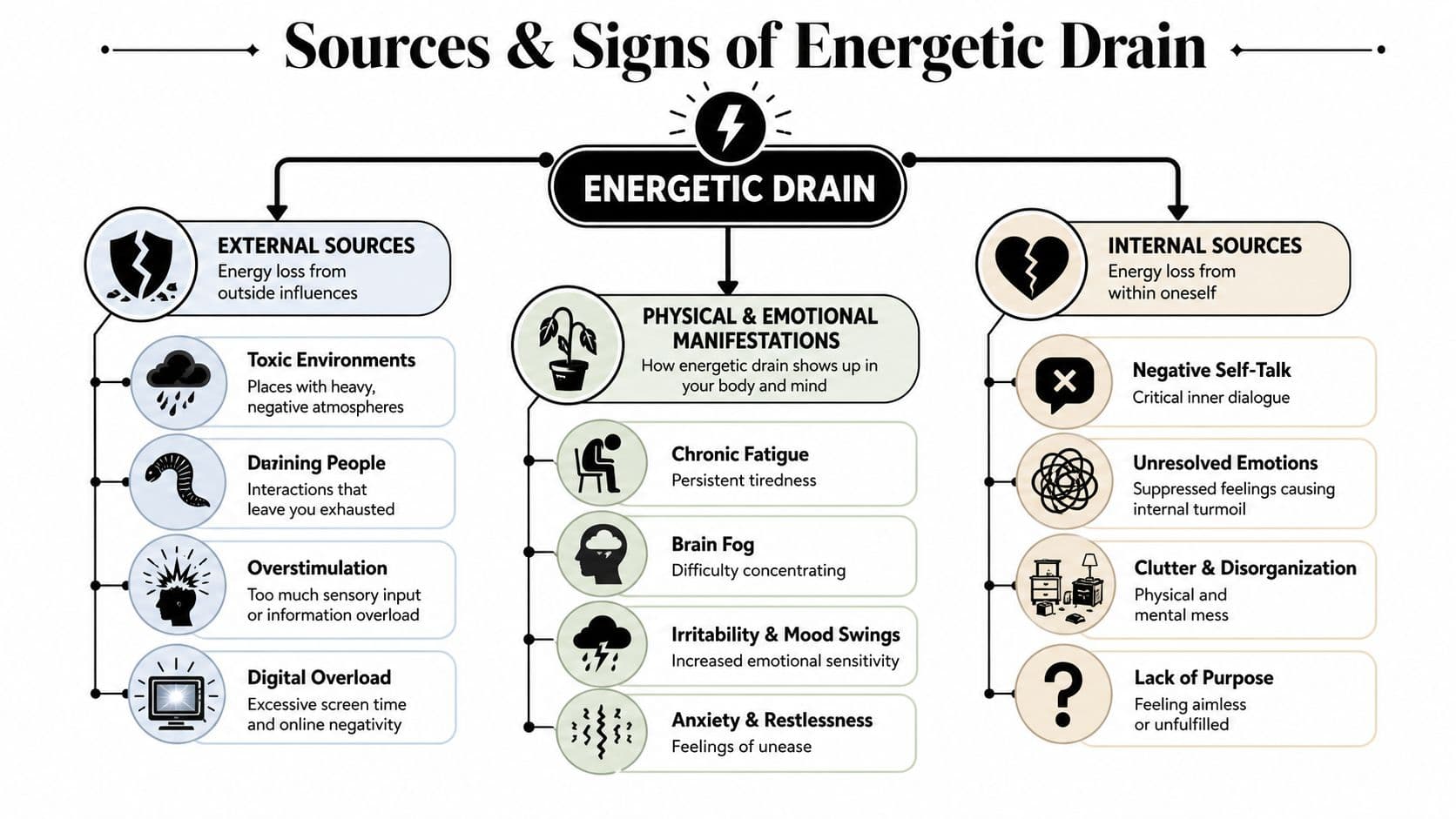
Common sources
- People: Chronic venting, guilt-based communication, manipulation, or the expectation that you’re always available.
- Places: Cluttered rooms, noisy offices, conflict-heavy homes, poor lighting, and chaotic schedules.
- Self-generated patterns: Negative self-talk, rumination, and perfectionism.
- Digital exposure: Notifications, doomscrolling, and hostile comment spaces that keep your nervous system activated.
Digital drain is real
Screen exposure shapes attention and mood. Young people are especially vulnerable to screen-mediated emotional strain, which factors into adolescent mental health worldwide2. Boundaries around notifications and screen time reduce constant activation and emotional fatigue.
If your phone is the first thing you check in the morning and the last thing at night, it’s shaping your inner climate.
Signs you’re absorbing too much
- Brain fog
- Irritability
- Persistent tiredness
- Restlessness
- Emotional spillover
- A sense of heaviness
Treat these signs as data. Ask: Who was I with? What space was I in? What was I consuming? Tracing the source helps you respond effectively.
Spiritual and Psychological Perspectives
You don’t have to choose only one frame. Spiritual language honors felt experience; psychology explains mechanisms. Use both where they help.
Two lenses for one experience
Spiritual concepts—auras, cords, shielding—map to psychological phenomena like stress response, rumination, and emotional mirroring. Translating between frameworks can clarify what to do next.
| Spiritual concept | Psychological parallel |
|---|---|
| Aura feels heavy | Heightened stress load or emotional exhaustion |
| Energy vampire | A person who’s chronically draining or intrusive |
| Psychic cords | Unfinished attachment, rumination, or enmeshment |
| Bad vibes in a room | Nervous system detecting tension or sensory overload |
| Need to cleanse | Need for emotional reset, closure, and a state shift |
| Shielding | Boundary-setting and attentional control |
What each lens does well
Spiritual language legitimizes felt sense and intuition. Psychology points to repeatable mechanisms—why certain interactions linger and why reducing exposure often works better than trying to transmute everything.
A helpful framework makes you clearer, calmer, and more responsible.
Foundational Practices: Grounding and Shielding
Start with basics that work together: grounding to return to your body and shielding to keep a clean boundary while staying open.

Grounding with paced breathing
Try this simple practice:
- Stand or sit with both feet supported. Soften your jaw and drop your shoulders.
- Bring attention to the soles of your feet.
- Imagine roots extending into the earth—thick, steady, and deep.
- Inhale slowly, feeling support rise through those roots.
- Exhale and release tension, picturing strain draining downward.
- Repeat for several breaths, staying with weight, contact, and steadiness.
This practice supports attention control and autonomic down-regulation when used regularly3.
Shielding without hardening
Shielding is defining what’s yours, not cutting off. Use this simple version:
- Visualize a bubble or field of light around your body—opaque for privacy, translucent for openness.
- Set an intention: “I stay connected to myself. I allow in what supports me. I let the rest pass around me.”
- Adjust the image if it feels rigid or weak.
- Refresh it before crowds, travel, or difficult conversations.
If prayer anchors you, use words that steady your focus and courage.
If a practice increases hypervigilance, change it.
For daily practice ideas, consider adding a short grounding routine on your site’s grounding page: [/daily-grounding-practice].
Cleansing Your Space, Body, and Objects
Cleansing changes the state of a space, object, or your body with intention. Done well, it creates closure and marks a before and after.
Start with practical cleaning
Open windows, remove trash, clear surfaces, wash fabrics, and let natural light in. Ordinary actions often create the biggest shifts.
Cleansing practices that help
- Sound: Bells, chimes, clapping, or singing bowls to interrupt heaviness.
- Salt: Baths or salt placed briefly in a space, then discarded.
- Smoke cleansing: Use respectfully and avoid appropriation of sacred plants.
- Water rituals: Use a conscious shower to wash the day away.
- Object clearing: Clean or remove emotionally loaded items.
Rituals work in part because they increase perceived control and create a structure for release3.
Quick personal cleanses
- After work: Wash your hands slowly and mentally close the interaction.
- After conflict: Change clothes and step outside before re-entering home life.
- After overstimulation: Take a salt bath or a quiet shower with no phone nearby.
Cleansing should follow reality: clean clutter if that’s the issue; address draining relationships when that’s the issue.
The Core: Self-Knowledge and Boundaries
Grounding, shielding, and cleansing help—but they have limits without clear boundaries and self-knowledge. Knowing where you end and someone else begins is the deepest protection.
Boundaries as energetic tools
Boundaries protect clarity. Practically, that looks like:
- Limiting access: Not everyone gets immediate replies or unlimited emotional processing time.
- Naming capacity: “I can listen for a few minutes, but I can’t carry this all evening.”
- Refusing draining roles: You’re not required to be fixer, rescuer, or emotional sponge.
Useful scripts:
- “I care about you, and I’m not available for this conversation right now.”
- “I can help with one part of this, not all of it.”
- “I’m stepping back from messages tonight. I’ll revisit this tomorrow.”
- “That doesn’t work for me.”
Vague availability breeds resentment; clear limits protect relationships and your energy.
Inner clarity changes what sticks
Reflection and self-knowledge help you notice patterns: which fears are old, which urgencies aren’t yours, which relationships trigger overgiving. Structured systems or life-path work can support this discernment. For practical boundary language, see [/how-to-set-healthy-boundaries].
Daily Routine and When to Get Help
Protection is maintenance. Small daily habits beat occasional intense rituals.
A simple daily rhythm
- Morning: Brief grounding. Feel your feet, breathe, and choose one intention.
- Before stress: Activate your shield for under a minute.
- Midday: Pause before opening messages—ask, “Am I available now?”
- Evening: Release the day—shower, tidy a corner, or sit in silence.
- Weekly: Deeper reset—open windows, clear clutter, remove what no longer belongs.
Keep practices short and consistent.
When to seek professional help
Seek a doctor or licensed mental health professional if you experience:
- Persistent hopelessness
- Anxiety or sadness that disrupt daily life
- Exhaustion that doesn’t lift with rest
- Difficulty functioning at work, school, or home
- Recurring patterns that feel unmanageable on your own
There’s no failure in needing help—sometimes the wisest protection is admitting you need skilled care.
Healing isn’t about becoming untouchable. It’s about becoming anchored, so what isn’t yours no longer takes over your inner world.
Quick Q&A
Q: How do I know if I’m absorbing someone else’s energy or just stressed?
A: Look for patterns—do you consistently feel worse after specific people or places? Track your interactions and symptoms (brain fog, irritability, heaviness). That pattern points to external influence rather than isolated stress.
Q: What’s a fast reset I can do between meetings or social events?
A: Try two minutes of grounding breathing: feel your feet, inhale support, exhale tension, and visualize a soft shield. Change clothes or wash your hands if you need a stronger cut-off.
Q: How do I set boundaries without feeling guilty?
A: Use short, clear statements about capacity: “I care about you, I can’t talk about this right now.” Practice small limits so they feel normal. Consistent, calm boundaries reduce guilt over time.
1.
Kramer, A. D. I., et al., “Experimental evidence of massive-scale emotional contagion through social networks,” PLOS ONE (2014). [https://journals.plos.org/plosone/article?id=10.1371/journal.pone.0090315]
2.
World Health Organization, “Adolescent mental health,” WHO fact sheet. [https://www.who.int/news-room/fact-sheets/detail/adolescent-mental-health]
3.
Study on ritual and perceived control, Journal of Experimental Psychology (see record). [https://psycnet.apa.org/record/2014-41416-001]
Discover Your Life Purpose Today!
Unlock your true potential and find your life’s purpose.
