Psychic empathic abilities are a heightened sensitivity to people, places, and subtle energy. This practical guide helps you spot common signs, protect your energy with grounding and shielding techniques, and strengthen reliable intuition through short daily practices. Use these exercises and boundary skills to reduce overwhelm and turn sensitivity into insight.

December 16, 2025 (10mo ago) — last updated October 10, 2026 (13d ago)
Psychic Empath Guide: Grounding & Energy Protection
Grounding, shielding, boundary and daily exercises for psychic empaths to protect energy, reduce overwhelm, and strengthen intuition.
← Back to blog
Psychic empathic abilities are a heightened sensitivity to people, places, and subtle energy. This practical guide helps you spot common signs, protect your energy with grounding and shielding techniques, and strengthen reliable intuition through short daily practices. Use these exercises and boundary skills to reduce overwhelm and turn sensitivity into insight.
Psychic Empath Guide: Grounding & Energy Protection
Summary: Recognize and manage empath and psychic sensitivity with grounding, shielding, boundaries, and simple daily exercises to protect energy and strengthen intuition.
Introduction
Psychic empathic abilities are a heightened sensitivity to people, places, and subtle energy. This practical guide helps you recognize common signs, protect your energy with grounding and shielding techniques, and develop reliable intuition through everyday practices. Read on for concrete exercises, boundary skills, and quick checks you can use now.
Use these tools to turn sensitivity from a drain into a source of insight and connection.
Unpacking Your Intuitive Senses
Have you ever walked into a room and immediately felt the mood shift, or had a gut feeling about someone that later proved true? Those are core signs of empathic and psychic perception. They’re natural human sensitivities turned up a few notches.
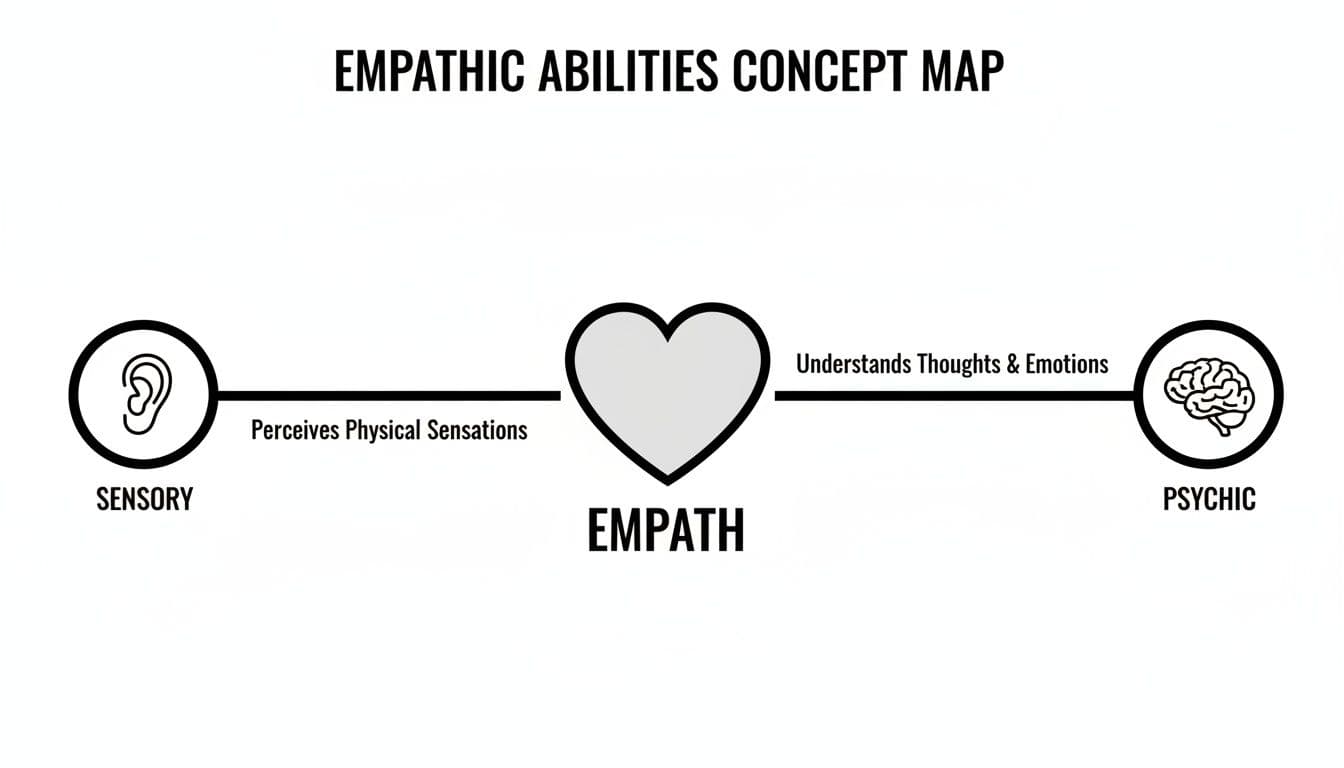
Imagine an internal radio that picks up emotional frequencies others miss. The empath acts as a bridge, translating physical cues into deeper impressions. Many people who identify as empaths experience life through this heightened filter, which often supports spiritual insight and relational depth.
Differentiating Psychic and Empathic Traits
While often used together, “psychic” and “empath” refer to related but distinct ways of receiving information. An empath primarily feels; a psychic primarily perceives nonphysical information through other channels.
Psychic vs Empathic Traits at a Glance
| Aspect | Empathic Abilities | Psychic Abilities |
|---|---|---|
| Primary function | To feel emotions, energy, or physical sensations of others | To perceive information through nonphysical senses (seeing, hearing, knowing) |
| Information source | From another person’s emotional or energetic field | From guides, collective fields, or the subconscious |
| Common experience | Feeling drained in crowds or absorbing a friend’s anxiety | Sudden insights, mental images, or inner guidance |
| Focus | Emotional and energetic connection | Information and insight |
Understanding where you sit on this spectrum, or whether you experience a blend, can be validating and clarifying.
The Science and Spirit of Empathy
Scientific and spiritual frameworks can complement one another when understanding empathy. Researchers note that empathy is a measurable, complex trait and that questionnaire differences don’t always map directly to consistent brain-activity differences1. Viewing empathic sensitivity through both lenses reframes it as a natural variation of human experience rather than something strange.
Signs You Might Be an Empath
Being an empath goes beyond being “sensitive.” It means your nervous system naturally registers emotional and energetic states in your environment. Approximately 15–20% of people are considered highly sensitive, which overlaps with many empathic traits4. Here are the most common signs.
You Absorb Other People’s Emotions
A defining empath trait is absorbing others’ emotions. You might leave a conversation feeling the same heaviness someone else had, or feel drained after watching a distressing news story. This mirroring can be powerful for connection but draining without care.
Crowds and Busy Places Are Draining
Packed malls, concerts, and busy transit often leave empaths exhausted. You absorb a collage of emotions from many people at once, an experience that can feel like sensory overload.
You Have Strong Intuition and Gut Feelings
Empaths often have clear gut instincts, an internal compass that signals when something is off. These hits of claircognizance help you sense mismatches between words and underlying feeling.
“Your intuition is an internal compass. Trusting those hits and testing them helps them become more reliable.”
Nature Is Your Sanctuary
Natural settings often reset an empath’s system. Time in forests, near water, or in quiet parks helps release accumulated emotional energy and restore balance.
When sensitivity isn’t balanced with coping strategies, it can increase vulnerability to anxiety and depression, so self-care and boundary skills are essential2.
Exploring Psychic Gifts and Intuitive Channels
“Psychic” covers a spectrum of intuitive channels, often called the clairs. These subtle abilities show up as inner images, sounds, feelings, or sudden knowing.
The Four Main Channels of Intuition
- Clairvoyance (clear seeing): mental images or symbolic visions.
- Clairaudience (clear hearing): inner words, sounds, or guidance.
- Clairsentience (clear feeling): sensing emotions or physical sensations, common for empaths.
- Claircognizance (clear knowing): sudden, unexplainable knowledge.
Most people have one dominant channel and others that show up occasionally. These impressions are often subtle, woven into daily life, like picturing a friend right before they call.
“The work is noticing the pattern of impressions and learning to trust the ones that consistently prove accurate.”
How Empathy and Psychic Perception Overlap
Empathy and psychic perception often work together. Think of empathic sensitivity as the microphone that picks up raw emotional data and psychic insight as the processor that translates that data into meaning. Clairsentience is the core bridge: feeling something and then getting a psychic insight that explains it.
This blend explains why many empaths also report psychic experiences; the emotional input can open channels for other forms of intuitive information to arrive.
Uncovering Your Personal Blueprint
Frameworks like Dan Millman’s The Life You Were Born to Live can help map innate tendencies, including sensitivity and intuition. Tools such as the Life Purpose App apply this system to give a practical blueprint—enter your date of birth and the app highlights natural strengths, likely challenges, and personal cycles to guide intuitive development. Explore Life Purpose App for more.
Practical Exercises to Ground and Protect Your Energy
Learning to live with empathic abilities is a skill. These practices help you turn sensitivity into a manageable, empowering resource. Use these grounding and protection exercises daily.
Foundational Grounding Technique
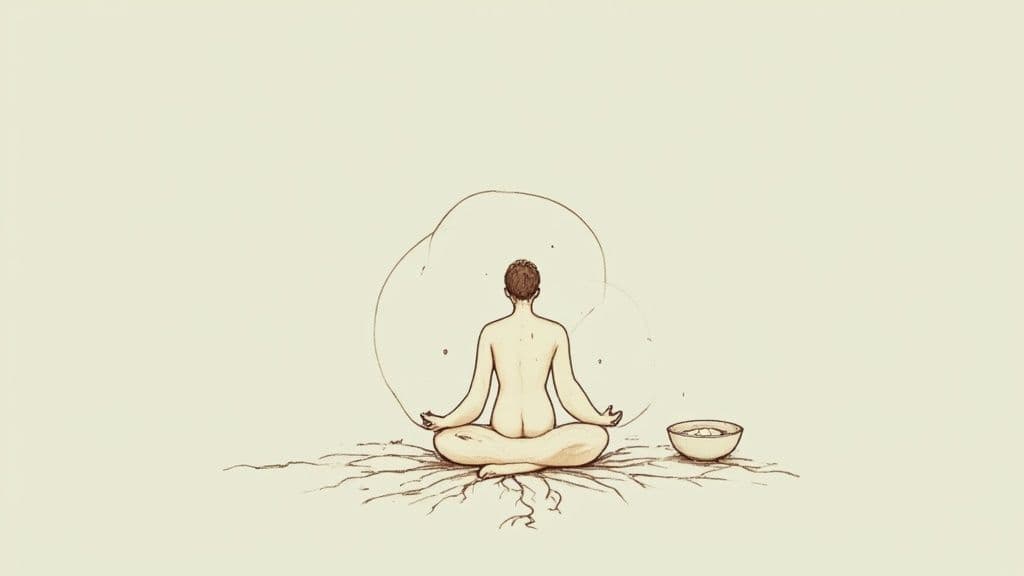
Grounding connects your energy to the earth so excess emotional charge can disperse. Try this visualization:
- Sit or stand with your feet flat on the floor.
- Breathe slowly and let your body relax.
- Visualize roots growing from your feet into the earth.
- Imagine heavy or foreign energy flowing down those roots and being absorbed by the ground.
- Feel calm, stabilizing energy rise back up to you.
Use this for a few minutes whenever you feel scattered. For related step-by-step routines, see Grounding techniques.
Creating a Protective Shield
A simple shield can act like a selective filter, letting supportive energy in while keeping negativity out. After grounding, visualize a bubble of white or golden light surrounding you and set the intention, “Only energy that is for my highest good may enter this field.” Refresh it before stressful events.
Energy Cleansing
Regular cleansing keeps your energy channels clear. One effective method is a salt bath:
- Add 1–2 cups of Epsom or sea salt to a warm bath.
- As you soak, intend that foreign energy is drawn out into the water.
- Visualize the water carrying that energy away down the drain.
If you don’t have a bath, use a quick shower scrub with the same intention.
Mindfulness Practice
Mindfulness helps you notice when you’ve picked up another person’s emotion. Regular attention to your internal state makes it easier to spot what’s yours and what’s not. Research shows training in mindfulness and meditation can strengthen empathic skills and emotional regulation3.
Setting Healthy Boundaries to Protect Your Wellbeing
Boundaries let you stay compassionate without sacrificing your own wellbeing. They’re a filter, not a wall.
Distinguishing Your Feelings from Theirs
When a sudden emotion arrives, pause and ask, “Is this feeling truly mine?” If it isn’t connected to your thoughts or context, it likely belongs to someone else. That small pause creates space to release what isn’t yours.
The Art of Saying No
Saying no protects your energy. You don’t need long explanations. A simple, “I’m not able to do that right now,” preserves your boundaries and mental space.
Ethical Considerations for Psychic Insights
Respect privacy. Tuning into someone’s energy isn’t permission to probe their life. Use insight for guidance and support, not intrusion.
Quick Q&A — Common Questions
Can I turn these abilities off?
Not fully, but you can manage them. Treat sensitivity like a volume control: with grounding, shielding, and practice you can lower the noise and choose when to tune in.
Is it dangerous to be this sensitive?
Sensitivity itself isn’t dangerous. The risk comes from lack of management. Learning care strategies prevents overwhelm and keeps your abilities healthy.
How can I tell if a feeling is mine or someone else’s?
Pause, breathe, and check: did the feeling arise from your current thoughts or body sensations? If not, it’s likely picked up from outside. With practice, this check becomes automatic.
Three Concise Q&A Summaries
Q: What are the top signs I’m an empath?
A: You absorb others’ emotions easily, feel drained in crowds, have strong gut instincts, and find nature deeply restorative.
Q: What daily practices help me manage empathic sensitivity?
A: Short grounding visualizations, a protective light shield, regular energy cleansing, and mindfulness checks.
Q: When should I seek professional help?
A: If persistent anxiety, depression, or exhaustion interferes with daily life despite self-care, consult a licensed mental health professional or your primary care provider.
Resources and Further Exploration
For personal mapping of life purpose and sensitivities, the Life Purpose App offers a practical tool based on Dan Millman’s framework. Explore more at https://lifepurposeapp.com.
1.
C. Decety and J. Lamm, “The role of empathy in social cognition,” Trends in Cognitive Sciences (2011). https://pmc.ncbi.nlm.nih.gov/articles/PMC4340688/
2.
Overview of links between high sensitivity, empathic overload, and mental health risk; American Psychological Association. https://www.apa.org/monitor/2014/10/empathy
3.
M. Goyal et al., “Meditation programs for psychological stress and well-being: a systematic review and meta-analysis,” JAMA Internal Medicine (2014). https://jamanetwork.com/journals/jamainternalmedicine/fullarticle/1809754
4.
Elaine N. Aron, founder of the Highly Sensitive Person concept, estimates about 15–20% of the population is highly sensitive. https://hsperson.com/about-the-hsp-test/
Discover your life path today
Enter your date of birth and see your life path, free.
Find your life path