Learn how a relationship compatibility chart works in Dan Millman's system — calculate composite numbers, read key indicators, and interpret results wisely.

October 23, 2026 (1mo ago)
Relationship Compatibility Chart: How to Read Yours
Learn how a relationship compatibility chart works in Dan Millman's system — calculate composite numbers, read key indicators, and interpret results wisely.
← Back to blog
Learn how a relationship compatibility chart works in Dan Millman's system — calculate composite numbers, read key indicators, and interpret results wisely.
A relationship compatibility chart can't tell you whether you're destined to stay together. It can offer a way to talk about how you relate, what feels easy, and where misunderstandings might arise. That distinction matters: a chart can be a prompt for reflection, but it can't give you a verdict about your relationship's future.
Dan Millman's The Life You Were Born to Live uses a composite-number approach to describe shared relationship energy. Read thoughtfully, that framework can help you notice patterns and start useful conversations. Read as a guarantee, it promises more than any chart can establish.
What a Relationship Compatibility Chart Really Shows
People often look up a relationship compatibility chart hoping for a clear score: compatible or incompatible, meant to last or not. But a chart can't reliably make that call. It's more useful as a structured mirror, offering language for discussing shared strengths, possible friction, and the ways two people respond to each other.
That distinction is practical, not just philosophical. A chart might suggest that a pair should talk about independence or communication. It can't tell you whether either person listens during a difficult conversation, follows through on commitments, or makes the other feel appreciated. Those things show up in how people treat each other, not in a birth-date calculation.
Prediction versus reflection
A prediction says a particular outcome will happen. A reflective prompt helps you examine what's happening and decide what to do next. A compatibility chart belongs in the second category. You can use its themes to ask, “Does this describe something we've noticed?” rather than, “Does this prove we're a good match?”
Relationship research offers a reason to be cautious about fixed match labels. An American Psychological Association discussion of relationship science describes machine-learning models trained on people's personalities, attitudes, values, and preferences before they met. Those models predicted 0% of the compatibility component in speed-dating interactions, suggesting that questionnaire information didn't reliably identify which specific people would connect (the APA's discussion of finding love).
A difficult-looking pairing can still thrive if the people involved treat each other with care and work through differences. An apparently easy match can stall if the partners don't communicate or show appreciation. A chart can suggest what to explore; it can't substitute for observing the relationship itself.
How Dan Millman's System Maps Relationship Energy
Dan Millman's The Life You Were Born to Live presents a birth-date system for exploring individual life paths and shared relationship dynamics. The Life Purpose App offers a digital way to engage with that system. Together, the book and app provide a defined framework, rather than a general claim that two people's personalities can be reduced to a single compatibility score.
At the individual level, the system uses a birth date to determine a birth number associated with a life path. The life-path reading describes themes, gifts, and challenges. In a relationship reading, Millman doesn't merely place two people's individual numbers side by side and rate their similarity. The method creates a composite energy, intended to describe something that emerges between them.
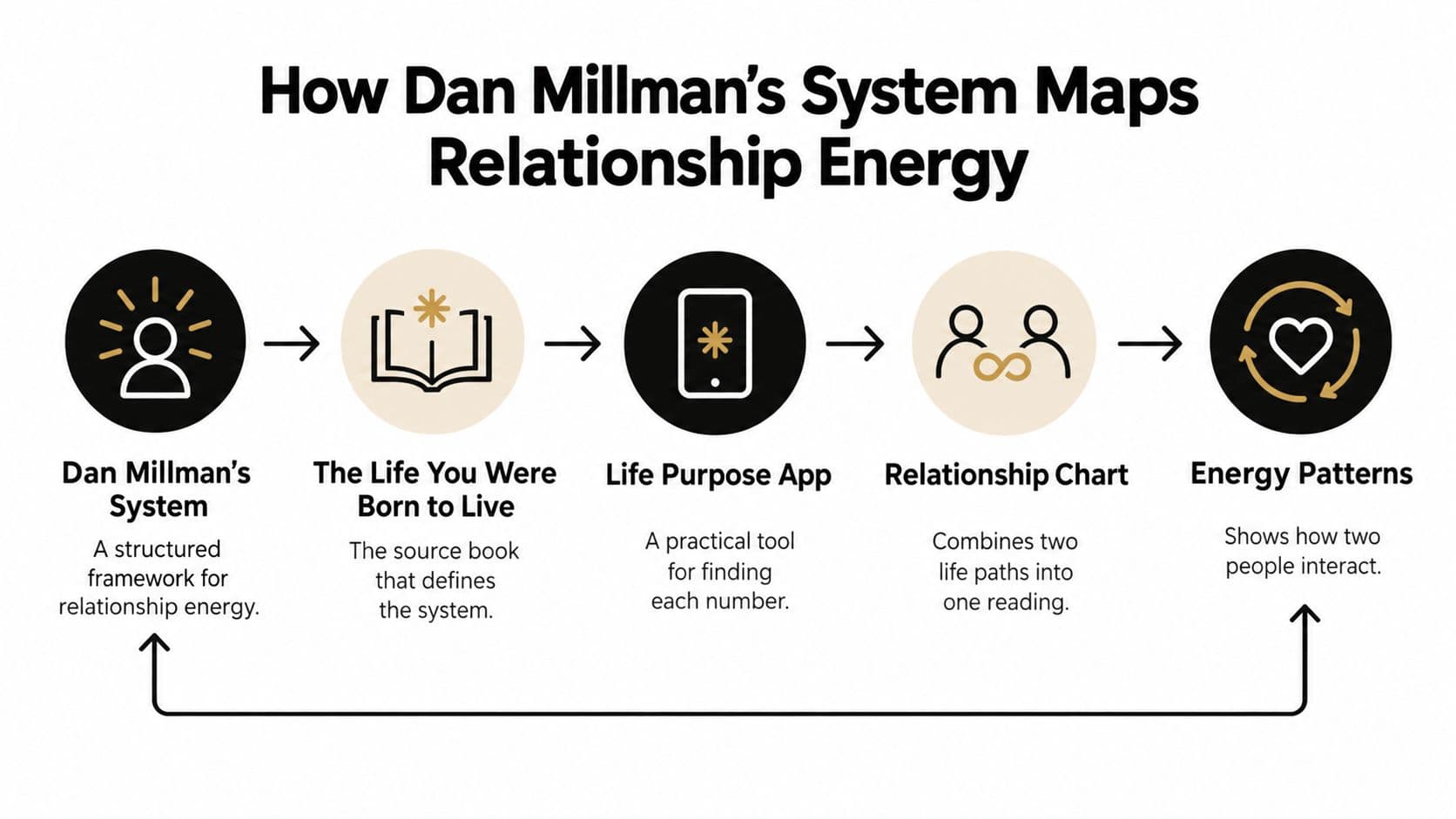
A shared pattern, not a pass-or-fail result
Think of the two individual birth numbers as describing what each person brings into the relationship. The composite number adds a third lens: how the pair's energies may combine. Millman's framework associates composite numbers with themes such as cooperation, expression, stability, freedom, vision, trust, power, and integrity (an overview of Millman's relationship approach).
Millman's approach doesn't treat one composite as superior to another. The reading isn't supposed to decide whether two people should date or marry. Instead, it raises a more useful question: How are these people expressing their shared dynamic? A theme associated with cooperation, for example, can prompt a conversation about how partners make decisions together. The theme doesn't prove they cooperate well.
For a closer look at how the Life Purpose App applies this approach to relationships, see its guide to relationship readings and shared dynamics. Whether you use a book, an app, or another way to explore the system, keep the distinction clear: the framework offers an interpretation to consider, not an objective measurement of a couple's future.
Calculating Your Composite Relationship Number
The composite-number method starts with each person's birth number. The specific birth-number calculation follows the conventions of Dan Millman's The Life You Were Born to Live, which also informs the Life Purpose App. If you're working by hand, use the book's instructions or a tool that applies the method consistently, rather than assuming every numerology system reduces birth dates in the same way.
Once you have both birth numbers, the relationship calculation uses the right-hand, or final, digit of each. Add those two digits. If the total is higher than 12, reduce it to a value below 13. That final value is the composite number, which the system reads as the relationship's shared energy, not as a score of how good the match is.
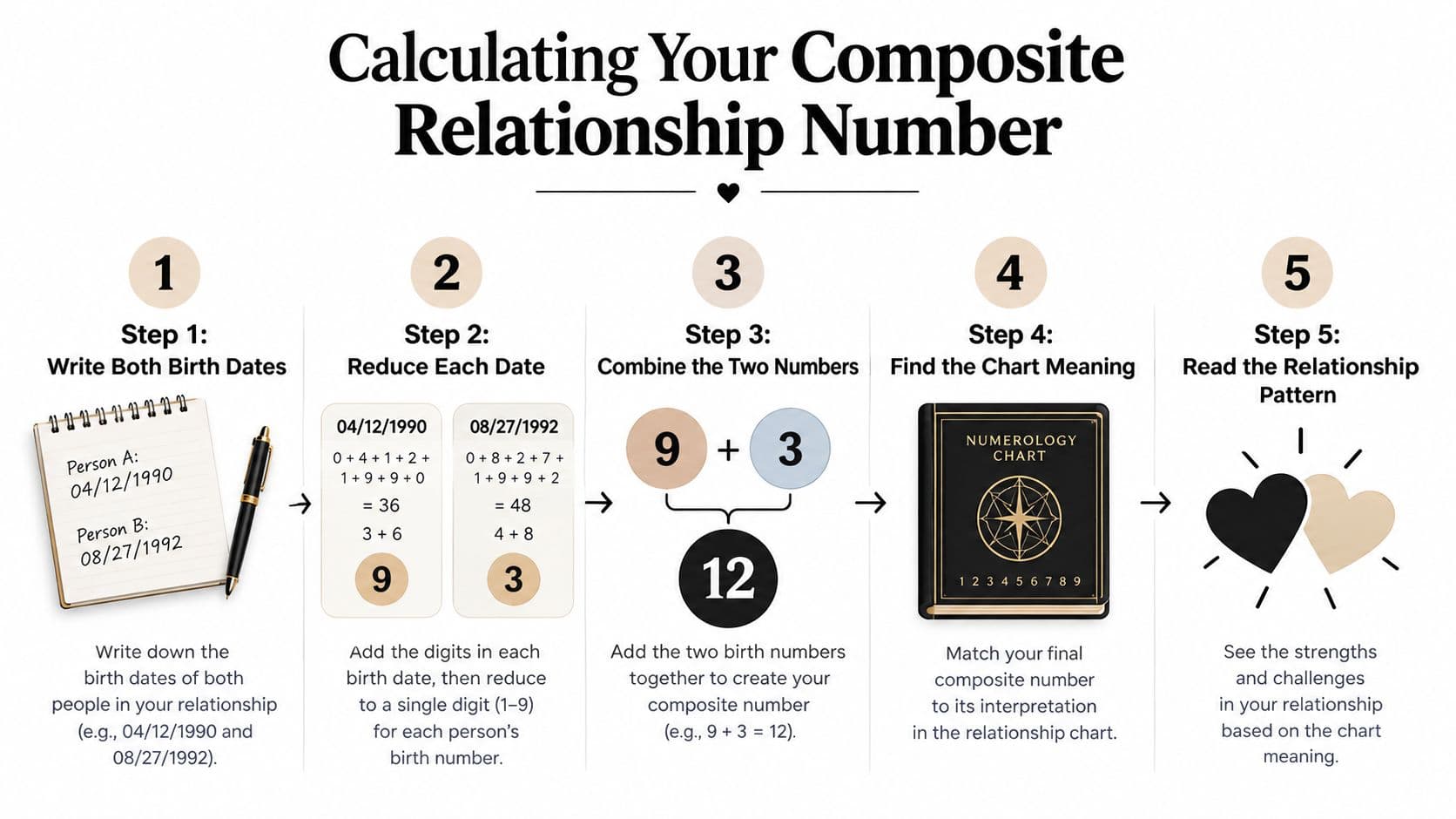
Follow the calculation in order
- Find each person's birth number. Use the birth-date method described in the system. Don't substitute a different calculator's rules without checking that it follows the same approach.
- Take the final digit of each number. The relationship calculation uses these digits rather than comparing the full numbers directly.
- Add the digits. Their sum gives you the initial composite total.
- Reduce a high total when needed. If the sum is higher than 12, reduce it to a value below 13, as the system specifies.
- Look up the theme. Read the resulting composite as a description of shared dynamics, not a ranking or instruction.
For example, if someone's final digit were 3 and the other person's were 4, their sum would be 7. That arithmetic illustrates the combination rule only; it doesn't establish the meaning of that composite or tell you anything definite about a real couple. You'd still need to consult the system's interpretation for the result.
A common point of confusion is whether the composite is one person's number compared with the other's. It isn't. The calculation produces a third number intended to represent the interaction between them. A digital calculator can make the process quicker, but understanding the steps helps you see what a chart is combining.
Reading the Key Indicators on a Compatibility Chart
A chart becomes easier to read when you separate the information into parts. The individual birth numbers describe each person's reading within the system. The composite number focuses on the shared relationship energy. If the chart also presents cycles or balances, treat them as added context rather than as evidence that a particular event must happen.
The revised 25th Anniversary Edition of The Life You Were Born to Live describes a method that covers people born from 1750 to the present, including a special handling rule for single-digit birth numbers for certain people born after 2000 (the edition's published description). That range and the system's conventions help distinguish it from an informal personality quiz. They don't make its interpretations scientific predictions.
Read the pieces as questions
Start with each person's individual life-path reading. Ask what each person recognizes in their own description, and what they'd phrase differently. Then turn to the composite themes. A word such as “stability” can open a conversation about routines, reliability, or how the pair handles change; it doesn't prove that either partner is dependable.
| Composite Energy | Shared Strength | Likely Growth Edge |
|---|---|---|
| Cooperation | Making decisions together | Avoiding one-sided compromise |
| Expression | Sharing ideas and feelings | Listening as well as speaking |
| Stability | Building trust through consistency | Staying open when plans change |
| Freedom | Respecting independence | Agreeing on expectations |
| Trust | Creating room for honesty | Addressing doubt directly |
| Integrity | Acting in line with shared values | Talking through differences in priorities |
These are conversation starters, not fixed definitions of any one composite number. Use the interpretation provided by the system, then check whether it matches the relationship you know. If it doesn't fit, don't force the label.
A chart may also include nine-year cycles, which offer timing context within the system. Read them as a way to reflect on what feels prominent in each person's life, not as a timetable that guarantees a relationship event. For another perspective on what a relationship reading can help you examine, see this guide to the meaning of relationship dynamics.
What Compatibility Charts Can and Cannot Predict
A relationship compatibility chart cannot tell you whether a couple will last. It can offer a framework for reflection, much like a map that suggests routes without showing every turn two people will take together. In Dan Millman's system, a composite number gives partners a shared theme to consider, not a verdict about their future.
Relationship research supports that distinction. A synthesis of 11,196 couples across 43 longitudinal datasets conducted by 29 laboratories found that relationship-specific factors, including perceived partner commitment and satisfaction, appreciation, sexual satisfaction, and conflict-management style, predicted 45% of the variance in current relationship satisfaction and 18% of satisfaction measured later (a summary of the relationship-science synthesis). These findings do not validate a birth-date method as a predictor. They point to the importance of what partners experience and do together.
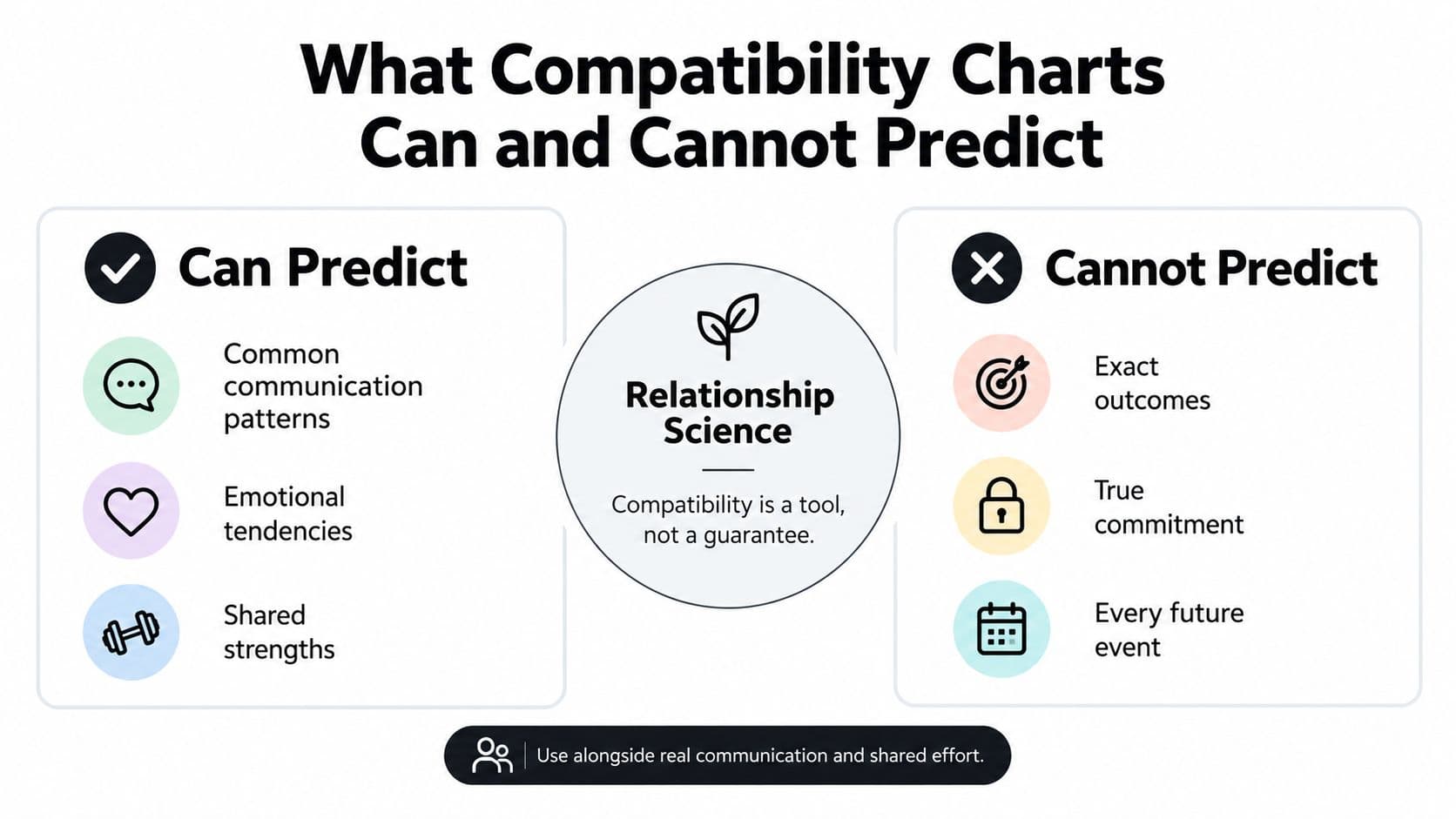
Check the relationship, not just the reading
A chart can prompt questions. The answers come from the relationship itself:
- Appreciation: Do both people feel noticed and valued?
- Commitment: Have they talked clearly about what commitment means to each of them?
- Conflict: Can they disagree without dismissing, punishing, or shutting each other out?
- Satisfaction: Can each person speak openly about what is working and what is not?
- Communication: Do they try to understand one another, especially when their styles differ?
Compatibility is better understood as an evolving process than a fixed quality assigned to a pair. A review of partner prediction also discusses why general traits have limits in predicting a particular connection before people meet. For a closer look at whether compatibility matters in a relationship, consider how shared values and everyday interactions shape the bond.
Practical rule: If a chart's conclusion conflicts with what you observe, take the people's actions seriously. A numerical match cannot override how partners treat each other.
A Worked Example of Interpreting a Chart
Consider two people who want to use a relationship compatibility chart to understand why they connect easily in some situations but struggle to make plans. They enter their birth dates into the method described in Dan Millman's The Life You Were Born to Live, then use the system to find each person's birth number and the composite relationship number.
Suppose the final digits are 3 and 4. Adding them gives 7. That gives the pair a composite number to look up, but the arithmetic alone doesn't tell them what the relationship is like. They need the system's interpretation to explore the associated theme, and they need their own experience to judge whether the theme fits.
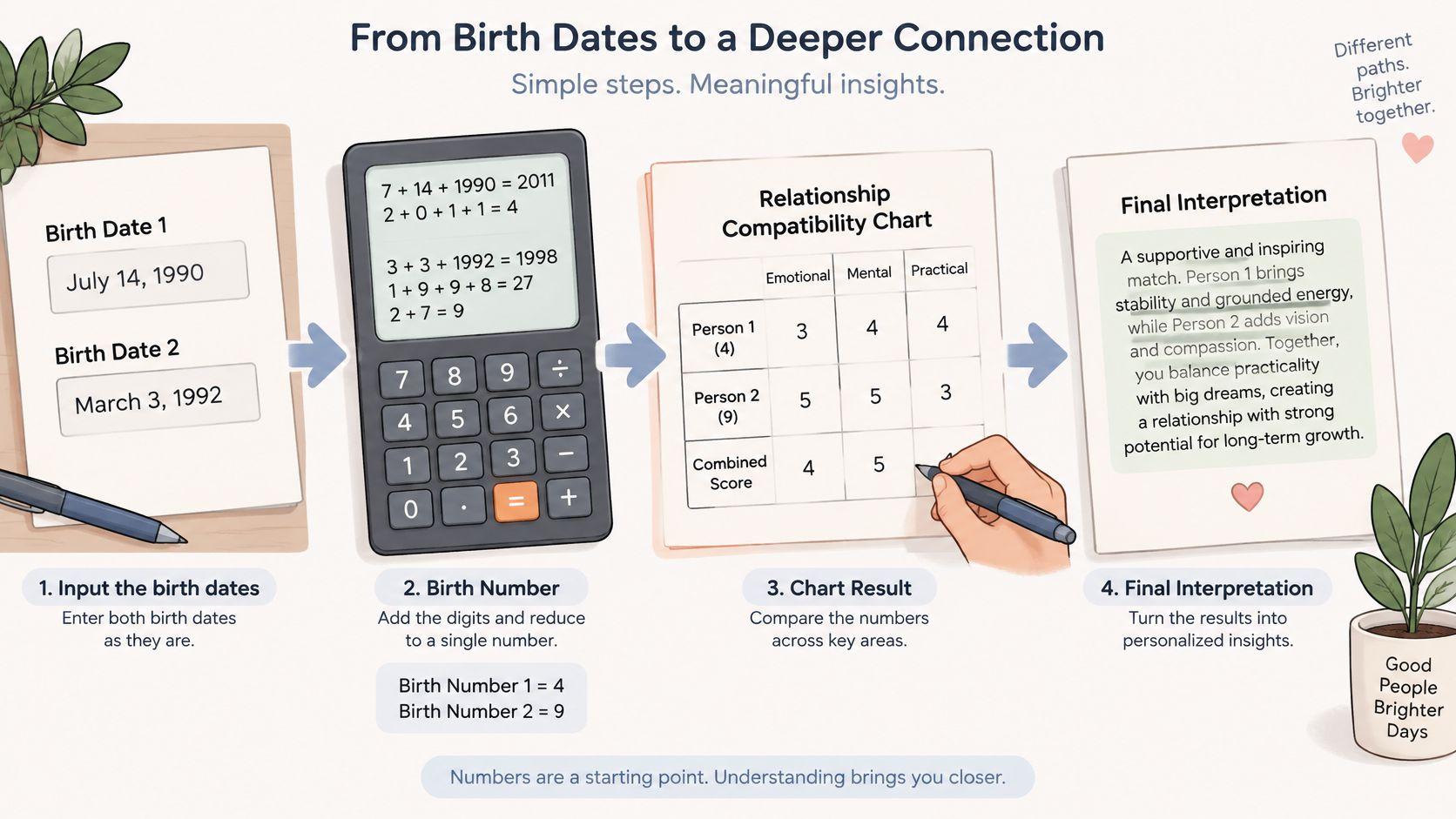
Turn the result into a conversation
First, each person considers their individual reading. One might recognize a preference for making decisions quickly; the other might recognize a need for time to weigh options. They don't need to treat either description as a complete account of their personality. They can just ask whether the difference sounds familiar and how it affects shared plans.
Next, they consult the system's description of the composite number. Rather than deciding that the number defines their relationship, they test it against a real question: “How do we make plans when one of us wants to decide sooner?” If the chart points toward a useful theme, they can use it to talk about expectations, communication, and what each person needs.
A reading may also show cycle information. If the pair chooses to explore it, they can use it as context for discussing what each person is focused on at the moment. It shouldn't be used to declare that a relationship is on a fixed path or that a particular outcome is inevitable.
This is the difference between reading a chart thoughtfully and turning it into a verdict. The pair leaves with a conversation to continue, not a label they have to accept. The Life Purpose App can calculate the individual numbers and composite for different relationships, including connections with friends, family members, or colleagues, so the same reflective approach needn't be limited to romantic partners.
Exploring Your Own Relationship Dynamics
A relationship compatibility chart is most useful when it helps you pay closer attention. The composite number offers a way to consider shared patterns; the conversation that follows helps you see whether those patterns match your real experience. Neither the number nor the interpretation can decide what two people should do.
If you're curious about a relationship, choose one question to bring to the reading. You might ask where you feel most in sync, what tends to create friction, or how you handle disagreement. Then compare the chart's themes with what each person observes. If the interpretation feels relevant, discuss it. If it doesn't, let it go rather than squeezing the relationship into a label.
The Life Purpose App lets users enter birth dates to explore life paths, composite relationship numbers, and cycle information within the system associated with Dan Millman's The Life You Were Born to Live. Its free tier includes a life-path summary and system overview; paid options provide the complete text of the 25th Anniversary Edition, detailed life-path analyses, unlimited contacts, and access to primary numbers and cycles. Those features can help organize a reading, but the interpretation still works best as a prompt for reflection.
Start with someone whose relationship matters to you and a question you'd like to discuss. Read the chart together, compare its themes with your experience, and let the conversation matter more than the number.
Use the Life Purpose App to enter two birth dates and explore the individual paths, composite relationship numbers, and shared themes described in Dan Millman's The Life You Were Born to Live. Bring the result to a real conversation, and visit Life Purpose App to begin your reading.
Discover your life path today
Enter your date of birth and see your life path, free.
Find your life path