Curious whether your birthdays explain the spark—or the friction—in your relationship? A zodiac compatibility test can offer language for why you click, why you clash, and what to do next. This guide explains the system behind compatibility readings, what to trust, and how to use results to improve communication, intimacy, and long-term planning.

May 9, 2026 (5mo ago) — last updated July 1, 2026 (3mo ago)
Zodiac Compatibility Test Guide
Learn how zodiac compatibility tests work—elements, planets, charts—and how to use results to improve emotional connection and relationship decisions.
← Back to blog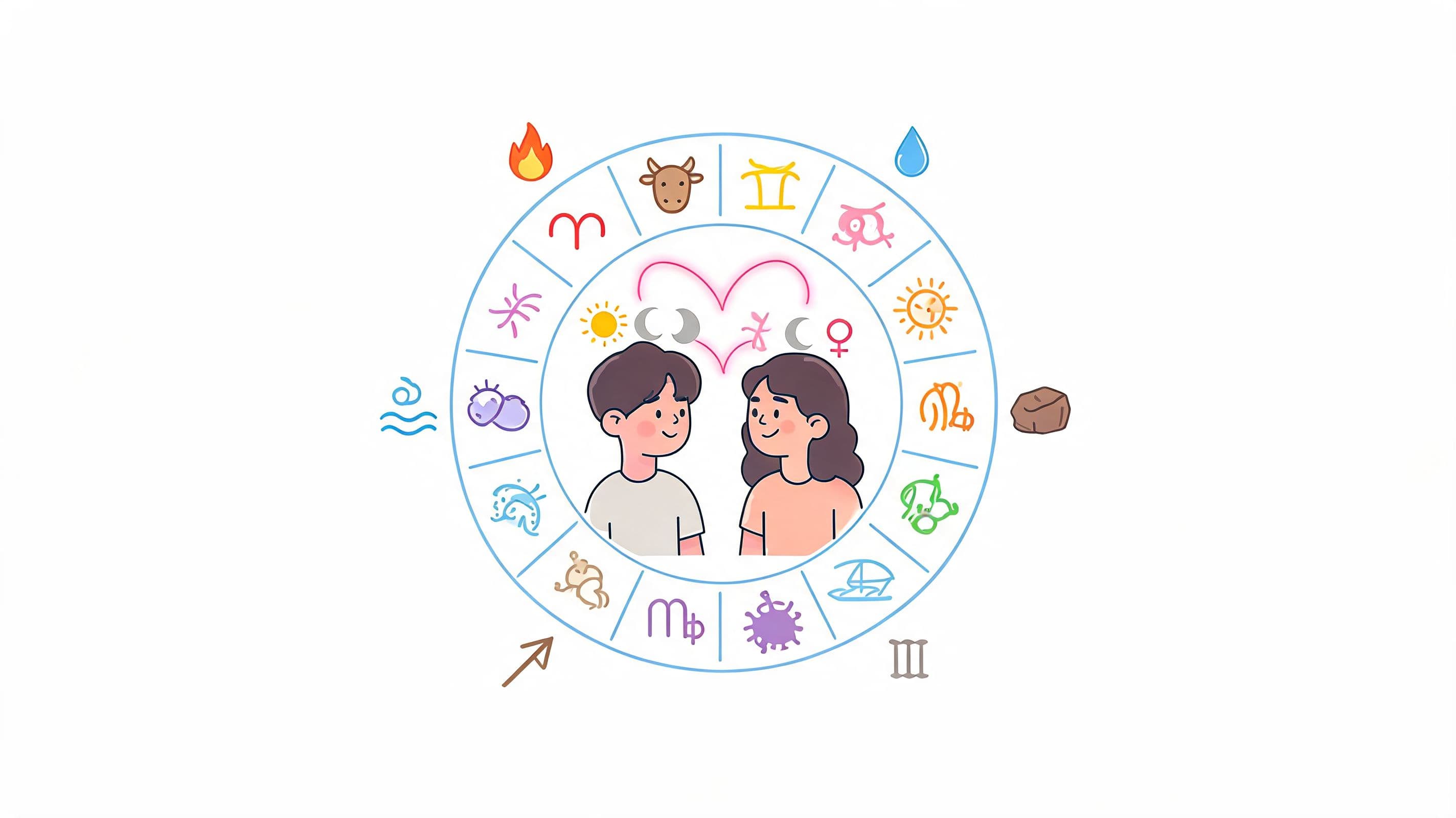
Curious whether your birthdays explain the spark—or the friction—in your relationship? A zodiac compatibility test can offer language for why you click, why you clash, and what to do next. This guide explains the system behind compatibility readings, what to trust, and how to use results to improve communication, intimacy, and long-term planning.
Zodiac Compatibility Test Guide
Summary: Learn how zodiac compatibility tests work—elements, planets, and full-chart factors—and how to use results to strengthen emotional connection and relationship choices.
Introduction
Curious whether your birthdays explain the spark—or the friction—in your relationship? A zodiac compatibility test can offer language for why you click, why you clash, and what to do next. This guide explains the system behind compatibility readings, what to trust, and how to use results to improve communication, intimacy, and long-term planning.
You're not alone in checking compatibility
You might text a friend a screenshot of a compatibility result at midnight. That curiosity is normal. People use astrology to name patterns—timing, emotional needs, attraction, and recurring friction—rather than to get a simple yes-or-no verdict.
Astrology’s modern popularity shows up in dating culture: younger generations are increasingly open to astrological insight, and digital compatibility tools have become common entry points for relationship self-reflection1.
A helpful compatibility reading doesn’t say “you’re doomed” or “you’re soulmates.” It reveals tendencies: who needs reassurance, who needs space, what creates chemistry, and where timing or values might complicate things.
Why people use compatibility tests
Relationships are messy and people want frameworks. Astrology offers one. It can translate vague feelings into concrete language, which helps with conversations like, “I need emotional safety before I can be playful,” or, “My Moon sign makes me feel more vulnerable than my Sun suggests.”
Common mistakes to avoid:
- Assuming Sun signs tell the whole story.
- Equating challenge with incompatibility; challenge can drive growth.
- Treating numerical scores as destiny.
If you remember those three points, you’ll get more value from any tool.
How zodiac compatibility actually works
A solid compatibility reading rests on two basic building blocks: elements and modalities. Understanding those helps you see astrology’s internal logic instead of just sign stereotypes.
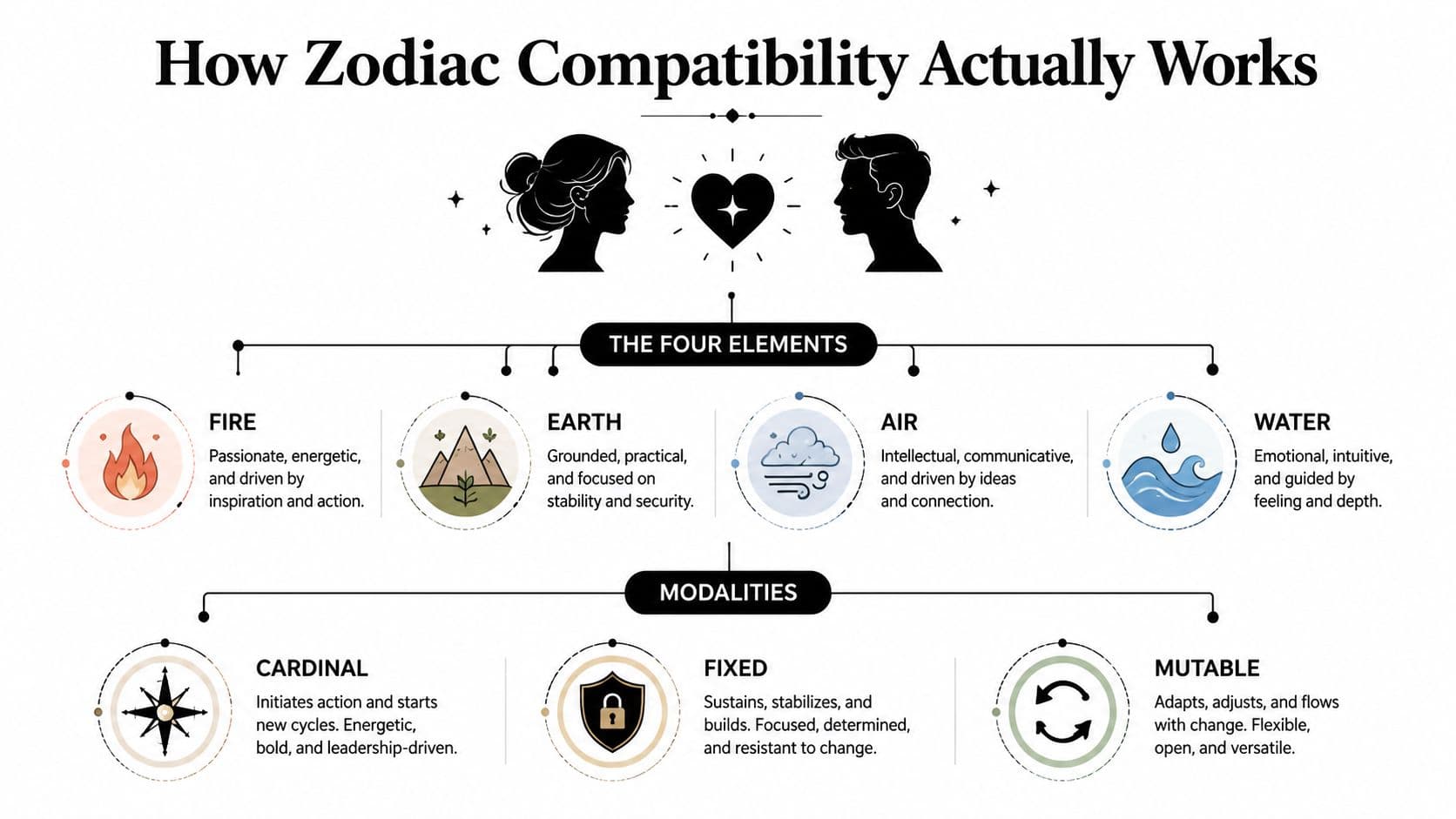
Think of elements as basic temperament and modalities as how that temperament moves.
The four elements
- Fire: enthusiasm, instinct, action.
- Earth: stability, practicality, results.
- Air: ideas, language, social connection.
- Water: feeling, intuition, emotional memory.
Fire and Air often energize each other. Water and Earth tend to provide mutual containment. But every pairing can be creative or tense depending on other chart factors. Studies and compatibility overviews note common patterns and relative degrees of ease or tension in elemental pairings2.
Elemental interactions at a glance:
| Combination | Dynamic | Plain-language outcome |
|---|---|---|
| Fire + Air | Energizing | Fast, idea-rich, exciting |
| Water + Earth | Grounding | Soothing and dependable |
| Fire + Water | Intense | Passionate and reactive |
| Air + Earth | Mixed tempo | Possibility vs. proof |
| Fire + Earth | Productive friction | One pushes, one builds |
| Air + Water | Insightful tension | Thought meets feeling |
The three modalities
- Cardinal: initiates and starts things.
- Fixed: stabilizes, commits, resists change.
- Mutable: adapts and pivots.
Modalities explain rhythm. Two Fixed signs can create loyalty but also standoffs. A Cardinal–Mutable pair may handle conflict better because one begins and the other adapts.
A practical rule: when chemistry feels great but daily life is hard, look to modality for an explanation.
Going deeper than your Sun sign
Sun-sign matching is like reading a book jacket. It gives a vibe, not a full picture. A complete synastry reading compares two birth charts and highlights planetary contacts that shape emotional life, attraction, and long-term durability.
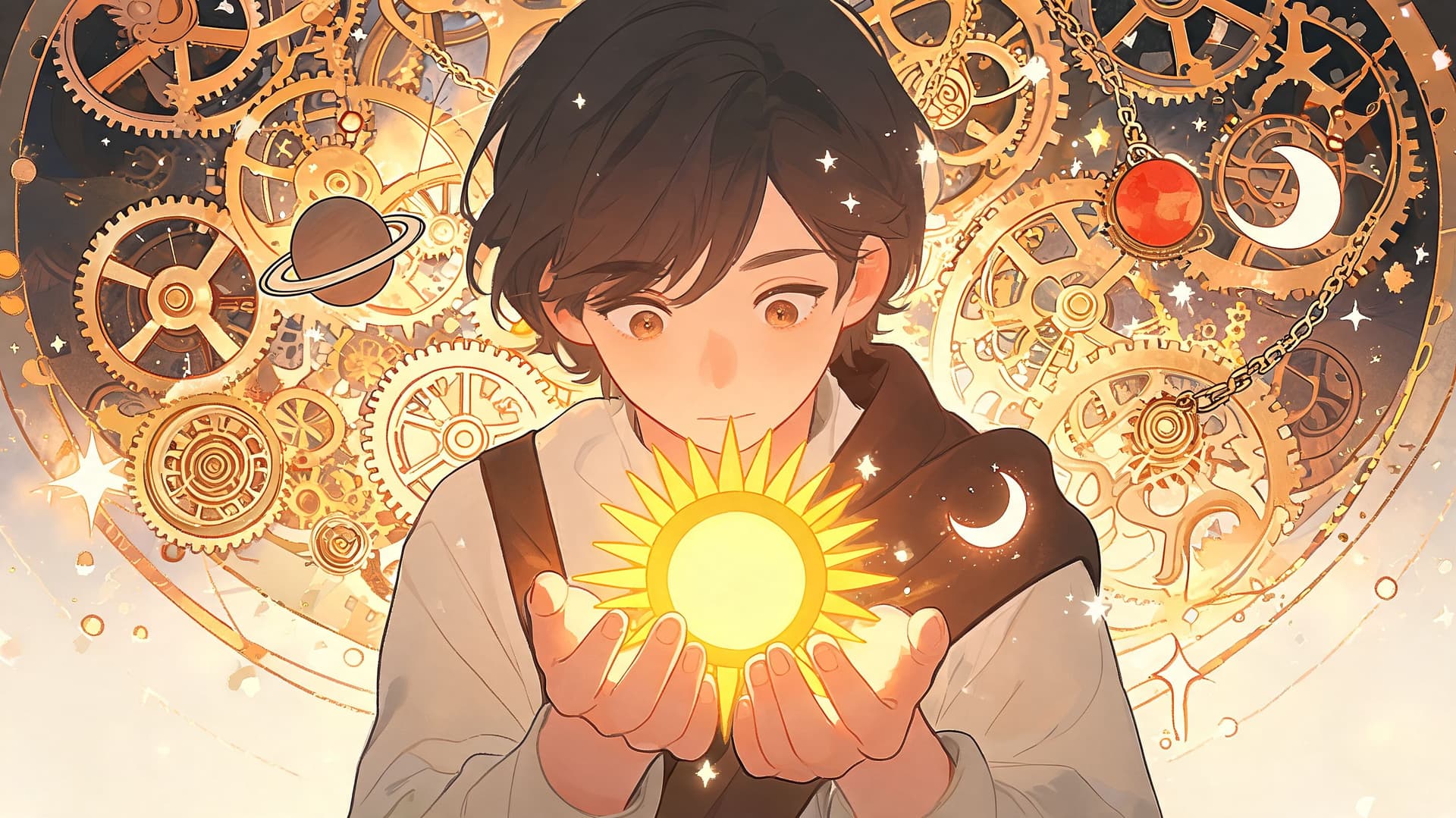
Key chart factors:
- Moon: inner emotional world and what soothes you.
- Venus: how you give and receive affection.
- Mars: desire, pursuit, and how you handle friction.
- Saturn: commitment patterns and long-term durability.
Full-chart analysis is far more informative than Sun-only matching. Detailed synastry tools and compatibility overviews report higher predictive value when full birth data are used rather than Sun-only comparisons3.
In practice:
- Venus–Mars contacts often equal easy attraction.
- Moon–Moon harmony feels like emotional understanding.
- Supportive Saturn aspects can indicate long-term stability and commitment4.
If you want a plain way to start: ask how you soothe each other (Moon), how you flirt and show love (Venus and Mars), and what holds you together under pressure (Saturn).
What a real compatibility test includes
A useful tool asks for more than sign names. The strongest calculators use birth date, time, and place. Simpler quizzes may ask personality questions that suggest planetary styles.
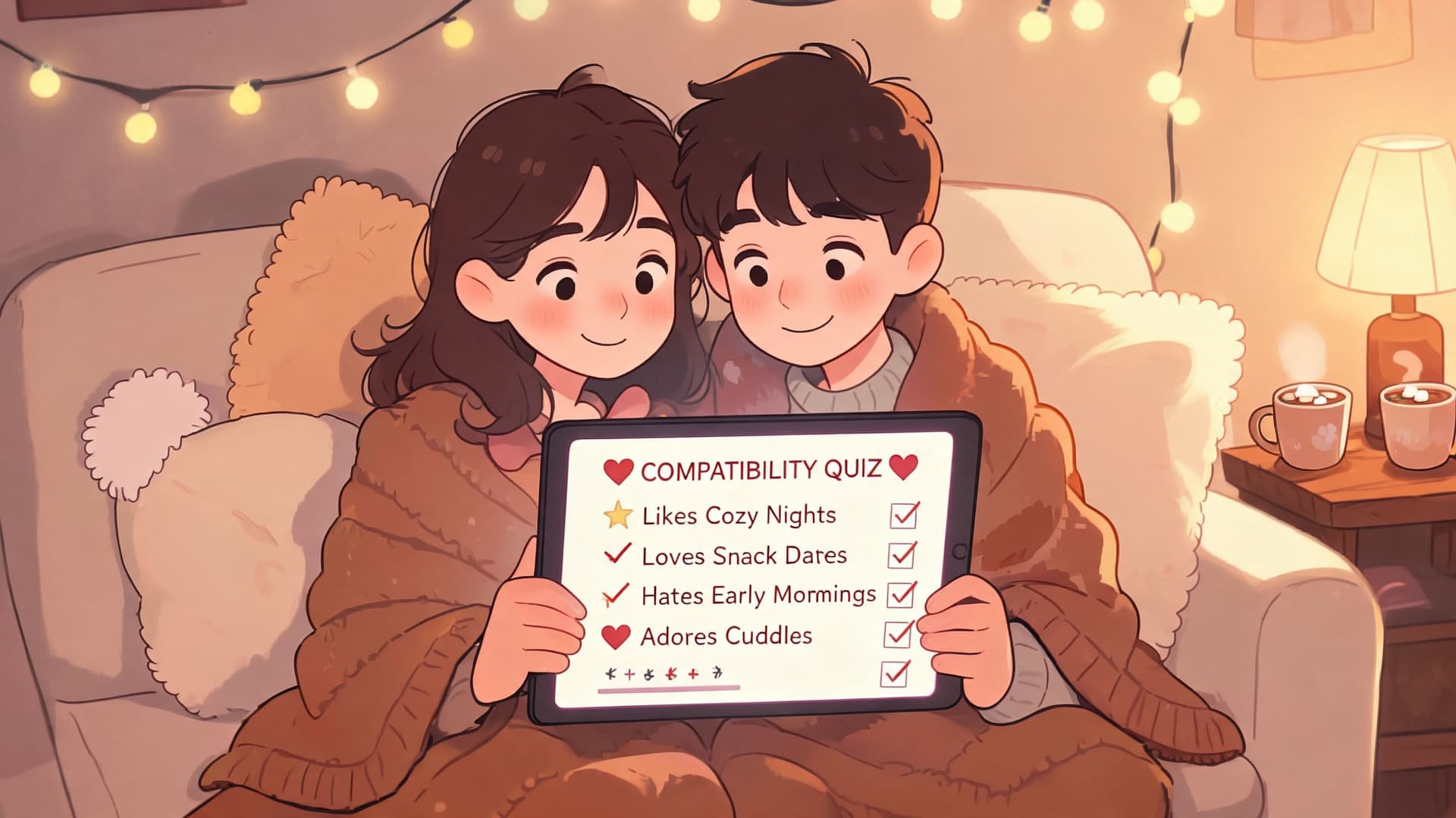
Helpful quiz questions include:
- When conflict appears, do you confront, pause, or withdraw?
- What makes you feel loved fastest—words, deeds, touch, or adventure?
- What turns you off in relationships—coldness, unpredictability, clinginess, criticism?
- How do you make major decisions—instinct, research, discussion, or feeling it out?
Answers point toward elemental and modal tendencies. Personality frameworks can complement astrology when used carefully rather than as competing authorities5.
How results are usually shown
Reports commonly organize findings under headings like harmony, challenge, chemistry, intensity, and stability. Numerical scoring appears on many sites as a summary. Use scores as shorthand, not fate. A high score doesn’t promise ease and a low score doesn’t erase love4.
Using results to strengthen your bond
A compatibility report is most useful when you act on it. Astrology names patterns; you still have to do the relational work.
Practical steps:
- Treat hard aspects as information. Differentiate emotional mismatch from value clashes and plan accordingly.
- Translate insights into behavior. If emotional styles differ, ask, “What helps each of us feel safe when we’re upset?”
- Build agreements. For conflict-heavy pairings, create fair-fighting rules. For pacing differences, name timelines and checkpoints.
Sample agreements:
- Fair-fighting: no interrupting, no threats, agree on a return time if someone needs space.
- Emotional bridging: one partner may want space first, then closeness. The other may want immediate reassurance. Decide a compromise that respects both needs.
- Pacing map: one partner moves quickly into commitment while the other needs time. Identify milestones that feel safe for both.
Lean into strengths as well. If your report shows natural harmony in communication, protect that by talking early and often. If you have grounding energy, create routines that support the relationship.
Reflection questions after a reading:
- What part felt accurate right away?
- What felt uncomfortable but possibly true?
- What need of mine shows up most strongly here?
- What does my partner need that I tend to forget?
- Where do we need to work, and where can we relax?
Beyond astrology: a holistic approach
Astrology is one useful lens among many. It explains temperament and recurring patterns but doesn’t replace conversation, shared values, timing, or professional support. Combining symbolic insight with therapy or counseling often produces the best results for stuck relationships6.
Numerology and life-path systems can add another perspective on why a relationship matters to personal growth. For practice-based tools grounded in Dan Millman’s approach, explore resources that focus on life purpose and growth7.
The essential takeaway: a zodiac compatibility test is worthwhile when it helps you name patterns, soften judgments, and speak more clearly about needs. Use it to guide questions and agreements, not to dictate decisions.
Common questions
Q: Do Sun signs matter most for compatibility?
A: No. Sun signs give a headline impression, but Moon, Venus, Mars, and Saturn usually tell the emotional, affectionate, desire, and commitment story.
Q: Should I trust numerical compatibility scores?
A: Treat scores as summaries. They can highlight strong energy or tension areas, but context from full-chart factors and real-life behavior matters more.
Q: How can astrology help when a relationship feels stuck?
A: Use astrology to name the pattern, then create behavioral agreements or seek professional support. A therapist or counselor can translate symbolic insights into sustainable habits and communication practices.
1.
Pew-linked summary via Astro-Seek: https://horoscopes.astro-seek.com/love-compatibility-calculator-horoscope-matching
2.
Vedaz compatibility overview on elemental and modality harmonies: https://www.vedaz.io/compatibility
3.
My Zodiac AI compatibility overview discussing full birth chart analysis: https://my-zodiac-ai.com/compatibility
4.
Cafe Astrology compatibility score methodology and explanation: https://cafeastrology.com/compatibility-report-scores.html
5.
Surreal Experiments guide to personality frameworks and tests: https://www.surrealexperiments.com/blog/16-personalities-test
6.
Grande Prairie counselling and couples therapy resources: https://interactivecounselling.ca/grande-prairie-counselling-services/
7.
Life Purpose App and Dan Millman’s "The Life You Were Born to Live": https://lifepurposeapp.com
Discover your life path today
Enter your date of birth and see your life path, free.
Find your life path