Clear relationship dynamics definition with real examples and a framework to spot healthy, unhealthy, and toxic patterns in any bond you care about.
August 11, 2026 (1mo ago)
Relationship Dynamics Definition and How to Read Them
Clear relationship dynamics definition with real examples and a framework to spot healthy, unhealthy, and toxic patterns in any bond you care about.
← Back to blog
You're in the middle of it already, even if you can't name it yet. The same conversation keeps coming back, the same hurt lands in a slightly different way, and both people leave wondering how a small disagreement turned into a familiar storm. That pattern has a name, and once you can see it clearly, you can stop treating every hard moment like a mystery.
Relationship Dynamics Definition and How to Read Them
What Relationship Dynamics Means
Two people can have the same argument for months and still miss what is really happening. One says the other never listens, the other says they are being attacked, and both are describing the surface while the deeper pattern keeps running underneath.
Relationship dynamics are the recurring patterns of interaction, communication, and behavior that develop between people over time. That definition matters because it is bigger than a single fight, a personality trait, or even how often two people talk. It points to what keeps happening between them, especially when one person's move tends to bring out the same response from the other.
A simple example helps. One person reaches, the other pulls back. One person gets louder, the other gets quieter. Over time, those repeated moves become the relationship's signature, the part people start to recognize even before they can name it. Relationship science and counseling focus on that exchange because they study what happens between people instead of only what happens inside each person. The field has moved from counting how often partners interact to looking at the quality of those interactions, including disclosure, conflict resolution, intimacy, and security (relationship dynamics overview).
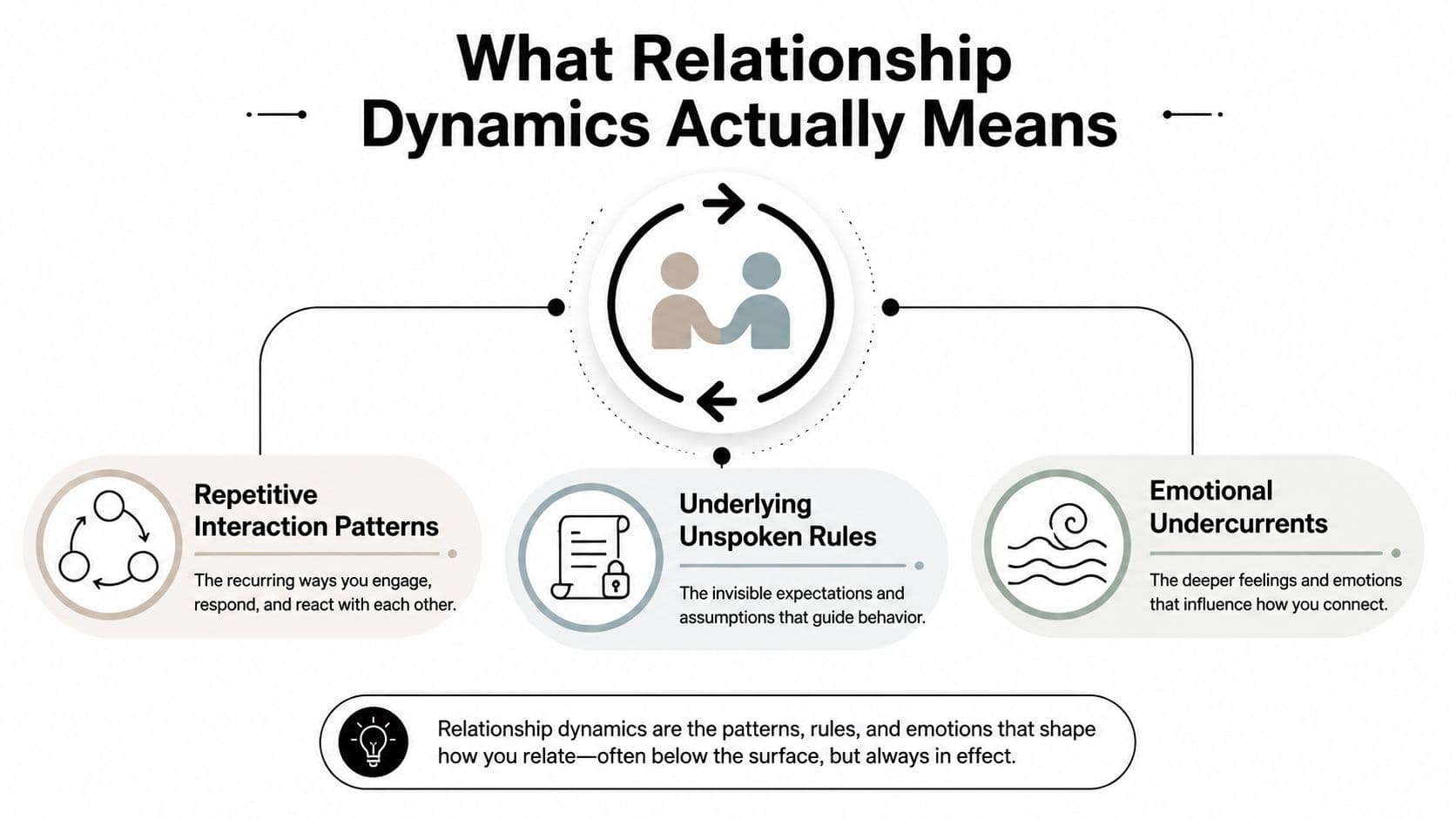
Simple sentence to remember: relationship dynamics are the repeated ways two people affect each other, not just how they feel on their own.
That framing also changes how you read compatibility. You are no longer asking only, “Do we get along?” You are asking, “What pattern do we create together, and does it fit the kind of bond we want to build?” For a companion look at that question, a useful next read is exploring compatibility concepts. If you want a deeper reflection on the background patterns that shape closeness, external resources on attachment relationships counselling can also help separate surface conflict from the repeated cycle underneath.
The Building Blocks Behind the Patterns
Once you stop thinking of a dynamic as one big mood, the pattern gets easier to read. Most relationships are made of smaller parts that can be strong in one area and weak in another, much like a recipe where one ingredient changes the whole flavor.
A practical way to see this is through five dimensions: disclosure, intimacy, conflict resolution, security, and enjoyment. Disclosure is whether people can tell the truth without fear. Intimacy is the felt closeness that comes from being known. Conflict resolution is what happens after tension starts. Security is whether both people feel safe enough to stay open. Enjoyment is whether the relationship still has warmth, ease, or shared pleasure.
Researchers now measure positive and negative dynamics side by side instead of calling a relationship good or bad. That matters because the same bond can hold affection and friction at the same time. A couple can enjoy each other's company and still struggle with jealousy or control. A family can feel loyal and still have poor repair after conflict.
If you're trying to understand your own relationship, a good counseling resource can also help you separate attachment patterns from surface-level disagreements. The overview from attachment relationships counselling is useful for that kind of reflection. For a deeper look at attachment patterns in close bonds, attachment styles in relationships can provide a complementary frame.
| Dimension | What it looks like in real life | Healthy signal | Warning signal |
|---|---|---|---|
| Disclosure | Sharing thoughts, fears, and needs | Honest conversation without punishment | Silence, secrecy, or fear of being judged |
| Intimacy | Emotional closeness and felt connection | You feel known and welcomed | Distance, detachment, or emotional coldness |
| Conflict resolution | How tension gets handled | Repair happens after disagreement | Repeated stuck fights or no repair at all |
| Security | Sense of safety in the bond | Both people can relax and be themselves | Walking on eggshells, hypervigilance |
| Enjoyment | Shared ease, humor, and pleasure | There's still warmth and mutual liking | Everything feels heavy, tense, or draining |
Practical rule: don't judge the whole relationship from one rough week. Look at which dimensions stay steady, and which ones keep breaking down.
That's the value of a multidimensional lens. It lets you ask better questions than “Is this relationship good or bad?” You can ask, “Where is it strong, where is it thin, and what keeps happening over and over?”
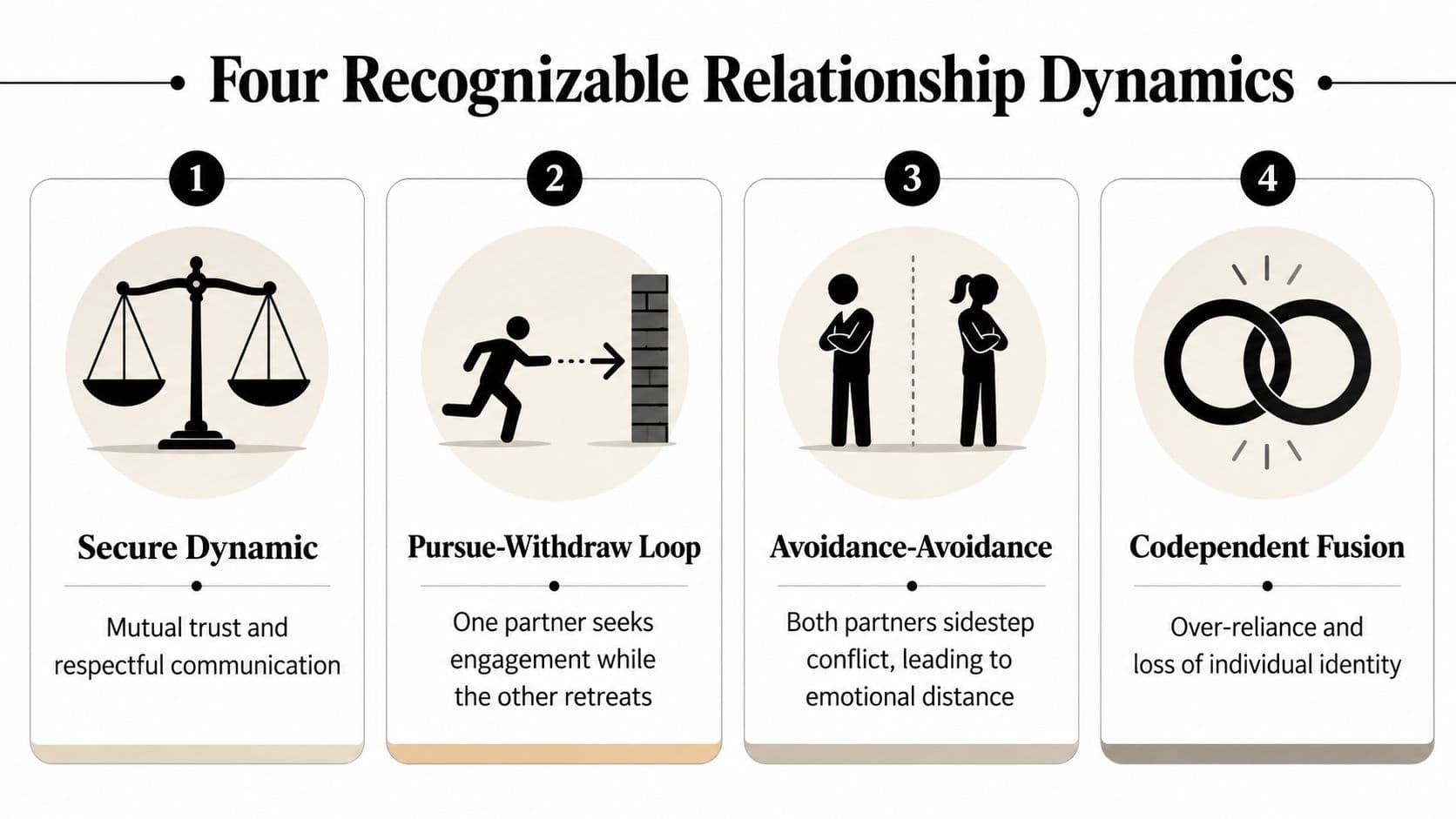
Four Dynamics You Will Recognize Immediately
Some dynamics are easier to recognize than others because they show up in so many settings, not just romance. A parent and teen can get stuck in them. Coworkers can, too. The pattern is the point, not the label on the relationship.
The secure dynamic
In a secure dynamic, two people can disagree without scrambling the bond. One brings up a problem, the other stays present, and both assume the relationship can survive honest conversation. There's still tension sometimes, but there's also a basic sense of mutual respect and return.
The pursue-withdraw loop
One person presses for answers, closeness, or resolution. The other retreats, goes quiet, or says they need space. The more one pushes, the more the other disappears. The more the other disappears, the harder the first person pushes. That loop can happen in couples, families, and even work relationships.
The criticism-defensiveness loop
This one often starts with a complaint that lands like an attack. The other person immediately explains, justifies, or counters, and both people stop hearing each other. What sounds like a single argument is usually a feedback loop where each response invites the next.
The controlling dynamic
In a controlling pattern, one person starts setting the terms for what's allowed, what's acceptable, and what the other person should feel. That might show up as pressure, monitoring, repeated correction, or quiet punishment. Over time, the other person may start adjusting out of fear rather than choice.
The key is to see these as feedback loops, not personality verdicts. Each person's move shapes the next move. That's why the same pair can look calm one day and reactive the next, even though the underlying pattern is still the same.
The field's move toward multidimensional measurement helps explain why these loops matter. In one national sample of youth and young adults, positive dynamics included love and closeness in 45.3%, intimate self-disclosure in 35.1%, and positive feelings about a partner in 33.4%, while negative dynamics included psychological abusive relationship aggression in 63.7%, jealousy in 46.0%, controlling behavior in 43.4%, and negative feelings about a partner in 47.3% (national sample of youth and young adults). Those numbers matter because they show how often positive and negative elements can live side by side.
When a Dynamic Crosses From Rough to Harmful
Not every tense relationship is unhealthy. People misread each other. They get tired. They say the wrong thing and then circle back later. Conflict alone doesn't make a dynamic toxic.
The question is whether the pattern includes persistent fear, controlling behavior, name-calling, isolation, or escalating aggression. Those markers matter because they point to risk, not just friction. A single rough conversation is one thing. A repeated pattern where one person feels smaller, less free, or more afraid is something else.
A simple decision rule
Ask yourself three questions. First, does the same harmful move keep happening? Second, does it get addressed and still continue? Third, does it leave you feeling less like yourself over time? If the answer keeps drifting toward yes, you're not just dealing with a mismatch.
That distinction is important for parents, too. Parenting stress can bring out sharp words and tired reactions, but repeated coercion, humiliation, or fear is not the same as ordinary strain. For people looking for a support point in that space, therapy for parents in New York is one example of a resource that can help sort out what's normal stress and what needs outside support.
A healthy framework also includes boundaries, because boundaries tell you where one person ends and another begins. If you want a practical companion piece, the healthy relationship boundaries examples guide gives language you can use.
If you're walking on eggshells, shrinking your voice, or changing your behavior out of fear, take that seriously.
People often hesitate to name a pattern as harmful because they want to be fair, patient, or hopeful. That instinct makes sense. Still, you don't need to wait for the situation to become extreme before you admit that something feels off. If controlling behavior, aggression, or isolation is part of the pattern, outside support can help you see it clearly and respond safely.
A Simple Way to Assess Any Relationship
A useful self-check doesn't need a survey. It needs honest observation. Over the next 30 days, watch one relationship and track what repeats after tension, not just what happens on a good day.
What to look for
- Repair: Who usually makes the first move after conflict?
- Freedom: Can both people say no without punishment or guilt?
- Fear: Does either person change their behavior to avoid backlash?
- Closeness: Do both people still share thoughts, needs, and affection?
- Enjoyment: Is there any ease left, or does everything feel like work?
Notice patterns across situations. A dynamic that looks fine in public but collapses at home still has a pattern. A relationship that only works when one person stays quiet has a pattern, too. The point is not to catch somebody out. It's to see what the relationship rewards and what it punishes.
Try this quietly: after each tense moment, write down who reached out, who stayed distant, and what changed afterward.
If you want more structure, give each of the five dimensions a simple internal rating based on the last month, not the last argument. Then ask which one feels most fragile. Often, that's where the next conversation needs to happen first.
How Dan Millman and the Life Purpose App Read Dynamics
Dan Millman's The Life You Were Born to Live offers a different lens on the same human problem. In that framework, a person's life path shapes the way they tend to give care, handle pressure, and show up in relationships. When two life paths meet, they create their own relational pattern, and that pattern can be examined with the same seriousness you would bring to any other dynamic.
The Life Purpose App turns that framework into a digital tool. It lets users enter a birth date, explore one of 45 unique life paths, and look at relationship dynamics, nine-year life cycles, and the core gifts and challenges tied to those paths. It also lets people compare friends, family members, co-workers, or public figures through in-app Wikipedia look-ups, which makes the idea more concrete when you are trying to understand a real bond.
Why this matters for relationship reading
The value here is reflection, not fortune-telling. Dan Millman's system gives you a vocabulary for noticing how two people may bring different strengths, blind spots, and stress responses into the same relationship. That becomes useful when a dynamic feels confusing, because the question shifts from “Who's right?” to “What pattern do these two people keep creating together?”
The app also maps nine-year life cycles, which can help people think about timing, change, and recurring themes without reducing a relationship to one moment. Used carefully, it becomes a way to ask whether a bond calls for more patience, more clarity, or a different kind of conversation.
Use it as a mirror, not a verdict. Try this: after each tense moment, write down who reached out, who stayed distant, and what changed afterward.
That is the safest and most honest way to bring a life-path system into relationship work. It can deepen self-awareness, but it should not replace the plain evidence of how two people treat each other.
The same kind of thinking can help with family bonds too, including the practical warmth you see in fresh mother son bonding ideas, where small repeated moments shape the tone of the relationship over time.
Small Shifts That Improve Any Dynamic
You don't have to overhaul a relationship to start changing it. Small moves often matter more than big speeches, because dynamics are built from repeated behavior.
Five experiments worth trying
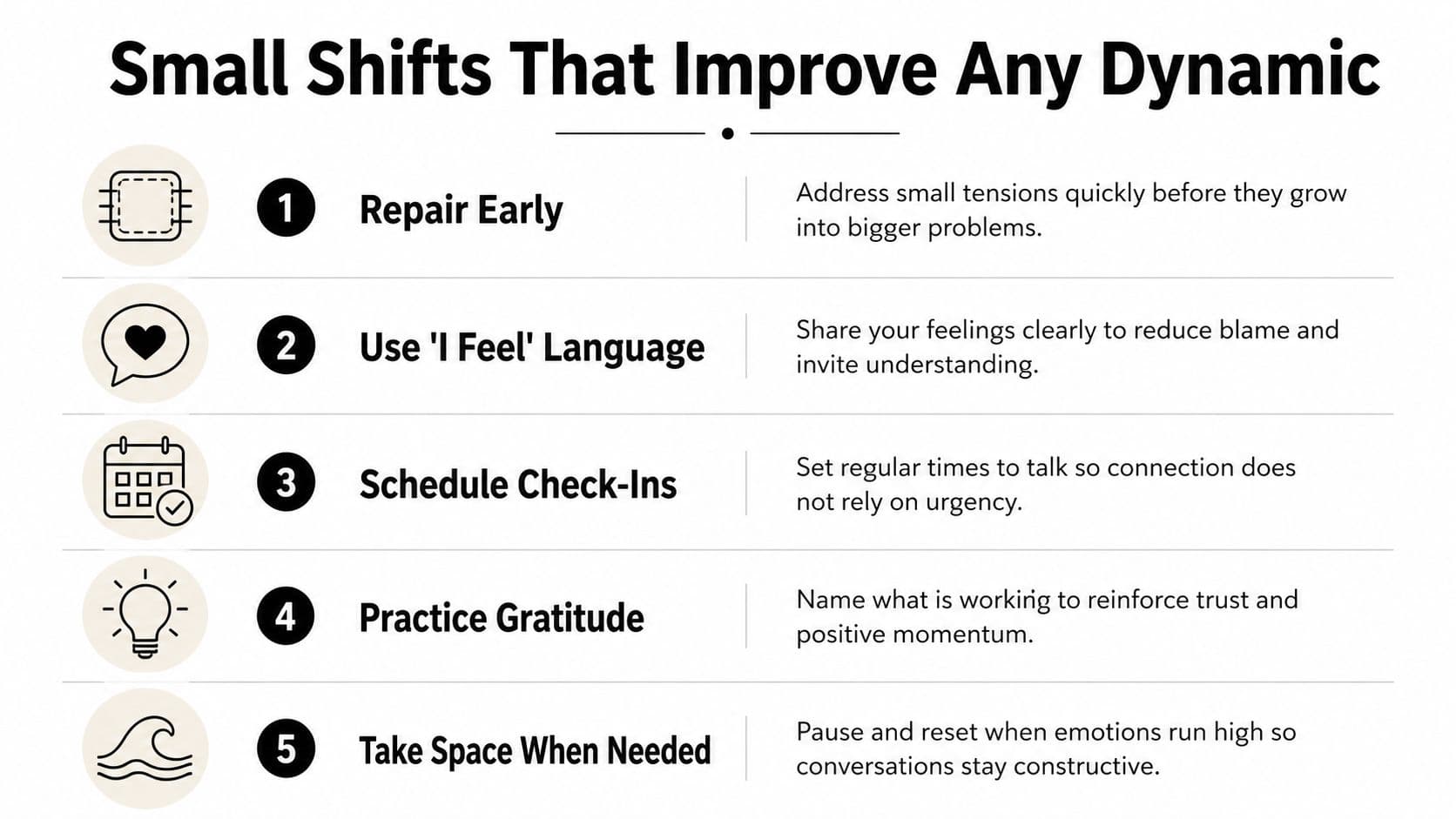
- Repair early. Don't wait until the resentment hardens. A quick “I don't like how that landed” can change the tone before it escalates.
- Use “I feel” language. It lowers the chance that the other person hears a verdict instead of a feeling.
- Schedule check-ins. A planned conversation often works better than trying to fix everything in the middle of a spike.
- Practice gratitude. If you're looking for a family-friendly way to build warmth, the ideas in fresh mother son bonding ideas show how small positive moments can keep a bond from going flat.
- Take space when needed. A calm pause is not abandonment. Sometimes it's the thing that keeps a hard conversation from turning sharp.
These aren't rules you must force on another person. They're experiments that change your contribution to the feedback loop. That matters, because you can't control the whole dynamic, but you can change the part you keep repeating.
Seeing the Pattern Is the First Step
A relationship dynamic is the recurring way two people treat each other, and that same loop can either stabilize a bond or slowly wear it down. The five dimensions, the four recognizable loops, and the harm threshold all point to the same truth. Patterns matter more than isolated moments.
If a relationship is mostly secure, the work is usually about repair and clarity. If it's caught in pursue-withdraw or criticism-defensiveness, the work is often about changing the next move. If fear, control, or aggression keeps showing up, the work shifts from communication skills to safety and support.
One real relationship is enough to start with. If you want a deeper compatibility read, the Life Purpose App, built around Dan Millman's The Life You Were Born to Live, lets you look at how two life paths tend to interact and what each person brings into the bond. Seeing the pattern clearly doesn't solve everything, but it does change the next conversation.
If you want a deeper way to explore how two people's patterns fit together, visit Life Purpose App and try it with one real relationship in mind. It can help you connect Dan Millman's life-path framework to the patterns you're already seeing, so you can read the dynamic with more clarity and less guesswork.
Discover Your Life Purpose Today!
Unlock your true potential and find your life’s purpose.
