Learn what a self awareness app does, which features matter, and how to evaluate privacy, cost, and depth before you commit to one for personal growth.

October 22, 2026 (5d ago) — last updated October 22, 2026 (4d ago)
Self Awareness App: What It Is and How to Choose One
Learn what a self awareness app does, which features matter, and how to evaluate privacy, cost, and depth before you commit to one for personal growth.
← Back to blog
Learn what a self awareness app does, which features matter, and how to evaluate privacy, cost, and depth before you commit to one for personal growth.
You finish a long day, put down your phone, and realize you've answered everyone's messages except your own questions. Why did that conversation bother you? Why do you keep agreeing to work you don't want? Your calendar is full, but you're not sure it reflects what matters to you.
A self awareness app can offer a place to examine those questions. Choosing one starts with understanding what it can help you observe, what it merely interprets, and what should remain your decision.
Why More People Are Reaching for a Self Awareness App
Perhaps you already use a meditation timer, track your exercise, or write occasional notes about your mood. Yet you still struggle to connect an uncomfortable afternoon with the choices, expectations, and relationships surrounding it.
That's a useful distinction. Feeling calmer matters, but understanding why you repeatedly overcommit is a different task. Someone looking for greater self-awareness may want help recognizing the gap between what they value and what they do.
In a 2023 study of 1,989 U.S. adults, 60% reported having used apps to improve well-being, while 44% had used a mental-health or well-being app during the previous year, with younger adults more likely to report use. The survey covered the broader well-being category, not purpose-focused products specifically, so it establishes familiarity with digital support rather than demand for any particular framework.
Start with the question you're carrying
Your reason for downloading matters more than the category label. Consider which of these needs sounds familiar:
- Emotional understanding: You want to notice what happens before you become withdrawn, impatient, or overwhelmed.
- Relationship clarity: You're trying to understand your contribution to a recurring disagreement.
- Direction: Your choices look sensible individually, but together they don't feel aligned with your priorities.
Thinking about why self-awareness is important can help you name the need before choosing the tool. Without that clarity, it's easy to mistake an appealing dashboard for useful support.
A useful starting question: What would I like to understand better outside the app?
The answer gives you something concrete to evaluate. You don't need an application that explains your entire identity. You need a process that helps you examine a meaningful question, without turning ordinary uncertainty into another task you're failing to complete.
What a Self Awareness App Actually Does
A self awareness app helps you observe your thoughts, emotions, behaviors, relationships, or direction, then gives you a way to reflect on what you notice. Its value depends on the connection between your input and the questions or feedback you receive.
That connection can take different forms. A check-in might record what happened before a difficult feeling. A guided exercise might ask whether your response matched your values. A purpose-focused tool might supply an interpretive framework rather than measure your behavior.
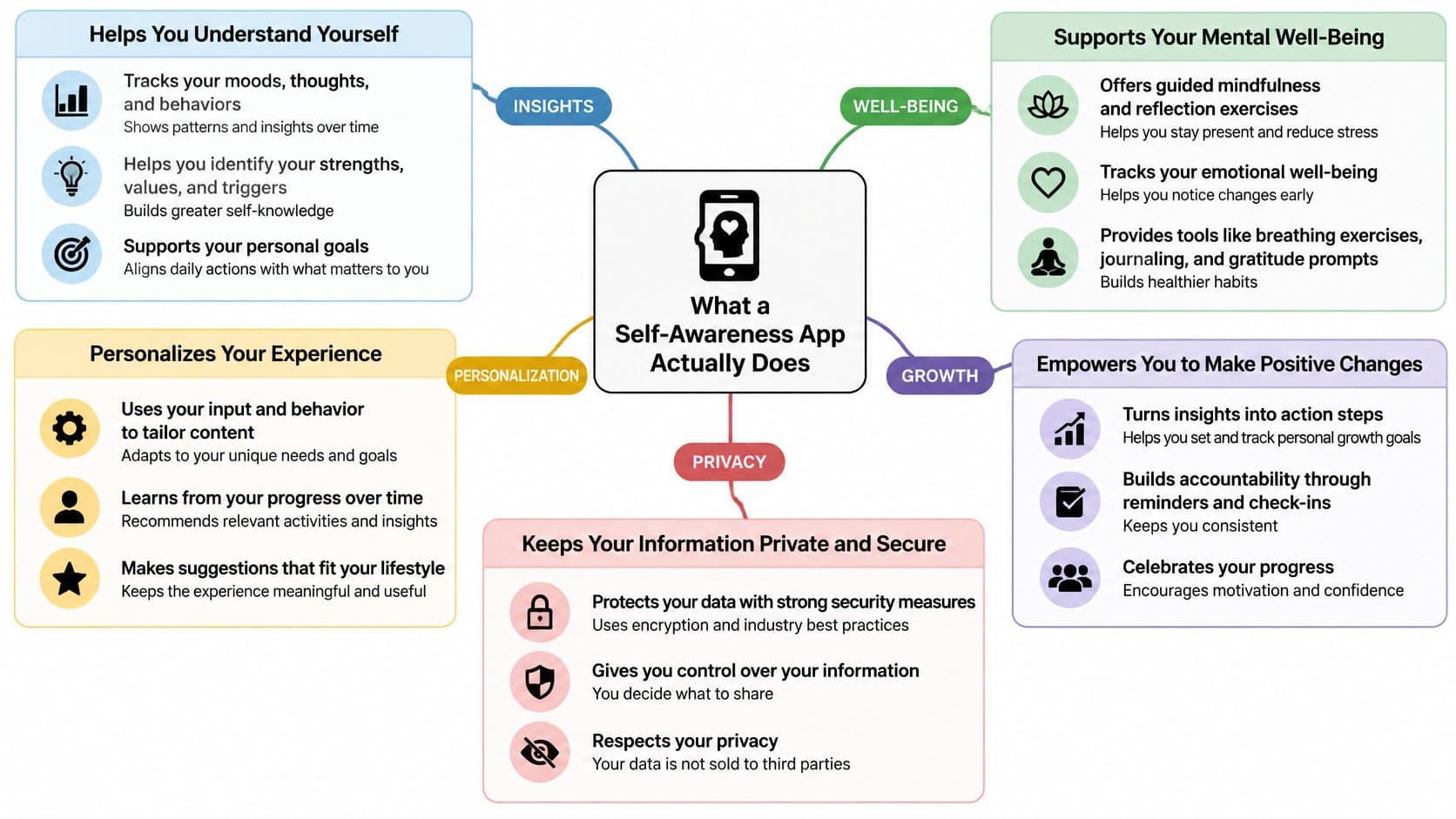
Similar tools, different jobs
These categories overlap, but it helps to distinguish their intended roles:
- Meditation tools: You might use these to practice attention or follow a guided exercise.
- Therapy-oriented tools: Check whether the service includes qualified professional care. A supportive interface alone does not establish that.
- Journaling tools: These provide space to write, but you may need to supply your own questions and review process.
Faith-based reflection is another approach. For readers who want an Islamic context, daily reflection on heart verses with Ayah offers a resource to consider alongside writing or contemplation. The relevant question is whether a framework fits your beliefs, not whether every reflective practice should look alike.
A symbolic framework is a distinct approach
The Life Purpose App uses the system in Dan Millman's The Life You Were Born to Live. Its revised framework expanded from 37 to 45 life paths in the anniversary edition, extending coverage to people born after 2000, as described in Millman's explanation of the revised book.
This is structured, birth-date-based interpretation, not direct observation of your thoughts or behavior. That distinction matters: a symbolic description can offer questions worth considering, but recognizing yourself in a passage doesn't establish that the method scientifically measures your personality.
Features That Separate Serious Self Awareness Apps From Shallow Ones
A useful feature gives you something to examine, not just something to tap. A notification becomes meaningful when it helps you connect a reaction with its context. A journal becomes more informative when you can revisit the circumstances behind an entry.
Look for structured prompts, contextual notes, accessible history, and opportunities to reconsider earlier conclusions. Treat streaks and inspirational quotes as optional extras, not evidence that you're developing insight.
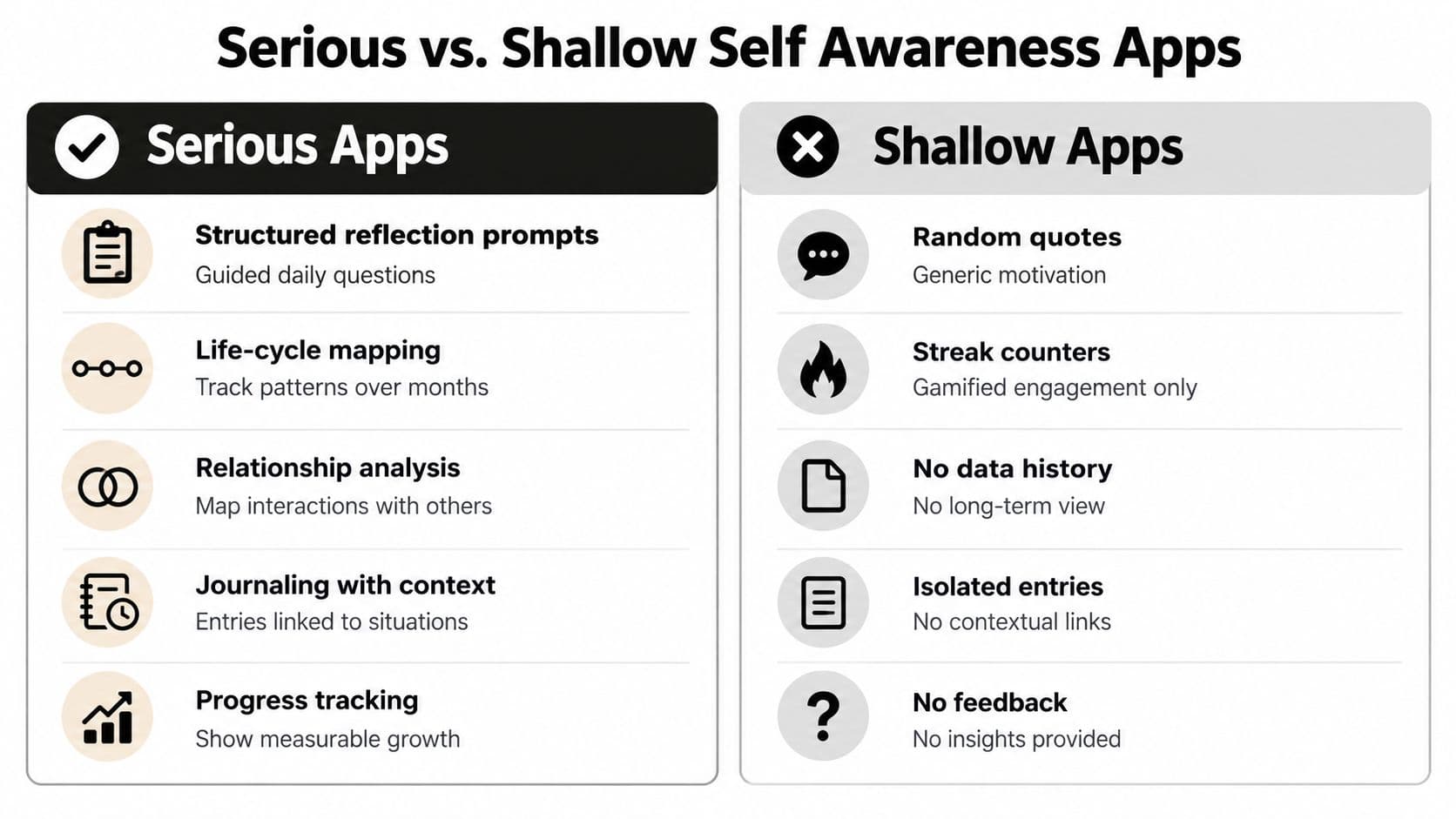
Features should support a reason to return
Within the Life Purpose App, Dan Millman's The Life You Were Born to Live provides a framework for repeating nine-year life cycles: year 1 emphasizes beginnings, 3 expression and communication, 5 change and freedom, and 9 completion and letting go, according to the app's explanation of its cycle system. These themes are interpretive prompts, not a schedule that determines what will happen.
Relationship analysis offers another occasion for reflection. Used thoughtfully, a comparison involving a friend, family member, coworker, or public figure can prompt questions about your expectations. It shouldn't become a shortcut for judging someone you haven't listened to.
The historical engagement challenge is substantial: a 2019 analysis of 93 mental-health apps found a median 100,000 installs, yet the median daily open rate was 4.0%, with the category differences summarized below.
Engagement Benchmarks for Reflection-Driven Apps
| App Category | Median Daily Open Rate | What This Tells You |
|---|---|---|
| All apps analyzed | 4.0% | Downloads alone don't establish continued use. |
| Mindfulness and meditation | 21.47% | Repeatable practices merit attention when evaluating design. |
| Mental-health-problem-focused | 10.02% | A clear topic doesn't automatically produce a returning habit. |
| Happiness-focused | 7.77% | Positive framing isn't enough to ensure engagement. |
Those are historical observations, not forecasts for a particular product. My practical reading is that you should inspect what you'll do after the initial result, not just how compelling that result looks.
Prefer a feature that helps you reconsider a real situation over one that merely congratulates you for opening the app.
How a Purpose-Focused App Supports Personal Growth
Consider a hypothetical workplace disagreement. A colleague asks for more detail before approving your proposal, and you interpret the request as distrust. Reading a description of your tendencies might feel reassuring, but it doesn't resolve the disagreement.
A useful next step is to separate the event from your interpretation. The event was a request for detail. Your conclusion was that your colleague doubted you. Those aren't the same thing.
Turn interpretation into an experiment
With the Life Purpose App, the relationship tools associated with Dan Millman's The Life You Were Born to Live can provide a starting point for examining communication. Suppose you use a compatibility lookup involving a colleague or family member. Rather than deciding that their profile explains them, use the reading to formulate a question you can ask.
- Observe: Write down what the person said, without assigning a motive.
- Ask: Clarify whether they need more information, more time, or a different kind of support.
- Try: Adjust your response, then notice whether the conversation becomes clearer.
The same distinction applies when considering health, money, sexuality, career, or relationships. A prompt can help you articulate a concern. It can't supply missing medical information, establish financial affordability, or replace another person's consent.
For example, a change-oriented theme in the Life Purpose App's interpretation of Dan Millman's The Life You Were Born to Live might encourage you to examine career dissatisfaction. Use that opening to investigate working conditions, practical constraints, and alternatives, rather than treating a theme as permission to resign.
What reflection research actually supports
In a randomized study of university freshmen, 80.49% of app users reported greater awareness of how they spent their time, and completed check-ins correlated positively with reported awareness change. That evidence concerns mobile reflection, not validation of a symbolic system.
The useful connection is procedural: return to your experience, record what happened, and compare it with your assumptions. Insight becomes actionable when you can name what you'll do differently, then check whether that action helped in the situation you faced.
How to Evaluate Any Self Awareness App Before You Commit
Start with the product's explanation of its method. Can you tell whether it records your answers, calculates a result, or generates an interpretation? If those processes blur together, you may give the output more authority than it deserves.
Evidence about measurement needs equally careful reading. A six-month validation study involving 99 participants found excellent within-person and between-person reliability, high convergent validity, and moderate discriminant validity for a smartphone ecological momentary assessment application. That supports the studied approach to repeated assessment, not every app that presents a score.
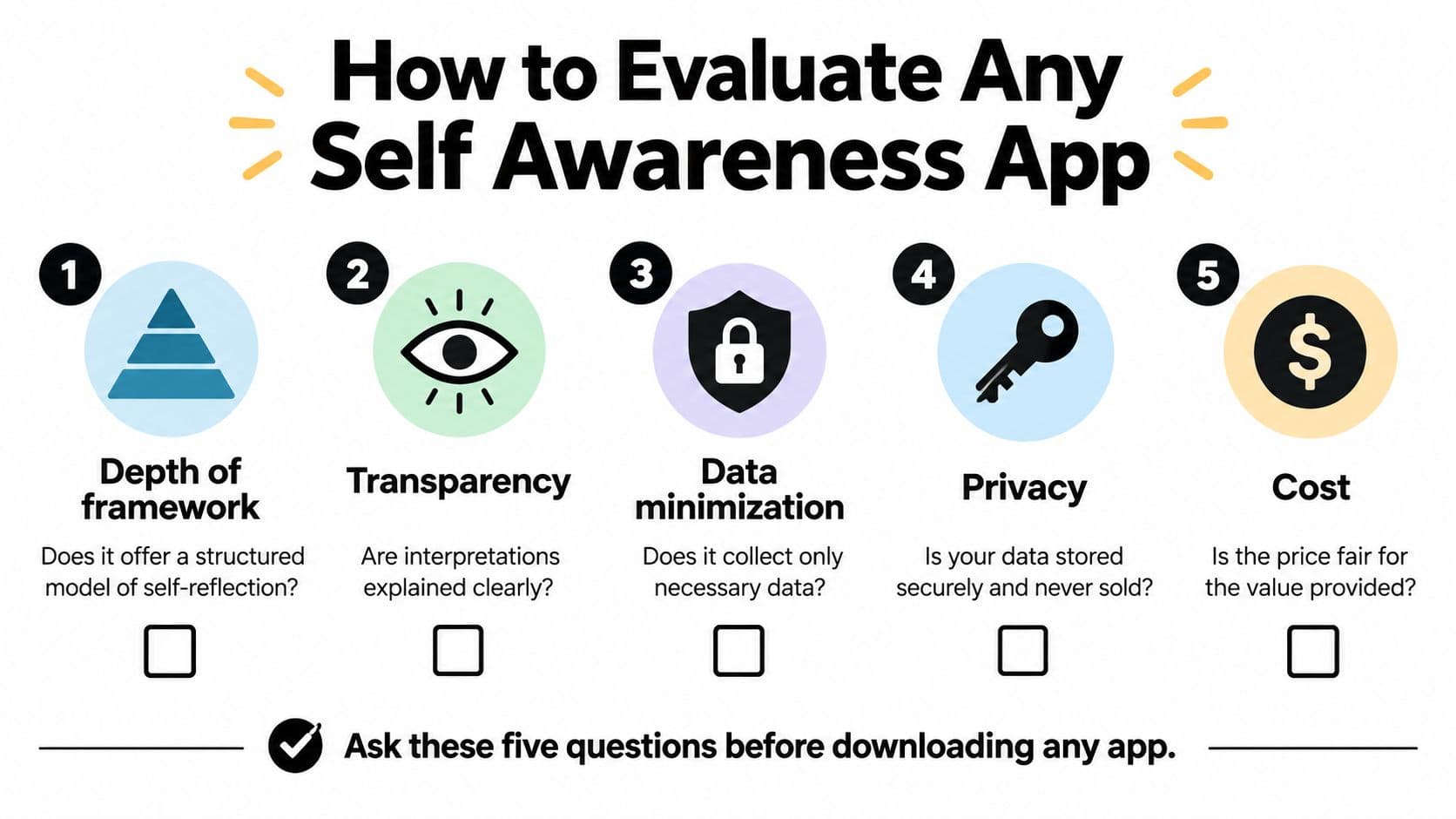
Compare the method, terms, and fit
Five Questions to Ask Before Installing a Self Awareness App
| Criterion | Question to Ask | Why It Matters |
|---|---|---|
| Framework depth | Does it provide a coherent process I can revisit? | A striking result isn't the same as an ongoing practice. |
| Transparency | How does it produce its interpretations? | You need to distinguish calculation from observation and advice. |
| Data minimization and privacy | What does it collect, retain, share, and let me delete? | Reflective entries can contain sensitive information about you and others. |
| Cost and access | What remains free, and what would continued use cost annually? | You should understand the commitment before entering personal material. |
| Language and cultural fit | Can I understand and question the wording comfortably? | Useful reflection shouldn't require accepting unfamiliar assumptions. |
For the Life Purpose App's implementation of Dan Millman's The Life You Were Born to Live, the anniversary-edition access overview describes a free summary and system introduction, with paid options providing the complete anniversary-edition text, detailed analyses of all 45 paths, unlimited contacts, primary numbers, and cycle access. It also states that supported birth dates run from 1800 to the present, allowing exploration involving older relatives or historical figures.
That's an access description, not a privacy assurance. Before entering another person's details, check what the service stores and whether you need to include identifying information at all.
When comparing personal development apps, test the ordinary experience as well as the feature list. Read a sample, inspect account controls, and check cancellation terms. You should be able to disagree with an interpretation without the product suggesting that disagreement proves it right.
The Honest Limits of Self Awareness Apps
An app can feel personal without helping you make a useful change. Warm language, detailed profiles, and attractive progress screens can make an experience satisfying. Satisfaction still isn't the same as better judgment or improved communication.
Research also makes simple comparisons difficult. A 2025 review of personalized mental-health and well-being apps noted that downloads and ratings are poor indicators of privacy, usability, or clinical quality, and reported completion rates as low as 29.4% for some interventions among young people. Neither an enthusiastic review nor a large audience answers what happens to your private entries.
Be especially careful with recordings about relationships, sexuality, distress, or someone else's behavior. Check sharing and deletion policies before entering material you wouldn't want exposed. If the explanation is unclear, withholding information is a reasonable choice.
Symbolic meaning isn't certainty
For the Life Purpose App and Dan Millman's The Life You Were Born to Live, a birth-date-based interpretation should remain a reflective lens, not a diagnosis or an empirically established prediction. Don't use apparent compatibility to excuse harmful conduct, or a timing theme to override practical evidence.
Keep your agency: An interpretation can raise a question. It doesn't acquire the right to answer for you.
A responsible tool should make its boundaries visible, offer understandable and culturally respectful language, and make room for professional support. Multilingual access is useful, but translation alone doesn't guarantee that every example or assumption fits your experience.
If reflection reveals serious distress, difficulty functioning, or concerns about your safety, don't keep searching the app for a definitive explanation. Bring those concerns to a qualified professional or an appropriate support service. You don't have to complete a self-guided process before asking for help.
Turning an App Into a Real Practice
Choose a question you're willing to observe, not an identity you're eager to confirm. You might examine why you avoid a particular conversation or which commitments leave you feeling resentful. Keep the question narrow enough that ordinary experiences can give you useful information.
For purpose-focused exploration, use the Life Purpose App's framework from Dan Millman's The Life You Were Born to Live as the starting material, then return to your own experience. Its English, French, and German availability offers language choices, but choose the wording you can examine most comfortably.
Read, notice, record, and revisit
- Read with a question: Begin with the relevant interpretation and note what seems applicable, uncertain, or inconsistent with your experience.
- Notice in daily life: Across a week, watch for situations connected to your question. Include examples that contradict your first impression.
- Record the context: Separate what happened, what you felt, and what you assumed. You can pair this with meditation and journaling if those practices help you slow down.
- Revisit and integrate: Review when circumstances or relationship dynamics change. Choose a practical adjustment and observe what follows.
Try that weekly rhythm for a month as a personal experiment, not a promised route to transformation. You might prepare differently for a difficult conversation, decline an unwanted commitment, or ask for clearer expectations at work.
A useful review can end with a revised question, not a more confident label.
You don't need to preserve every interpretation. Keep what helps you examine your experience more truthfully, and leave behind what doesn't.
Choosing a Self Awareness App That Respects You
A self awareness app is a mirror, not a verdict. It can return observations, possibilities, and questions, but you remain responsible for deciding what fits. The strongest reason to keep using one is that it helps you engage more thoughtfully with life away from the screen.
Choose a tool that respects your intelligence by explaining its method, your privacy by limiting unnecessary collection, and your agency by allowing uncertainty. You shouldn't need to surrender your judgment to receive guidance.
Leave room for other perspectives
For readers drawn to purpose-focused reflection, the Life Purpose App presents Dan Millman's The Life You Were Born to Live as a structured, birth-date-based approach. Consider it alongside lived experience, trusted relationships, and professional advice when appropriate, rather than as an authority above them.
- Keep your judgment: A description can be interesting without being accurate for you.
- Look for practical value: Ask whether using the tool helps you listen, choose, or follow through differently.
The right fit isn't necessarily the app with the most elaborate profile. It's the one you can use thoughtfully without becoming less trusting of your own experience.
The Life Purpose App offers a free introductory summary and expanded access to the framework in Dan Millman's The Life You Were Born to Live. Visit Life Purpose App to explore its approach, then bring a real question from your own experience to the reading and decide whether it supports the reflection you're looking for.
Discover your life path today
Enter your date of birth and see your life path, free.
Find your life path