Discover what a self discovery app is, how it supports spiritual growth and relationships, and which features to prioritize. Includes guidance

October 1, 2026 (23d ago) — last updated October 1, 2026 (22d ago)
Self Discovery App: How to Find True Purpose
Discover what a self discovery app is, how it supports spiritual growth and relationships, and which features to prioritize. Includes guidance
← Back to blog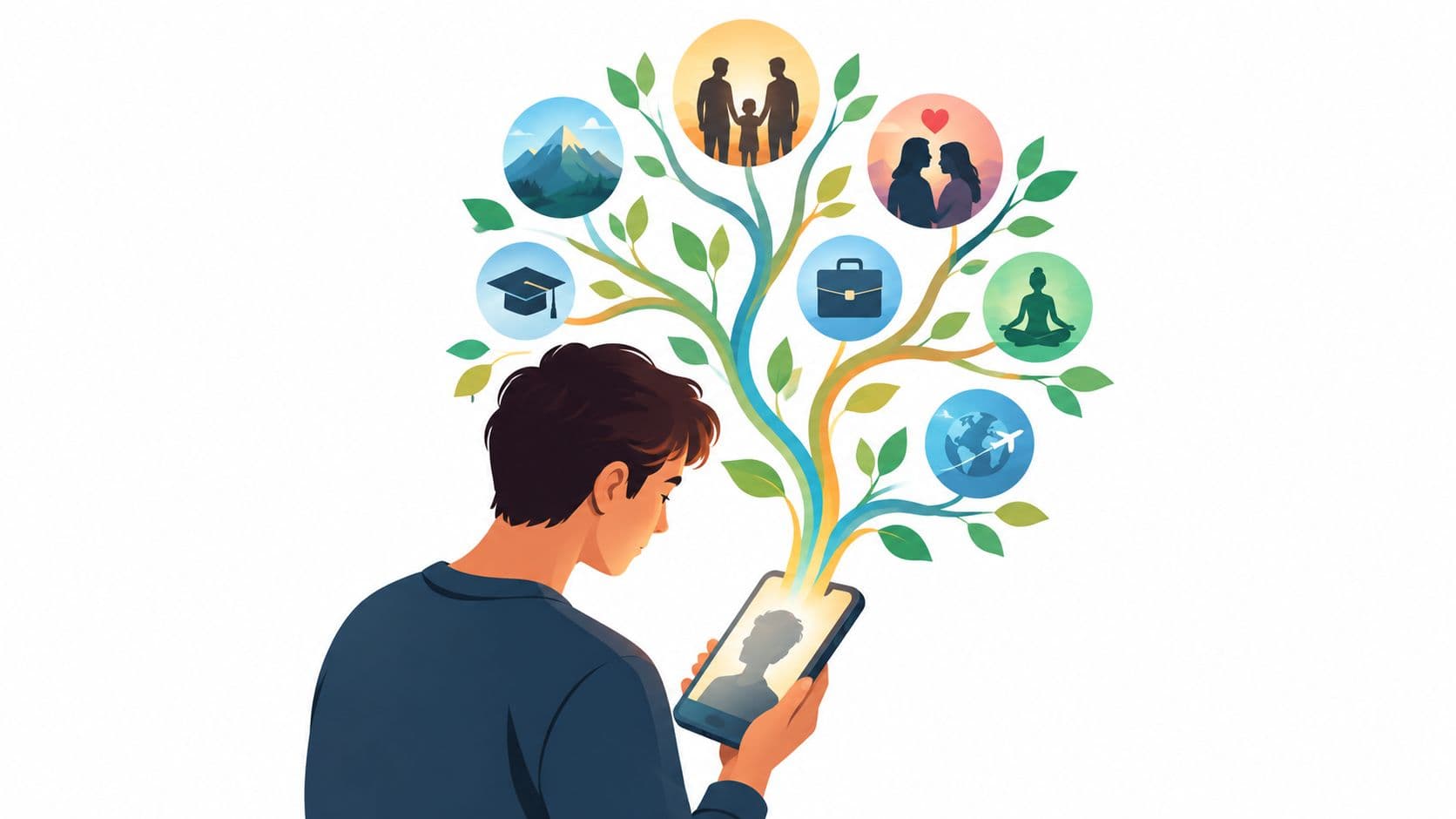
Discover what a self discovery app is, how it supports spiritual growth and relationships, and which features to prioritize. Includes guidance
A self discovery app is a mobile tool that helps you understand yourself through structured reflection, spiritual frameworks, or guided insight, and the market around it is already large enough to feel mainstream. In 2023, self-help apps generated $4.2 billion in market size, while meditation apps reached $2.1 billion (Gitnux self-help industry statistics); that scale explains why so many people try one when they want clarity fast.
It usually starts in a very ordinary moment. You're in bed, half trying to relax, half wondering why life feels off, and a search in the app store turns into a quiet hope that a few taps might tell you something true.
The Late-Night Search for Meaning That Leads to an App Store
The phone glow is low, the room is still, and one question keeps returning. Maybe work feels misaligned, a relationship has become difficult to understand, or your daily choices no longer resemble the person you hoped to become. After distraction stops working, a self discovery app can seem like a practical doorway into honest reflection.

The appeal is clear. An app offers privacy, an immediate starting point, and a manageable way to approach questions that can feel too large for a blank journal page. It may give you language for feelings you have carried for years without naming. It cannot make the decision for you, and its value depends on whether its guidance remains useful after the first session.
That makes three questions more helpful than a feature checklist. Will the app handle personal information with care? Will it support reflection over time, rather than provide a momentary burst of reassurance? Does its method connect with an established spiritual framework, or does it merely sort you into a flattering personality category?
The hope is real, and so is the skepticism
A thoughtful tool can act like a first mirror. It reflects patterns you may have missed, while leaving you responsible for examining them in real life. A vague result may feel comforting, but comfort alone does not create insight.
Practical rule: if an app gives you a feeling before it gives you a framework, be careful. Feelings matter, but they're not the same as insight.
The strongest apps offer structure without reducing a person to a label. They occupy the space between a coach and a horoscope, encouraging questions rather than claiming perfect certainty. For a gentle introduction to that mindset, soul searching offers a useful starting point. Self-discovery lessons from Live Better With also provides a related perspective.
What a Self Discovery App Is and What It Does
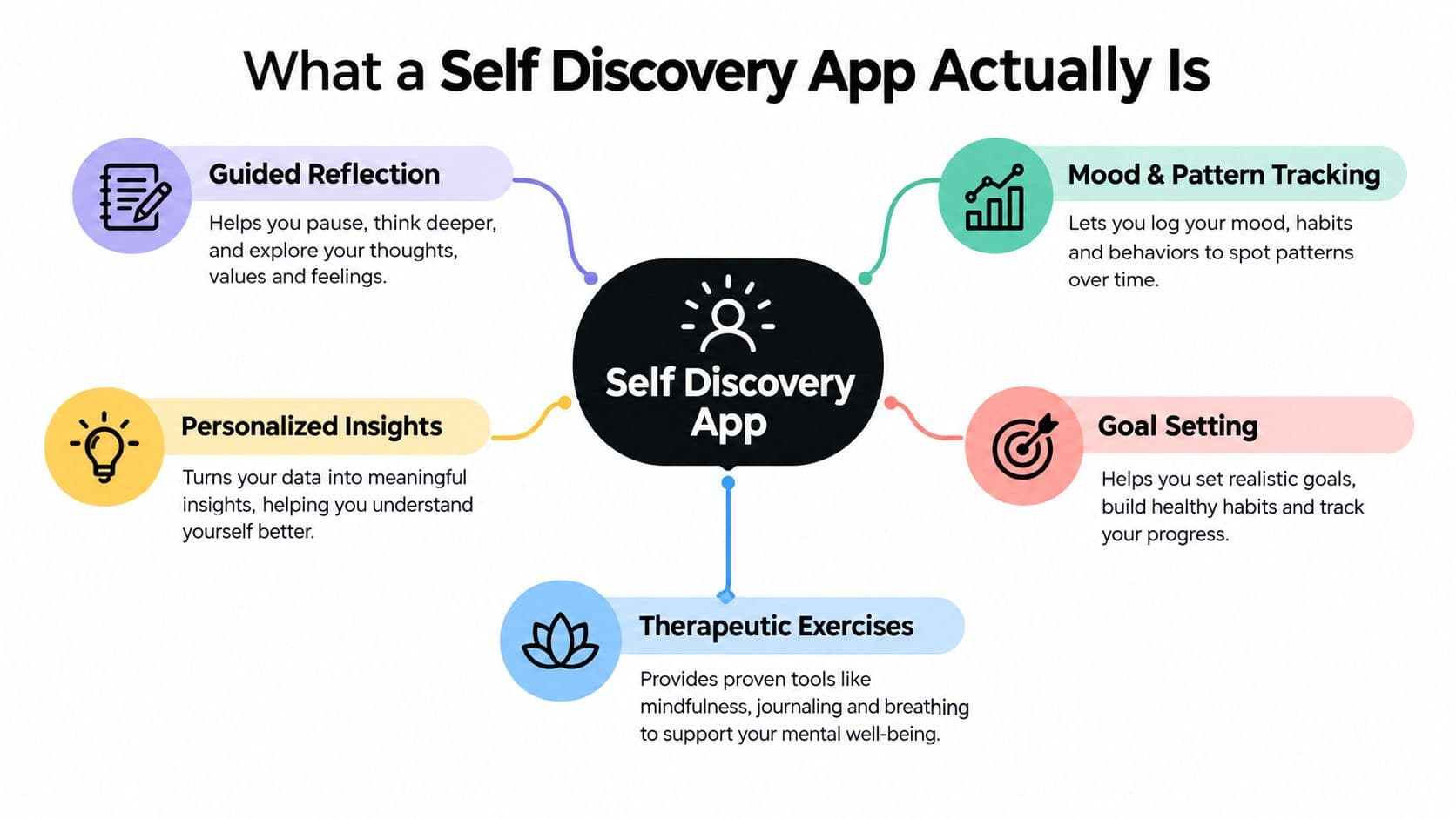
A self discovery app helps you turn reflection into a usable pattern. It can sit between a journal entry and a spiritual framework, giving structure to questions that otherwise stay vague. A mood tracker records how you feel. A quiz sorts you into a category. A self discovery app goes further by helping you see what your answers may mean over time.
The distinction matters because insight usually needs context. Without that, even a thoughtful question can feel like a blank page with better design.
The Life Purpose App is a clear example. It is built as a digital companion to Dan Millman's book, The Life You Were Born to Live, and it uses birth dates to identify one of 45 life paths (Apple Books description).
Why structure matters more than novelty
A self discovery tool has to do more than feel interesting for one evening. A 2024 study found that among users of a fully self-guided online self-knowledge platform, 88.9% used it for only one day and just 3.3% completed all activities, while a hybrid format raised full completion to 40% (Frontiers in Digital Health). The lesson is simple. A tool needs enough structure to keep giving something back after the first impression fades.
That is why the strongest apps act less like novelty machines and more like patient guides. They can help you notice patterns, return to them later, and compare what you thought with what you did. They also have limits. A good app can frame reflection, but it cannot replace lived experience, honest relationships, or the slow work of changing habits.
The best mental model is straightforward. A self discovery app should feel like a mirror that returns a pattern, not a trick that promises certainty. If it only entertains you, it may be pleasant. If it helps you recognize yourself more clearly, it has done its job.
For a related perspective, Self-discovery lessons from Live Better With offers a useful complement.
The Feature Stack Most Users Should Care About
A crowded app store can make every tool look equally useful. Wellness apps generated $848 million in revenue in 2025 and reached 56 million users, with 138 million installations that year, up 10.4 percent from the previous year (Statista health and fitness apps). That demand gives you plenty of options, but a long feature list does not show whether an app will support reflection beyond the first session.
Features that usually matter most
Start with three questions. Does the app help you reflect? Can you recognize patterns over time? Are its interpretations tied to a clear framework rather than a generic personality label?
In the Life Purpose App, those functions may include a free-tier summary, a more detailed life-path analysis, and compatibility views for relationships and contacts. Each feature has a practical role. A summary gives you an initial lens, deeper analysis supplies context, and comparison tools help you examine how a framework relates to other people. The framework should remain visible, so you can judge the interpretation instead of treating an app's wording as a final verdict.
Useful filter: if a feature never changes what you notice, remember, or choose, it's decoration.
Long-term value also depends on simple access. Multilingual support can help people in the same household or team use the tool in a shared language. Unlimited contact look-ups can make repeated comparisons easier across family members, coworkers, or public figures. Privacy belongs in the feature stack too. Before saving personal reflections or contact details, check what the app stores and how that information is handled.
What tends to be overvalued
Daily streaks, cheerful dashboards, and frequent sharing prompts can make activity visible without making insight deeper. Compatibility readouts deserve the same caution. They can open a conversation, but a confident-sounding result cannot account for every choice, history, or change in a relationship.
A useful test is whether a feature answers a real question. Does it clarify a recurring pattern? Help you compare your assumptions with an established framework? Give you something meaningful to revisit later? A broader comparison of personal development apps worth exploring can help you assess different approaches without judging them by feature count alone.
How a Self Discovery App Supports Spiritual Growth and Relationships
A late-night conversation can expose a question that a personality quiz cannot answer. Why do you react the same way under pressure? Why does a familiar conflict keep returning? A self discovery app can help organize those questions, giving spiritual reflection a practical starting point rather than a collection of vague labels.
Dan Millman's framework gives the app its shape
Dan Millman's life-path framework treats each person as having distinct gifts, issues, and needs. Its value here lies in how those patterns can be considered over time. The system includes nine-year life cycles, which give users a way to examine whether a season of change, withdrawal, or ambition is affecting how they relate to other people. The wider framework is outlined in the Apple Books description, while the app turns the material into something users can revisit in context.
The Life Purpose App maps those patterns onto relationship dynamics, so two people can compare tendencies instead of trading fixed labels. One person may seek space while another seeks immediate reassurance. Seeing that difference can replace blame with a more useful question: what does each person need in order to respond with greater awareness?
That distinction matters. An app can provide a vocabulary and a sequence for reflection. It cannot decide whether a relationship is healthy, explain every event in someone's history, or do the personal work required to change a habit.

Relationships are where vague insight gets tested
Compatibility tools become useful when they lead to a specific conversation. Two people might compare how they handle uncertainty, conflict, affection, or responsibility, then check whether the suggested pattern fits their lived experience. The result should remain a prompt for attention, not a verdict about character or destiny.
For a practical example, our guide to how life-path patterns show up in relationships explores the point at which a spiritual framework either becomes useful or stays abstract. The question shifts from “What label am I?” to “What am I learning about how I connect, react, and grow?”
That question supports spiritual maturity because it returns responsibility to the person using the tool. The app may reveal a recurring pattern, yet reflection, honest communication, and deliberate choices determine what happens next.
Privacy, Pricing, and the Hidden Costs of Downloading a Self Discovery Tool
A late-night reflection can lead to an app asking for your birth date, relationship details, journal entries, or preferences. Those details can identify you and people close to you, so they deserve the scrutiny you would give information held by a medical service. Privacy is part of the app's purpose, not a technical footnote. A tool that invites honest reflection must also explain how it handles what you reveal.
What to check before you sign up
Read the privacy policy before creating an account. Look for clear answers about what the app collects, why it needs each category, how long it retains the information, and whether it shares data with other companies. Check whether you can delete your account or limit permissions. A vague explanation, difficult-to-find policy, or rushed consent screen deserves caution. The privacy policy page on user data offers a useful reference for the kind of information a policy should explain.
The category's scale creates real incentives to collect and retain user data, which makes privacy worth examining before the feature list. Market figures alone cannot establish that a particular app is trustworthy. They only show why careful reading matters (Gitnux self-help industry statistics).
Pricing needs the same plain language. A free tier may provide a short summary, while paid access supplies the interpretation that makes the system more useful over time. The Life Purpose App uses that structure: its free access includes a life-path summary and system overview, while paid access includes the complete 25th Anniversary Edition text, detailed analyses, unlimited contacts, and primary numbers and cycles.
The hidden cost is not always money
The bill may be a subscription, but the larger cost can be attention. Repeating the same reading, waiting for reassuring answers, or checking notifications can turn reflection into a habit of consumption. An app should function like a journal prompt or compass, not a machine that keeps you returning without helping you act.
Before paying, ask what changes after the first result. Does the tool offer guidance you can apply to decisions and relationships? Does it encourage independent reflection, or does every question lead to another purchase? Long-term value comes from clearer choices and better questions, not from collecting increasingly elaborate labels.
How to Choose a Self Discovery App That Actually Fits Your Needs
Start with five questions. First, does the app use an established framework, or is it inventing personality language on the fly? Second, does it explain what data it collects and why? Third, does the free tier let you test the core idea before you pay? Fourth, does it help you understand relationships without freezing people into fixed categories? Fifth, does it give you something ongoing, not just a one-time result?
The Life Purpose App fits that checklist in a straightforward way because it's tied to Dan Millman's published framework, it gives a clear life-path summary on the free tier, and it offers deeper access for people who want to explore the system more fully. It also supports contact comparisons and multilingual use in English, French, and German, which matters if you want the tool to fit into real life instead of staying locked inside a novelty phase.
Best test: if the app still feels useful after the first surprise wears off, it probably has substance.
A self discovery app can open a door, but it can't walk through it for you. If you're looking for a grounded place to start, Life Purpose App offers a practical way to explore Dan Millman's framework, compare life-path patterns, and decide whether this style of self-knowledge resonates with you.
Discover your life path today
Enter your date of birth and see your life path, free.
Find your life path