Unlock true inner understanding. This guide explores the art of self knowledge, offering psychological insights & spiritual practices to help you know yourself
July 12, 2026 (1mo ago) — last updated July 13, 2026 (1mo ago)
The Art of Self Knowledge: How to Truly Know Yourself
Unlock true inner understanding. This guide explores the art of self knowledge, offering psychological insights & spiritual practices to help you know yourself
← Back to blog
Some days you handle work, relationships, and responsibilities just fine, then one small comment throws you off for hours. Or you keep saying you want a different life, but your choices keep circling back to the same patterns. That experience is often what sends people looking for self knowledge.
Not because they want to become perfect. Because they want to become clear.
Self knowledge isn't a luxury for people with extra time. It's a practical way to understand why you react the way you do, what matters to you, and what kind of life suits you. When you know yourself better, decisions get less foggy. Boundaries get easier. Relationships make more sense. Even confusion becomes more workable because you can name what's happening instead of getting lost inside it.
A healthy path inward usually needs more than one tool. Inner reflection matters. So does honest feedback. So does a structure that helps you notice patterns you might miss on your own. If you're looking for a grounded starting point, this guide to discovering yourself offers simple prompts that can help you begin putting language around what you've been feeling.
The Journey to Knowing Yourself
For many, this journey begins at a moment of friction. They feel split inside. One part wants stability, another wants freedom. One part wants closeness, another pulls away. Self knowledge starts when you stop treating those inner contradictions as proof that something is wrong with you.
It helps to think of self knowledge as a practice, not a finish line. You don't arrive one day with complete certainty about who you are. You build a clearer relationship with yourself over time. You notice your patterns, test your assumptions, and learn how to act in ways that feel more honest.
Why this matters in ordinary life
Knowing yourself affects everyday choices more than people realize.
- In relationships, it helps you see whether you're asking for what you need or expecting others to guess.
- At work, it shows you whether you're driven by meaning, security, recognition, or challenge.
- In stressful moments, it helps you tell the difference between intuition and reactivity.
Without that inner clarity, people often make decisions from pressure, fear, or habit. Then they wonder why even the 'right' choice feels wrong afterward.
Practical rule: If your outer life keeps repeating the same frustration, your inner map probably needs updating.
A balanced way to approach self knowledge
Some people lean only on psychology. Others lean only on spiritual systems. In my experience, both can help when used carefully.
Psychology gives us language for behavior, emotion, and self-perception. Spiritual frameworks can offer meaning, pattern, and a sense of deeper direction. Used together, they can support a fuller kind of insight. One helps you observe what is happening. The other can help you ask why it matters and what it points toward.
That combination is what makes this work accessible. You don't need to be an expert, unusually introspective, or naturally 'good' at reflection. You just need curiosity, honesty, and a willingness to notice yourself with a little more compassion.
What Exactly Is Self-Knowledge
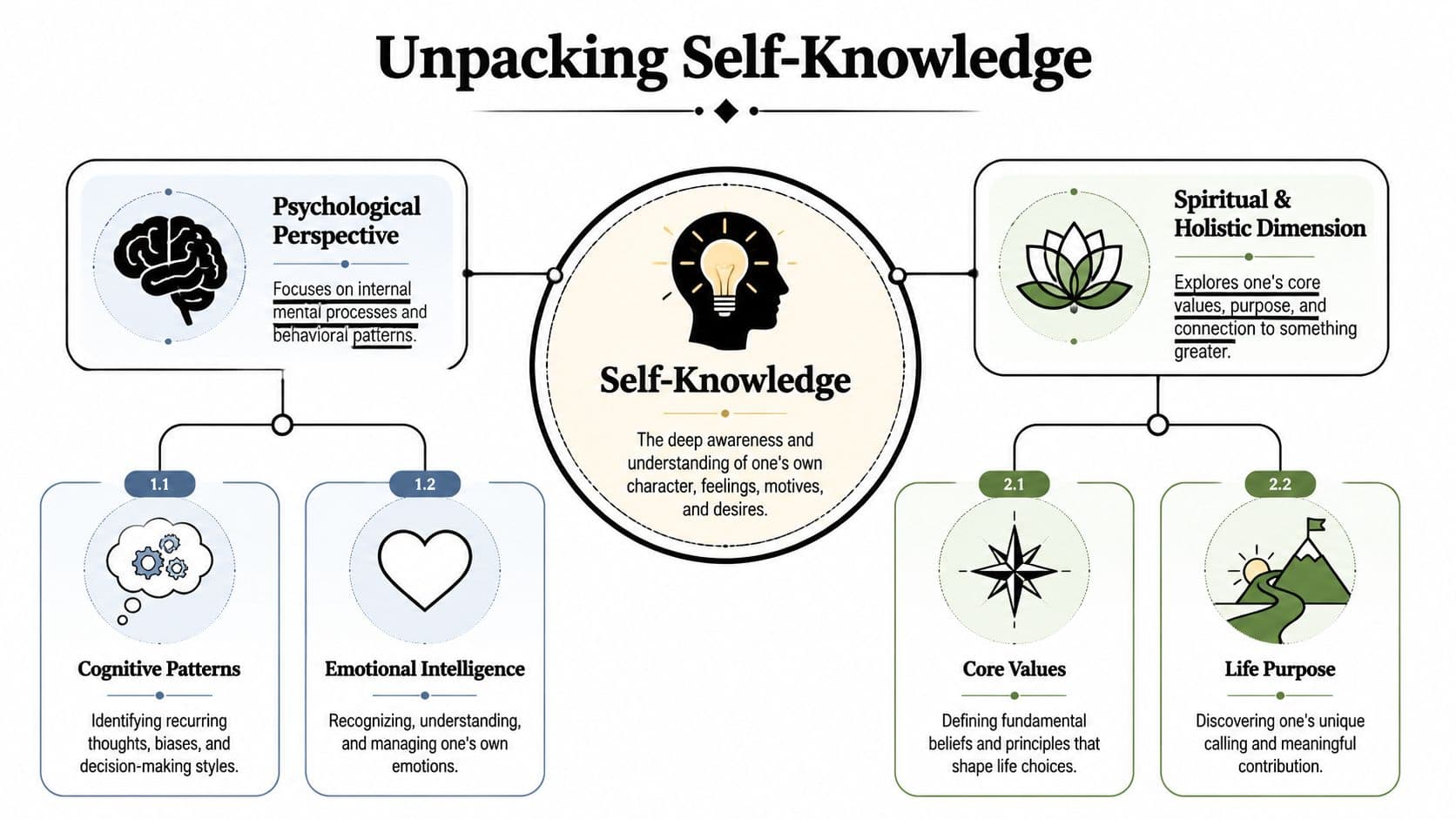
At the simplest level, self knowledge means understanding your own character, motives, emotions, desires, and patterns. But that definition gets richer when we look at it from both psychology and spiritual inquiry.
Psychology treats self-knowledge as something more concrete than a private feeling. Researchers have measured it by comparing how people rate themselves with how other people rate them on personality traits and daily behavior. In that view, self-knowledge is partly about accuracy, not just introspection or confidence, as described in this overview of self-knowledge in psychology.
The psychological side
A common misunderstanding is that thinking about yourself a lot means you know yourself well. It doesn't. Some people spend enormous energy analyzing their feelings and still miss the structure underneath their behavior.
One useful distinction comes from research on integrative self-organization and compartmentalization. Psychological studies confirm that individuals with integrative self-organization report higher feelings of authenticity and have more consistent self-evaluations. In contrast, compartmentalized individuals, even those with high self-esteem, show greater contingencies of self-worth and slower endorsement of positive self-statements, highlighting a structural vulnerability in their self-knowledge, according to this research on self-concept structure.
That language can sound abstract, so here's the plain version.
Integrative versus compartmentalized selves
An integrative self tends to say, 'I have strengths and flaws, and they all belong to me.'
A compartmentalized self tends to say, 'I'm confident at work, insecure in love, calm with friends, ashamed when I fail, and these parts barely talk to each other.'
Neither style makes someone bad or broken. But compartmentalization can create hidden strain. A person may look confident while feeling fragile inside because their sense of worth depends heavily on how things are going in separate areas of life.
When your identity changes dramatically from one context to another, the issue may not be low confidence. It may be low integration.
This helps explain why some people feel successful yet strangely unreal. Their self-image may be positive, but it isn't stable enough to hold complexity.
The spiritual side
Spiritual traditions ask a different, but related, question. Not only 'Who am I in behavior and emotion?' but also 'What is the deeper pattern or purpose of this life?'
That perspective doesn't replace psychological insight. It adds another layer. A spiritual approach to self knowledge often focuses on themes such as purpose, values, lessons, and recurring life challenges. It invites you to look for meaning in what repeats.
For some people, that means prayer, meditation, or contemplation. For others, it includes a structured symbolic system. When people explore numerology through Dan Millman's book, 'The Life You Were Born to Live', and the Life Purpose App, they're often looking for this kind of pattern-based reflection: a way to understand their gifts, tensions, and direction through a coherent framework.
Both perspectives matter. Psychology helps you become more accurate. Spiritual inquiry helps you become more oriented.
Four Powerful Methods for Deepening Self-Knowledge
Self knowledge grows through repeated contact with your real experience. Not your ideal self. Not your public self. Your actual lived patterns.
A clinically validated model of self-connection describes this clearly. True self-connection requires awareness of internal states, acceptance of those states without judgment, and behavioral alignment with them. This three-part model predicts self-actualization, vitality, and psychological need satisfaction, as explained in this research on self-connection.
That gives us a practical test. If a method only makes you more aware but doesn't help you accept what you find or live from it, the work stays incomplete.
Mindful reflection and journaling
Journaling is useful when it's specific. 'How do I feel?' is often too broad. Better questions create better insight.
Try prompts like these:
- Name the trigger: What happened right before my mood changed?
- Name the story: What did I immediately tell myself it meant?
- Name the need: What was I hoping for that I didn't receive?
This kind of reflection helps you separate events from interpretations. Over time, patterns show up. You may notice that criticism feels unbearable when you're already tired, or that indecision spikes when you're trying to please everyone.
If reflective writing feels awkward, a more devotional style can help. Some people find that writing as if they are speaking to their future self or to God softens their defenses. A thoughtful example is this piece on praying for your future, which blends reflection with intention in a gentle way.
Somatic awareness
Your body often knows something before your mind can explain it.
Pay attention to moments when your chest tightens, your stomach drops, your jaw clenches, or your breathing changes. Those signals don't give you a full answer, but they do give you a clue. They tell you where to look.
You might notice:
- A heavy body after saying yes: That can point to resentment or overcommitment.
- A sense of expansion around certain people: That may suggest safety or alignment.
- Numbness during conflict: That can reveal overwhelm, not indifference.
This method matters because many people try to know themselves only through thought. But self knowledge also lives in sensation, pace, fatigue, desire, and relief.
Your body won't give you a polished explanation. It will give you an honest signal.
Constructive feedback from trusted people
Because self-knowledge includes accuracy, other people can sometimes see patterns you miss. The key is to ask people who are both kind and honest.
Instead of asking, 'What do you think of me?' ask narrower questions:
- 'When do I seem most like myself?'
- 'What do I do when I'm stressed?'
- 'What strength do you think I underuse?'
Specific questions produce usable answers. Vague questions usually bring vague reassurance.
For another practical set of reflection tools, this article offers prompts that can support this process.
Life-theme analysis
Some lessons don't show up in a single day. They repeat across years.
Look back at your relationships, work choices, conflicts, and turning points. Do similar themes keep appearing? Maybe you repeatedly choose responsibility over joy. Maybe you keep learning how to speak up. Maybe every major change asks you to trust yourself more.
Structured symbolic systems can be helpful. Some people use Dan Millman's book, 'The Life You Were Born to Live', and the Life Purpose App as one framework for noticing recurring themes tied to purpose, challenge, and growth. Used wisely, a framework like that doesn't replace your judgment. It gives you language for patterns that already seem to be living in your story.
A Comparison of Self-Knowledge Methods
| Method | Primary Focus | Best For |
|---|---|---|
| Journaling | Thoughts, beliefs, emotional triggers | People who need clarity through language |
| Somatic awareness | Physical signals and nervous system responses | People who overthink and lose touch with felt experience |
| Constructive feedback | Blind spots and observable behavior | People who want greater accuracy |
| Life-theme analysis | Recurring patterns, meaning, long-term lessons | People who want a wider view of their path |
Mapping Your Life Path with Dan Millman's Work
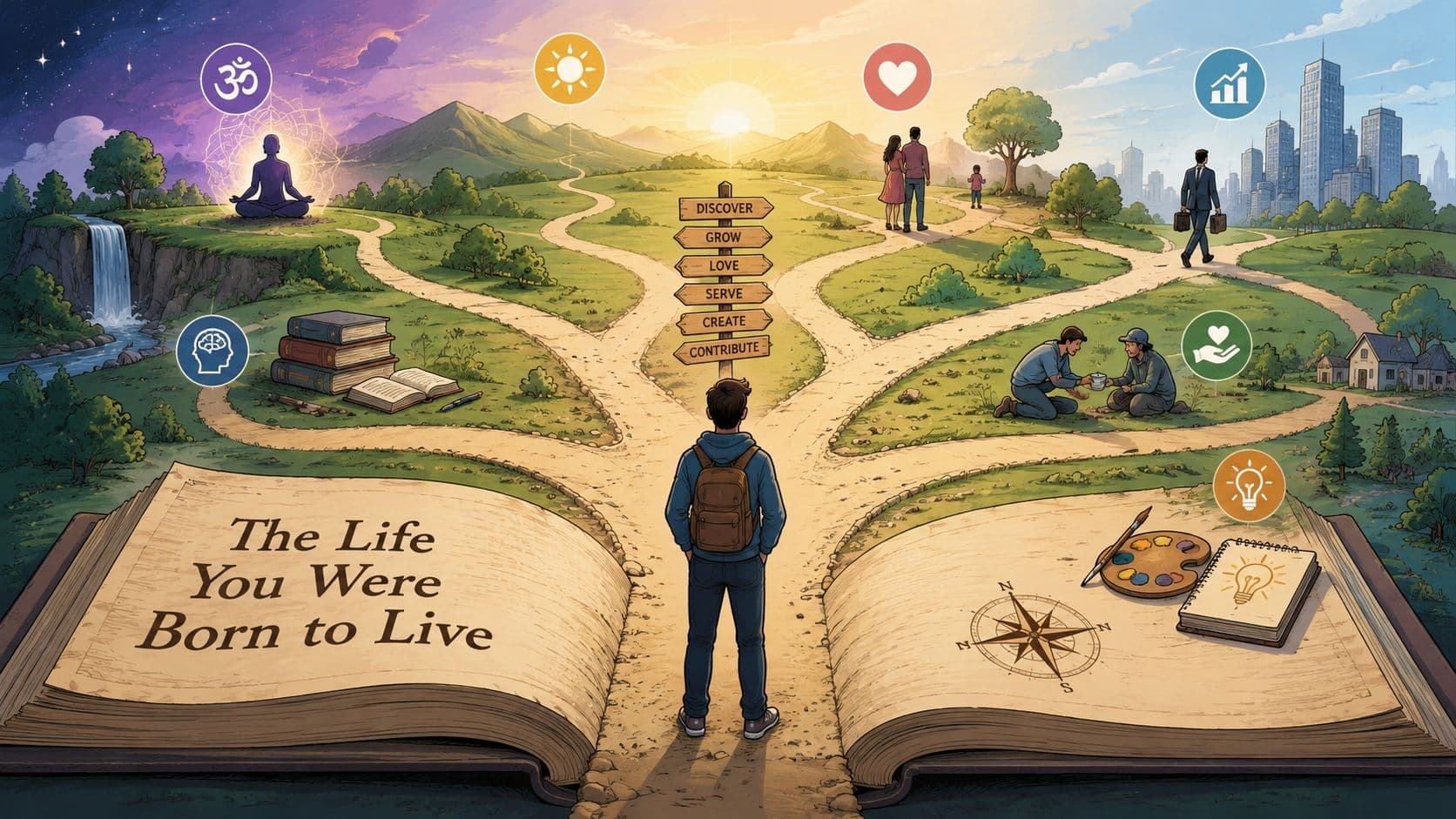
For people who want a more structured spiritual approach to self knowledge, Dan Millman's book, 'The Life You Were Born to Live', offers a distinctive framework. It doesn't ask you to guess your purpose from mood alone. It gives you a system for exploring recurring gifts, tests, and themes through your birth date.
How the system works
In Dan Millman's system, detailed in 'The Life You Were Born to Live,' birth dates are summed but not reduced to a single digit. This results in one of 45 unique life paths. For example, 37, not 1. The 25th Anniversary Edition expanded the system from 37 to 45 paths to ensure accuracy for anyone born after 1999, with the complete system accessible through the material described in this interview about Dan Millman's numerology system.
That detail matters because people often assume all numerology systems reduce everything to one final digit. This one doesn't. The full number carries meaning.
Why structure can help
A structured map can be comforting when your inner life feels scattered. Instead of treating every struggle as random, you start asking better questions.
- What challenge keeps asking for maturity in me?
- What talent keeps showing up, even when I ignore it?
- What lesson seems woven through my relationships, work, or health choices?
In this system, each life path points to a profile of gifts and challenges. That doesn't lock you into fate. It gives you a lens. The value isn't blind belief. The value is pattern recognition.
A good spiritual framework shouldn't shrink your freedom. It should help you use your freedom more consciously.
The role of life cycles
Another reason people connect with Dan Millman's book, The Life You Were Born to Live, and the Life Purpose App is that the framework doesn't stop at a single life-path description. It also includes nine-year cycles, which many people use as a way to reflect on timing, change, and personal development.
That can be helpful when you're trying to understand why one season feels like building, another feels like loss, and another feels like recalibration. Even without treating the framework as absolute, many readers find that cycles offer a meaningful way to reflect on where they are and what kind of effort a season is asking of them.
If you want to understand the framework in more detail, this overview of Dan Millman numerology gives a clear introduction.
Using the Life Purpose App as Your Companion
A book can offer depth. An app can make a practice easier to use in daily life.
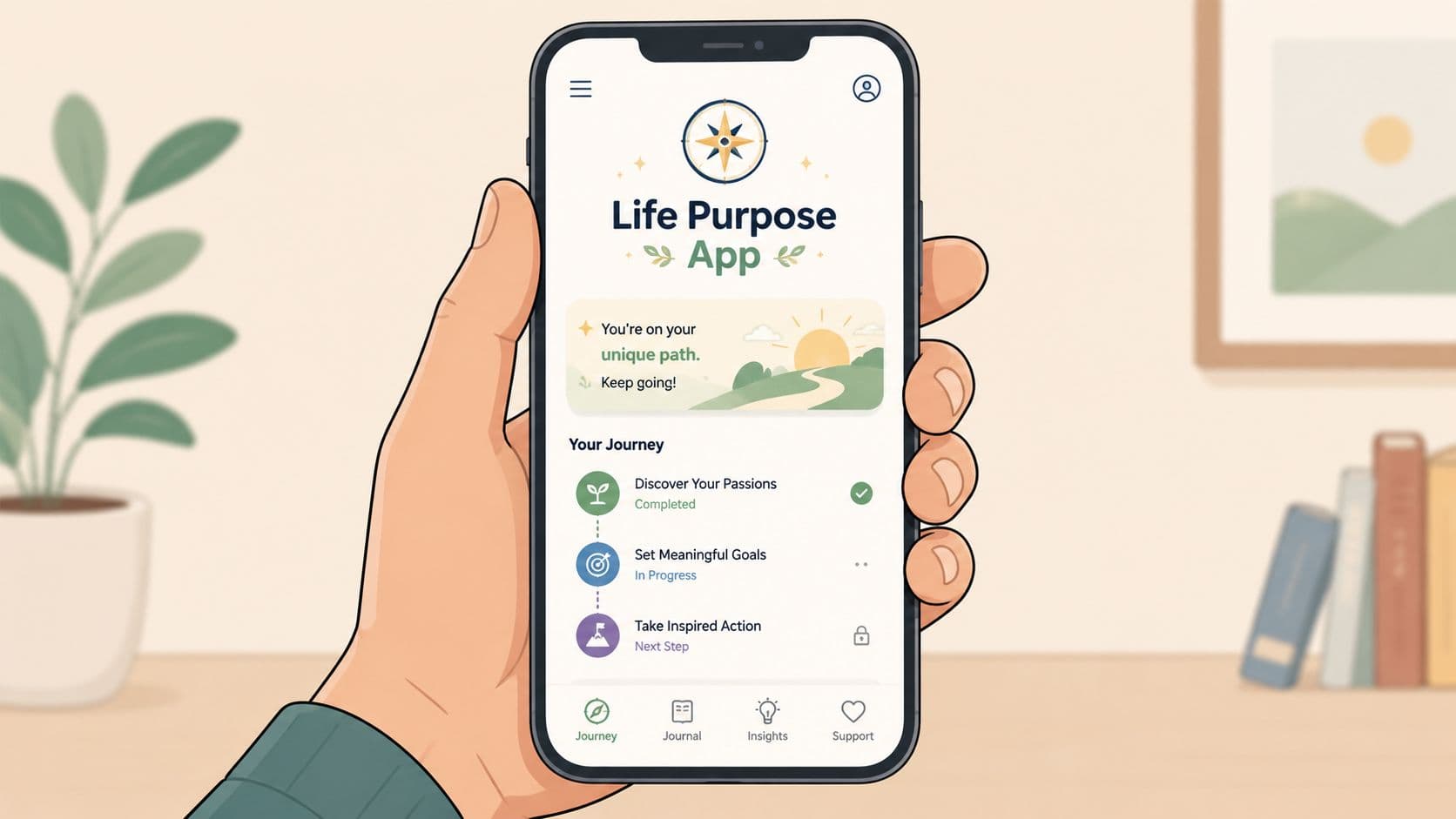
For readers working with Dan Millman's book, 'The Life You Were Born to Live', the Life Purpose App functions as a digital companion to that system. It uses your birth date to identify your life path and lets you explore themes related to purpose, gifts, challenges, and relationship dynamics within the framework.
What makes a tool useful for self knowledge
A useful self-knowledge tool should do more than produce a label. It should help you reflect, compare, and apply what you learn. In that sense, a digital companion can be practical because it reduces friction. Instead of flipping through pages each time you want to revisit a theme, you can return to the relevant material quickly.
People often use a tool like this for a few reasons:
- To revisit their core pattern: Looking again at gifts and challenges can help during periods of confusion.
- To reflect on timing: Nine-year cycles can prompt questions about what a season of life is asking for.
- To explore relationship dynamics: Comparing patterns with a partner, friend, or family member can open up useful conversations.
The app also connects with the broader reflective side of this work. If you want an example of how symbolic guidance and reflection can work together, this piece on your life purpose oracle offers another angle on that process.
A grounded way to use it
Tools like this work best when you treat them as mirrors, not verdicts.
Read your life path. Notice what resonates. Journal what feels true, what feels unclear, and where your lived experience agrees or disagrees. If a relationship pattern stands out, don't jump straight to conclusions. Use it as a prompt for conversation, observation, and reflection.
That approach keeps spiritual self-inquiry grounded. You're not handing your authority away. You're using a structure to sharpen your attention.
Living an Authentic Life Through Self-Knowledge
Authenticity isn't about expressing every feeling the moment it appears. It's about learning which feelings, values, and patterns are yours, then living in a way that matches them more often.
That takes both inward listening and outside perspective. Research into the Self-Awareness Gap shows that intense self-focus doesn't automatically produce accurate self-knowledge. People prone to boredom, for example, may focus strongly on inner experience while still lacking accurate understanding, which challenges the idea that simple introspection is enough, as discussed in this article on the self-awareness gap.
What authenticity really asks of you
If you've spent years overthinking yourself, that finding can feel oddly relieving. It means you're not failing because reflection isn't working. You may just need more than reflection alone.
Authentic living usually asks for a mix of practices:
- Inner observation so you can notice your reactions and desires
- Acceptance so you don't turn every discovery into self-criticism
- External feedback or structure so your self-image becomes more accurate
- Aligned action so your insight changes how you live
A gentler way forward
Self knowledge isn't supposed to make you harsh with yourself. It's supposed to make you more honest, and honesty works best when it includes kindness.
You may find that some parts of you are integrated and steady, while others still feel fragmented. That's normal. You may discover that your purpose isn't one grand revelation but a thread running through many small choices. That's normal too.
The feeling of being adrift doesn't disappear because you finally figure yourself out. It softens because you learn how to return to yourself. Again and again. With better questions, better tools, and a little more trust in what your life keeps showing you.
If you want a structured place to begin, the Life Purpose App offers a way to explore the system from Dan Millman's book, The Life You Were Born to Live, through your birth date, life path themes, cycles, and relationship patterns. Used thoughtfully, it can support reflection alongside journaling, and other self-knowledge practices.
Discover Your Life Purpose Today!
Unlock your true potential and find your life’s purpose.
